
AI Adoption in Machine Building 2026
(see all)
Sample preview:
Questions answered
- Where and how are machine builders adopting AI across design, own operations/production, and after-sales?
- Which AI use cases are being prioritized across machine categories and lifecycle phases?
- How mature is AI deployment in machine building today, and for which use cases are companies in planning, piloting, or scaling phases?
- Which machine types show the strongest AI adoption?
- What challenges are machine builders facing in scaling AI adoption?
- Which trends are shaping the future of machine building?
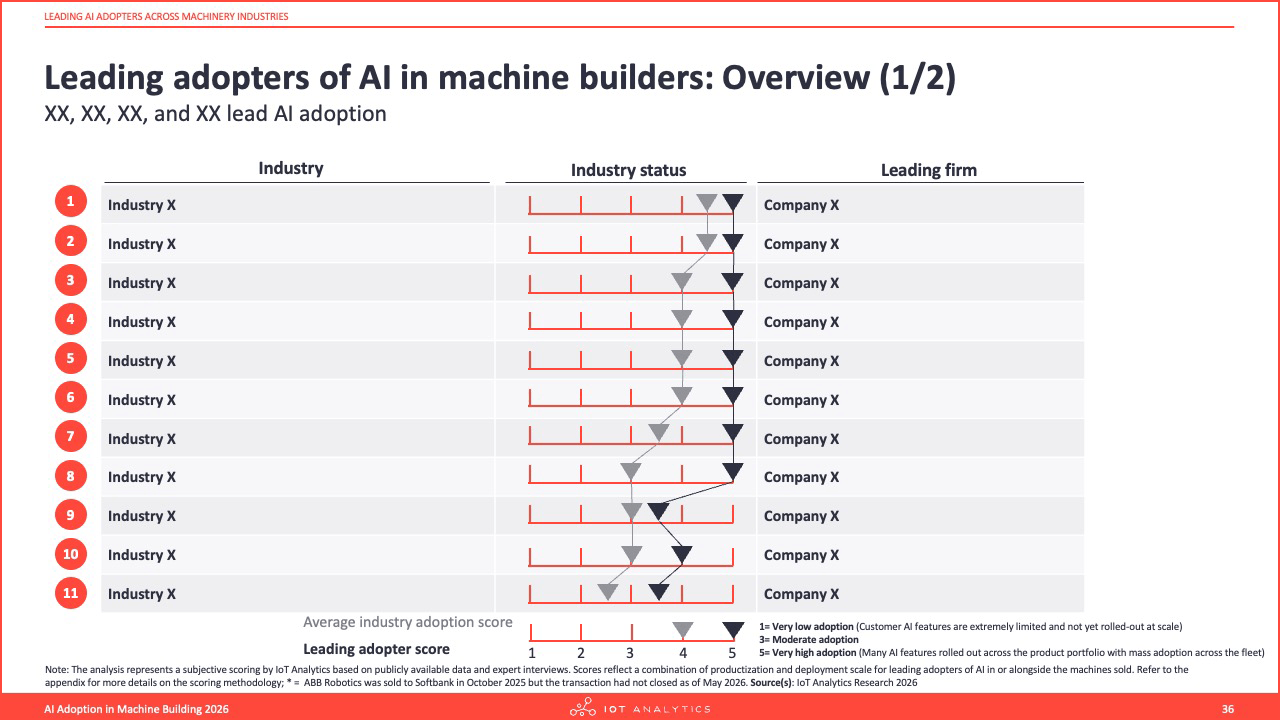
- Who are the leading adopters of AI in machine building today?
- What is the maturity of AI deployment in the different machinery sectors today?
Table of Contents
AI Adoption in Machine Building 2026
- Executive summary
- Introduction
- Introduction: Chapter overview and key take aways
- Machine building: What it is and what types of machines exist
- Key lifecycle phases in machine building
- Economic relevance of the machine builder industry
- The challenges machinery companies observe in today’s market
- The future vision: One Al-enabled automated data flow for customers
- Organizational priorities for machinery companies (2 parts)
- Case study: Deere & Co. is strongly investing in Al across the value chain (4 parts)
- This report is mostly based on a survey of machinery companies
- Analyst view: Key Al-related trends & challenges
- Analyst view: Key Al-related trends & challenges: Chapter overview and key takeaways
- Trend 1
- Trend 2
- Trend 3
- Trend 4
- Trend 5
- Challenge 1
- Challenge 2
- Challenge 3
- Challenge 4
- Overview: Al adoption in machinery
- Al adoption in machine building: Chapter overview and key takeaways
- Al adoption in machine building (2 parts)
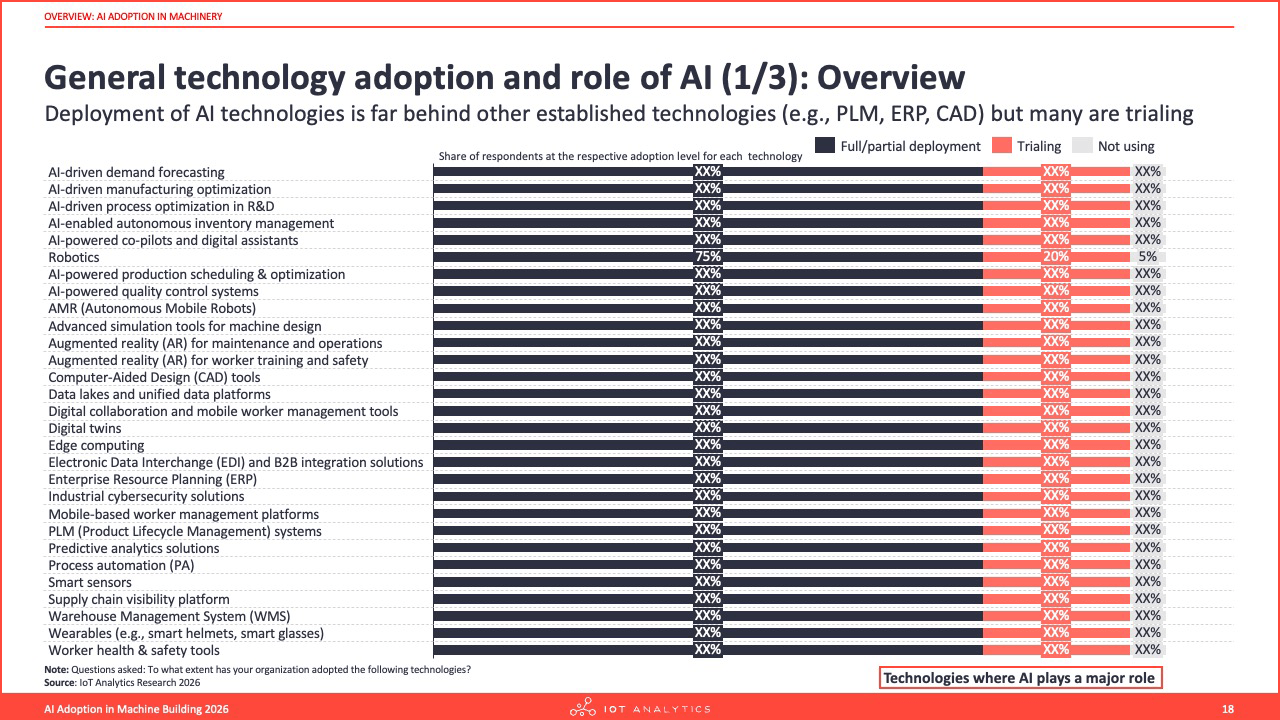
- General technology adoption and role of Al (3 parts)
- Prioritization of Al use cases (2 parts)
- Barriers when adopting Al technologies (4 parts)
- Commentary by machinery companies on selected Al adoption barriers
- Al in machine design and engineering
- Al in machine design and engineering: Chapter overview and key takeaways
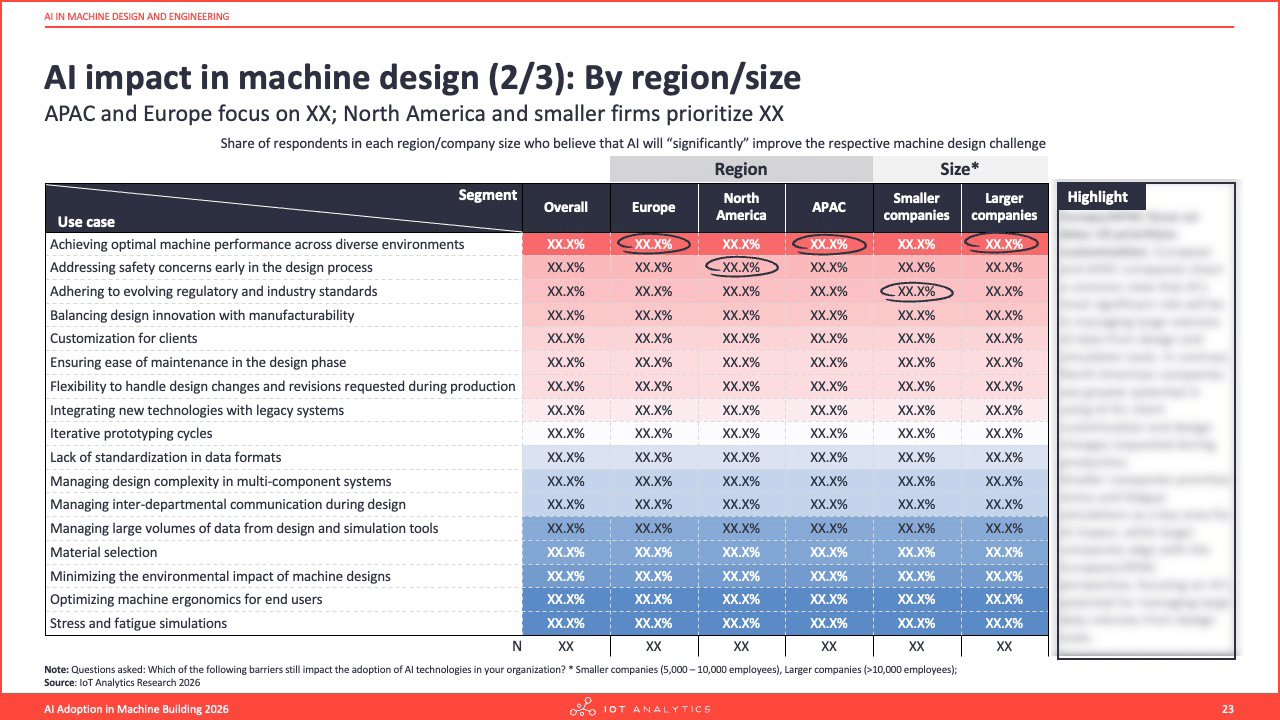
- Al impact in machine design (3 parts)
- Current stage of Al adoption in machine design (3 parts)
- Current stage of Gen Al adoption in machine design (3 parts)
- Example: Krones uses Al to accelerate machine design & configuration (2 parts)
- Example: How vendors are offering Gen Al solutions in design & engineering
- Al in machine manufacturing
- Al in machine manufacturing: Chapter overview and key takeaways
- Al impact on key manufacturing challenges (2 parts)
- Current stage of Al adoption in manufacturing (3 parts)
- Example: DMG MORI using Al on the factory floor
- Al in after sales, service and smart machines
- Al in after sales, service and smart machines: Chapter overview and key takeaways
- Typical Al use cases in conjunction with smart machines
- How leading Al companies think about smart Al products & field service
- Role of Al in after sales, service and smart machines
- Current stage of Al adoption in after sales and service
- Stage of Al adoption in maintenance & supply chain (2 parts)
- Leading Al adopters across machinery industries
- Leading Al adopters across machinery industries: Chapter overview and key takeaways
- Leading adopters of Al in machine builders: Overview (2 parts)
- Leading adopters of Al in machine builders according to respondents
- Leading Al adopter 1: ABB
- Leading Al adopter 2: Applied Materials
- Leading Al adopter 3: Caterpillar
- Leading Al adopter 4: Komatsu
- Leading Al adopter 5: Kone
- Deep-dive: Al in selected machinery industries
- Deep-dive: Al in selected machinery industries: Chapter overview and key takeaways
- Deep-dive 1: Machine tool industry (4 parts)
- Deep-dive 2: Robotics (9 parts)
- Deep-dive 3: Construction/Mining machinery (3 parts)
- Methodology & market definitions
-
- General research methodology
- Methodology for scoring leading Al adopters across machinery industries
- Survey respondents split
-
Companies mentioned
A selection of companies mentioned in the report.
ABB Robotics
Applied Materials
Atlas Copco
Bühler
Caterpillar
DMG MORI
Daikin
ENGEL
Emerson Automation Solutions
GANUC
Grundfos
HOMAG (Dürr Group)
Heidelberger Druckmaschinen
Heller
Hermle
John Deere
KONE
Kion Group
Komatsu
Mazak
Rolls-Royce
SMS group
Sandvik Coromant
Saurer (Jinsheng Group)
Siemens Energy
Tetra Pak
About the report
The AI Adoption in Machine Building Report 2026 is part of IoT Analytics’ ongoing coverage of industrial technology topics. The findings are based on a dedicated survey of industry participants, expert interviews, and first-hand insights gathered from leading trade fairs. The report explores how machine builders are adopting AI across design, production, and after-sales, highlights key use cases, and profiles the technologies and machinery companies driving this shift.
Overview: Economic Weight and Market Context
In 2024, production output for the industry reached approximately €3.26 trillion. To put that into perspective, the sector’s total output is equivalent to 76% of Germany’s gross domestic product, which was roughly €4.33 trillion in the same year. China continues to lead production, accounting for about one-third of the global total.
Current State of AI Deployment
AI has moved past the experimental phase and is now a standard tool for the majority of the sector. The industry is successfully moving beyond simple proofs-of-concept; over half of surveyed companies have already scaled AI solutions across their operations or their entire enterprise. Deployment is currently most advanced in the Asia-Pacific region, followed by North America and Europe.
Operational Priorities and Barriers
- Machine builders are mostly using AI to find specific efficiency gains and address labor shortages. Internal quality control and defect detection are the top priorities for over 90% of respondents. In engineering, about nine out of ten companies prioritize design automation, specifically to manage the massive volumes of data generated during simulation phases. On the production floor, predictive maintenance is the most common use case, currently deployed at more than half of all surveyed manufacturing facilities.
- Scaling these tools remains difficult for many organizations. Over half of the industry points to high upfront costs as a critical barrier. Additionally, about four out of ten companies are currently struggling with a lack of internal software talent and insufficient data infrastructure. For larger firms, poor data quality is the most frequent obstacle, while smaller companies are more likely to be slowed down by the costs of integrating AI with legacy systems.
2026 Technical Shift: Edge Intelligence to Autonomous Agents
The report identifies a move away from fragmented data workflows toward an integrated digital thread. Key shifts in machine architecture include:
- Moving Intelligence to Hardware: Builders are increasingly embedding AI acceleration directly into machine controllers for real-time, low-latency decision-making.
- 3D Machine Vision: There is a clear transition from traditional 2D checks to 3D laser-based scanning systems that compare physical components directly to digital models.
- Engineering Automation: Generative tools are now entering standard workflows to help automate CAD generation and simplify complex robot programming through natural-language interfaces.
- Emerging AI Agents: Early concepts for “AI agents” are being tested. These systems can query technical documentation and telemetry data autonomously to troubleshoot problems or trigger service tickets without an operator.
Related reading
A research article based on this report: AI in machine building 2026: Adoption, barriers, use cases, and leading sub-industries
Our insights are trusted by global industry leaders


Single User License
- 1 named user within a particular department and country
- Complete report in PDF
- Complete report in PPTX
- 1 hour discussion with the analyst team
Team User License
- 1–5 named users within a particular department and country
- Complete report in PDF
- Complete report in PPTX
- 1 hour discussion with the analyst team
Enterprise Premium License
- Report may be distributed to all employees of the enterprise
- Complete report in PDF
- Complete report in PPTX
- 1 hour discussion with the analyst team
Get your free sample
Download the sample to learn more about:
- Report structure
- Companies included
- Methodology
- Additional data points
Any questions?
Get in touch with us easily. We are happy to help!

Prajwal Praveen
Senior Sales Manager
Phone: +49 (0) 408 221 1722
Email: sales@iot-analytics.com