
Intralogistics Market and Technology Trends Report 2026
(see all)
Sample preview:
Questions answered
- What is the intralogistics market, and which technologies, products, and services are included?
- How large is the global intralogistics market, and how is it expected to develop through 2030?
- How do the major market segments compare across identification and sensing, fixed material handling, mobile material handling, controls and connectivity, software, and integration and consulting services?
- Who are the leading vendors across the major intralogistics market segments?
- Which technology and market trends are shaping warehouse automation, robotics, sensing, connectivity, and software?
- Which new products and technologies introduced in 2026 are relevant for the intralogistics market?
- How are competitive dynamics and customer requirements changing, and what are the strategic implications for intralogistics vendors?
Table of Contents
Intralogistics Market and Technology Trends Report 2026.pdf
- Executive summary
- Executive Summary (2 parts)
- Intralogistics market landscape
- The intralogistics market landscape (3 parts)
- The intralogistics market: Market size & forecast
- The intralogistics market: The key demand drivers going into 2027
- The intralogistics market: Top vendors
- Competitive dynamics: Chinese OEMs are entering western markets with distinct strategies; Western vendors seek differentiation through software
- Strategy 1: Chinese vendors increasingly adapt their hardware portfolio to address Western customer needs
- Strategy 2: Chinese vendors add more local services to address Western customer needs
- Strategy 3: Chinese vendors also compete on technology and not only on price
- Response from incumbents: Focus on software orchestration to differentiate from Chinese competition
- Overview of the technology trends discussed in this report
- Software
- Software: Market size & competitive landscape
- Software: Trends overview
- Trend 1
- Trend 2 (2 parts)
- Trend 3
- Trend 4
- Trend 5 (2 parts)
- Trend 6
- Other relevant 2026 product developments (2 parts)
- Controls, network & connectivity
- Controls, network & connectivity: Market size & competitive landscape
- Controls, network & connectivity: Trends overview
- Trend 7 (2 parts)
- Trend 8
- Trend 9
- Other relevant 2026 product developments (2 parts)
- Mobile material handling systems (Focus: Robotics)
- Mobile material handling systems: Market size & competitive landscape
- Deep dive – Mobile robots: Market size & competitive landscape
- Mobile material handling systems: Trends overview
- Trend 10 (2 parts)
- Trend 11
- Trend 12
- Trend 13
- Trend 14
- Trend 15
- Trend 16
- Other relevant 2026 product developments (2 parts)
- Fixed material handling systems
- Fixed material handling systems: Market size & competitive landscape
- Fixed material handling systems: Trends overview
- Trend 17
- Trend 18
- Trend 19
- Other relevant 2026 product developments (2 parts)
- Identification & sensing hardware
- Identification & sensing hardware: Market size & competitive landscape
- Identification & sensing hardware: Trends overview
- Trend 20 (2 parts)
- Trend 21 (2 parts)
- Trend 22
- Trend 23
- Other relevant 2026 product developments (2 parts)
- Strategic outlook & implications
- Strategic outlook & implications (2 parts)
- Appendix: Research methodology
- Research Methodology
- About IoT Analytics
- About IoT Analytics
- Other publications by IoT Analytics
- Information and contact
About the report
The Intralogistics Market and Technology Trends Report 2026 is IoT Analytics’ trend report on intralogistics. It identifies 23 technology trends that are changing how goods are moved, stored, identified and controlled inside a facility or site, and sets them against a market model and vendor analysis. The 97-page report was published in October 2026 as part of IoT Analytics’ ongoing coverage of industrial automation, warehouse technology and supply chain technologies.
Key data
- Trends covered: 23 technology trends across five areas
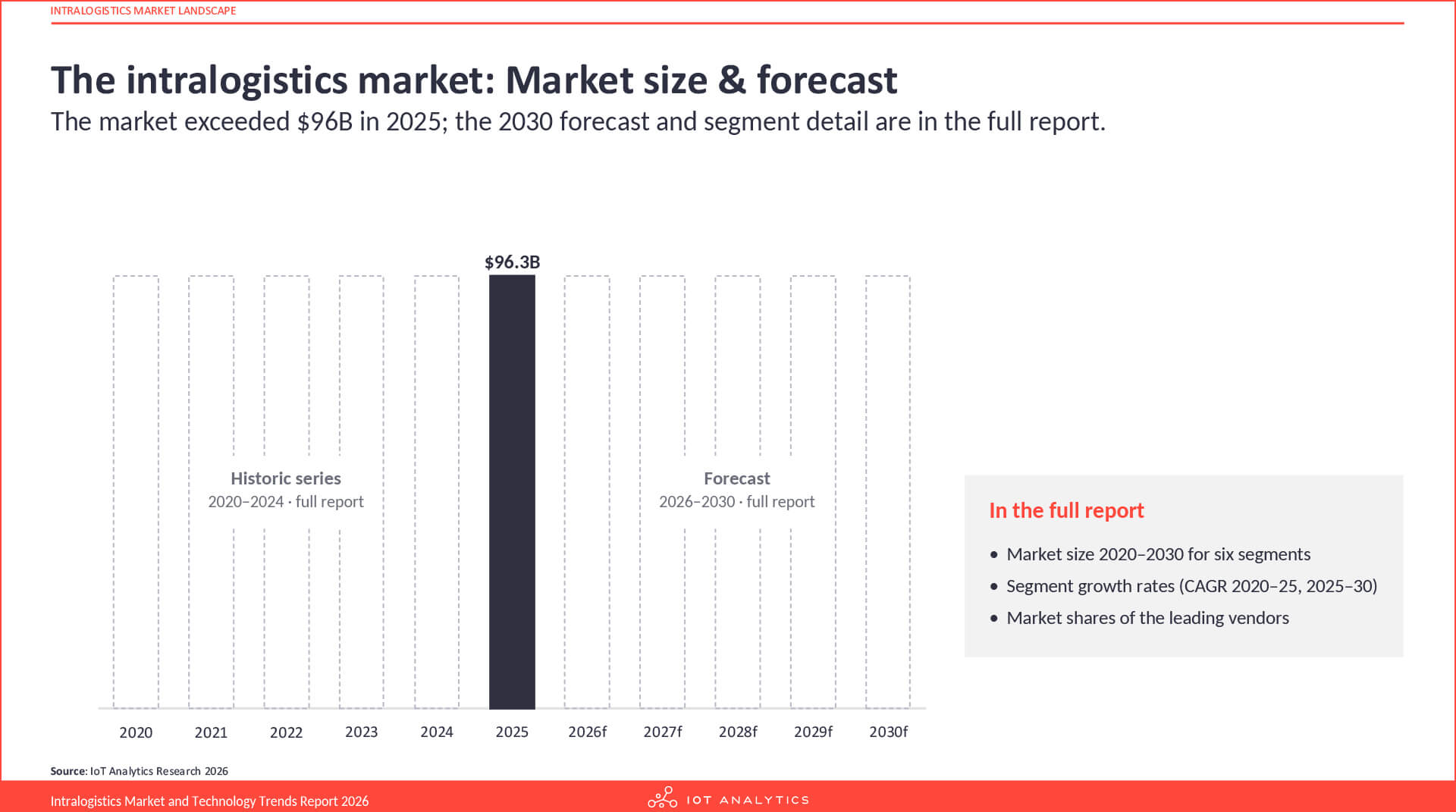
- Market size 2025: $96 billion
- Forecast 2030: about $133 billion, a 6.7% CAGR
- Growth engines: software (11.4% CAGR) and mobile robots (about 14% CAGR)
- Companies covered include: SAP, Toyota, Siemens, Honeywell, Zebra, Cisco, Cognex, Locus Robotics, Hikrobot, HELI and Geek+
The 23 technology trends
The trend chapters draw on examples from 2026 product launches and on interviews with vendors, integrators and operators. The trends fall into five areas:
- 6 software trends
- 3 controls, network and connectivity trends
- 7 mobile material handling trends
- 3 fixed material handling trends
- 4 identification and sensing trends
Our research article covers three of them:
AI agents take on control-desk decisions
Software agents start taking over recurring situations that control-desk staff used to resolve, from staffing to restocking to maintenance planning.
A vendor-agnostic orchestration layer emerges between WMS and automation
As warehouses add robots from different suppliers, a software layer standardizes how data and commands move between the WMS and the robot systems.
AMMRs combine transport and handling
Autonomous mobile manipulators mount a robot arm on a mobile base, so they can pick or hand over goods without a person stepping in.
The market and competition behind the trends
The trends play out in a fragmented market. No vendor owns the intralogistics stack, and Chinese OEMs are entering Western markets by adapting products to local rules, adding local service and competing on technology as well as price. Western vendors are responding with software.
What the report covers
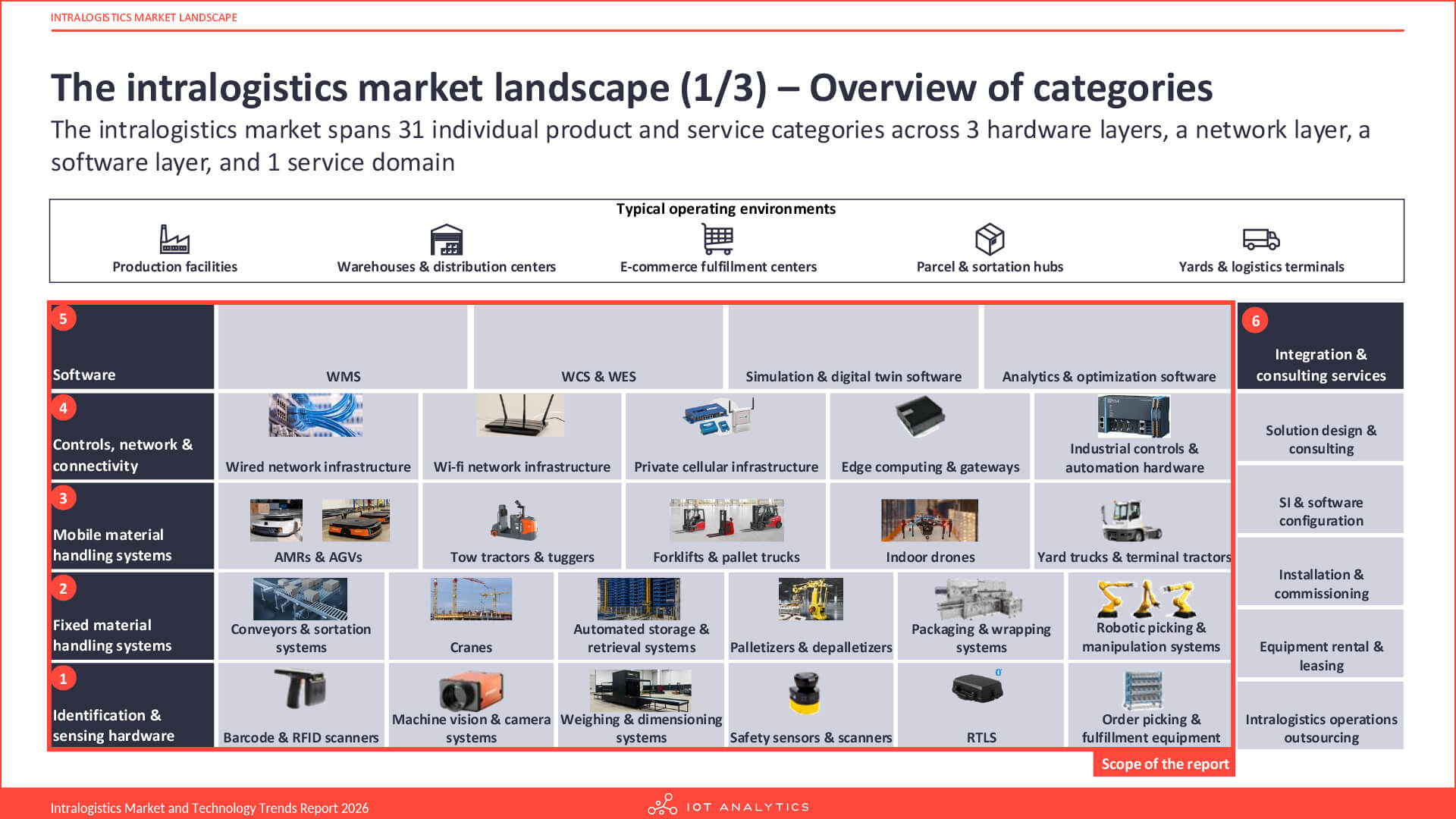
The market model covers 31 product and service categories in six segments: mobile material handling, fixed material handling, identification and sensing hardware, software, controls, network and connectivity, and integration and consulting services.
- 23 technology trends, with examples from 2026 product launches
- Market size and forecast to 2030 for all six segments
- 2025 market shares of the top 20 vendors, with each vendor’s revenue split across the six segments
- Competitive analysis and vendor shares for each hardware and software segment, plus a separate look at mobile robots
- The strategies Chinese OEMs use to enter Western markets, and how incumbents respond
- Recommendations for vendors and for warehouse operators
Research base
More than 30 interviews with vendors, integrators and operators, including conversations at LogiMAT 2026 and MODEX 2026, form the basis of the findings, together with market modeling and a review of 2026 product launches. The authors are Justina-Alexandra Sava and Knud Lasse Lueth.
Who it’s for
The report is written for vendors of automation, robotics, warehouse software and components, and for the consultants and investors who follow them.
Related reading
A research blog article based on this report will be released soon after the release of this report.
→Sign up for the newsletter to be notified of future updates
Our insights are trusted by global industry leaders


Single User License
- 1 named user within a particular department and country
- Complete trend report in PDF
- Complete trend report in PPTX
- 1 hour discussion with the analyst team
Team User License
- 1–5 named users within a particular department and country
- Complete trend report in PDF
- Complete trend report in PPTX
- 1 hour discussion with the analyst team
Enterprise Premium License
- Unlimited users within a particular business division globally
- Complete trend report in PDF
- Complete trend report in PPTX
- 1 hour discussion with the analyst team
See Terms & Conditions for license details →
*The subscription is valid for 12 months upon date of purchase.
Get your free sample
Any questions?
Get in touch with us easily. We are happy to help!

Prajwal Praveen
Sales Manager
Phone: +49 (0) 408 221 1722
Email: sales@iot-analytics.com