
In short
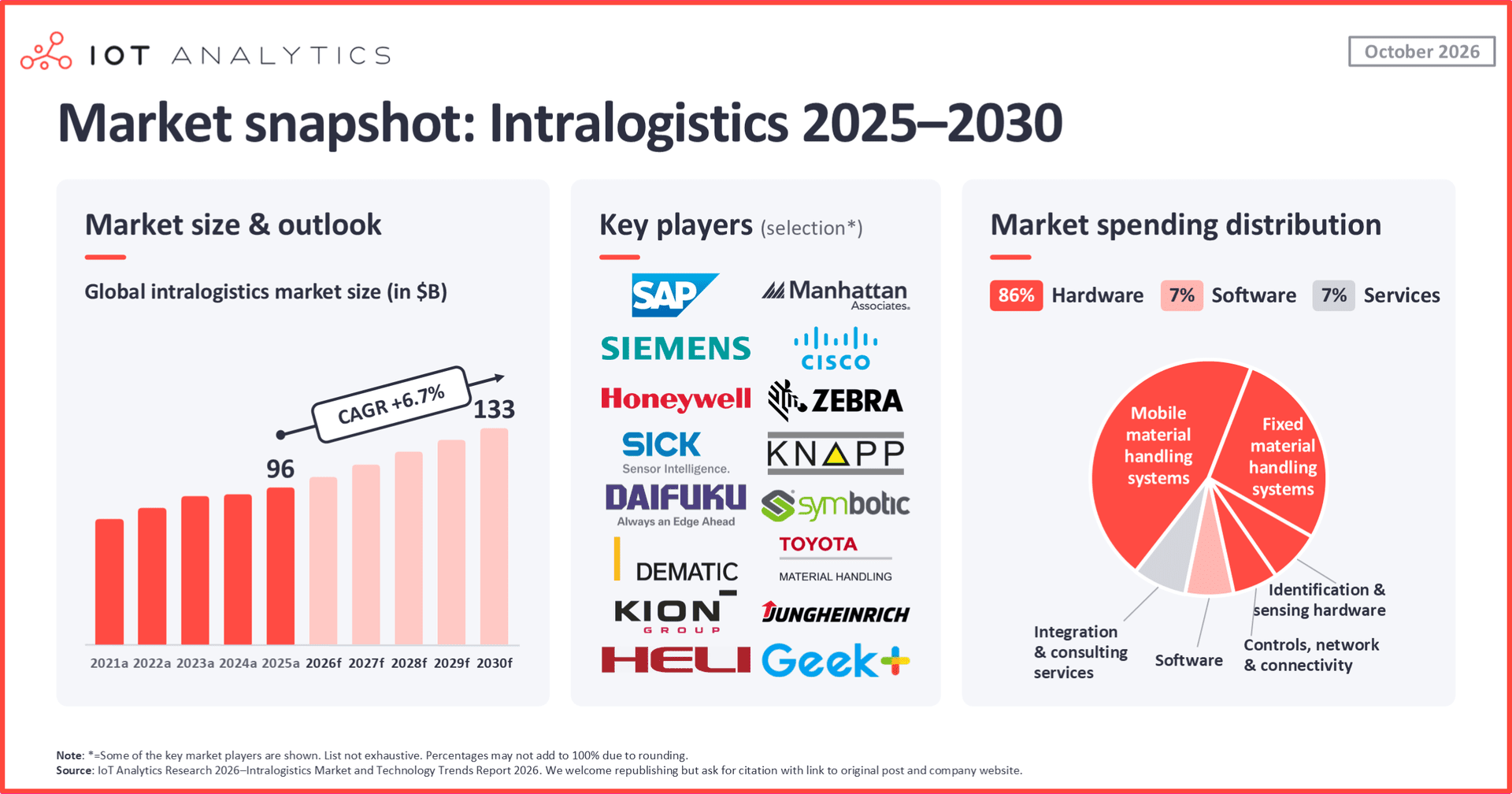
- The intralogistics market reached $96 billion in 2025 and is forecast to grow at 6.7% CAGR to $133 billion by 2030, according to IoT Analytics’ Intralogistics Market and Technology Trends Report 2026.
- Software is expected to grow at an 11.4% CAGR to $10.8 billion, while mobile robots are set to nearly double their spending to $8.4 billion by 2030.
- The IoT Analytics team shares 3 of their 23 identified intralogistics technology trends: 1) AI agents taking over more recurring control-desk tasks, 2) vendor-agnostic orchestration layer emerging between WMS and automation, and 3) AMMRs combining transport and handling.
Why it matters
- Labor shortages, speedy delivery promises, and constant supply chain disruption are keeping automated solutions a must. Intralogistics vendors and warehouse operators alike should understand market drivers and trends to remain competitive.
In this article
- The intralogistics market: $96 billion in 2025, surpassing $130 billion by 2030
- 5 intralogistics market drivers: Why warehouses keep automating
- 2 intralogistics growth engines: Software and mobile robots
- Leading intralogistics vendors: A fragmented market, with Chinese vendors pushing westward
- 3 intralogistics market trends
- Analyst opinion
- Frequently asked questions about intralogistics
- Further analysis
- All 23 intralogistics technology trends (Insights+ Exclusive)
- Competitive landscape: Top 20 vendors (Insights+ Exclusive)
- Strategic implications for vendors and operators (Insights+ Exclusive)
The intralogistics market: $96 billion in 2025, surpassing $130 billion by 2030
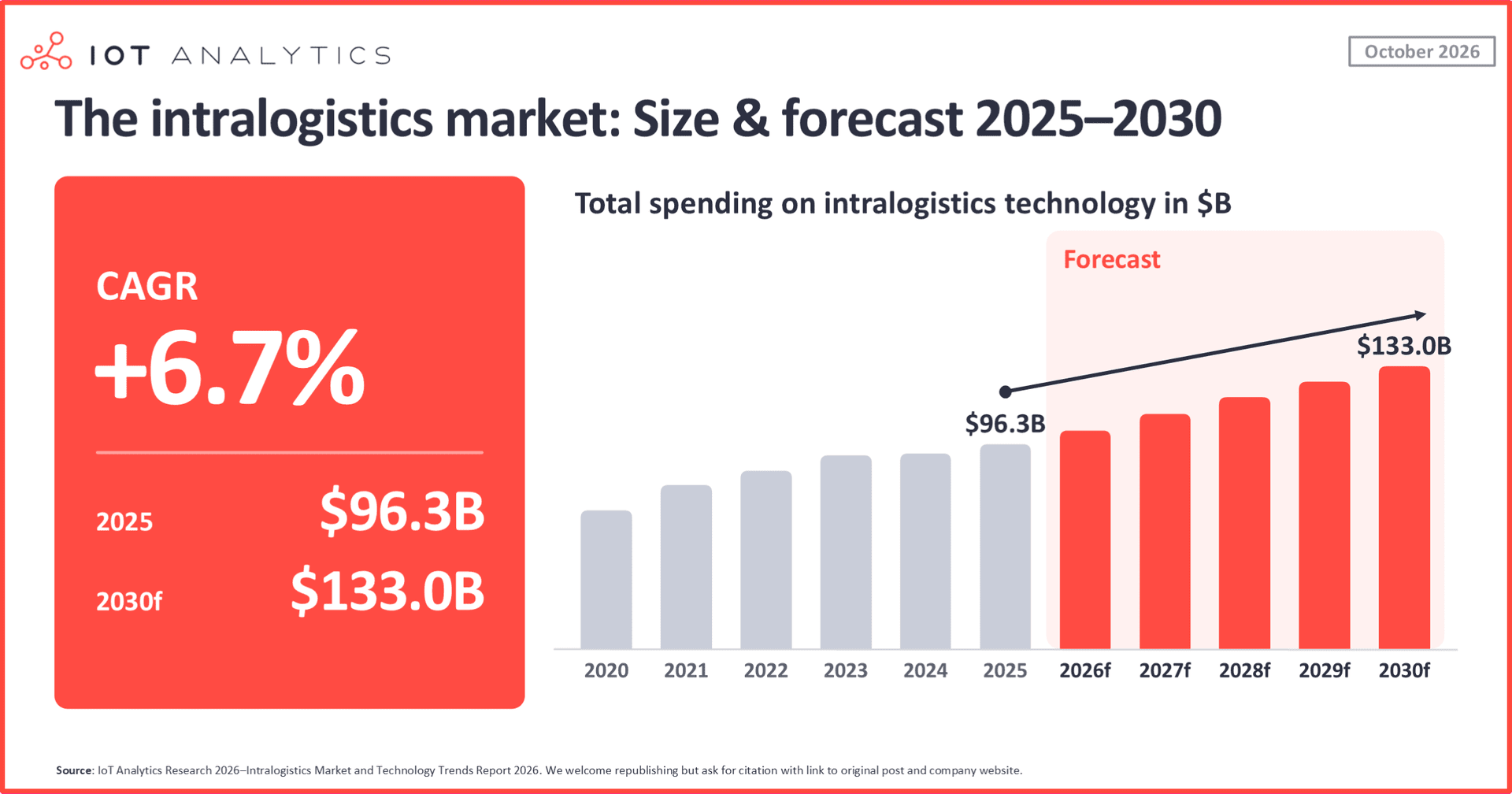
Warehouses keep automating, and the market keeps growing—nearly 7% through 2030. Labor shortages, same-day delivery promises, and constant supply chain disruption have made intralogistics one of the most closely watched industrial technology markets. According to IoT Analytics’ 97-page Intralogistics Market and Technology Trends Report 2026 (published October 2026), the market reached $96 billion in 2025, after growing 8% CAGR since 2020. We expect a CAGR of 6.7% through 2030, to about $133 billion.
Insights from this article are derived from
Intralogistics Market and Technology Trends Report 2026
A 97-page report sizing 31 product and service categories across 6 segments, combining market research and modeling with insights from over 30 interviews with vendors, integrators, and operators, including discussions at LogiMAT 2026 and MODEX 2026.
Already a subscriber? View your reports and trackers here →
What comprises the intralogistics market?
We define the intralogistics market as the hardware, software, connectivity infrastructure, and services used to move, store, identify, control, and optimize goods and related information within a facility or site. Transport between sites is excluded from our sizing. As such, IoT Analytics sees 6 segments within the intralogistics market:
- Mobile material handling systems: Forklifts, AGVs and AMRs, tuggers, indoor drones, and yard trucks make up the largest segment, with 45% of the market.
- Fixed material handling systems: Conveyors, sortation, automated storage and retrieval systems (AS/RS), cranes, palletizers, packaging, and robotic picking systems form the second-largest segment.
- Identification and sensing hardware: Barcode and RFID scanners, machine vision, dimensioning, safety sensors, and real-time location systems capture data on goods and assets.
- Software: Warehouse management systems (WMS), warehouse control and execution systems (WCS and WES), digital twins, and analytics plan and run warehouse processes.
- Controls, network, and connectivity: PLCs, wired and wireless networks, private cellular networks, and edge gateways link and control the equipment.
- Integration and consulting services: Design, integration, commissioning, rental, and outsourced operations services deploy and run the solutions.
Below, we dive into 5 drivers pushing warehouses to automate, 2 growth engines within the market, leading intralogistics vendors, and 3 intralogistics market trends.
5 intralogistics market drivers: Why warehouses keep automating
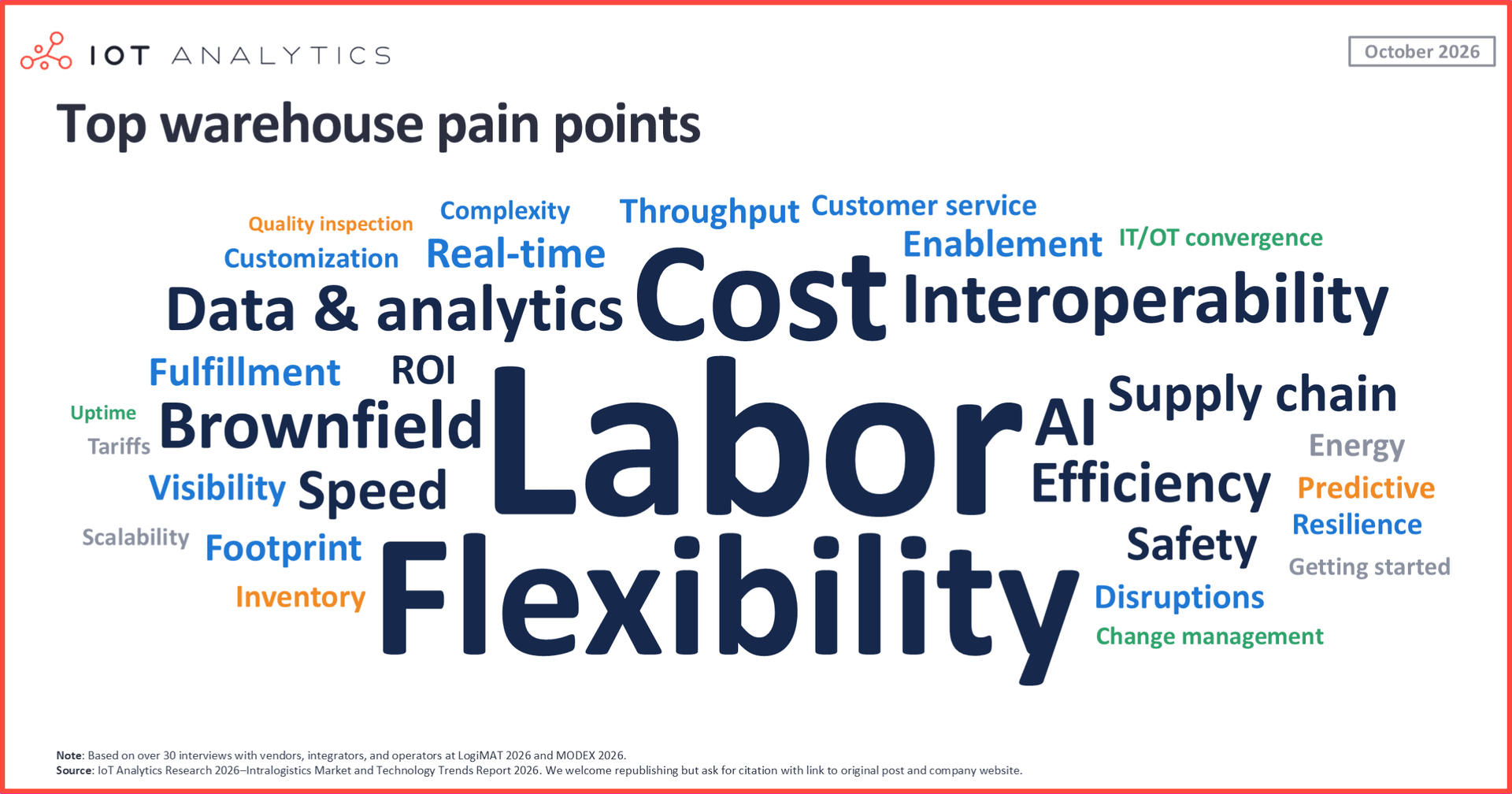
Labor tops the list. During our interviews and research, 5 pain points came up again and again:
1. Labor. Retirements outpace new entrants, and warehouses with labor-intensive picking operations report 200–300% annual staff turnover.
“When we talk to our customers about what keeps them awake at night, the one theme that keeps coming up again and again is a lack of skilled workers… The outflow into retirement is accelerating while at the same time the inflow from kids to working age is diminishing.”
Mattias Allring, Director Strategic Innovation, Toyota (March 2026)
2. Flexibility. Tariffs, disruptions, and changing order profiles force operators to change layouts more often. As a result, they favor modular automation over rigid multi-year projects costing $20 million or more.
“With all the disruption going on, we’re starting to see customers wanting more flexibility, agility, ability to change their systems quickly.”
Ken Ramoutar, CEO, Lucas Systems (April 2026)
3. Cost. High interest rates discourage new greenfield sites. Operators are adding vertical lift modules and shuttles to get more out of existing buildings.
“In this macroeconomic environment, the single biggest thing we hear is help us sweat our assets. It’s about getting more out of their current buildings.”
Ron Egan, SVP North America Sales, Fortna (April 2026)
4. Speed. Catalogs run to tens of thousands of SKUs with same-day or next-day delivery, which goods-to-person systems and AS/RS help to meet.
“Needing to fulfill on time and accurately, in many times same day but certainly next day, is no longer a nice to have. It’s an absolute requirement.”
Jim Reposa, VP of Business Process Optimization, Barrett Distribution Centers (April 2026)
5. Safety. Workers walk more than 10 km a day and repeatedly lift heavy cases. Operators must use robots to reduce physical strain, injuries, sick leave, and compensation claims.
“It’s heavy, repetitive tasks that break bodies over time… those are assignments that no human being actually should have. It should be the robots.”
Nicholas Tengelin, CEO, Rebl Industries (March 2026)
2 intralogistics growth engines: Software and mobile robots
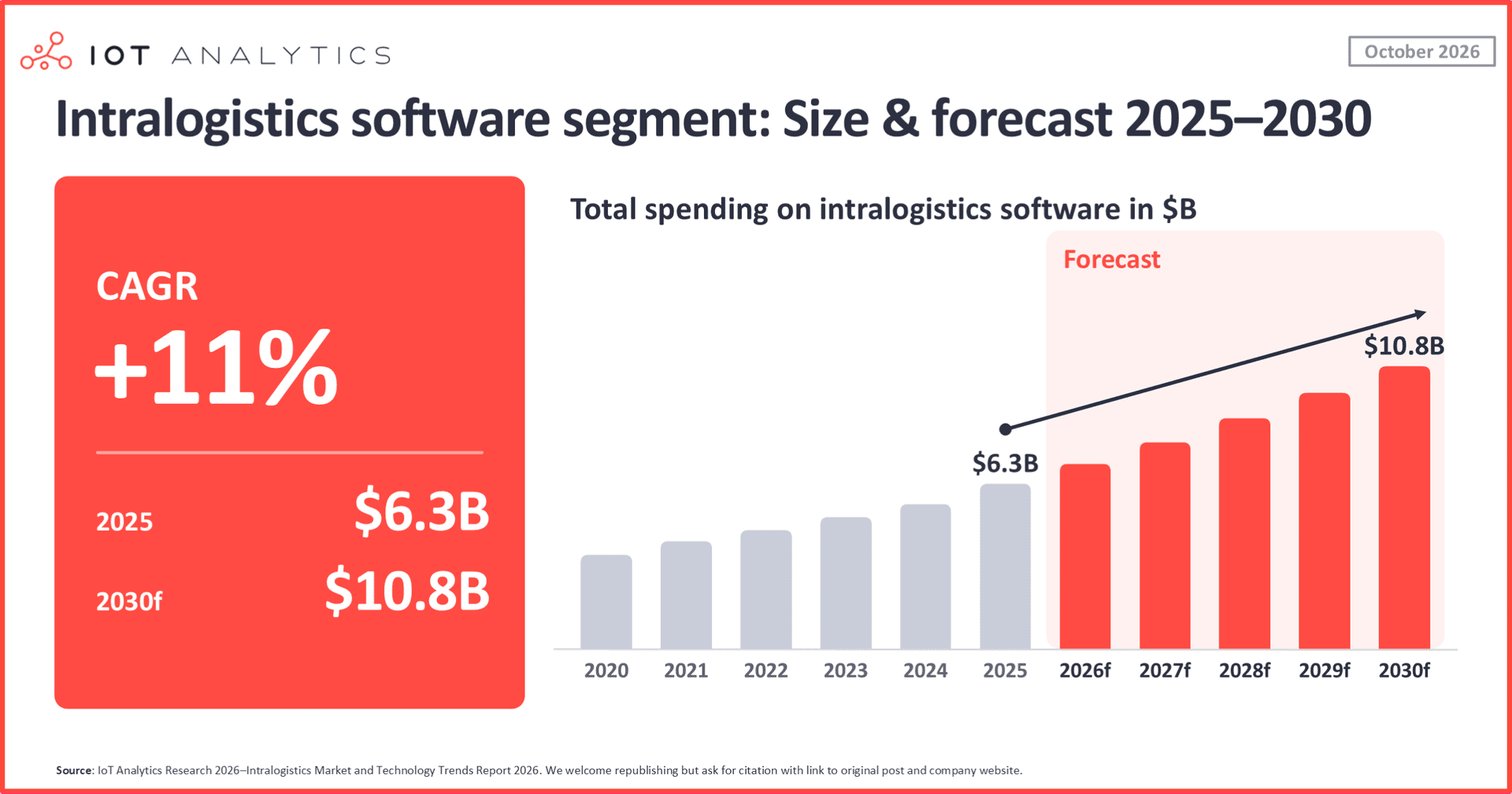
Software is the fastest-growing segment. Intralogistics software was a $6.3 billion market in 2025. IoT Analytics expects it to grow at 11.4% CAGR to $10.8 billion by 2030, as vendors build AI into everyday WMS and WES workflows and orchestration software takes on a bigger role.
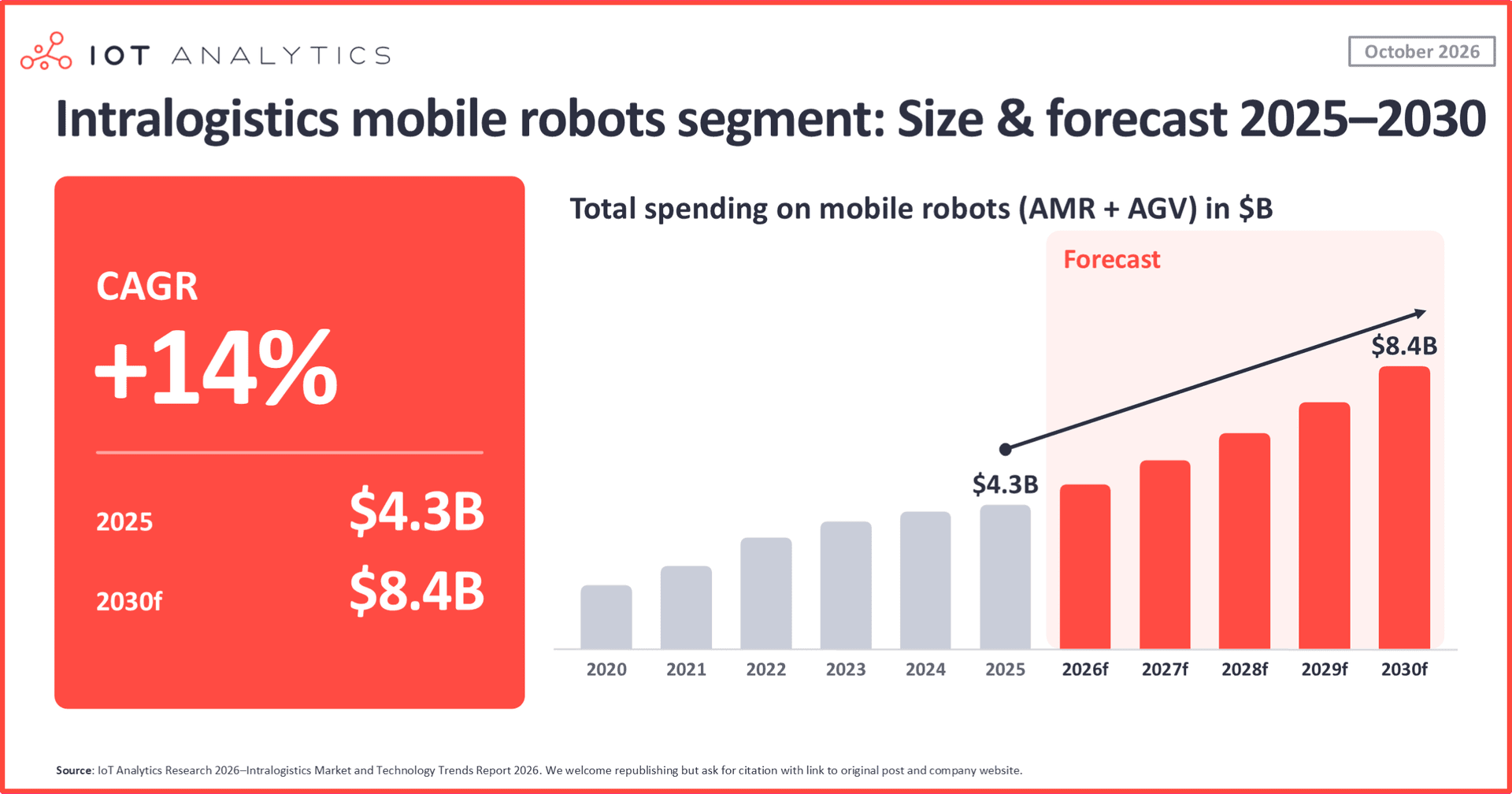
Mobile robots drive growth in mobile material handling. Mobile robots, including autonomous mobile robots (AMRs) and automated guided vehicles (AGVs), are one of 5 categories in the mobile material handling segment, alongside forklifts, tuggers, indoor drones, and yard trucks. Spending on mobile robots is expected to grow from $4.3 billion in 2025 to $8.4 billion in 2030, a CAGR of about 14%. For context, the material handling segment is expected to grow at 5.7% CAGR.
Robot fleets are becoming cheaper, easier to manage, and more capable. The vendor landscape is also changing. For example, in April 2026, Skild AI acquired Zebra Technologies‘ robotics automation business, including its Symmetry Fulfillment software and AMRs.
Leading intralogistics vendors: A fragmented market, with Chinese vendors pushing westward
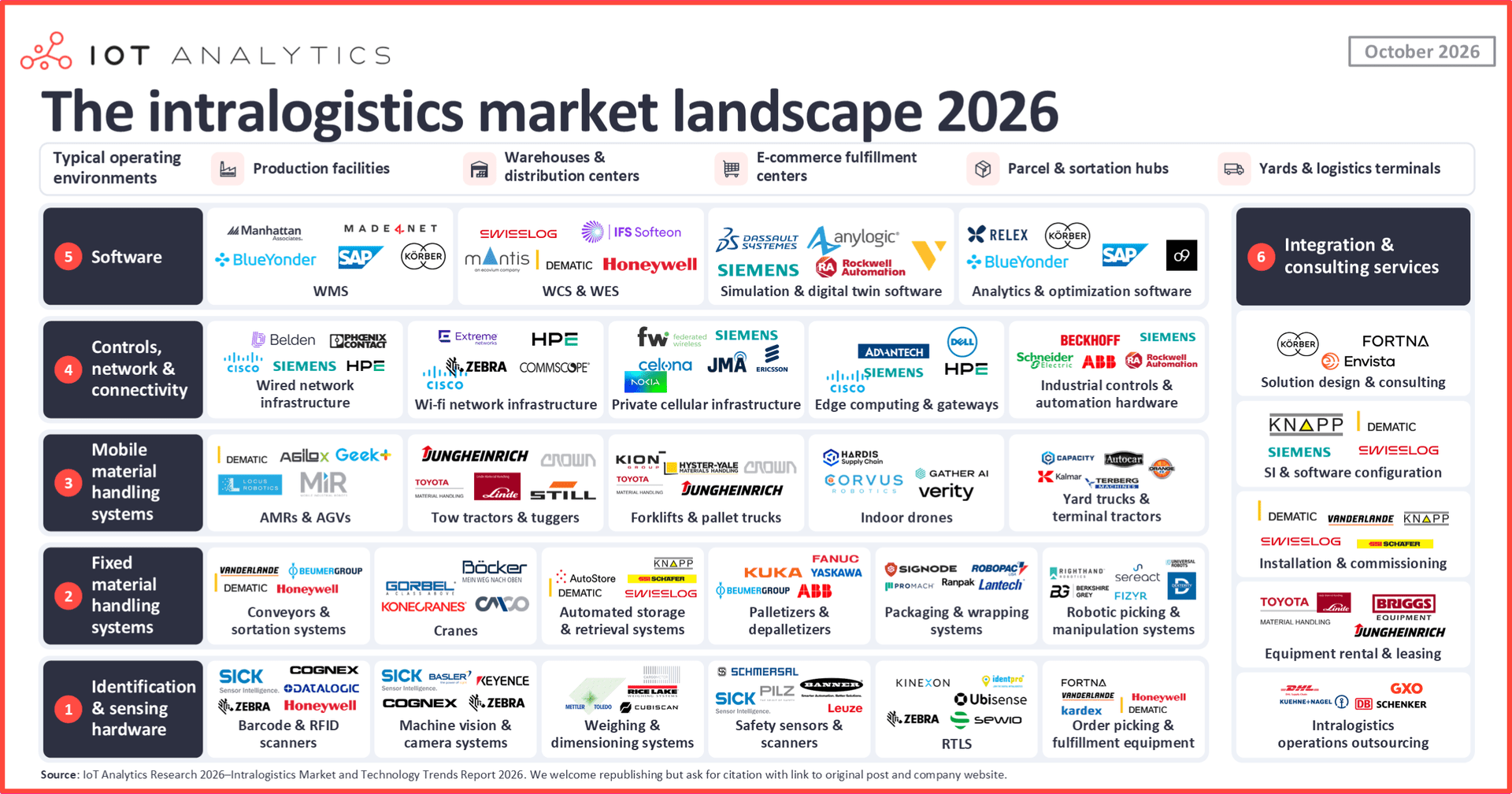
Intralogistics draws vendors from different industries, with no one owning the stack. The market spans 31 categories, each with its own key players. From software firms like SAP to equipment makers like Toyota and connectivity suppliers like Cisco, most vendors specialize in a few categories rather than competing across the entire intralogistics market.
There are a few bridging players, though. Siemens, Honeywell, Zebra, Swisslog, and Körber appear in categories ranging from software and controls to automation and services.
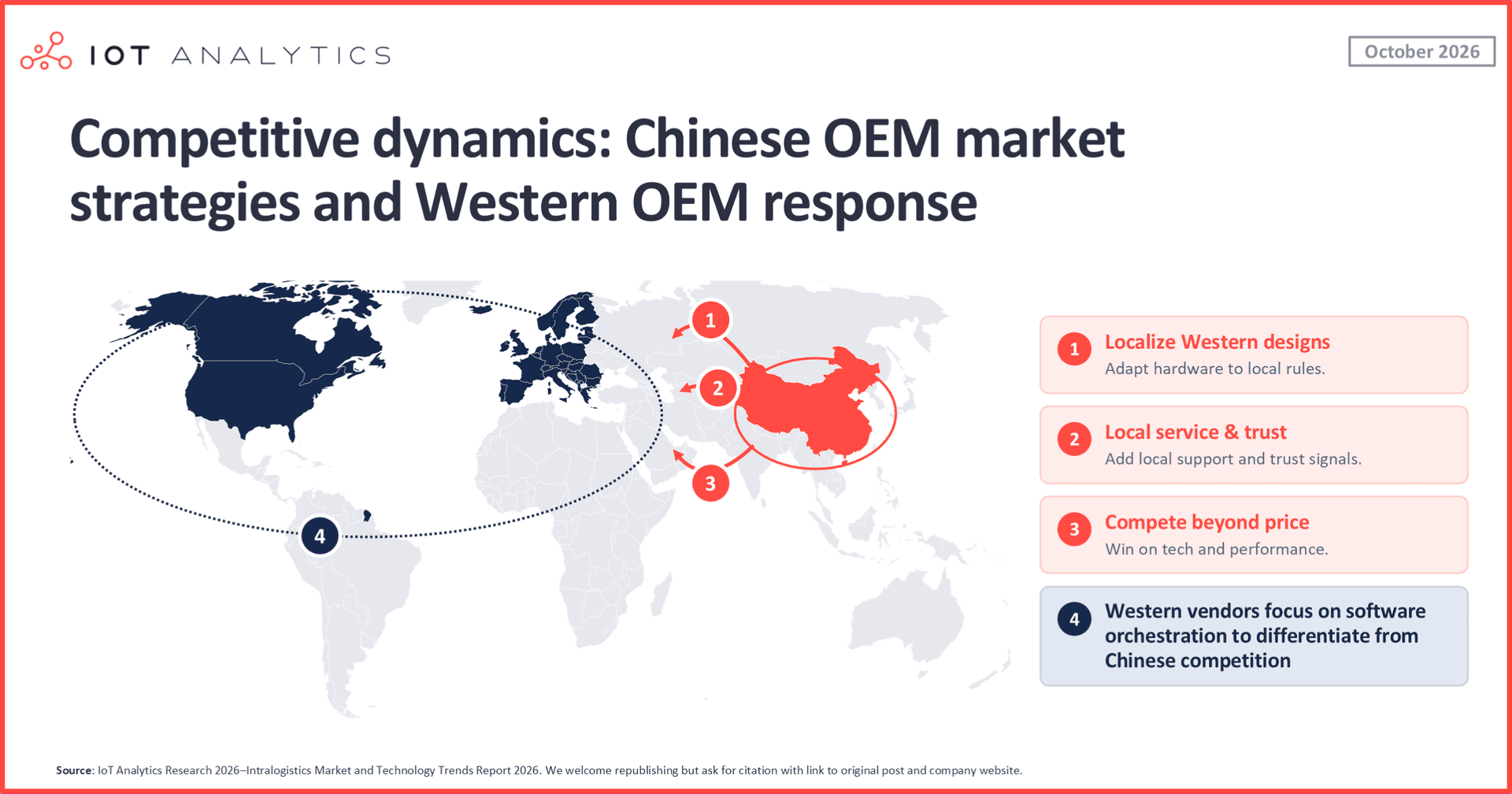
Chinese vendors push into Western markets. Based on our analysis in the report, Chinese OEMs are entering Western markets via 3 strategies:
- Adapting their products to Western rules
- Adding local service
- Competing on technology rather than price alone.
For example, HELI introduced cushion-tire forklifts for North America, and Hikrobot added certified European safety laser scanners to its mobile robots.
For their part, Western vendors, such as Locus Robotics and Cognex, have been focusing on software orchestration to differentiate their products from their Chinese peers.
“Anyone can make a robot, right? People have replicated it as closely as possible. But the real value is in the software, the people, and the support. Locus knows that this is where things can fall over. The robot is only a small part of where the value actually comes from. The value comes from the orchestration.”
Sales representative, Locus Robotics (March 2026)
3 intralogistics market trends
The report identifies 23 intralogistics technology trends across software, connectivity, mobile and fixed material handling, and identification and sensing. Below, we present 3 of them.
Trend 1: AI agents take on more control-desk decisions
Warehouse software automates more operational decisions. AI agents use operational data to detect recurring situations, prepare responses, and trigger follow-up actions. They take on tasks that control-desk staff or supervisors used to handle, such as labor allocation, replenishment, and maintenance scheduling. Operators still set priorities and handle exceptions. Examples include:
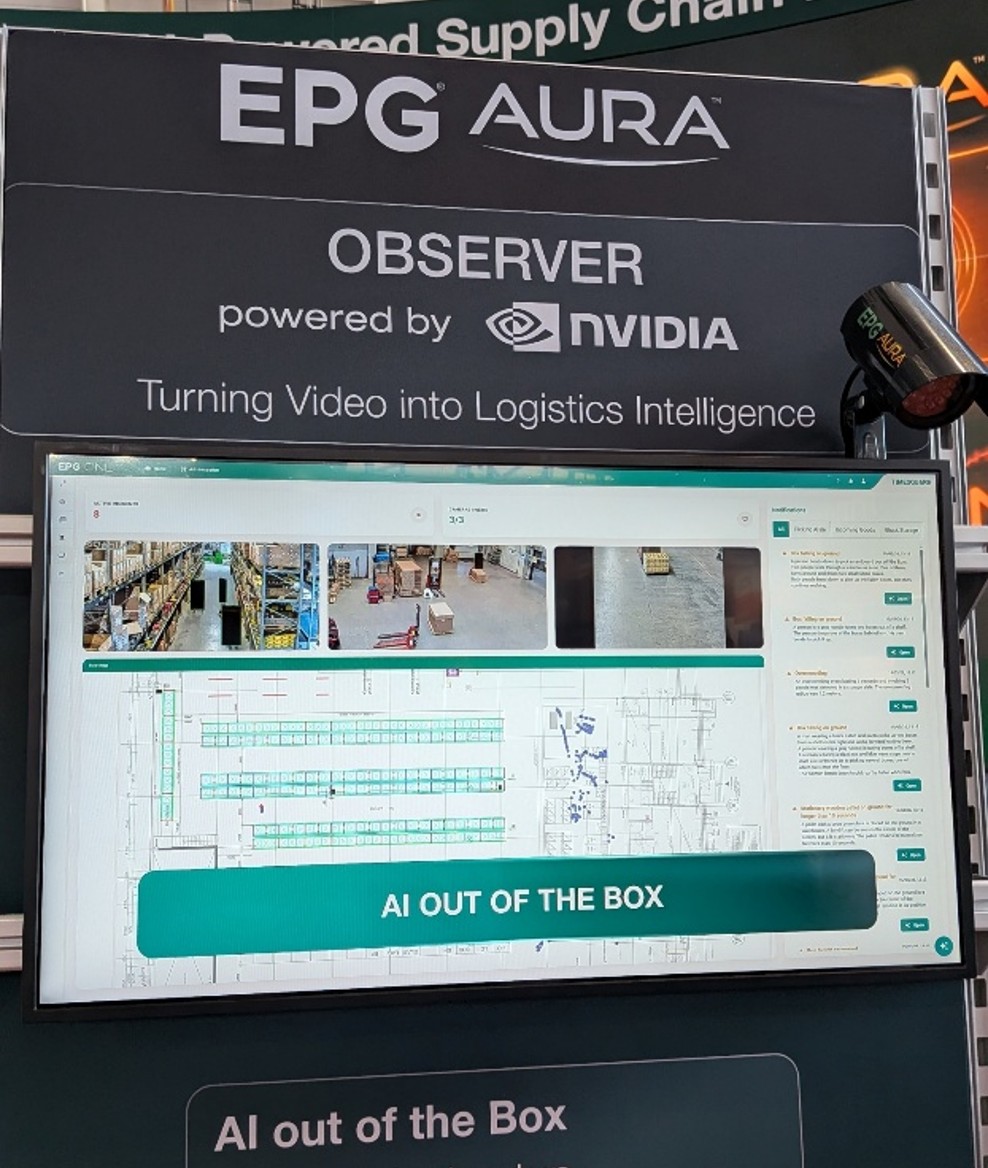
- EPG launches an agentic platform. At LogiMAT 2026, Germany-based software vendor EPG launched Aura. The solution uses AI agents to handle warehouse events: if a truck runs late, an agent reallocates resources and triggers replenishment without a manager stepping in.
- IGZ lets its control tower learn from staff. Germany-based SAP partner IGZ describes its control tower as being at “Level 2”: the AI watches how employees respond to recurring situations and offers to take over that function in future cases.
- Reply lets users build their own agents. Galileo Dynamic Intelligence, from system integration and digital services company Reply, lets warehouse users create agents that, depending on their access rights, connect to WMS or ERP systems to extract, analyze, and reconcile order data.
“An AI agent can determine how many people are needed on a given day based on the orders. The manager no longer has to allocate people manually. If a system is not running properly, the AI agent can schedule a maintenance session autonomously without asking the manager.”
Representative, EPG (LogiMAT, March 2026)
“Level 2 means that the AI looks over the employee’s shoulder. It recognizes patterns, like when the employee reacts the same in the same situation. The system can then ask: ‘Should I take over this function in the future whenever this situation occurs?'”
Johann Zrenner, Managing Director, IGZ (April 2026)
Trend 2: A vendor-agnostic orchestration layer is emerging between WMS and automation
Operators want to add robots without rebuilding integrations. As warehouses add equipment and robots from different suppliers, they need a software layer that connects new hardware without rebuilding the WMS integration each time. Vendor-agnostic platforms increasingly sit between warehouse software and robot systems and standardize how data and commands are exchanged. Examples include:
- SVT Robotics standardizes automation integration. US-based SVT Robotics positions its SOFTBOT Platform as a vendor-agnostic integration layer. Their customer, DHL, used it to integrate new robots across 7 countries in hours, without SVT’s engineers.
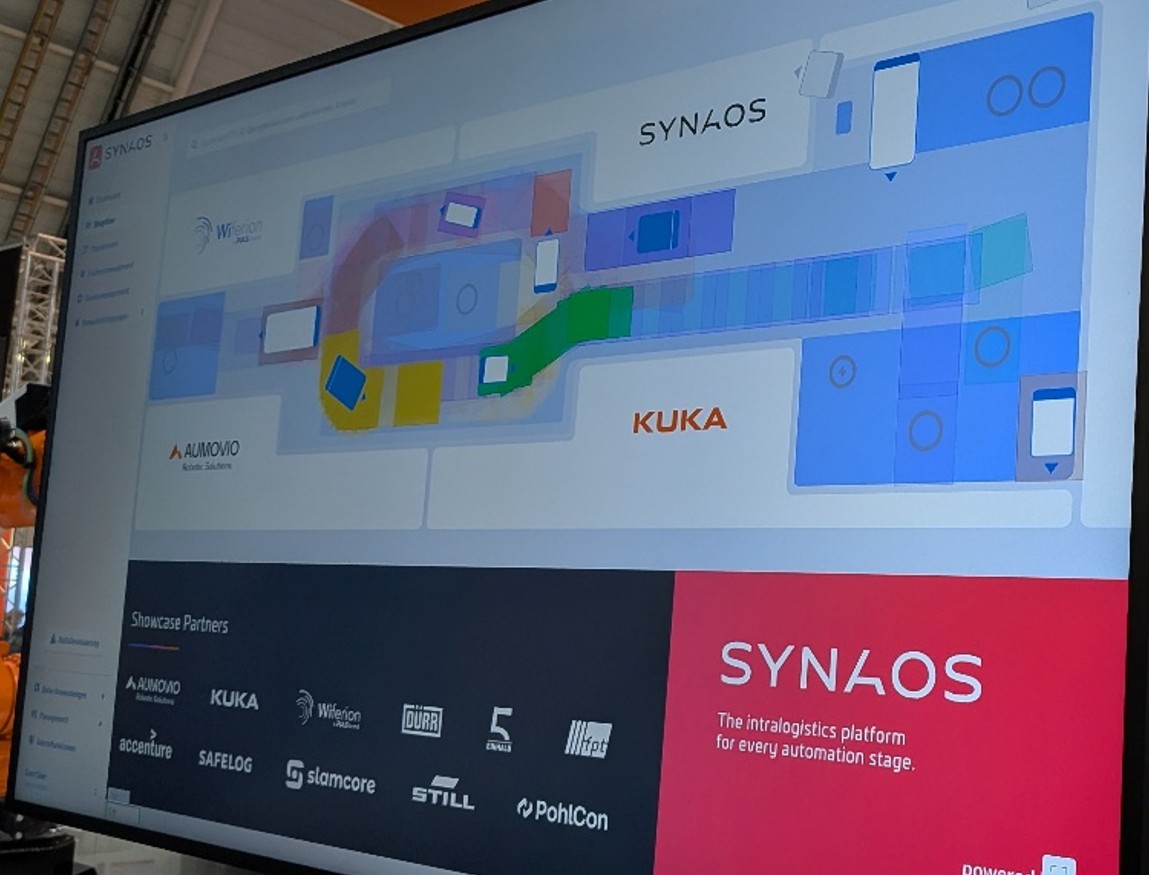
- SYNAOS manages mixed robot fleets. At LogiMAT 2026, Germany-based SYNAOS showed a fleet management platform that connects mobile automation from vendors such as KUKA, SAFELOG, STILL, and AUMOVIO in one software environment.
“We didn’t start the company to be an integration company. Integration is a feature, but the real value is in optimization, in the analytics and understanding of what your business is doing. If you don’t integrate in a proper way, then you can never extract that value.”
A.K. Schultz, CEO, SVT Robotics (April 2026)
Trend 3: AMMRs combine transport and handling
Robots now handle goods, not just move them. AMRs and AGVs already handle many transport tasks, but picking requires more complex interaction with goods. Autonomous mobile manipulator robots (AMMRs) combine a robot arm with a mobile base, so goods can be picked, transferred, or supplied without manual handover. Examples include:
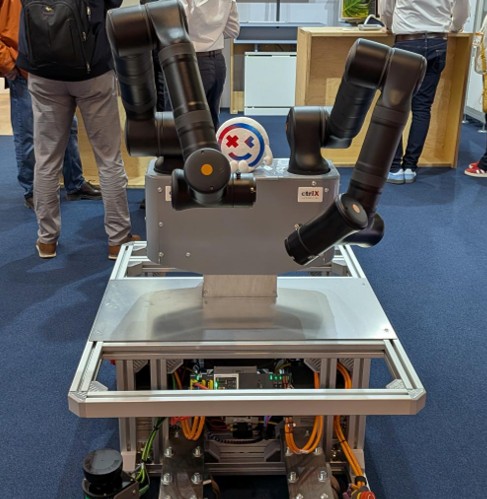
- Bosch Rexroth shows a dual-arm AMMR. At LogiMAT 2026, Germany-based Bosch Rexroth presented a mobile manipulator on its ctrlX AUTOMATION platform that combines an AMR base with 2 cooperative robot arms.
- ek robotics adds a NEURA arm to its AMR. Germany-based ek robotics combines its X MOVE 1200 AMR with the MAiRA M cobot from its parent company, NEURA Robotics, so a vision-guided arm can handle small load carriers after transport.
- Locus Robotics launches a robots-to-goods system. In April 2026, US-based Locus Robotics launched Locus Array, a large-scale robot that handles inbound storage, picking, and outbound handling without a human placing items on the robot.
“We’re seeing the trend of warehouse operators needing to reduce the dependency on labor. That is where this comes in. It is fully automated in terms of the flow of product inbound. Storage, picking, handling outbound is taking people out of that process completely.”
Representative, Locus Robotics (MODEX, April 2026)
Analyst opinion
As part of extensive research for the report, IoT Analytics analyst @Justina-Alexandra Sava conducted over 30 interviews with vendors, integrators, and operators, including discussions at LogiMAT 2026 and MODEX 2026. Here are her main conclusions:
Labor, not technology, sets the pace. Staff shortages top the list of pain points in our interviews. As long as warehouses cannot hire and keep enough people, demand for automation will hold up.
The value lies in software. Software is still a smaller segment. However, it is growing fastest, and it determines how well robots, people, and equipment work together. AI agents at the control desk are the next step.
Openness is becoming a buying criterion. More operators run robots from several vendors and expect them to work together through standards such as VDA 5050 and vendor-agnostic software. Closed systems will find it harder to win new sites.
Competition will intensify. Chinese OEMs are improving their hardware, adding local service, and lowering prices. This puts greater pressure on Western vendors to compete through software and services.
Frequently asked questions about intralogistics
IoT Analytics defines intralogistics as the hardware, software, connectivity infrastructure, and services used to move, store, identify, control, and optimize goods and related information within a facility or site.
The intralogistics market consists of 6 segments:
1. Mobile material handling systems – Forklifts, AGVs and AMRs, tuggers, indoor drones, and yard trucks make up the largest segment.
2. Fixed material handling systems – Conveyors, sortation, automated storage and retrieval systems (AS/RS), cranes, palletizers, packaging, and robotic picking systems form the second-largest segment.
3. Identification and sensing hardware – Barcode and RFID scanners, machine vision, dimensioning, safety sensors, and real-time location systems capture data on goods and assets.
4. Software: Warehouse management systems (WMS), warehouse control and execution systems (WCS and WES), digital twins, and analytics plan and run warehouse processes.
5. Controls, network, and connectivity – PLCs, wired and wireless networks, private cellular networks, and edge gateways link and control the equipment.
6. Integration and consulting services – Design, integration, commissioning, rental, and outsourced operations services deploy and run the solutions.
IoT Analytics research identifies 5 key drivers for intralogistics market growth:
1. Labor – Retirements outpace new entrants, and warehouses with labor-intensive picking operations report 200–300% annual staff turnover.
2. Flexibility – Tariffs, disruptions, and changing order profiles force operators to change layouts more often, so they favor modular automation over rigid multi-year projects of $20 million or more.
3. Cost – High interest rates discourage new greenfield sites, so operators add vertical lift modules and shuttles to get more out of existing buildings.
4. Speed – Catalogs run to tens of thousands of SKUs with same-day or next-day delivery, which goods-to-person systems and AS/RS help to meet.
5. Safety – Workers walk more than 10 km a day and repeatedly lift heavy cases. Operators must use robots to reduce physical strain, injuries, sick leave, and compensation claims.
According to IoT Analytics’ Intralogistics Market and Technology Trends Report 2026, there are 2 segments identified as growth engines:
1. Software – IoT Analytics expects the software segment to grow at an 11.4% CAGR, from $6.3 billion in 2025 to $10.8 billion in 2030.
2. Mobile robots – Spending on mobile robots is expected to grow at 14% CAGR, from $4.3 billion in 2025 to $8.4 billion in 2030.
Further analysis
Below, in our Insights+ section, we share all 23 technology trends, the 3 strategies Chinese OEMs use to enter Western markets, and our recommendations for vendors and warehouse operators. The complete 97-page Intralogistics Market and Technology Trends Report 2026, including market sizes and vendor shares for all 6 segments.
Access key market data for $99/month per user
The Insights+ Subscription unlocks exclusive facts & figures. You will gain access to:
- Additional analyses derived directly from our reports, databases, and trackers
- An extended version of each research article not available to the public
Full report access not included. For enterprise offerings, please contact sales: sales@iot-analytics.com
