
NVIDIA GTC Berlin 2026: What’s next for industrial AI & AI infrastructure
(see all)
Sample preview:
Product Details
From $600.00
Already a subscriber?
About the report
The NVIDIA GTC Berlin 2026: What’s next for industrial AI & AI infrastructure report summarizes NVIDIA GTC Berlin 2026, NVIDIA’s second European AI conference after GTC Paris in 2025 (Berlin, 20–22 October 2026). Insights are based on an analyst Q&A with NVIDIA CEO Jensen Huang, a site visit to the Siemens Erlangen electronics factory that deploys NVIDIA AI, a partner talk, more than 20 booth conversations, and 6 analyst briefings. Each showcase and trend comes with booth quotes and an analyst view. It covers the keynote and 4 focus areas (agentic AI and open models, physical AI and robotics, digital twins and simulation, and AI infrastructure) through 7 keynote highlights, 12 event showcases, 7 trends, and 16 key takeaways.
NVIDIA now supplies much more than chips, from agent runtimes and factory blueprints to robot tools and AI data-center designs. Yet the demonstrations and reference designs highlighted at GTC Berlin depended on assets that partners control: solvers, plant data, physical measurements, and grid-connected sites. The report shows where this dependency creates value and where it limits deployment:
- Engineering agents run inside specialist software. Cadence’s AuraStack and Dassault Systèmes’ AURA and LEO agents turn an engineer’s goal into actions inside established design and simulation tools, so solver owners keep control.
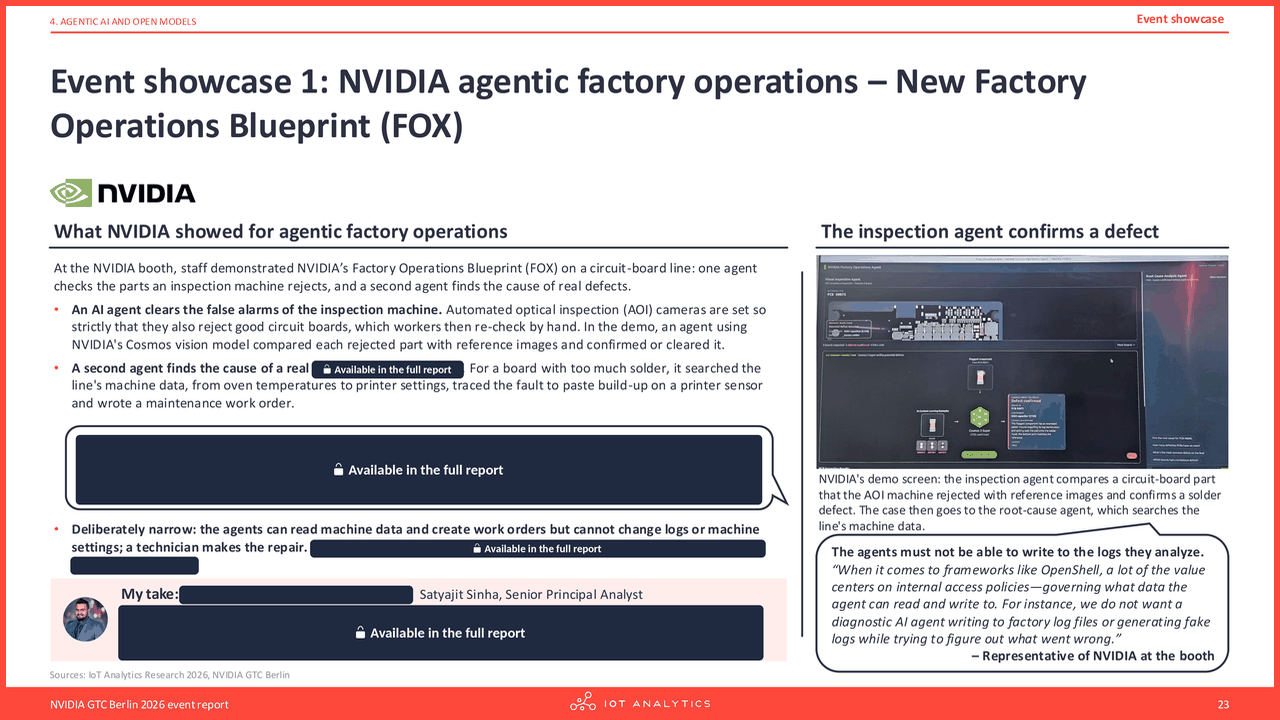
- Agent permissions move outside the model. NVIDIA’s open-source OpenShell runtime enforces policies outside the agent, and the first factory agents shown, such as NVIDIA’s Factory Operations Blueprint (FOX), can create work orders but cannot change machine settings.
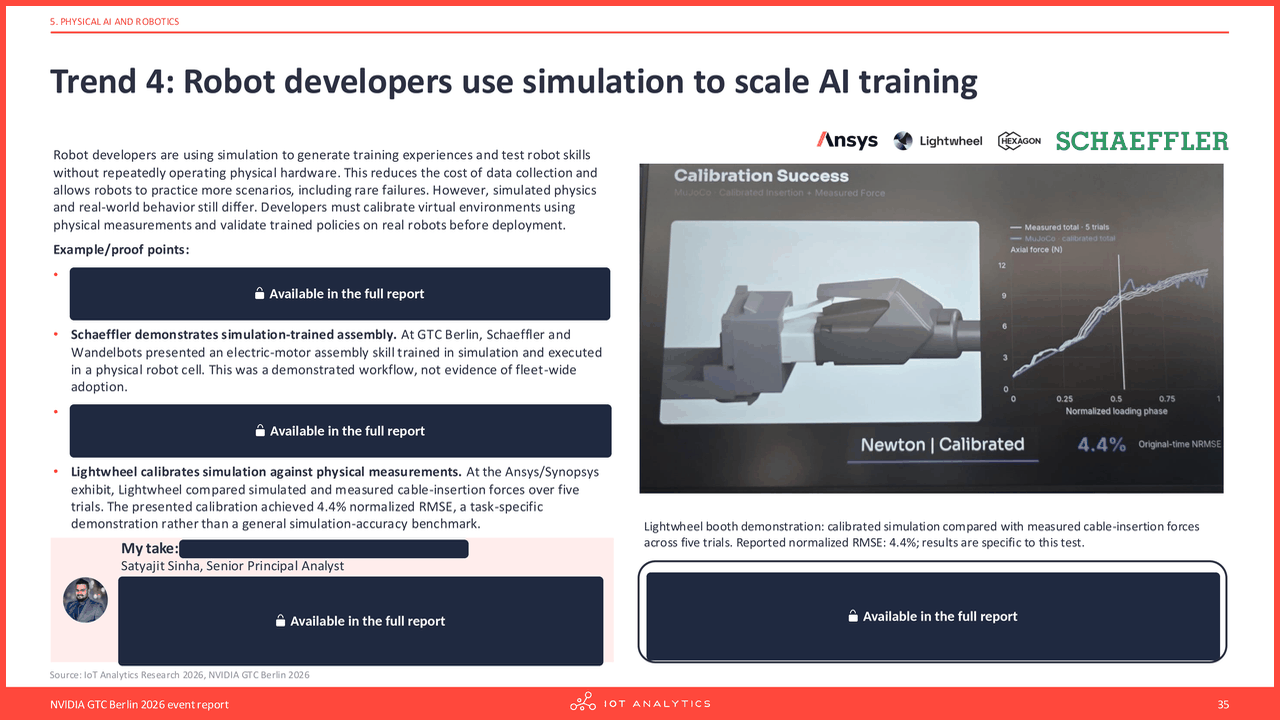
- Simulation scales robot training, but physical measurement decides reliability. Lightwheel calibrated its simulation against forces measured on a real robot, and Schaeffler and Wandelbots ran a simulation-trained assembly skill in a physical cell.
- AI data centers are prepared earlier. Virtual validation (NVIDIA DSX Air, Cadence Reality) and factory preintegration (NVIDIA DSX POD) target the time GPUs sit idle before the first token.
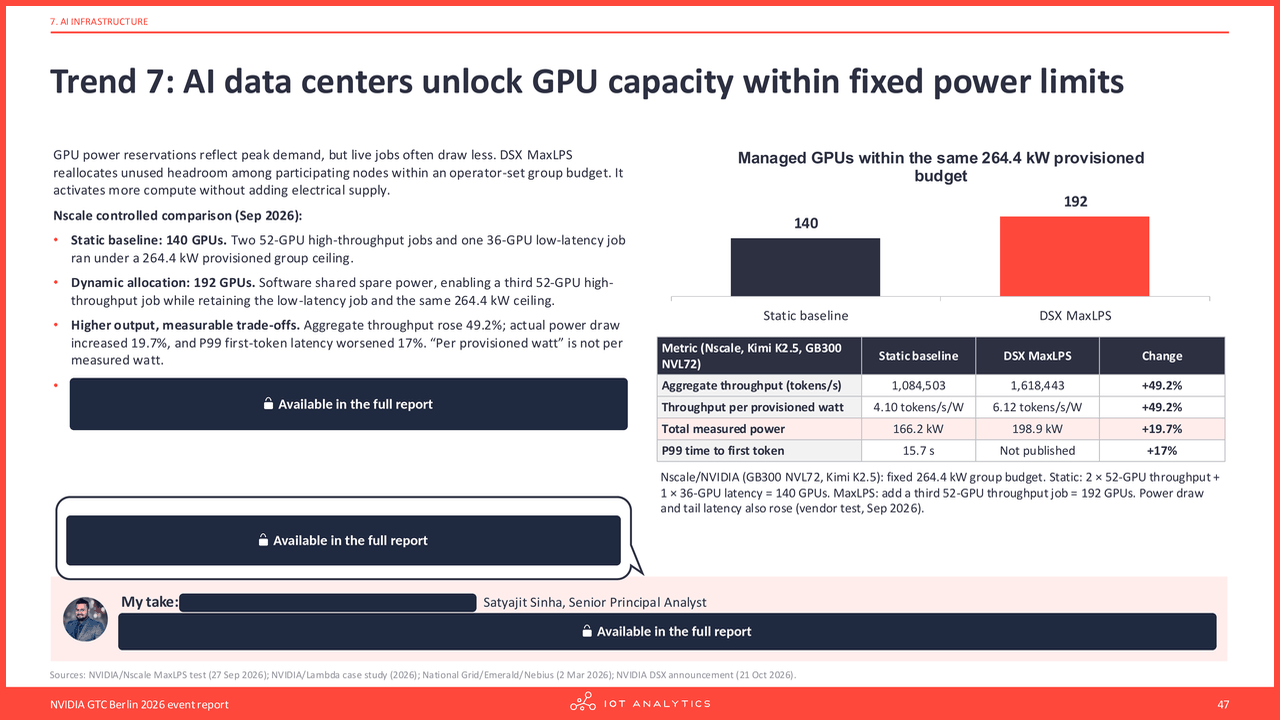
- Dynamic power allocation raises output under a fixed ceiling. In a controlled Nscale test of NVIDIA DSX MaxLPS, 192 instead of 140 GPUs ran under the same 264.4 kW provisioned ceiling, with clear trade-offs in measured power and latency.
The report helps industrial software, automation, robotics, and data-center infrastructure vendors benchmark the announcements of NVIDIA and its partners, consultants prepare client advice on agentic and physical AI, and investors see where value is being created as AI moves into engineering tools, factory operations, and AI factories.
The main purpose of this document is for our readers to keep up with the latest industrial technology developments and to stay ahead of major shifts in the market.
Table of Contents
NVIDIA GTC Berlin 2026: What’s next for industrial AI & AI infrastructure (PDF)
- About the event
- About NVIDIA GTC Berlin 2026 (attendees, keynote viewers, sessions, topics)
- Impressions from GTC Berlin 2026
- Summary & key takeaways
- Overview of 12 event showcases, 7 trends, and 7 keynote highlights
- 16 key takeaways
- NVIDIA keynote & other highlights
- Keynote highlights: 5 layers of the AI economy, 5 building blocks of an AI agent, OpenShell agent security, DSX POD, agents in Siemens and Dassault Systèmes engineering software, Agile ONE SN reference humanoid, AI-RAN
- 5 other NVIDIA announcements
- Site visit: Siemens Erlangen electronics factory
- Agentic AI and open models
- Event showcases: NVIDIA Factory Operations Blueprint (FOX), Cadence AuraStack and InnoStack
- Key trends
- Physical AI and robotics
- Event showcases: NVIDIA robotics software stack, NVIDIA edge AI computers, Wandelbots, Hexagon Robotics
- Key trends
- Digital twins and simulation
- Event showcases: NVIDIA AI factories, Cadence Reality Digital Twin, Ansys and Lightwheel, Siemens
- Key trends
- AI infrastructure
- Event showcases: NVIDIA DSX POD, NVIDIA Minerva
- Key trends
- Outlook
- 5 key developments to watch in agentic AI, physical AI, and digital twins through 2027
- About IoT Analytics
Related reading
Research article based on this publication: NVIDIA GTC Berlin 2026: What’s next for industrial AI and AI infrastructure
Our insights are trusted by global industry leaders


Single User License
- 1 named user within a particular department and country
- Complete event report in PDF
- Complete event report in PPTX
- 1 hour discussion with the analyst team
Team User License
- 1–5 named users within a particular department and country
- Complete event report in PDF
- Complete event report in PPTX
- 1 hour discussion with the analyst team
Enterprise License
- Report may be distributed to all employees of the enterprise
- Complete event report in PDF
- Complete event report in PPTX
- 1 hour discussion with the analyst team
Get your free sample
Any questions?
Get in touch with us easily. We are happy to help!

Prajwal Praveen
Sales Manager
Phone: +49 (0) 408 221 1722
Email: sales@iot-analytics.com