In short
- The smart maintenance market is expected to grow 2.5 times by 2032. IoT Analytics estimates the smart maintenance market at $8.1 billion in 2025 and expects it to grow at a 14% CAGR to $20.4 billion by 2032, led by wireless sensing and standalone analytics offerings.
- Closing the loop has become a top discussion theme. Closing the loop from sensor alert to completed repair usually requires combining offerings from several vendors, so sensor, analytics, and CMMS vendors are connecting their products.
- The learning step is the one most often missing. The technician’s closeout note is the data that predictive models need to improve, yet in most plants it never flows back to the model.
Why it matters
- For maintenance technology vendors. Value is moving to the steps between the alert and the repair. Vendors that stop at a dashboard risk losing the account to those that connect to work execution.
- For plant operators. A closed loop turns sensor data into fewer failures and shorter repairs. However, it depends on clean data and working processes more than on the best algorithm.
In this article
- The smart maintenance and asset performance market
- Why closing the maintenance loop has become such an important topic
- How the maintenance loop works and what it takes to close it
- Who closes which part of the loop
- Why closing the loop takes several vendors
- 4 key smart maintenance vendors and their strategies in closing the maintenance loop
- The role of AI in closing the loop
- Analyst opinion
- The bigger picture: Maintenance is only one of several loops in manufacturing that are starting to close
- Frequently asked questions about the smart maintenance market
- Further analysis
- Top 20 smart maintenance vendors and share shifts (Insights+ Exclusive)
- Smart maintenance market leaders in each of the 6 segments (Insights+ Exclusive)
- 11 overarching trends and 4 vendor challenges (Insights+ Exclusive)
- Recommendations for smart maintenance vendors (Insights+ Exclusive)
“Closing the loop” has become a top theme in smart maintenance discussions. Over the past year, the phrase came up repeatedly at leading maintenance and asset performance trade fairs and in the 75+ interviews the IoT Analytics team conducted with vendors and adopters. Vendors use it for the same goal: a sensor detects a fault, software diagnoses it, a work order is completed, and the result improves the next alert. So far, closing this loop end to end usually requires the offerings of several companies. Sensor specialists, analytics vendors, and maintenance software providers each cover part of it. They are also increasingly linking up through integrations, partnerships, and acquisitions.
The smart maintenance and asset performance market
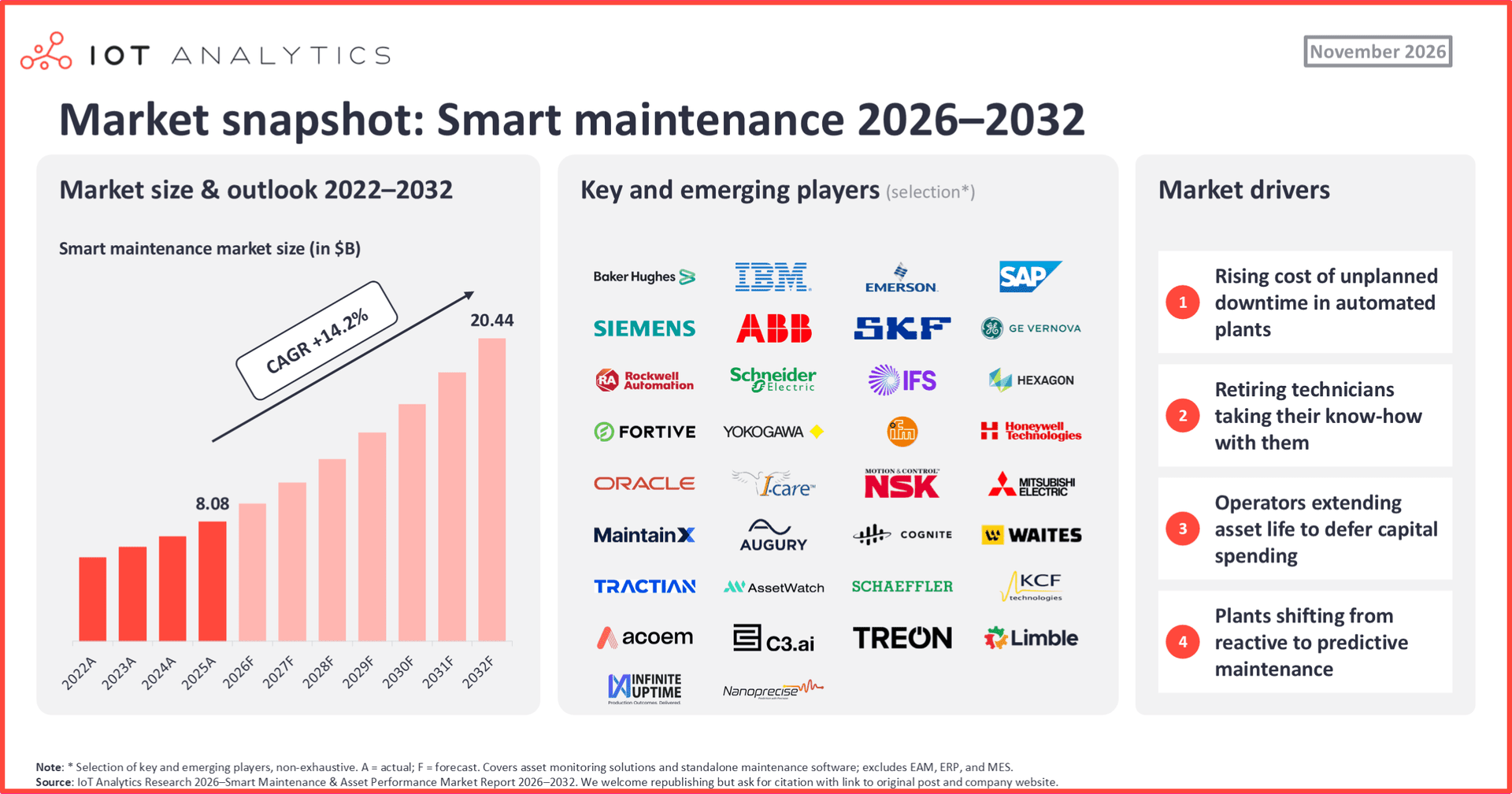
The smart maintenance market is expected to grow at a 14% CAGR to 2032. IoT Analytics’ 376-page Smart Maintenance & Asset Performance Market Report 2026–2032 (published November 2026) estimates that the global smart maintenance market reached $8.1 billion in 2025. The market is expected to grow at a 14% CAGR to $20.4 billion by 2032. Baker Hughes, IBM, and Emerson lead a fragmented market in which no vendor holds more than 6%.
Wireless sensing is gaining share fastest and is expected to become the largest segment by 2032, with wireless specialists such as I-care, AssetWatch, and Tractian gaining share, while several automation incumbents lose share in this segment. Standalone predictive and prescriptive analytics is also growing quickly. The report breaks the forecast down by segment, region, and industry, and tracks sensor shipments, which reached 4.1 million units in 2025 and are expected to grow 16% a year through 2032.
How IoT Analytics covers the smart maintenance market
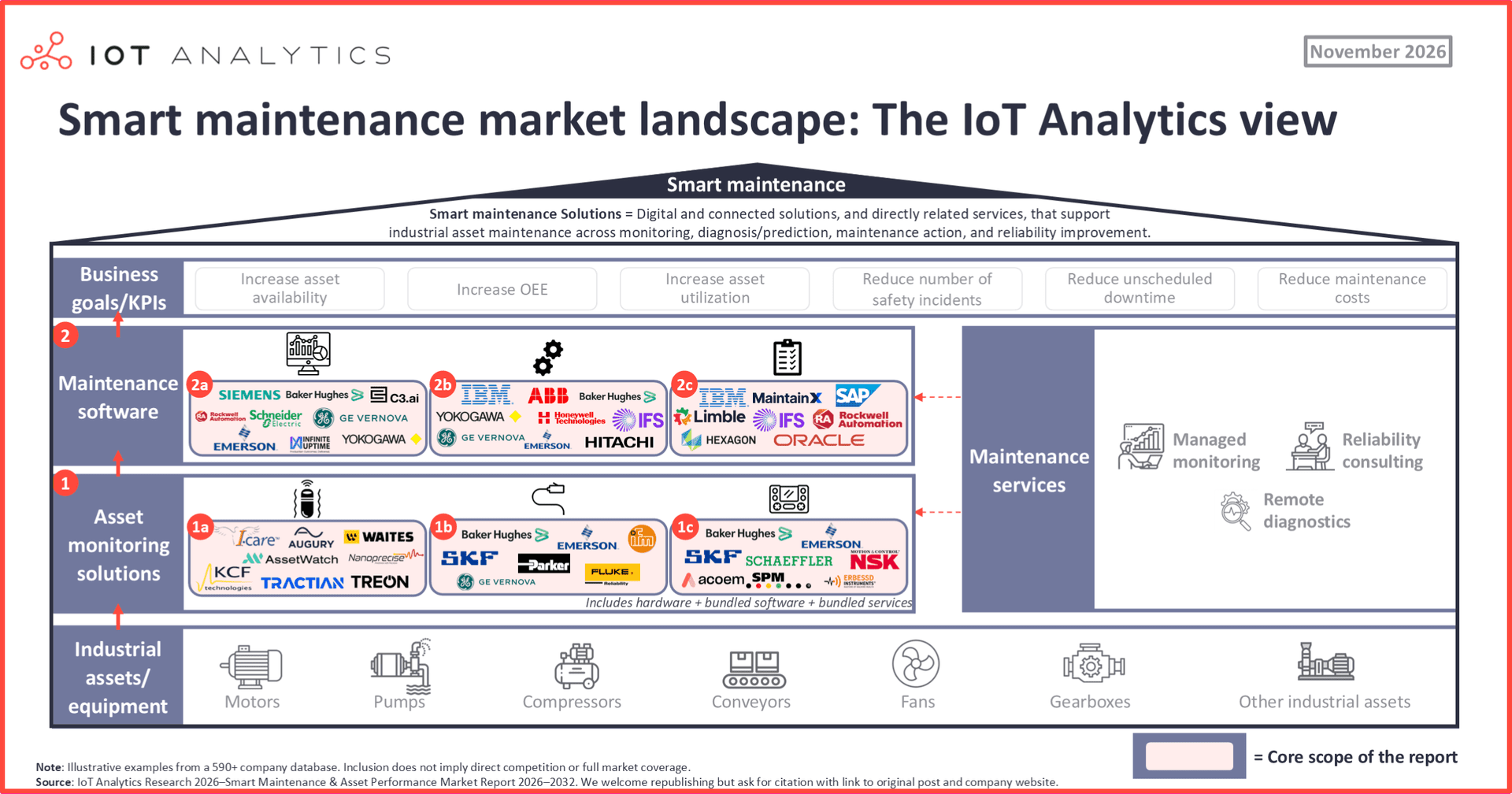
IoT Analytics sizes 6 smart maintenance segments. We define smart maintenance as digital and connected solutions, and directly related services, that support industrial asset maintenance across monitoring, diagnosis, maintenance action, and reliability improvement. The core scope covers 3 asset monitoring solutions (wireless, wired, and portable sensing, including bundled software and services) and 3 maintenance software solutions (standalone analytics, asset performance management [APM], and computerized maintenance management systems [CMMS]).
Standalone maintenance services such as managed monitoring and reliability consulting sit outside the core scope, as do EAM, ERP, and MES. The report comes with the Smart Maintenance Vendor Database 2026, an Excel file that classifies 597 vendors by offering, country, size, ownership, and recent M&A activity. The estimates rest on primary research: interviews with 75+ experts, 2 surveys of 120 end users each, and visits to 4 trade fairs, including Hannover Messe and IMTS 2026.
Insights from this article are derived from
Smart Maintenance & Asset Performance Market Report 2026–2032
A 376-page report sizing the smart maintenance market to 2032, including top 20 vendor shares, 25 company profiles, 25 trends, and 5 case studies.
Already a subscriber? View your reports and trackers here →
Why closing the maintenance loop has become such an important topic
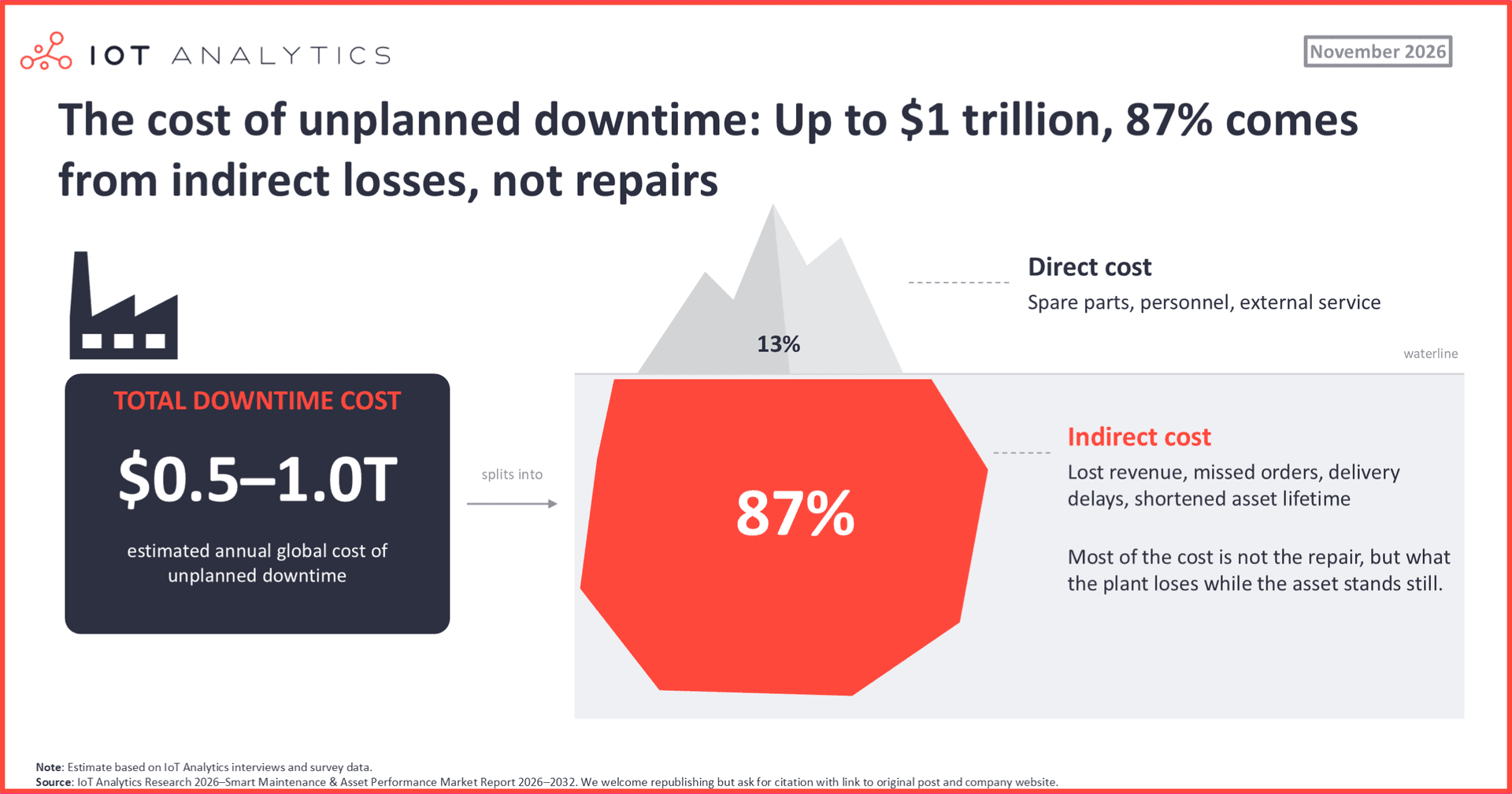
Downtime costs industry up to $1 trillion a year. IoT Analytics estimates that unplanned downtime costs industry $0.5 trillion to $1.0 trillion a year. About 87% of that cost is indirect, such as lost revenue and missed orders.
A single outage can cost hundreds of millions. At US-based chemical company LyondellBasell, an unplanned outage at its propylene oxide/TBA asset in Bayport, Texas, began in March 2026 and lasted about 13 weeks. Management estimated the lost EBITDA at $25 million per week, or about $150,000 per hour, for a total of about $40 million in the first quarter and $250 million in the second.
“The outage had an estimated EBITDA impact of approximately $250 million during the quarter.”
Aaron Ledet, EVP, LyondellBasell (May 2026)
Experienced technicians have historically replaced the need to close the loop. Maintenance organizations never prioritized closing the loop from alert to repair. Experienced technicians filled the gaps: they read the alert, knew what was wrong, fixed it, and remembered it for next time. However, that expertise is getting scarce. In IoT Analytics’ 2025 survey of 120 digital decision-makers in machine building, 43% named workforce skill gaps and lack of expertise as a critical or significant barrier to adopting AI. Vendors see the same pattern: MaintainX co-founder Nick Haase estimates that half of maintenance and reliability professionals reach retirement age within about 5 years. When these experts leave, systems must close the loop, or repair times will rise.
“50% of maintenance reliability professionals are going to be at retirement age in the next like 5 years. They’re leaving the workforce all that tribal knowledge is leaving.”
Nick Haase, Co-founder, MaintainX (June 2025)
Downtime is only reduced when alerts lead to completed work. A prevented failure leaves no trace on the profit and loss statement, so buyers look for proof on the shop floor. UK-based meal-kit company Gousto, for example, connected its factory equipment, including older machines fitted with vibration sensors, to one data platform. Its CMMS now turns anomalies into work orders and sends them to engineers through an app. Over 18 months, mechanical availability rose from 70% to 98.5%, and mean time to repair (or MTTR) fell from 1 hour to 15 minutes.
How the maintenance loop works and what it takes to close it
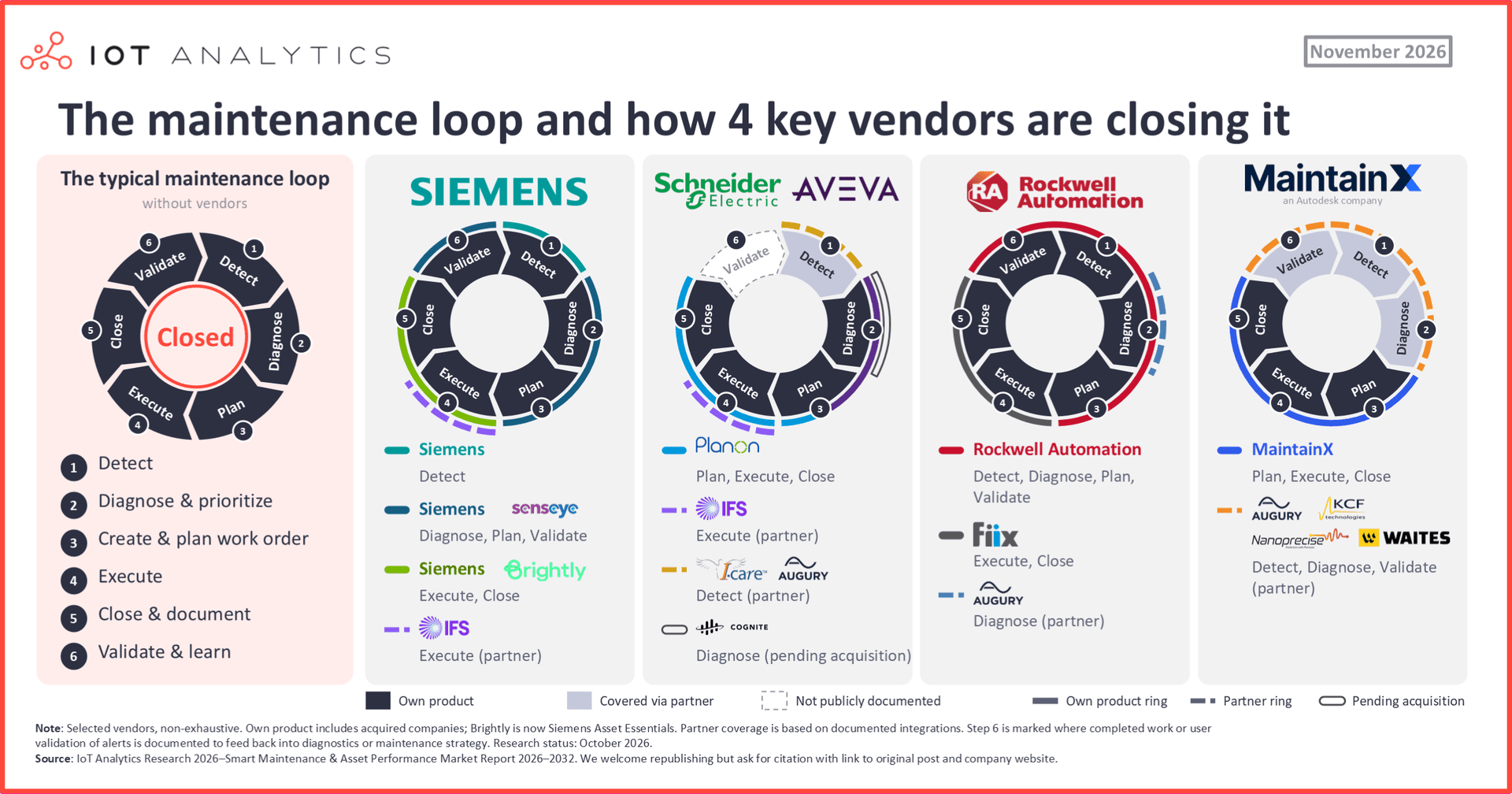
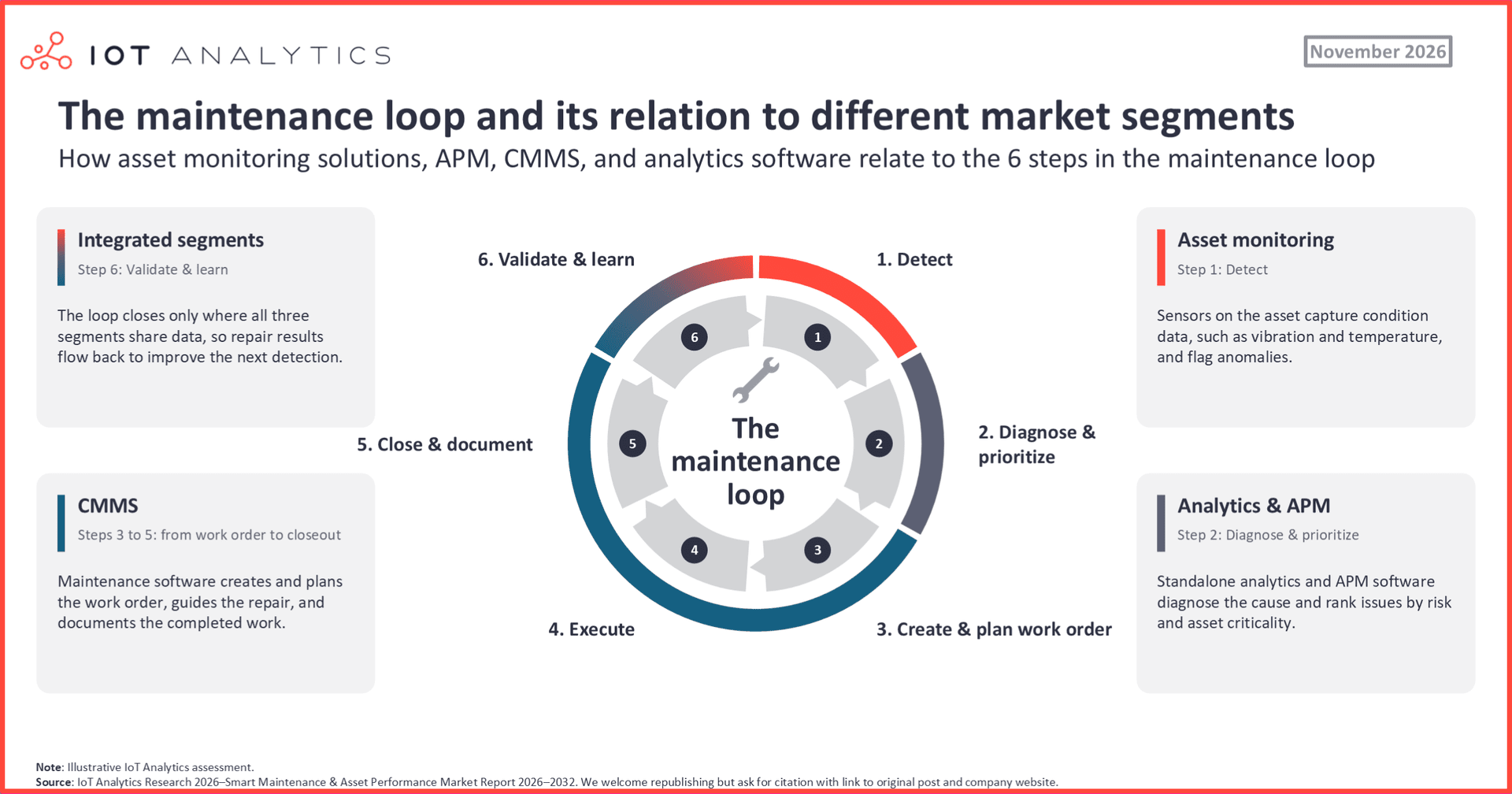
The maintenance loop has 6 steps:
- Detect – Sensors pick up a change in vibration, temperature, or current, and models flag an anomaly.
- Diagnose and prioritize – Analytics or APM software identifies the likely fault and ranks the issue by risk, often with a remote analyst checking it.
- Create and plan the work order – The CMMS receives the asset, fault type, and priority, and planners schedule the job, people, and parts.
- Execute – Technicians carry out the repair.
- Close and document – Technicians record findings, parts used, and the root cause.
- Validate and learn – Confirmed failures, false alarms, and repair results retrain the models.
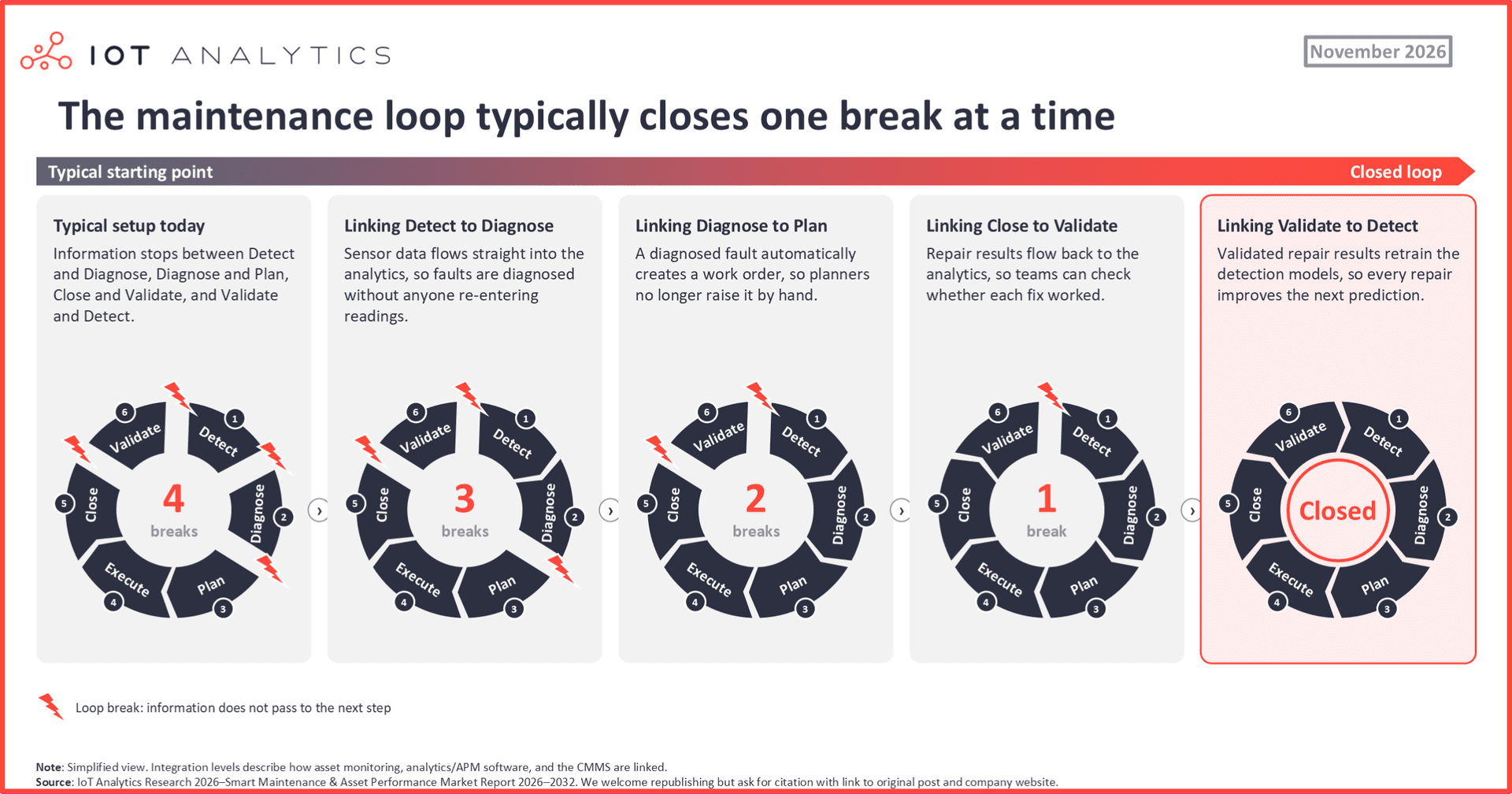
Detection and action grew up in separate worlds. In many manufacturing organizations, reliability engineers and vibration analysts run condition monitoring, while maintenance planners run the CMMS, often with IT as the owner. The 2 sides are bought from different vendors, and no system captures what technicians found in the field. Alerts reach planners by email or phone, closeout notes are free text, often rushed or left empty, and “no fault found” is seldom recorded.
Who closes which part of the loop
Each of the 6 market segments covers a different part of the loop, and each is now reaching into the neighboring steps. The 3 asset monitoring solutions (wireless, wired, and portable sensing) detect faults. The 3 maintenance software solutions take it from there: standalone analytics diagnoses faults and recommends a fix, APM decides which issues matter most, and CMMS plans, executes, and documents the work. Vendors in every segment are now reaching into the neighboring steps, mostly through product extensions and integrations.
Asset monitoring solutions: from sensing toward the work order
Wireless sensing solutions: extending sensing into execution. The segment is expected to grow from $1.1 billion in 2025 at a 24% CAGR to $5.1 billion by 2032, the fastest of all 6 segments. Wireless specialists used to stop at the alert, but they no longer do. Most vendors now bundle sensors, software, and expert diagnosis into one subscription and push the findings into the customer’s work order system or even supply their own CMMS. Nanoprecise, Waites, KCF Technologies, and Augury all integrated with CMMS vendor MaintainX between October 2025 and March 2026. In the Waites integration, technician updates sync back to Waites’ analysts, one of the few cases in which the learning step closes.
“When our AI sensors detect a specific failure mode, such as pump cavitation, our platform opens a work order in the connected CMMS (e.g., MaintainX, SAP) or in our own CMMS.”
Sales Engineer at a wireless vibration monitoring specialist (September 2026)
Wired sensing solutions: moving from the alert toward the repair. The wired sensing segment is expected to grow from $1.4 billion in 2025 at a 6% CAGR to $2.1 billion by 2032. Like wireless specialists, wired vendors are reaching into execution. ifm electronic’s moneo Asset Health identifies the likely cause of a fault and creates a maintenance ticket with a repair recommendation. SKF goes further on critical machines: it links condition monitoring with lubrication, alignment, bearing replacement, and on-site maintenance support, and takes responsibility for reliability outcomes through performance-based contracts.
Maintenance software: from the diagnosis to the closeout
Standalone analytics: Moving from prediction to prescription. Analytics vendors now add the likely root cause and a recommended repair to each alert; Siemens (Senseye), Augury, and Treon all presented such features in 2025 and 2026. To turn recommendations into work, they connect to execution: in July 2026, for example, Augury partnered with Rockwell Automation so that Augury’s alerts automatically create work orders in Rockwell’s Fiix CMMS. The segment is expected to grow from $1.1 billion in 2025 at a 22% CAGR to $4.2 billion by 2032.
Computerized Maintenance Management System (CMMS): Holding the work and the feedback. The CMMS is where work orders are planned, executed, and closed, and where technicians record what was actually wrong. That makes it the source of the learning step. CMMS vendors are also moving upstream: MaintainX showed a pressure-threshold trigger that opens a work order at IMTS 2026, and Rockwell Automation connects machine data from its control systems to its Fiix CMMS. The CMMS market is expected to grow from $1.9 billion in 2025 at a 13% CAGR to $4.6 billion by 2032, faster than the 12% annual growth rate in 2022–2025.
“What many sensing companies do not provide typically is that closed loop with the work being executed and learning from it.”
Nick Haase, Co-founder, MaintainX (September 2026)
Why closing the loop takes several vendors
Few vendors cover every step. Leading vendors in the smart maintenance market include Baker Hughes, IBM, Emerson, SAP, Siemens, ABB, SKF, and GE Vernova, along with fast-growing specialists such as I-care, Augury, and Tractian. Most cover 1 or 2 steps of the loop and rely on partners for the rest, which is why cross-layer integrations have become so common. Our Smart Maintenance Vendor Database 2026 shows how specialized the market is: of 597 vendors, 76% offer only 1 of the 6 solution categories, and only 7% offer 3 or more.
Many integrations stop before the last step. Despite the ongoing efforts to close the loop, many plants today still pass alerts to the CMMS by hand. Others have automated parts of the loop, so alerts create work requests in the CMMS or the CMMS reports work order status back to the analytics software. Few use repair outcomes to retrain their models, even though a technician’s note such as “bearing replaced, outer race damage confirmed” or “no fault found” is exactly the label a model needs.
4 vendor strategies to close the loop
To offer customers a closed loop, vendors take one of 4 routes:
- Build. Vendors develop the missing step themselves. Tractian, for example, sells wireless sensors and AI diagnostics and has built its own CMMS, so its alerts can open work orders without a third party.
- Integrate. Sensing vendors connect their alerts to another vendor’s CMMS: Augury, Waites, KCF, and Nanoprecise with MaintainX, and Tractian with MaintainX or SAP. Where technician updates flow back, as with Waites and KCF, the integration also closes the learning step.
- Partner. In July 2026, Rockwell Automation and Augury agreed a technology and go-to-market partnership that turns detected issues into prioritized work orders in Rockwell’s CMMS, Fiix. In June 2026, Siemens and IFS partnered to close the loop between design intent and real-world asset performance.
- Acquire. Autodesk’s $3.6 billion purchase of MaintainX (May 2026) adds work execution and its closeout data to a design software company. Schneider Electric agreed to acquire Cognite for $3.1 billion to bring industrial data and AI to AVEVA, and Bosch agreed to acquire predictive analytics vendor Uptake.
4 key smart maintenance vendors and their strategies in closing the maintenance loop
Siemens, Schneider Electric, and Rockwell Automation are among the top 20 smart maintenance vendors (by market share) and among the 25 in-depth vendor profiles in the report. MaintainX is one of the fastest-growing challengers in the space. The 4 have one thing in common: each company is working on and investing heavily in closing the loop.
1. How Siemens is closing the loop
Siemens covers steps 1 to 5 with its own products. It combines its own condition monitoring hardware with Senseye analytics and Brightly CMMS, both acquired in 2022. More recently, built-in Industrial Copilots and AI agents across Senseye and Brightly have closed the prescriptive and ticketing gap by translating raw alerts into root-cause diagnoses, repair instructions, and automated work orders. To strengthen field execution, Siemens also partnered with IFS in June 2026 to link its digital twin and production intelligence directly with IFS’s AI-native EAM and field service management.
2. How Schneider Electric is closing the loop
Schneider covers the software side of the loop (steps 2 to 5) through AVEVA for analytics and APM, and Planon for the CMMS. It does not offer a dedicated line of monitoring hardware of its own in our scope, so it relies on partners such as I-care and Augury for machine data. Its pending acquisition of Cognite, agreed in 2026 for $3.1 billion, would add an industrial data and AI layer on top of the AVEVA APM software.
3. How Rockwell Automation is closing the loop
Rockwell covers steps 1 to 5 with its own products. It pairs its sensing and analytics with Fiix, the CMMS it acquired in 2020. On July 14, 2026, Rockwell introduced Fiix MAX, an embedded AI maintenance assistant that surfaces asset history, parts context, and work instructions directly inside the CMMS workflow. Later that month, Rockwell also partnered with Augury to integrate Augury’s Reliability Agent directly with Fiix MAX so that validated machine-health issues can automatically generate prioritized work orders in Fiix (with root-cause diagnoses and recommended repair steps).
4. How MaintainX is closing the loop
MaintainX starts from the CMMS, covering steps 3 to 5, and relies on partners for detection and diagnosis. Between October 2025 and March 2026, it integrated with 4 wireless specialists: Augury, KCF Technologies, Nanoprecise, and Waites. In the Waites and KCF integrations, technician feedback flows back to the sensing vendor, so MaintainX is the only one of the 4 where the learning step is documented. Since May 2026, Autodesk has owned MaintainX, which could also link field data back to product design.
The role of AI in closing the loop
AI is starting to take on a central role as the orchestrator of the closed loop. Until recently, AI in maintenance meant anomaly detection. The examples from Siemens, Schneider, Rockwell, and MaintainX above show that vendors are adding agents that act on alerts and coordinate the steps that follow, from the work request to the technician and spare parts. Other examples include:
- IBM adds agentic AI to Maximo. Its Maximo Condition Insight analyzes asset data, work orders, meter readings, and failure modes.
- SAP turns alerts into pre-filled work orders. Its AI agents convert asset health signals into recommended actions and maintenance requests.
- Bosch presents a Smart Maintenance Agent. The company’s agent allocates technicians and spare parts and starts work orders.
Analyst opinion
IoT Analytics CEO Knud Lasse Lueth and analyst Zeynep Kaman led the research for the Smart Maintenance & Asset Performance Market Report 2026–2032. Here are their main conclusions:
CMMS vendors are becoming the key to a fully automated smart maintenance loop. The market is fragmented. The largest vendors each hold less than 6%, and each covers only part of the loop. To fill the gaps, vendors partner, integrate, or acquire, and most of these deals involve a CMMS. MaintainX integrated with 4 wireless vendors in 6 months, Rockwell Automation partnered with Augury, and Autodesk bought MaintainX for $3.6 billion. The CMMS is where the repair is planned, carried out, and documented. Without it, a sensor or analytics vendor cannot show that its alerts lead to repairs.
The learning step is the weakest link in the loop. The loop only closes when the technician’s findings go back into the model. This tells the model whether an alert was right or a false alarm, so it can improve the next one. The 4 wireless vendors that integrated with MaintainX now do get technician updates back. Many other vendors are currently unable to close this final step because they lack the integration and partnerships.
Data, not AI, limits automation. AI can only close the loop if it gets the right data, and that data sits in many places: sensors, the CMMS, spare parts systems, and often in the heads of technicians. In many plants, these sources are not connected, and asset records are incomplete or out of date. An AI agent working with this data will create the wrong work orders or learn the wrong lessons. That is why plants first need the basics: connected systems, clean asset data, and work orders that are carried out and properly closed. Only then can AI learn from each repair. Poor maintenance data ranks among the 5 most pressing adopter challenges in the report, next to the shortage of skilled labor.
AI autonomy is the next big debate in smart maintenance. Vendors are already taking positions at opposite ends of this scale. At one end are vendors such as Tractian, which position themselves as AI-first and let their AI diagnose faults without a human analyst reviewing each alert. At the other end are vendors such as Waites or AssetWatch, who emphasize the need for human experts before an alert reaches the customer. Both approaches face the same challenge, because a single false alarm can damage a plant’s trust in the system. In our view, plants will hand more of the loop to AI only once vendors can show a track record of correct alerts and completed repairs. The report maps where vendors such as Waites, I-care, and Tractian place their products on a 5-level scale of AI autonomy, from human-only to AI-only.
The bigger picture: Maintenance is only one of several loops in manufacturing that are starting to close
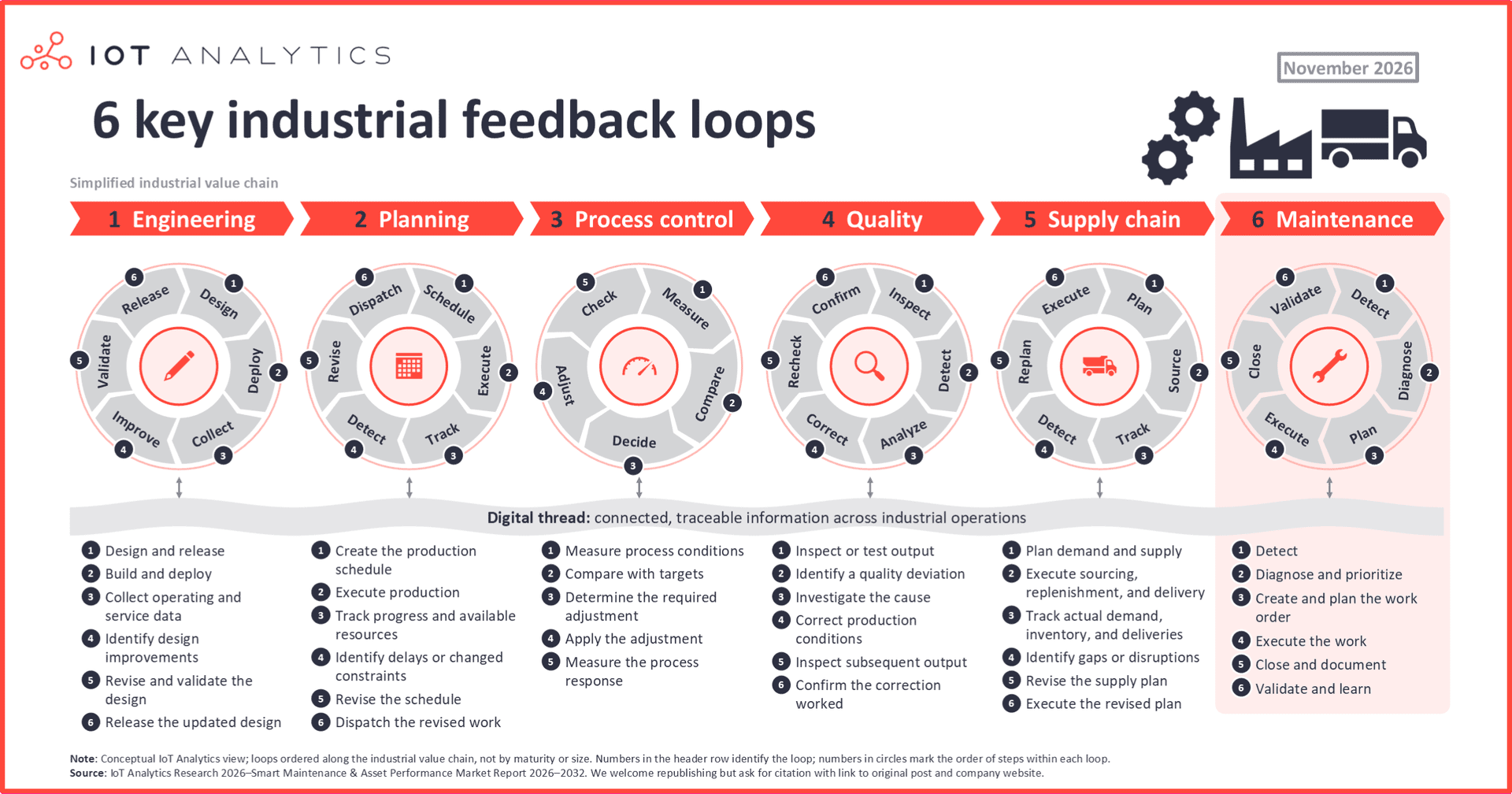
Maintenance is one of several loops AI is starting to close. As part of IoT Analytics’ coverage of industrial technology, a number of loops are being discussed. Across industrial operations, the same pattern of sensing, deciding, acting, and learning applies in several spots. Along the value chain, from engineering to maintenance, we see early signs of at least 6 loops:
- Loop 1: The engineering loop – field experience to design. Engineers use production, field-performance, and service findings to revise product or production-system designs, then assess how those changes perform.
- Loop 2: The planning loop – shop-floor execution to revised production schedules. Planners use actual production progress, equipment availability, and material constraints to revise schedules, then track execution against the revised plan.
- Loop 3: The process control loop – process deviation to parameter adjustment. Controllers or operators adjust operating variables or target settings in response to measured conditions and objectives, then monitor the process response.
- Loop 4: The quality loop – quality deviation to process correction. Teams use inspection and test results to correct production conditions, then check subsequent output to confirm that quality meets requirements.
- Loop 5: The supply chain loop – demand and supply changes to revised supply plans. Teams use demand, inventory, supplier, and delivery updates to adjust sourcing, replenishment, and distribution plans, then track whether execution meets requirements.
- Loop 6: The maintenance loop – condition alert to verified repair. The one we discussed in this article.
Agentic AI is the catalyst, but adoption will take time. We observe that vendors realize that agentic AI suddenly lets them close each of these loops in ways they could not before. And that is why we are seeing these discussions. Despite significant innovation, we expect it to take years for closed-loop systems to reach the mainstream in most of these areas, as manufacturers are conservative and slow to adapt to what is now possible.
Frequently asked questions about the smart maintenance market
IoT Analytics estimates that the global smart maintenance market reached $8.1 billion in 2025. It expects the market to grow at a 14% CAGR to $20.4 billion by 2032, about 2.5 times its 2025 size.
Wireless sensing is the fastest-growing segment, rising from $1.1 billion to $5.1 billion (24% CAGR), and is expected to become the largest segment by 2032. Standalone analytics grows from $1.1 billion to $4.2 billion (22% CAGR), CMMS from $1.9 billion to $4.6 billion (13% CAGR), and wired sensing from $1.4 billion to $2.1 billion (6% CAGR).
Closing the loop means connecting every step from the first sensor alert to the completed repair, and feeding the result back into the predictive model. The maintenance loop has 6 steps: detect, diagnose and prioritize, create and plan the work order, execute, close and document, and validate and learn. The final step is the one most often missing. The technician’s closeout note (for example, “bearing replaced, outer race damage confirmed” or “no fault found”) is exactly the data a model needs to improve, yet in most plants it never flows back to the model.
IoT Analytics estimates that unplanned downtime costs industry $0.5 trillion to $1.0 trillion a year, and downtime only falls when alerts turn into completed work. In the past, experienced technicians filled the gaps between alert and repair, but that expertise is getting scarce. In a 2025 IoT Analytics survey, 43% of decision-makers in machine building named skill gaps as a critical or significant barrier to adopting AI. Closing the loop pays off on the shop floor: after Gousto connected its equipment and CMMS, mechanical availability rose from 70% to 98.5%, and mean time to repair fell from 1 hour to 15 minutes.
Baker Hughes, IBM, and Emerson lead a fragmented market in which no vendor holds more than 6%. Other leading vendors include SAP, Siemens, ABB, SKF, and GE Vernova, along with fast-growing specialists such as I-care, Augury, and Tractian.
Most vendors cover only 1 or 2 steps of the maintenance loop: of the 597 vendors in IoT Analytics’ database, 76% offer only 1 of the 6 solution categories. To close the loop, vendors build the missing steps (Tractian), integrate (Augury, Waites, KCF, and Nanoprecise with MaintainX), partner (Rockwell Automation with Augury), or acquire (Autodesk‘s $3.6 billion purchase of MaintainX).
AI in maintenance used to mean anomaly detection. Vendors are now adding AI agents that act on an alert and coordinate the next steps. IBM‘s Maximo Condition Insight analyzes asset data, work orders, and failure modes. SAP‘s agents turn asset health signals into pre-filled maintenance requests. Bosch‘s Smart Maintenance Agent allocates technicians and spare parts. Siemens and Rockwell Automation embed AI assistants in their CMMS products. Adoption is still early: only 1 in 5 process plants in IoT Analytics’ survey uses AI to predict failures. IoT Analytics argues that data, not AI, sets the limit, because AI can only close the loop if the underlying data is connected and clean.
Further analysis
Below, in our Insights+ section, we share the top 20 smart maintenance vendors and their share shifts, the leaders in each of the 6 segments, 11 overarching trends and 4 vendor challenges, and our recommendations for vendors. The complete 376-page Smart Maintenance & Asset Performance Market Report 2026–2032 goes much further, including:
- Forecasts through 2032 by segment, region, and industry
- 25 company profiles
- 25 trends
- 5 adopter case studies
- Survey results from 120 process plants
- A buy-versus-build guide
The report also comes with the Smart Maintenance Vendor Database 2026, an Excel file with 597 classified vendors. The report is available to corporate subscribers and for individual purchase.
Access key market data for $99/month per user
The Insights+ Subscription unlocks exclusive facts & figures. You will gain access to:
- Additional analyses derived directly from our reports, databases, and trackers
- An extended version of each research article not available to the public
Full report access not included. For enterprise offerings, please contact sales: sales@iot-analytics.com