
Industrial Routers & Access Points Market Tracker and Forecast 2020-2030
A market tracker and forecast of the industrial router & access point market to 2030: revenue, shipments, and ASP by company, connectivity, region, and industry vertical, with a 55-page market report.
Key Data Snapshot:
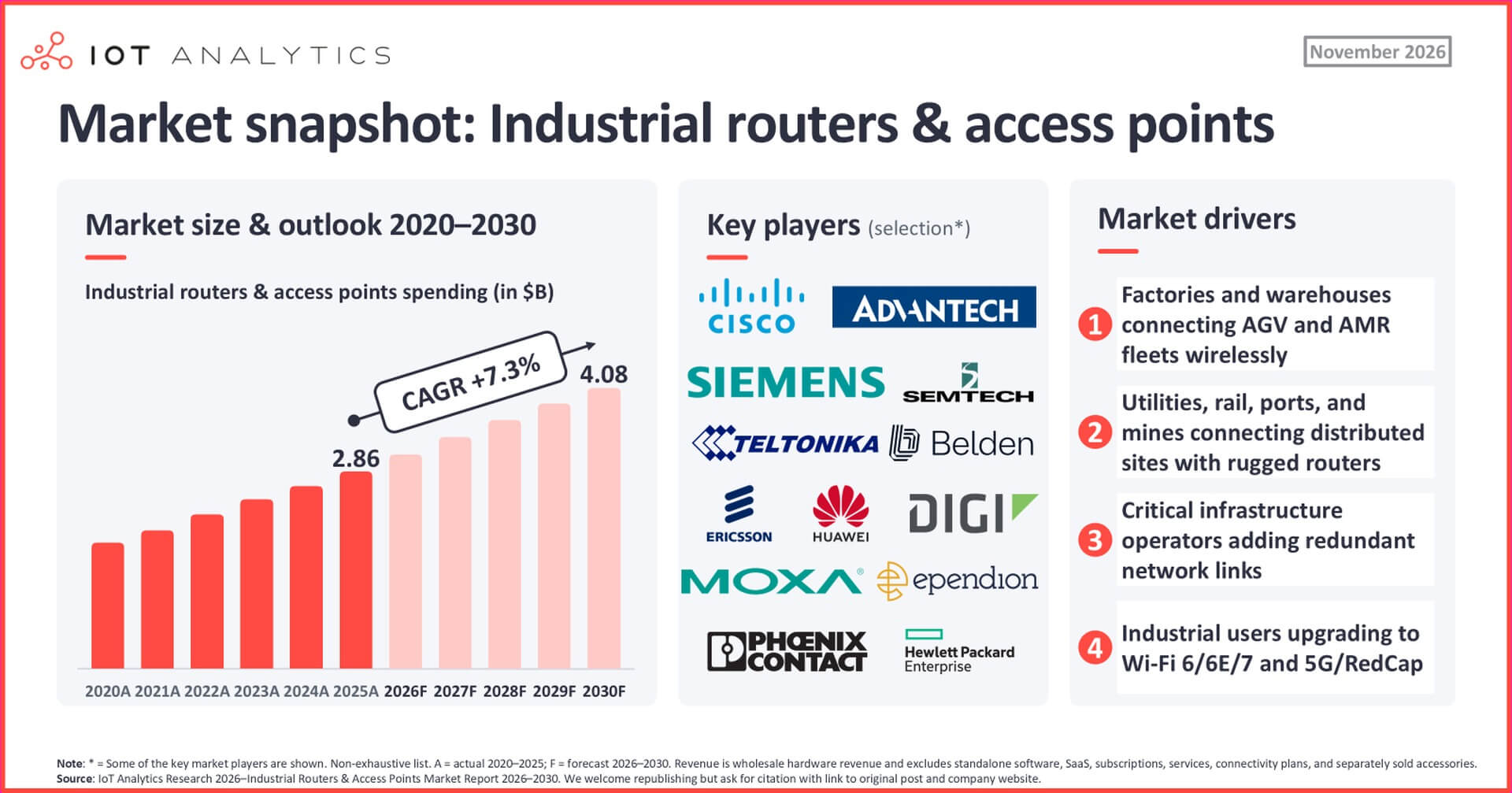
- 2025 Market Size: $2.86 billion
- 2030 Forecast: $4.08 billion
- Key Players: Advantech, Belden, Cisco, Digi, Ependion, Ericsson Cradlepoint, HPE Networking, Huawei, Moxa, Phoenix Contact, Semtech, Siemens, Teltonika
Industrial Routers & Access Points Market Tracker: Size, Drivers, and Trends 2020-2030
Industrial Routers & Access Points Market Overview
IoT Analytics research indicates that the global industrial router and access point market reached $2.86 billion in 2025. The market is forecast to reach $4.08 billion by 2030, representing a compound annual growth rate (CAGR) of 7.3% between 2025 and 2030. Growth is expected to be slower than the 9% CAGR between 2020 and 2025, but the market adds more revenue in the forecast period: $1.21 billion, compared with $1.03 billion between 2020 and 2025. Annual shipments are expected to rise from 4.6 million units in 2025 to 6.6 million units in 2030, while the blended average selling price (ASP) stays near $620.
The market covers 3 device classes:
- Industrial Wi-Fi access points, clients, and bridges: Ruggedized or industrially qualified Wi-Fi devices that connect industrial devices and users to a local wireless network.
- Industrial cellular routers and CPE: Ruggedized or industrially qualified routers and customer-premises equipment that use a public or private cellular network to connect industrial equipment, mobile assets, or remote sites.
- Wired industrial routers: Ruggedized or industrially qualified routers that use Ethernet or another wired connection to route traffic within or between industrial networks.
Revenue covers wholesale hardware only and excludes IoT gateways, industrial Ethernet switches, firewalls, private 5G infrastructure, standalone cellular modules, software, and services.
Key Trends & Market Drivers
Demand for industrial access hardware grows with how operations are designed, not only with how many sites are built. 4 drivers add devices per site:
- Mobile automation. Factories and warehouses deploying AGVs and AMRs need both wireless coverage and on-board client hardware.
- Distributed sites. Utilities, rail networks, ports, and mines use rugged cellular routers and wireless links to connect remote field assets.
- Network resilience. Critical infrastructure operators add redundant links, so critical sites need more than one router.
- Technology refresh. Industrial users replace aging hardware with Wi-Fi 6/6E, Wi-Fi 7, and 5G/RedCap equipment.
Wi-Fi accounts for about 75% of incremental shipments through 2030. Wi-Fi 6/6E and Wi-Fi 7 together are forecast to account for 79.1% of industrial Wi-Fi revenue by 2030, up from 40.4% in 2025. Wi-Fi 6/6E remains the main upgrade generation, with nearly 70% of 2030 industrial Wi-Fi revenue, compared with about 9% for Wi-Fi 7. In cellular, 5G/RedCap is expected to reach 59.2% of revenue by 2030, while 4G/LTE still represents about half of cellular shipments, so higher-priced 5G/RedCap routers lift revenue faster than units.
Recent market developments illustrate these drivers. US-based network hardware company Cisco runs its Ultra-Reliable Wireless Backhaul (URWB) technology on industrial IW9165 and IW9167 access points and selected enterprise Wi-Fi 6/6E/7 models, so the same wireless infrastructure supports conventional Wi-Fi clients and moving industrial assets such as AGVs and forklifts. Lithuania-based Teltonika Networks introduced its first 5G transport router, the ATRM50, with EN 50155 and EN 45545 rail certifications and an operating range of -40°C to 75°C. In a modernization project, a European energy distribution company runs 2 Advantech LTE routers on separate mobile networks at critical sites, with satellite connectivity as a third backup path.
What is in this report and tracker?
This 55-page analysis, published in November 2026, sizes revenue, shipments, and ASP for 2020–2030 (actuals for 2020–2025, forecast for 2026–2030) by primary connectivity (Wi-Fi, cellular, wired), region, and industry vertical. It covers vendor concentration and leading vendors in 2025, vendor revenue growth from 2020 to 2025, vendor consolidation, 5 vendor insights (Cisco, HPE Networking, Moxa, Siemens, Teltonika), and detailed market definitions, including how hybrid and multifunction devices are classified.
The Enterprise Premium License also includes the full report in PPTX and the Industrial Routers & Access Points Tracker and Forecast 2020–2030 in Excel. The tracker contains the market model behind the report: revenue in USD million, shipments in million units, and ASP in USD per unit for 2020–2030E (actuals for 2020–2025, forecasts for 2026E–2030E), with 2025–2030E CAGRs. Values are split by company, primary connectivity (Wi-Fi, cellular, wired), Wi-Fi connectivity (Wi-Fi 4, Wi-Fi 5, Wi-Fi 6/6E, Wi-Fi 7), cellular connectivity (4G/LTE/legacy, 5G/RedCap), region, and industry vertical. The editable Excel format is ready for your own analysis, charts, and planning models.
The tracker goes beyond what the report shows:
- Vendor-level forecasts. Revenue, shipments, and ASP for each named vendor and Others for every year from 2020 to 2030E; the report shows vendor share bands for 2025 and revenue growth for 2020–2025 only.
- Wi-Fi and cellular generations. Revenue, shipments, and ASP by Wi-Fi 4, Wi-Fi 5, Wi-Fi 6/6E, and Wi-Fi 7, and by 4G/LTE/legacy and 5G/RedCap, for every year; the report discusses these splits only in its commentary.
- Exact values. Every data point behind the report’s charts, unrounded, for each year from 2020 to 2030E.
- Single User License and Team User License: complete market report in PDF.
- Enterprise License: complete market report in PDF and PPTX, plus the Industrial Routers & Access Points Tracker and Forecast 2020–2030 in Excel.
Key Questions Addressed
- Which products are included in the industrial router & access point market, and which device types does it cover?
- How is scope decided for multifunction and hybrid devices?
- What is included in and excluded from the sized market?
- How large is the market, and how fast is it expected to grow to 2030?
- How do revenue, shipments, and ASP interact, and is growth volume-led or price-led?
- How are industrial Wi-Fi access points, clients, and bridges developing, and how does the shift to Wi-Fi 6/6E and Wi-Fi 7 affect pricing?
- How fast are industrial cellular routers and CPE growing, and what role does the shift to 5G/RedCap play?
- How are wired industrial routers developing, and is wireless connectivity replacing them?
- How is the market split by region and industry vertical, and where does incremental growth come from?
- Which vendors lead the market, and how concentrated is it?
Table of Contents
Industrial Routers & Access Points Market Tracker and Forecast 2020–2030 (EXCEL)
- Intro: overview, key definitions, scope, industry vertical definitions, vendor, connectivity and region lists
- Overview: global revenue, shipments and ASP
- By Company: revenue, shipments and ASP by named vendor, Others and the total market
- By Primary Connectivity: revenue, shipments and ASP by Wi-Fi, cellular and wired
- By Wi-Fi Connectivity: revenue, shipments and ASP by Wi-Fi 4, Wi-Fi 5, Wi-Fi 6/6E and Wi-Fi 7
- By Cellular Connectivity: revenue, shipments and ASP by 4G/LTE/legacy and 5G/RedCap
- By Region: revenue, shipments and ASP by region
- By Industry Verticals: revenue, shipments and ASP by industry vertical
Industrial Routers & Access Points Market Report 2026-2030 (PDF, PPTX)
- Executive summary
- Executive summary (2 parts)
- Introduction & market scope
- Chapter overview: Introduction & market scope
- Industrial routers & access points in the edge-to-cloud stack (2 parts)
- Market definition: Overview
- Market definition: Industrial Wi-Fi
- Market definition: Industrial cellular
- Market definition: Wired industrial routers
- Market scope: Included and excluded hardware
- Market size & outlook
- Chapter overview: Market size & outlook
- Global industrial router & access point revenue, 2020–2030
- Analyst commentary on the industrial router & access point market
- Global industrial router & access point shipments, 2020–2030
- Global industrial router & access point ASP, 2020–2030
- Global industrial router & access point revenue by primary connectivity, 2020–2030
- Global industrial router & access point shipments by primary connectivity, 2020–2030
- Global industrial router & access point ASP by primary connectivity, 2020–2030
- Global industrial router & access point revenue by region, 2020–2030
- Global industrial router & access point shipments by region, 2020–2030
- Global industrial router & access point ASP by region, 2020–2030
- Global industrial router & access point revenue by industry vertical, 2020–2030
- Global industrial router & access point shipments by industry vertical, 2020–2030
- Global industrial router & access point ASP by industry vertical, 2020–2030
- Competitive landscape
- Chapter overview: Competitive landscape
- Industrial router & access point vendor concentration, 2020 vs. 2025
- Leading industrial router & access point vendors, 2025
- Industrial router & access point vendor revenue growth, 2020–2025
- Vendor consolidation among tracked vendors
- Vendor insight: Cisco
- Vendor insight: HPE Networking
- Vendor insight: Siemens
- Vendor insight: Teltonika
- Vendor insight: Moxa
- Industrial Routers & Access Points Tracker and Forecast 2020–2030
- Methodology & market definitions
- Market definitions
- Industry vertical definitions (2 parts)
- Industrial router & access point connectivity definitions
- Classification of hybrid and multifunction devices
- Industrial routers & access points vs. adjacent equipment
- Vendor universe covered in the tracker
- About IoT Analytics
Frequently Asked Questions
What is the industrial router & access point market size?
What is driving growth in the industrial router & access point market?
What is the top trend in the industrial router & access point market?
Companies mentioned
A selection of companies covered in the tracker and report.
Advantech
Belden
Cisco
Digi
Ependion
Ericsson Cradlepoint
HPE Networking
Huawei
Moxa
Phoenix Contact
Semtech
Siemens
Teltonika
Included data
Timeframe
- Actuals: 2020–2025 (annual)
- Forecasts: 2026–2030 (annual)
- CAGR: 2025–2030
Metrics
- Revenue (USD million)
- Shipments (million units)
- ASP (USD per unit)
Coverage
- Companies: named vendors plus Others
- Primary connectivity: Wi-Fi, cellular, wired
- Wi-Fi generations: Wi-Fi 4, Wi-Fi 5, Wi-Fi 6/6E, Wi-Fi 7
- Cellular generations: 4G/LTE/legacy, 5G/RedCap
- Regions: 5 regions
- Industry verticals: 6 verticals plus Others
Breakdowns
- Every metric by company
- Every metric by primary connectivity
- Every metric by Wi-Fi and cellular generation
- Every metric by region
- Every metric by industry vertical
Related reading
Our insights are trusted by global industry leaders


Report-Only License
- 1–5 named users within a particular department and copuntry
- Industrial Access Points Tracker and Forecast 2020-2030 in EXCEL
- Complete market report in PPTX
- 1 hour discussion with the analyst team
- Complete market report in PDF
- Market data in PDF (graphs within the report)
Tracker + Report License
- Unlimited users within a particular business division globally
- Industrial Access Points Tracker and Forecast 2020-2030 in EXCEL
- Complete market report in PPTX
- 1 hour discussion with the analyst team
- Complete market report in PDF
- Market data in PDF (graphs within the report)
Get your free sample
Download the sample to learn more about:
- Report structure
- Select definitions
- Scope of research
- Market data
- Companies included
- Additional data points
Any questions?
Get in touch with us easily. We are happy to help!

Prajwal Praveen
Senior Sales Manager
Phone: +49 (0) 408 221 1722
Email: sales@iot-analytics.com