
Industry 4.0 & Smart Manufacturing Market Report 2026–2030
(see all)
Sample preview:
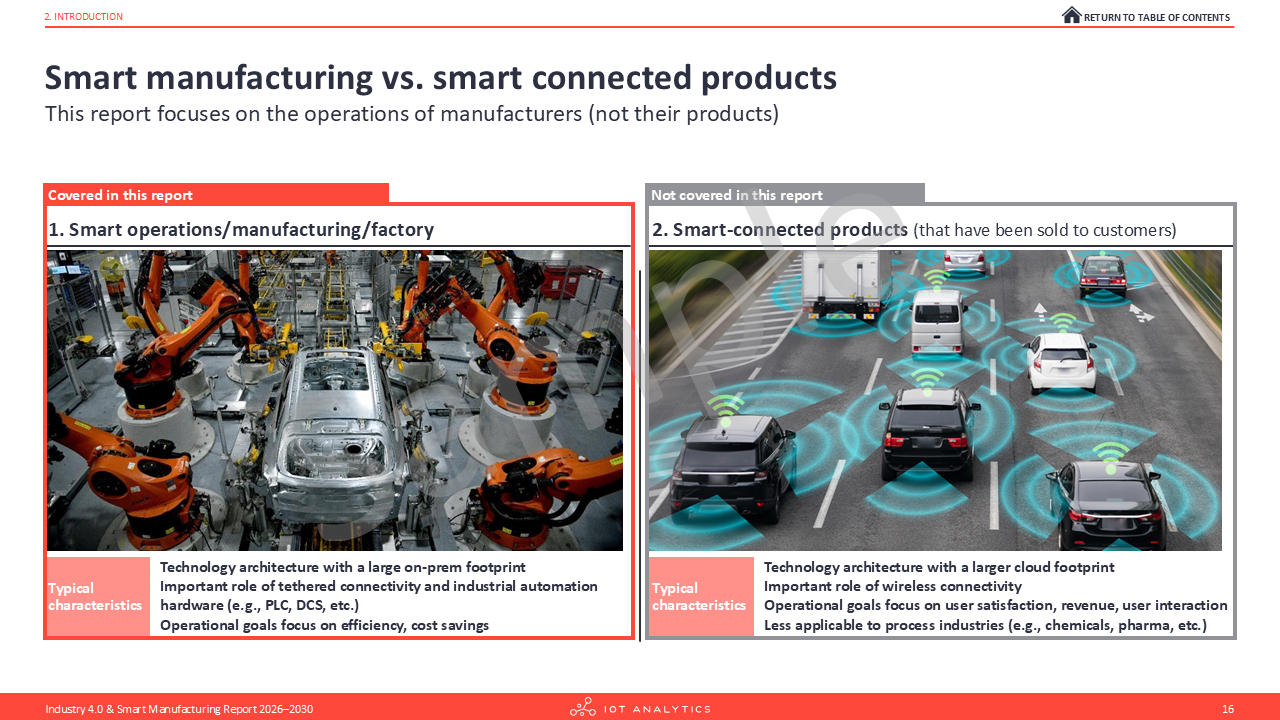

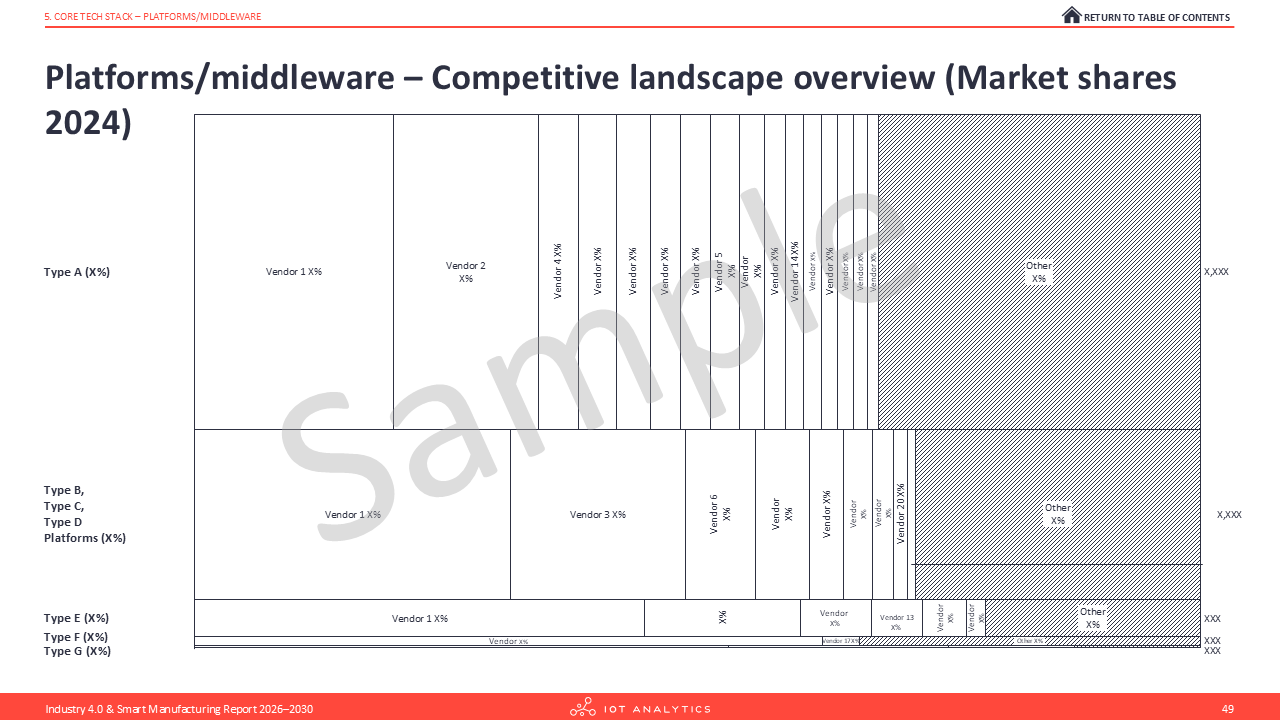
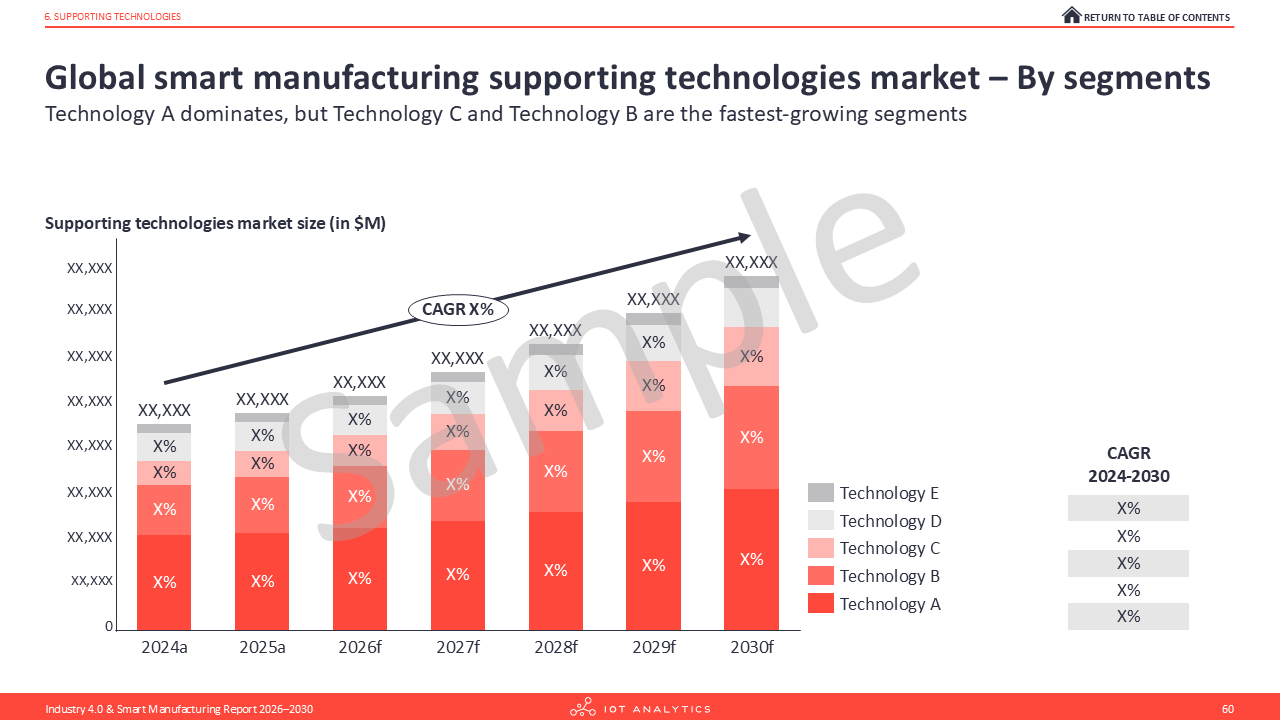
Questions answered
- How are smart manufacturing and Industry 4.0 defined?
- What are the 25 key technologies and components that make up smart manufacturing?
- How large is the smart manufacturing market, and how is it expected to grow (by region, by industry, by technology)?
- Who are the leading vendors and how are they positioned in the market?
- Who are the market leaders in each of the 25 individual technology categories across 240+ vendors?
- What is the role and size of the services market?
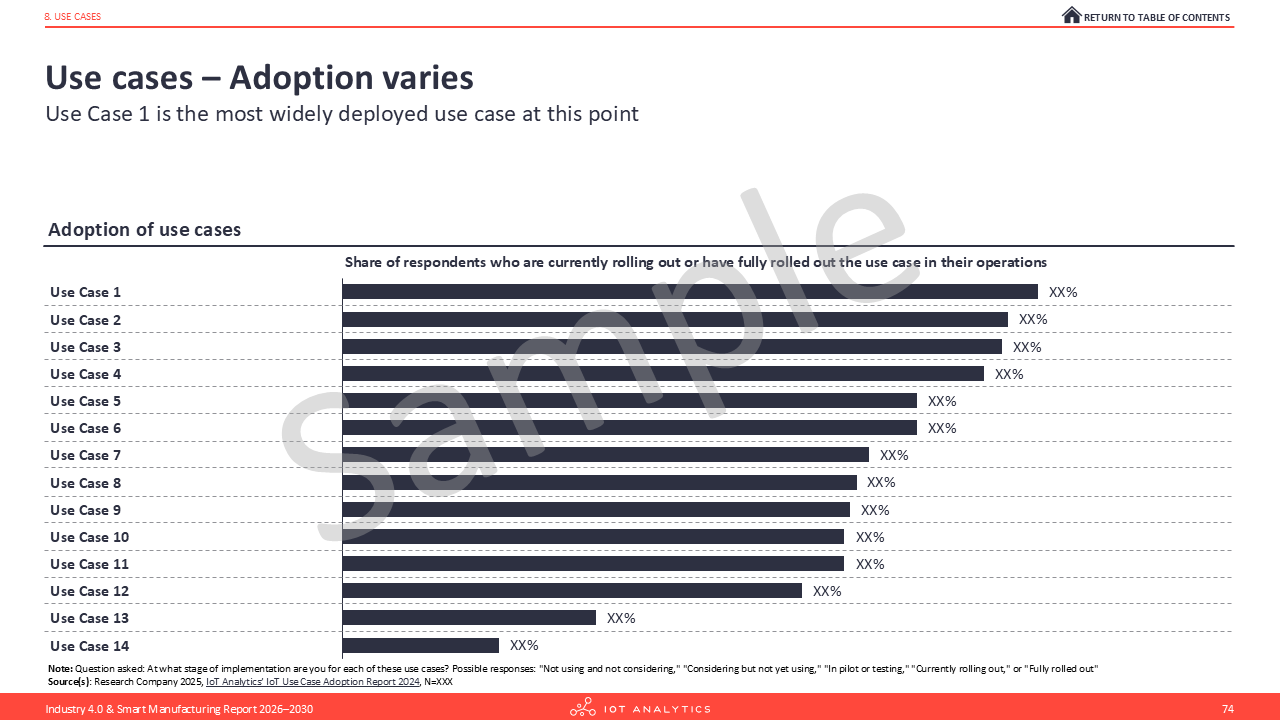
- Which use cases are driving adoption across industries?
- What are some of the standout case studies of smart manufacturing adoption?
- What are the main trends and challenges shaping smart manufacturing?
Table of Contents
Industry 4.0 & Smart Manufacturing Market Report 2026-2030
- Executive summary
- Executive summary (5 parts)
- 3 key action items from this report for…
- Introduction
- Introduction—Chapter overview and key takeaways
- Historical context
- Smart manufacturing definition and application
- Interest in smart manufacturing and Industry 4.0
- Smart manufacturing vs. smart connected products
- Definitions by key organizations
- IoT Analytics’ definition of smart manufacturing
- Commonalities in definitions
- Vertical scope of the report
- Smart manufacturing technology maturity models (2 parts)
- Industry 4.0 benchmarks and productivity gains
- Manufacturing jobs and robot density
- Current state of Industry 4.0 maturity
- Technology priorities
- Vision for the coming years
- Industry survey (2 parts)
- Typical benefits of implementation
- Example—WEF Lighthouse factory (2 parts)
- Market overview & competitive landscape
- Market size & outlook overview
- Global smart manufacturing market—Overall
- General drivers and inhibitors
- Data in perspective
- Global smart manufacturing market—By segments
- Global smart manufacturing market—By technology
- Global smart manufacturing market—Technology share shifts
- Industry 4.0 technologies—Growth vs. Maturity
- Overall—Top 20 smart manufacturing vendors
- Key company profile—ABB (2 parts)
- Key company profile—Siemens (6 parts)
- Key company profile—Emerson (2 parts)
- Key company profile—Schneider Electric (2 parts)
- Key company profile—Microsoft (2 parts)
- Overarching trends and challenges
- Overarching trends and challenges—Chapter overview
- Trend 1 (2 parts)
- Trend 2 (4 parts)
- Trend 3
- Trend 4
- Trend 5 (2 parts)
- Trend 6
- Overarching challenges—Overview
- Challenge 1
- Challenge 2
- Challenge 3
- Challenge 4
- Challenge 5
- Core tech stack
- Industry 4.0 tech stack—Chapter overview and key takeaways
- Smart manufacturing tech stack elements (2 parts)
- Global Smart manufacturing core tech stack market—By segments
- Edge—Definition and Market size
- Edge hardware—Competitive landscape
- Global smart manufacturing edge market—By region and industry
- Detailed edge market segments (3 parts)
- Edge—Field instruments (2 parts)
- Edge—Remote I/O (2 parts)
- Edge—PLC (2 parts)
- Edge—DCS (2 parts)
- Edge—HMI (2 parts)
- Edge—Gateways (2 parts)
- Edge—IPCs (2 parts)
- Edge—Trends: Overview
- Edge—Trend 1 (2 parts)
- Edge—Trend 2
- Edge—Trend 3
- Edge—Trend 4 (3 parts)
- Edge—Trend 5
- Edge—Trend 6
- Platforms/middleware—Definition and Market size
- Platforms/middleware—Competitive landscape
- Global smart manufacturing platforms/middleware market—By region and industry
- Detailed platforms/middleware market segments (3 parts)
- Platforms/middleware—Message brokers (3 parts)
- Platforms/middleware—Device management (2 parts)
- Platforms/middleware—Application management (2 parts)
- Platforms/middleware—Data management (4 parts)
- Platforms/middleware—Industrial DataOps (2 parts)
- Platforms/middleware—AI platforms (2 parts)
- Platforms/middleware—Protocol converters (2 parts)
- Platforms/middleware—Trends: Summary
- Platforms/middleware—Trend 1 (3 parts)
- Platforms/middleware—Trend 2 (2 parts)
- Platforms/middleware—Trend 3 (2 parts)
- Platforms/middleware—Trend 4
- Platforms/middleware—Trend 5
- Platforms/middleware—Trend 6
- Platforms/middleware—Trend 7 (3 parts)
- Platforms/middleware—Trend 8
- Smart manufacturing software applications—Definition and Market size
- Applications—Competitive landscape
- Global smart manufacturing applications market—By region and industry
- Detailed applications market segments (3 parts)
- Applications: Industrial automation software (2 parts)
- Applications: MOM/MES (2 parts)
- Applications: Asset performance and management (2 parts)
- Applications: Factory logistics (2 parts)
- Applications: Trends: Summary
- Applications—Trend 1 (2 parts)
- Applications—Trend 2
- Applications—Trend 3
- Applications—Trend 4
- Applications—Trend 5
- Applications—Trend 6
- Applications—Trend 7
- Applications—Trend 8 (2 parts)
- Applications—Trend 9 (2 parts)
- Security—Definition
- Security: Key software components (7 parts)
- Security—Market size & competitive landscape
- Global smart manufacturing security market—By region and industry
- Detailed security market segments (3 parts)
- Security: Trends: Summary
- Security—Trend 1
- Security—Trend 2 (2 parts)
- Security—Trend 3
- Security—Trend 4
- Security—Trend 5
- Supporting technologies
- Smart manufacturing supporting technologies—Chapter overview
- Elements of smart manufacturing—Supporting technologies
- Global smart manufacturing supporting technologies market—By segments and region
- Supporting Tech—Competitive landscape
- Detailed supporting technologies market segments (3 parts)
- Additive manufacturing—Definition, use cases, market, and trends (6 parts)
- Stationary robots—Definition, use cases, market, and trends (11 parts)
- Autonomous mobile robots—Definition, use cases, market, and trends (7 parts)
- Machine vision—Definition, use cases, market, and trends (11 parts)
- Augmented reality—Definition, use cases, market, and trends (4 parts)
- Humanoid robots—Select vendors
- Services
- Services—Chapter overview and key takeaways
- Professional services for smart manufacturing—Overview (3 parts)
- Adopter perspective—Buy or build? (2 parts)
- Professional services for smart manufacturing—Market size
- Example—How vendors provide smart manufacturing services
- Trends & challenges overview
- Trend 1 (3 parts)
- Trend 2
- Trend 3 (2 parts)
- End-user challenge 1 (4 parts)
- End-user challenge 2
- End-user challenge 3
- Use cases
- Use case analysis—Chapter overview
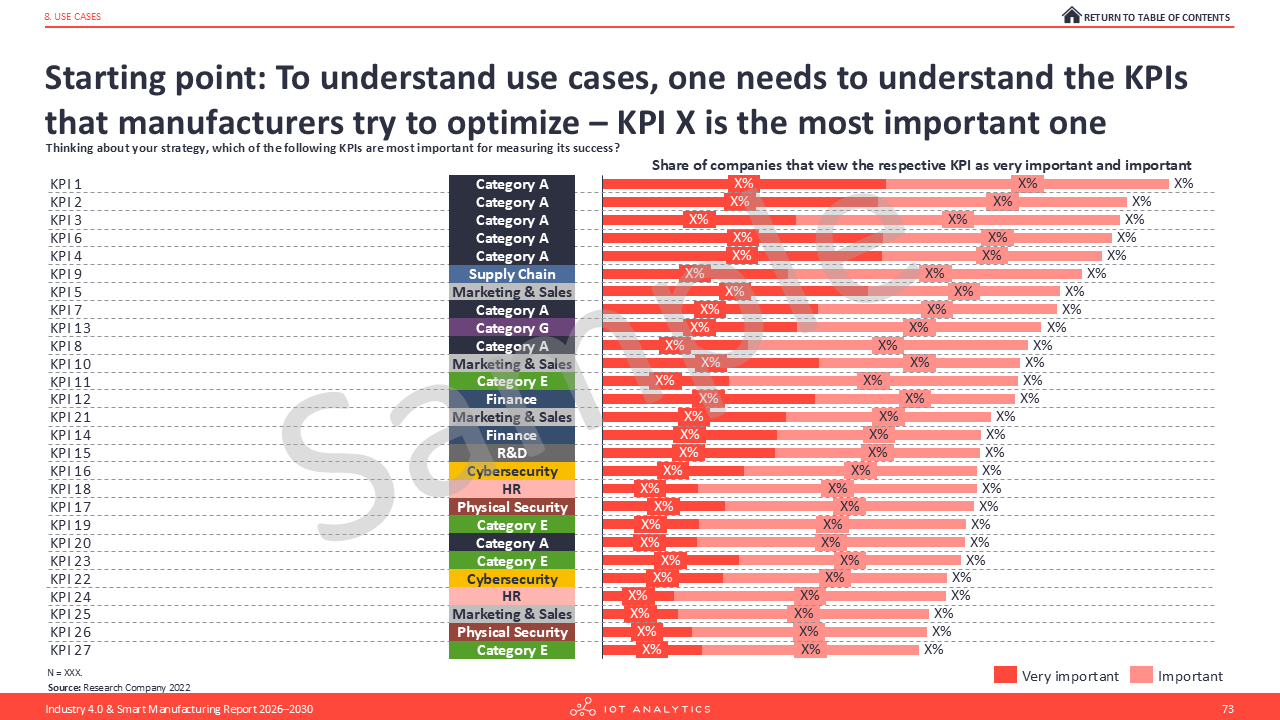
- KPI optimization and OEE
- Use case adoption and definitions (2 parts)
- Use cases 1 through 14
- Case studies
- Case studies—Overarching insights
- Case study 1: Gousto (10 parts)
- Case study 2: Michelin (10 parts)
- Case study 3: Georgia-Pacific (9 parts)
- Case study 4: Ford (16 parts)
- Case study 5: Roche (12 parts)
- Adoption landscape
- Adoption landscape—Chapter overview
- End user adoption—Survey overviews (2 parts)
- State of smart factories—Scalability and security
- Smart factory paradigms and technologies
- Severity of challenges
- Cybersecurity breaches examples
- Leading smart factory adopters
- Analysis of leading adopters (3 parts)
- Tesla Giga Berlin example
- Challenges and adoption barriers
- Impact of AI on applications
- AI adoption, elements, and cost savings
- Methodology & market definitions
- Research Methodology
- About IoT Analytics
- About IoT Analytics and other publications
- Information and contact
Companies mentioned
A selection of companies mentioned in the report.
ABB
Accenture
Advantech
Beckhoff Automation
Capgemini
Deloitte
Emerson
Endress+Hauser
Fanuc
Honeywell
IBM
Keyence
KUKA
Microsoft
Mitsubishi Electric
Omron
Rockwell Automation
SAP
Schneider Electric
Siemens
Yaskawa
Yokogawa
About the report
The global manufacturing sector is undergoing a transformation driven by Industry 4.0 technologies, with increasing adoption of automation, connectivity, and artificial intelligence across production environments. This transformation is expanding investments in smart manufacturing technologies and reshaping how industrial operations are designed, executed, and optimized.
This report provides a structured analysis of the global Industry 4.0 and smart manufacturing ecosystem, focusing on the full technology stack and its supporting technologies. Its primary objective is to help readers understand this landscape by defining, sizing, and analyzing key components, including edge hardware, platforms/middleware, applications, security, supporting technologies, and services.
The findings are based on extensive primary research, including interviews with 25+ experts from technology vendors and industrial end users, complemented by survey data and secondary research conducted across the smart manufacturing ecosystem.
Report at a glance
- 406-page report: A comprehensive analysis of the global smart manufacturing market, covering technologies, trends, vendor landscape, and adoption dynamics.
- 25 technology categories: Detailed analysis of core and supporting technologies across the Industry 4.0 stack, including edge, platforms, applications, and security.
- 50+ trends and challenges: Examination of overarching trends such as IT/OT convergence, industrial AI, and software-defined manufacturing, alongside key adoption barriers.
- Vendor landscape (240+ companies): Competitive analysis across major segments, including profiles of leading industrial and technology vendors.
- Market sizing and forecast: Global smart manufacturing market analysis by segment, technology, region, and industry, with forecasts to 2030.
Key areas of analysis
- Introduction to Industry 4.0 and smart manufacturing: Defines the scope of Industry 4.0, outlines key concepts, and positions smart manufacturing within the broader industrial transformation landscape.
- Big picture—The smart manufacturing market: Provides a global market overview, including market size, segmentation, growth drivers, and inhibitors shaping adoption.
- Industry 4.0 technology stack: Analyzes the core technology layers—edge hardware, platforms/middleware, applications, and security—including market size, competitive landscape, and trends.
- Supporting technologies deep dives: Covers key enabling technologies such as robotics, machine vision, additive manufacturing, augmented reality, and autonomous mobile robots, including market dynamics and use cases.
- Services and implementation landscape: Examines the role of professional services, system integration, and managed services in enabling smart manufacturing deployments.
- Use cases and case studies: Provides analysis of key smart manufacturing use cases and includes detailed real-world case studies demonstrating implementation and business impact.
A data-driven foundation for key business functions
- Strategy and corporate development: Inform strategic planning with market sizing, long-term forecasts, and analysis of macro trends such as AI adoption, IT/OT convergence, and reshoring.
- Product management and marketing: Guide product roadmaps using insights into technology evolution, competitive dynamics, and emerging Industry 4.0 use cases.
- R&D and engineering leadership: Prioritize technical investments based on detailed analysis of core technologies, software architectures, and integration trends across the stack.
- Market intelligence and competitive analysis: Benchmark positioning within the smart manufacturing ecosystem using vendor landscape analysis and technology-level insights.
Key concepts defined
- Industry 4.0: The current phase of industrial transformation is characterized by the integration of digital technologies—including IoT, AI, cloud computing, and automation—into industrial processes.
- Smart manufacturing: The application of Industry 4.0 technologies within production environments to improve operational efficiency, flexibility, and decision-making across the manufacturing value chain.
- Smart manufacturing technology stack: A structured framework consisting of edge hardware, platforms/middleware, applications, and security, supported by enabling technologies such as robotics and machine vision.
- Industrial AI: The use of artificial intelligence and machine learning within industrial environments to optimize processes, enable predictive capabilities, and automate decision-making.
- IT/OT convergence: The integration of information technology systems with operational technology on the shop floor, enabling seamless data flow and unified system architectures.
Related reading
A research article based on this report: The top 10 smart manufacturing technology vendors
→Sign up for the newsletter to be notified of future releases
Our insights are trusted by global industry leaders


Single User License
- 1 named user within a particular department and country
- Complete market report in PDF
- Market data in PDF (graphs within the report)
- Market model data in EXCEL
- Complete market report in PPTX
- 1 hour discussion with the analyst team
Team User License
- 1–5 named users within a particular department and country
- Complete market report in PDF
- Market data in PDF (graphs within the report)
- Market model data in EXCEL
- Complete market report in PPTX
- 1 hour discussion with the analyst team
Enterprise License
- Report may be distributed to all employees of the enterprise
- Complete market report in PDF
- Market data in PDF (graphs within the report)
- Market model data in EXCEL
- Complete market report in PPTX
- 1 hour discussion with the analyst team
Get your free sample
Download the sample to learn more about:
- Report structure
- Select definitions
- Scope of research
- Market data
- Companies included
- Additional data points
Any questions?
Get in touch with us easily. We are happy to help!

Prajwal Praveen
Senior Sales Manager
Phone: +49 (0) 408 221 1722
Email: sales@iot-analytics.com