
Smart Maintenance & Asset Performance Market Report 2026–2032
A 376-page report sizing the smart maintenance market to 2032, incl. top 20 vendor shares, 25 company profiles, 25 trends, and 5 case studies.
Key Data Snapshot:
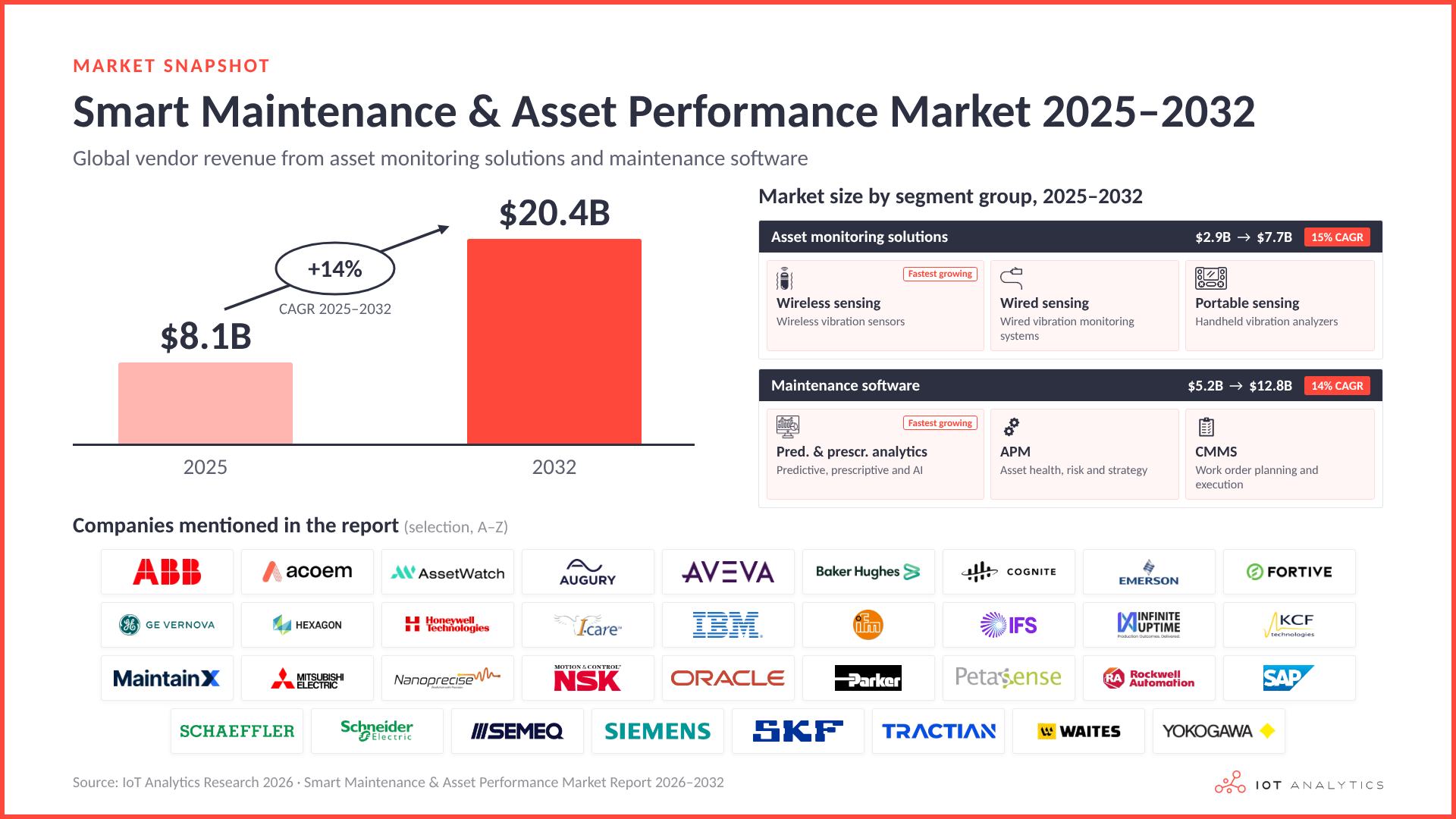
- 2025 Market Size: $8.1 billion
- 2032 Forecast: $20.4 billion
- Key Players: ABB, Augury, Baker Hughes, Emerson, I-care, IBM, Rockwell Automation, SAP, Schneider Electric, Siemens, SKF, Tractian
Smart Maintenance & Asset Performance Market Size, Trends, and Leaders 2026-2032
Smart Maintenance & Asset Performance Market Overview
IoT Analytics research indicates that the global smart maintenance market reached $8.1 billion in 2025. The market is expected to grow at a compound annual growth rate (CAGR) of 14% to $20.4 billion by 2032. Unplanned downtime costs industry an estimated $0.5 trillion to $1 trillion per year, while about half of maintenance and reliability professionals reach retirement age within roughly 5 years. Both factors push maintenance practice from reactive and preventive work toward predictive and prescriptive approaches.
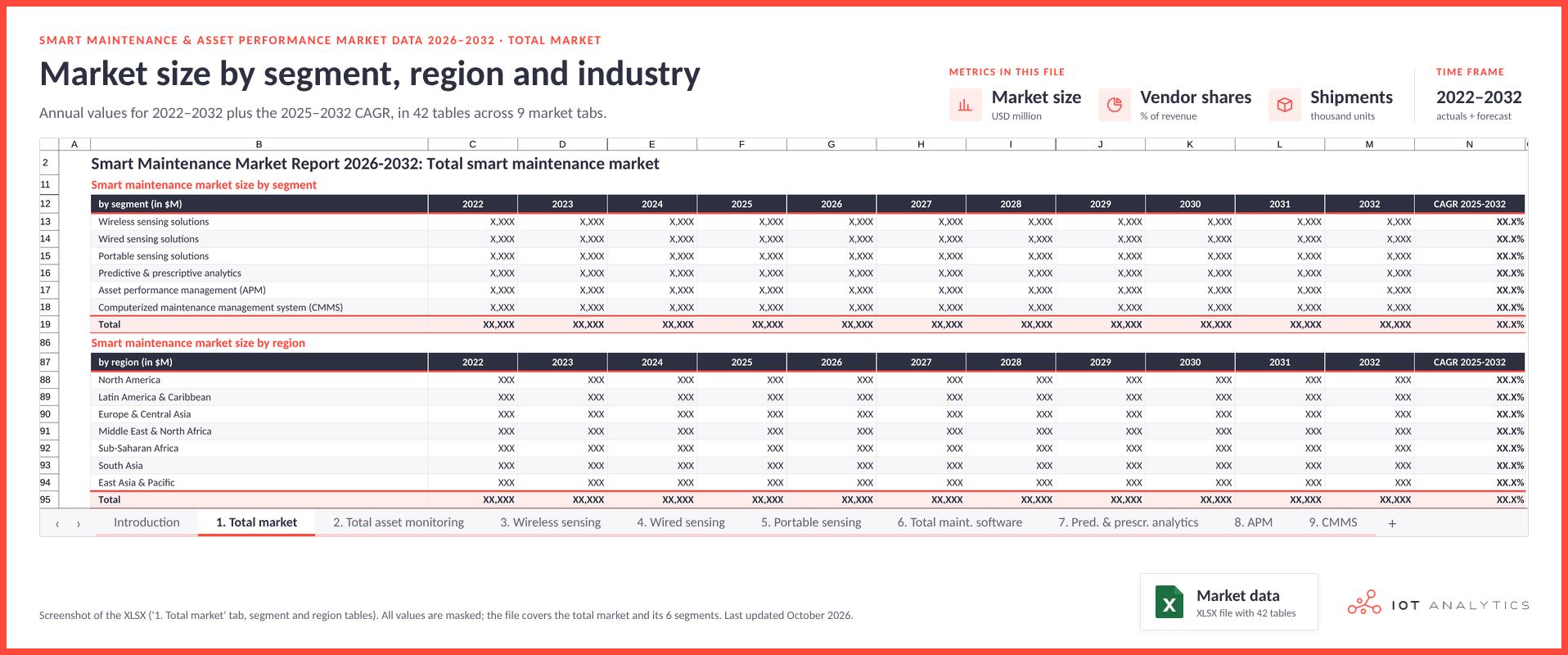
Compared with the 2023 edition, the report scope has expanded from predictive maintenance to the full maintenance workflow: from capturing asset-health data to diagnosing problems and planning and executing the maintenance response. The report sizes 6 market segments:
- Wireless sensing solutions: Comprises wireless vibration-sensing hardware, connectivity infrastructure, and associated software and services sold as one asset monitoring solution.
- Wired sensing solutions: Comprises wired vibration-sensing hardware, wired infrastructure, and associated software and services sold as one asset monitoring solution.
- Portable sensing solutions: Comprises handheld or route-based vibration data collectors and analyzers, plus associated software and services sold as one asset monitoring solution.
- Standalone predictive & prescriptive analytics: Comprises predictive, prescriptive, and AI-enabled analytics software for maintenance decisions, sold separately from sensors.
- Asset performance management (APM): Comprises software for asset health, risk indexing, and maintenance strategy.
- Computerized maintenance management systems (CMMS): Comprises software for planning, scheduling, executing, and tracking maintenance work.
Key Trends & Market Leaders
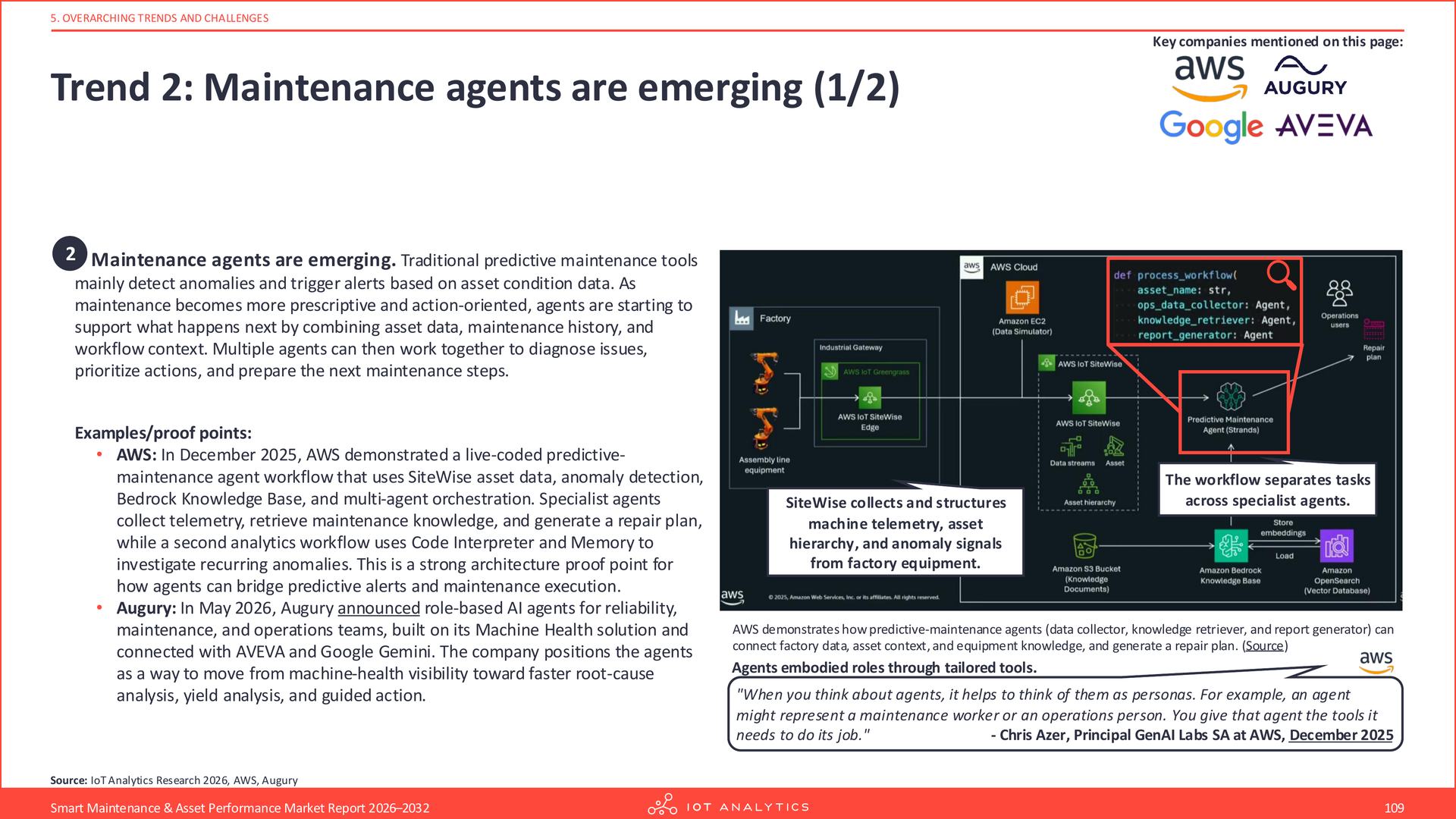
The maintenance stack is becoming prescriptive and action-oriented. Software is moving from alerts to repair instructions: IBM, SAP, and Siemens have launched AI agents and copilots that turn alerts into pre-filled work orders, although no vendor runs maintenance without human review yet. At the same time, wireless asset monitoring is gaining ground in new deployments, as wireless sensors extend continuous monitoring from critical machines to the wider asset base.
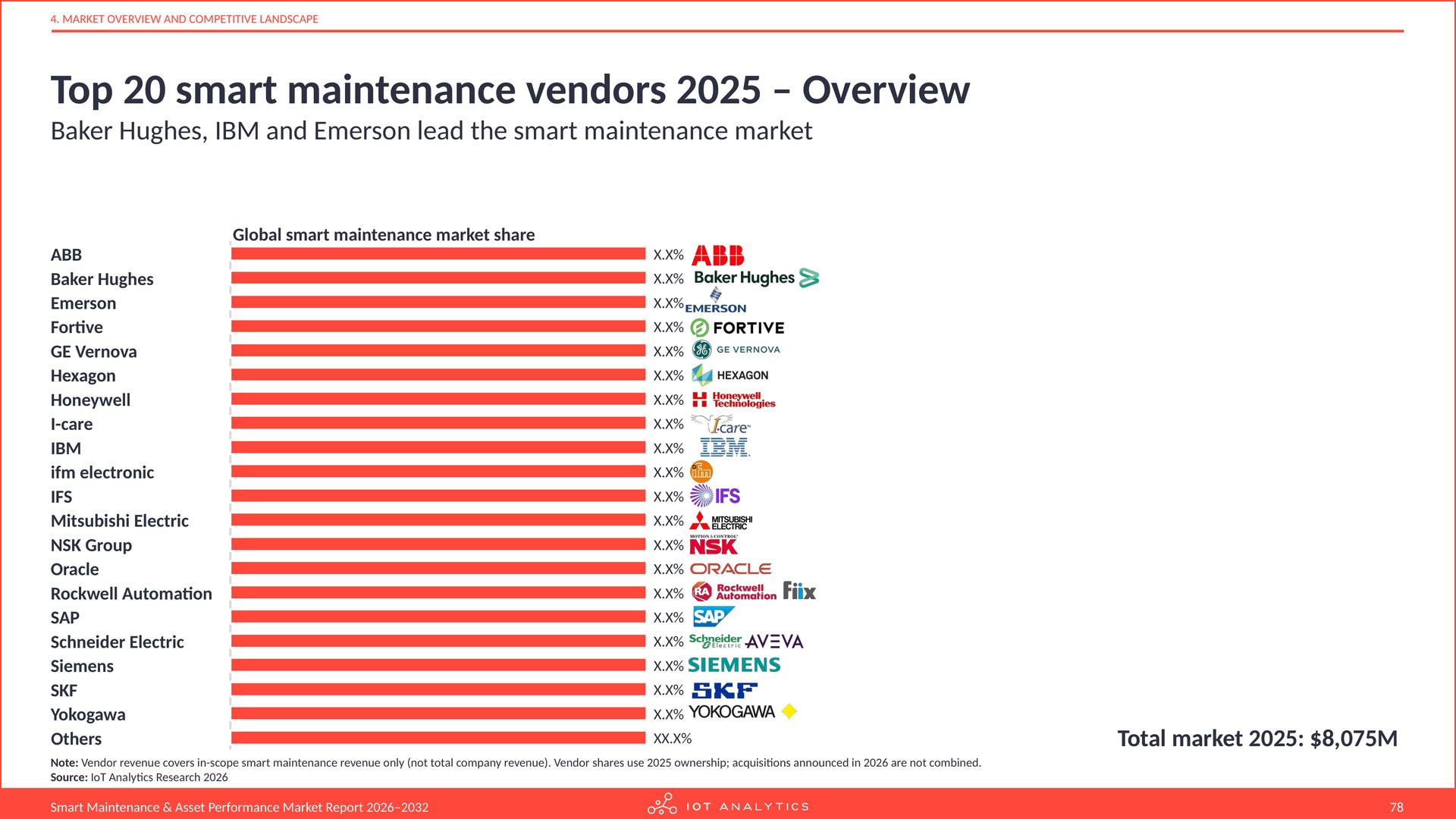
The market is fragmented, and its leaders follow different strategies. Baker Hughes, IBM, and Emerson lead the market in 2025. Some leaders build on their own sensors (Baker Hughes, Emerson), while others sell software only (IBM, SAP). Strategic buyers are consolidating the market: buyers acquired a record 13 smart maintenance vendors in 2026 to date, including Autodesk’s $3.6 billion acquisition of MaintainX and Schneider Electric’s $3.1 billion agreement to acquire Cognite.
What is in this report?
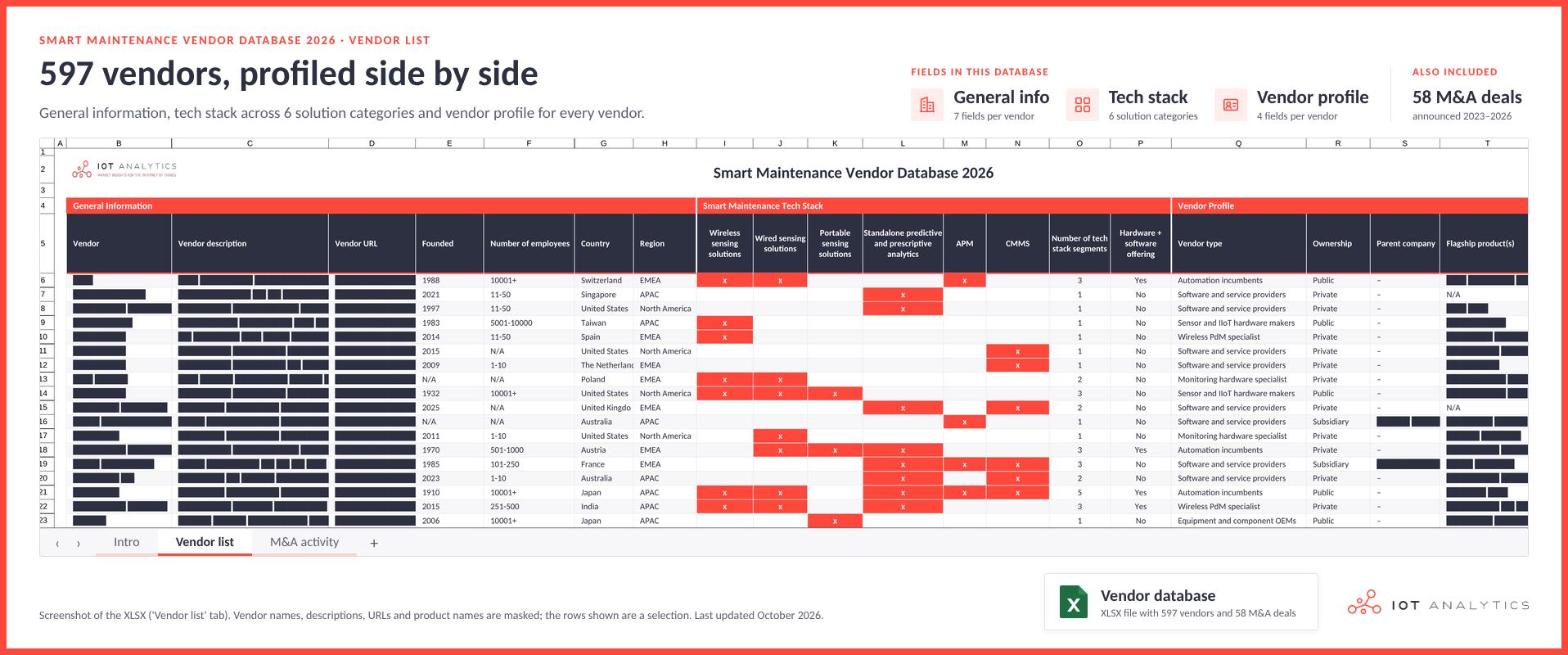
This 376-page analysis, published in November 2026, details market sizing and forecasts to 2032 for 6 segments, split by industry and region; shipments and average sensor prices for asset monitoring solutions; market shares and share shifts of the top 20 vendors overall and per segment; 25 company profiles; 25 trends and 4 vendor challenges; funding and M&A activity since 2019; data from 2 end-user surveys; ROI and buy-vs-build considerations; and 5 adopter case studies, including ExxonMobil. Team and Enterprise licenses add the Smart Maintenance Vendor Database 2026 in Excel, which classifies 597 vendors by company profile, solution category, ownership, and M&A activity and goes well beyond the vendor selection shown in the report.
Key Questions Addressed
- What is smart maintenance, and how has the market scope changed since the 2023 report?
- What does downtime cost, and which KPIs must smart maintenance improve?
- Which sensing, analytics, and prediction technologies are used?
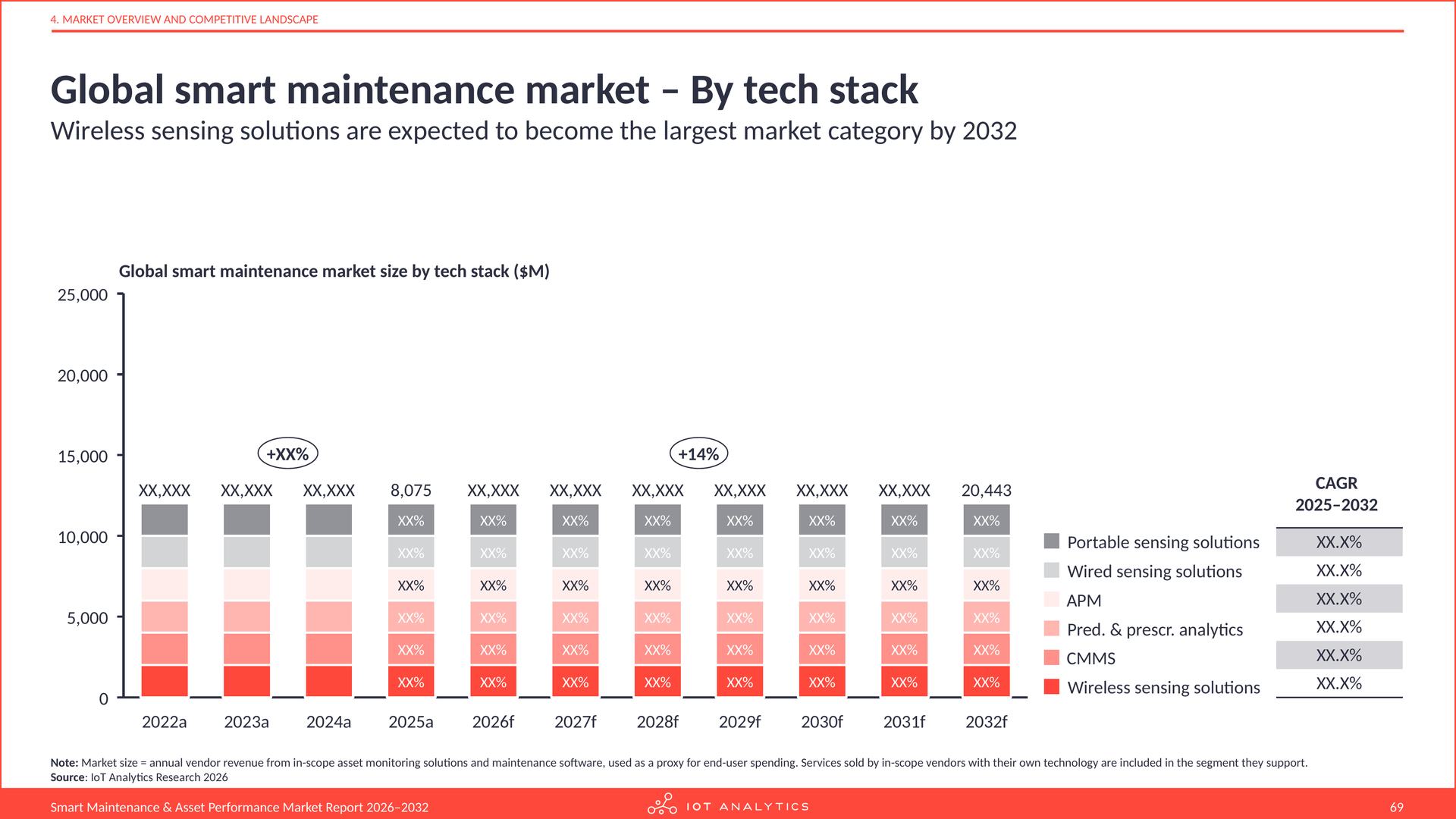
- What is the current market size, and how is the market expected to grow to 2032 by tech stack, region, and industry?
- How large are the 6 sub-markets, from wireless sensing to APM and CMMS?
- Why is wireless sensing gaining share from wired and portable solutions?
- Who are the top 20 vendors, and how did market shares shift in 2025?
- How do leading vendors such as I-care and Augury build their offerings?
- How much funding and M&A activity is the market attracting?
- Which 25 trends and 4 vendor challenges shape the market?
- Which adopter challenges exist, and what savings and ROI can adopters expect?
- What key learnings do the 5 case studies (e.g., ExxonMobil) reveal?
Table of Contents
Smart Maintenance & Asset Performance Market Report 2026-2032 (PDF)
- Executive summary
- Executive summary (8 parts)
- 3 key action items from this report
- Introduction
- Chapter overview: Introduction
- Starting point: Industrial downtime costs up to $1 trillion annually
- The business-disruption share of downtime costs
- The biggest problem: The expertise that prevents downtime is retiring
- Our opinion: Smart maintenance technologies can bend repair times back below today’s benchmark
- Shifting maintenance practice from reactive and preventive to predictive and prescriptive
- Condition-based, predictive, and prescriptive approaches require sensing technologies
- The main KPIs: Asset availability and OEE
- Deep-dive maintenance costs: Several aspects influence the cost optimum
- Industrial AI is becoming a top priority, and maintenance is a frontrunner
- Downtime and maintenance are seen as the biggest AI cost-saving items
- The ROI of predictive maintenance
- Who makes the decisions for smart maintenance technologies?
- The smart maintenance solutions market: Overview
- Smart maintenance market taxonomy and scope rules (2 parts)
- Fundamentals of smart maintenance technology
- Chapter overview: Fundamentals of smart maintenance technology
- Maintenance fundamentals: The smart maintenance process and maintenance approaches (2 parts)
- Deep dive 1: Sensing (3 parts)
- Deep dive 2: Analytics & AI (11 parts)
- Deep dive 3: Maintenance software (3 parts)
- Deep dive 4: Workflow integration (3 parts)
- Market overview and competitive landscape
- Chapter overview: Market overview and competitive landscape
- Global smart maintenance market: Overall
- General drivers and inhibitors for the smart maintenance market 2026
- Global smart maintenance market: By tech stack
- Global smart maintenance market: Technology share shifts 2025 vs. 2032
- Global smart maintenance market: By industry (4 parts)
- Global smart maintenance market: By region
- Competitive landscape (2 parts)
- Top 20 smart maintenance vendors 2025 (3 parts)
- Overview of the smart maintenance market in 2025
- AI autonomy within smart maintenance solutions: How vendors position their products
- Funding activity in smart maintenance (2019–2026 YTD)
- Most-funded smart maintenance companies
- Smart maintenance M&A activity and strategic rationale
- Key company profiles: Baker Hughes, IBM, Emerson, SAP, Siemens (18 parts)
- Overarching trends and challenges
- Overarching smart maintenance trends and challenges
- Trends 1–11 (16 parts)
- Vendor challenges 1–4
- Asset monitoring solutions
- Asset monitoring overview: Revenue, shipped units, average price per sensor, asset types, top 20 vendors, share shifts, vertical-specific champions (13 parts)
- Wireless vs. wired vs. portable dynamics (4 parts)
- Wireless sensing solutions: Revenue, industry, region, shipped units, vendor landscape, top vendors, share shifts, competitive landscape (12 parts)
- Wireless sensing key company profiles: I-care, Augury, Waites, KCF Technologies, Tractian, AssetWatch, Nanoprecise, SEMEQ, Petasense, Acoem (38 parts)
- Wireless sensing trends (5 parts)
- Wired sensing solutions: Revenue, industry, region, shipped units, vendor landscape, top vendors, share shifts, competitive landscape (12 parts)
- Wired sensing key company profiles: SKF, ifm electronic, Parker Hannifin (8 parts)
- Portable sensing solutions: Revenue, industry, region, shipped units, vendor landscape, top vendors, share shifts, competitive landscape (12 parts)
- Portable sensing key company profiles: Fortive, NSK Group, Schaeffler (8 parts)
- Portable sensing trend
- Maintenance software solutions
- Maintenance software overview: Overall, segment, industry, region, hosting type, top vendors, share shifts (11 parts)
- Maintenance software trends (5 parts)
- Standalone predictive & prescriptive analytics: Market, vendor landscape, top vendors, share shifts, competitive landscape (5 parts)
- Standalone analytics key company profile: Schneider Electric (3 parts)
- Standalone analytics trends (3 parts)
- APM: Market, vendor landscape, top vendors, share shifts, competitive landscape (5 parts)
- APM key company profile: ABB (2 parts)
- APM trend
- CMMS: Market, vendor landscape, top vendors, share shifts, competitive landscape (5 parts)
- CMMS key company profiles: Rockwell Automation, IFS (6 parts)
- CMMS trend
- End-user adoption and implementation considerations
- Chapter overview: End-user adoption and implementation considerations
- Smart maintenance adoption in process plants and machine building (4 parts)
- The 5 most pressing smart maintenance adopter challenges (7 parts)
- Typical cost savings from smart maintenance (2 parts)
- Other benefits of smart maintenance
- Predictive maintenance as a digital cost-savings activity
- Cloud migration plans for maintenance management
- Sample ROI calculation of a smart maintenance solution (2 parts)
- Buying vs. building a smart maintenance solution (5 parts)
- Case studies
- Adoption examples: Chapter overview
- 5 overarching insights from the 5 smart maintenance case studies
- Case study 1: ExxonMobil (6 parts)
- Case study 2: Çolakoğlu Metalurji (8 parts)
- Case study 3: Cosmo Oil (10 parts)
- Case study 4: US Aggregates (7 parts)
- Case study 5: Gousto (5 parts)
- Methodology & market definitions
- Research methodology
- Survey methodology: Respondent profiles of the 2 end-user surveys
- Industry mappings to ISIC codes (2 parts)
- Appendix
- PdM vs. other maintenance approaches (3 parts)
- Typical types of assets and application areas in maintenance
- About IoT Analytics
Frequently Asked Questions
What is the smart maintenance market size?
Who are the leading companies in the smart maintenance market?
What is the top trend in the smart maintenance market?
Companies mentioned
A selection of companies mentioned in the report.
ABB
Acoem
AssetWatch
Augury
AVEVA
Baker Hughes
Cognite
Emerson
Fortive
GE Vernova
Hexagon
Honeywell
I-care
IBM
IFS
ifm electronic
KCF Technologies
MaintainX
Mitsubishi Electric
Nanoprecise
NSK Group
Oracle
Parker Hannifin
Petasense
Rockwell Automation
SAP
Schaeffler
Schneider Electric
SEMEQ
Siemens
SKF
Tractian
Waites
Yokogawa
Related reading
A research article on this topic will be published soon.
Our insights are trusted by global industry leaders


Single License
- 1 named user within a particular department and country
- Complete market report in PDF
- Market data in PDF (graphs within the report)
- Market model data in EXCEL
- Smart Maintenance Vendor Database 2026 (597 vendors) in EXCEL
- Complete market report in PPTX
- 1 hour discussion with the analyst team
Team License
- 1–5 named users within a particular department and country
- Complete market report in PDF
- Market data in PDF (graphs within the report)
- Market model data in EXCEL
- Smart Maintenance Vendor Database 2026 (597 vendors) in EXCEL
- Complete market report in PPTX
- 1 hour discussion with the analyst team
Enterprise License
- Unlimited users within a particular business division globally
- Complete market report in PDF
- Market data in PDF (graphs within the report)
- Market model data in EXCEL
- Smart Maintenance Vendor Database 2026 (597 vendors) in EXCEL
- Complete market report in PPTX
- 1 hour discussion with the analyst team
Get your free sample
Download the sample to learn more about:
- Report structure
- Select definitions
- Scope of research
- Market data
- Companies included
- Additional data points
Any questions?
Get in touch with us easily. We are happy to help!

Prajwal Praveen
Senior Sales Manager
Phone: +49 (0) 408 221 1722
Email: sales@iot-analytics.com