
State of IoT Devices and Connectivity 2026–2030
A 153-page report sizing connected IoT devices to 2035, incl. connectivity technologies, device and connectivity trends, and company strategies.
Key Data Snapshot:
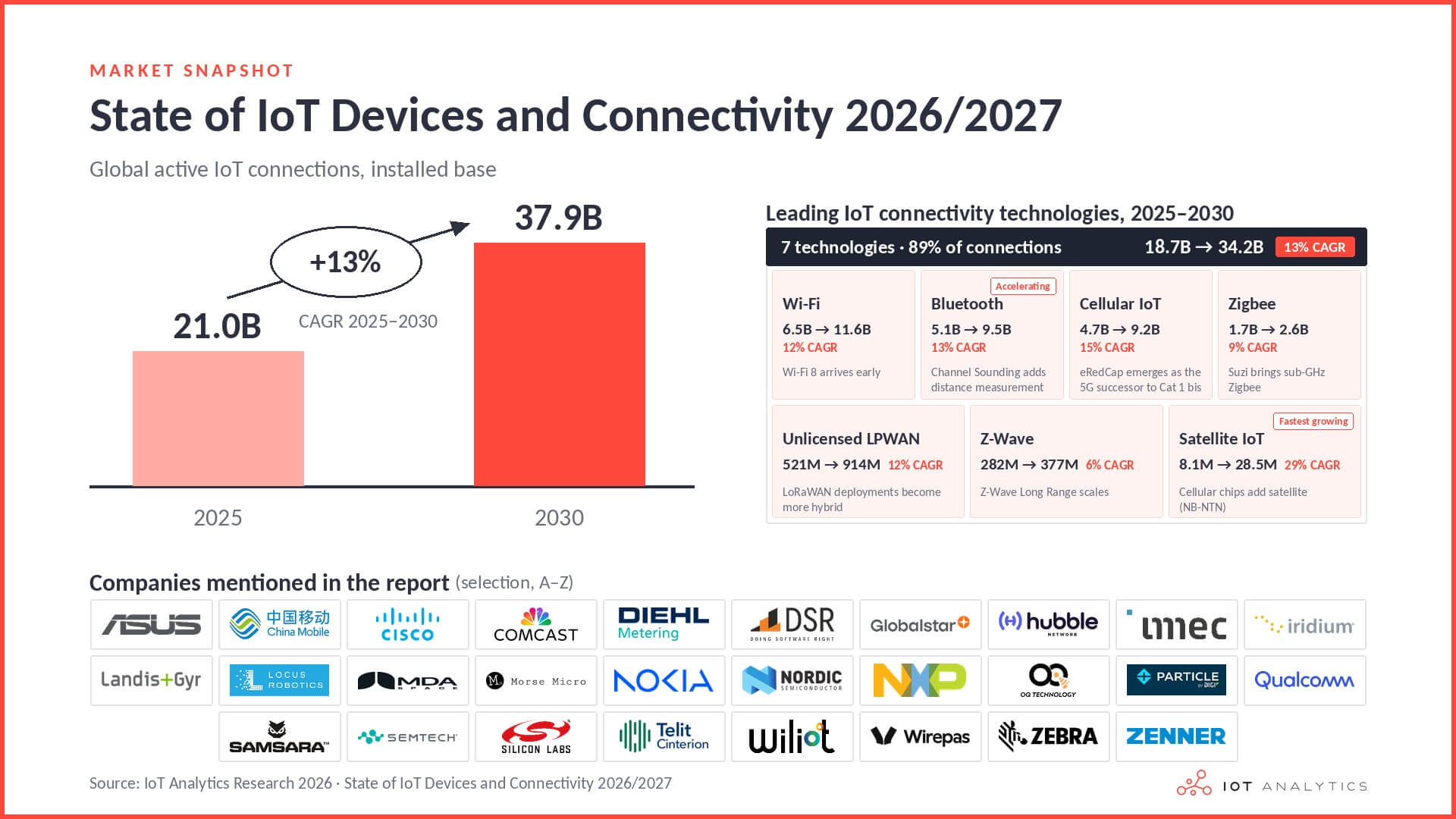
- 2025 IoT Connections: 21.0 billion
- 2030 Forecast: 37.9 billion
- Leading Connectivity Technologies: Wi-Fi, Bluetooth, Cellular IoT, Zigbee, Unlicensed LPWAN, Z-Wave, Satellite IoT
Connected IoT Devices: Market Size, Connectivity Trends, and Outlook to 2035
Connected IoT Device Market Overview
IoT Analytics research shows that the global connected IoT device market continues to grow, driven by the adoption of IoT across industries, advances in wireless connectivity, and the emergence of new IoT applications. The market is expected to maintain strong growth over the coming years.
Wireless connectivity technologies account for the vast majority of active IoT connections, with distinct adoption patterns and growth trajectories:
- Wi-Fi: Remains the largest IoT connectivity technology, supported by widespread adoption across consumer, commercial, and industrial applications.
- Bluetooth: Continues to benefit from its extensive device ecosystem and adoption across consumer and enterprise applications.
- Cellular IoT: Records strong growth, supported by the adoption of Cat 1 bis and 5G IoT.
- Zigbee: Maintains an established position in smart home and building automation applications.
- Unlicensed LPWAN: Continues to gain traction in applications requiring long-range, low-power connectivity.
- Z-Wave: Maintains its presence in the smart home connectivity market.
- Satellite IoT: Records strong growth, enabling IoT deployments in areas with limited terrestrial network coverage.
Key Trends & Market Leaders
Cellular 5G IoT is gaining traction, with eRedCap emerging as the next-generation alternative to Cat 1 bis. The cellular IoT connectivity market remains concentrated among leading network operators.
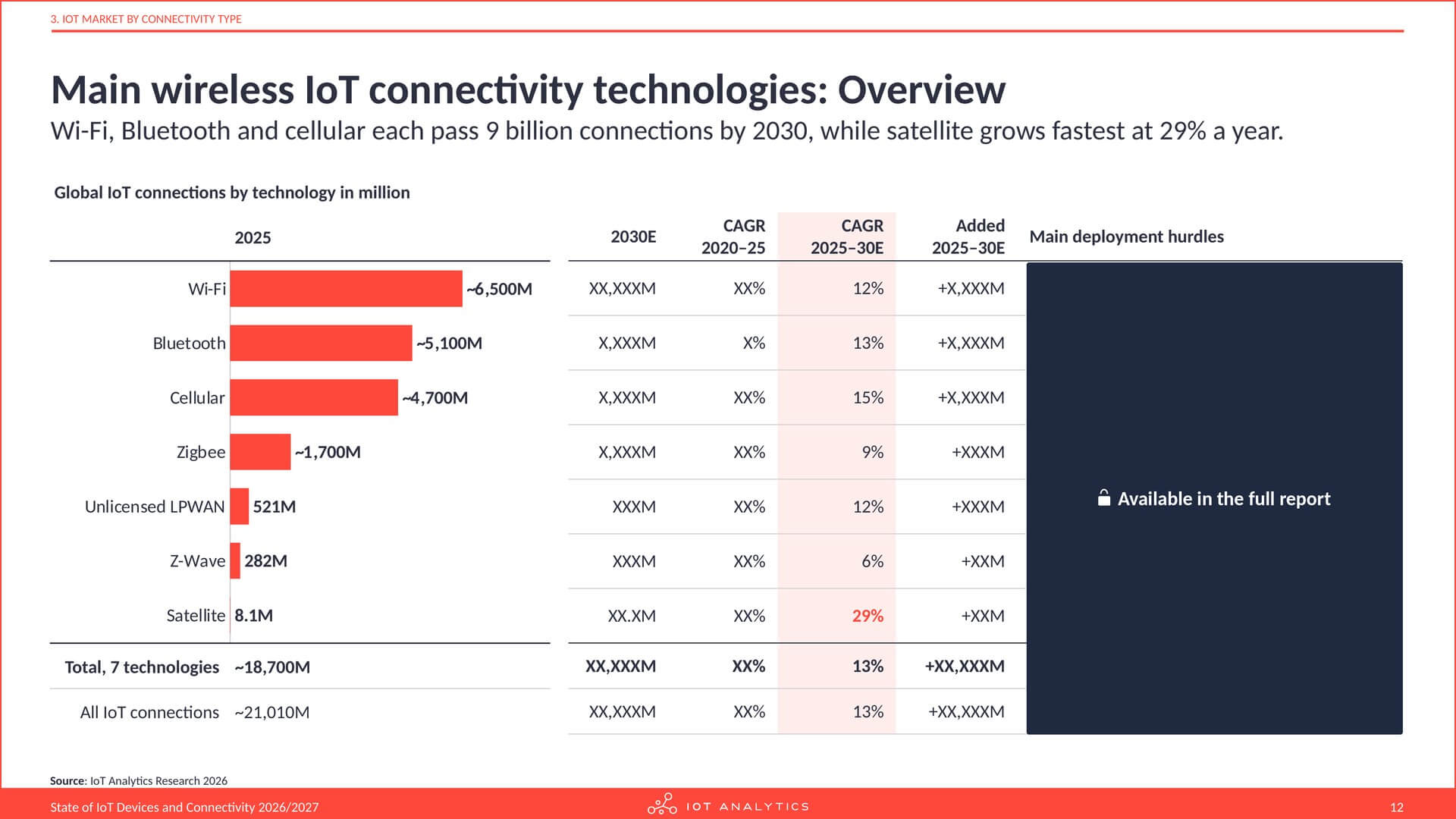
The adoption of dedicated AI accelerators in connected IoT devices is gaining momentum, enabling local data processing and inference. Connectivity technologies are also converging, with key developments including the integration of satellite connectivity into cellular chipsets, the early commercialization of Wi-Fi 8 products, the introduction of Bluetooth Channel Sounding for distance measurement, and the adoption of hybrid LoRaWAN deployment models.
For detailed market figures, growth forecasts, and further insights into the latest IoT connectivity trends, read our accompanying blog article.
What is in this report?
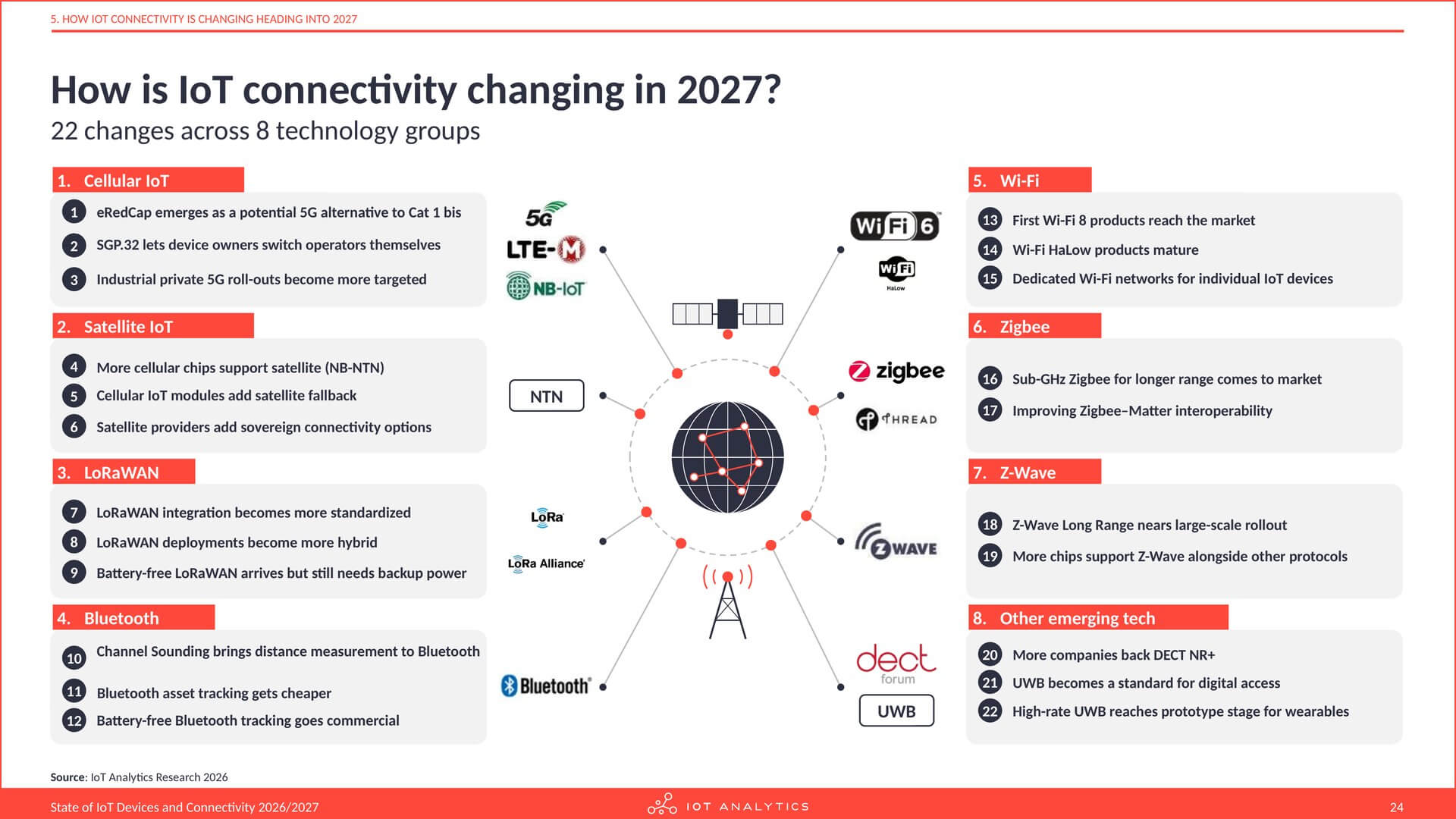
The 153-page State of IoT Devices and Connectivity 2026–2030 report, published in November 2026, sizes connected IoT devices to 2035 and details 7 wireless connectivity technologies, IoT connections by industry, 9 device trends, 22 connectivity changes across 8 technology groups, a deep dive on smart water metering requirements, analyst opinions, 12 strategic moves by operators, connectivity providers, chipmakers, and module makers, and IoT funding and M&A activity. The analysis draws on statements by executives and experts from 200+ companies, earnings calls and filings, and IoT Analytics’ market models and trackers.
The report is written for IoT device makers, chip and module vendors, network operators and connectivity providers, as well as the consultants and investors who advise them.
Key Questions Addressed
- How many IoT devices are connected in 2026, and how many are expected by 2035?
- What are the key signals in the IoT market right now, from IIoT hardware demand to memory costs?
- How are the main IoT connectivity technologies developing, from Wi-Fi and Bluetooth to cellular and satellite IoT?
- How are IoT devices changing heading into 2027 (e.g., on-device AI and compliance), and what challenges do device makers face?
- How is IoT connectivity changing heading into 2027, from eRedCap and satellite IoT to emerging technologies such as DECT NR+ and UWB?
- How are customer requirements changing, for example in EU smart water meter tenders?
- What do IoT Analytics analysts expect for edge AI, smart metering, and robotics?
- Which strategic moves are operators, IoT connectivity providers, chipmakers, and module makers making?
- How are IoT funding and M&A activity developing?
Table of Contents
State of IoT Devices and Connectivity 2026–2030 (PDF)
- Executive summary
- Executive summary (4 parts)
- Report scope: From connected devices to cloud software
- Overall IoT connectivity market
- Key signals in the IoT market right now
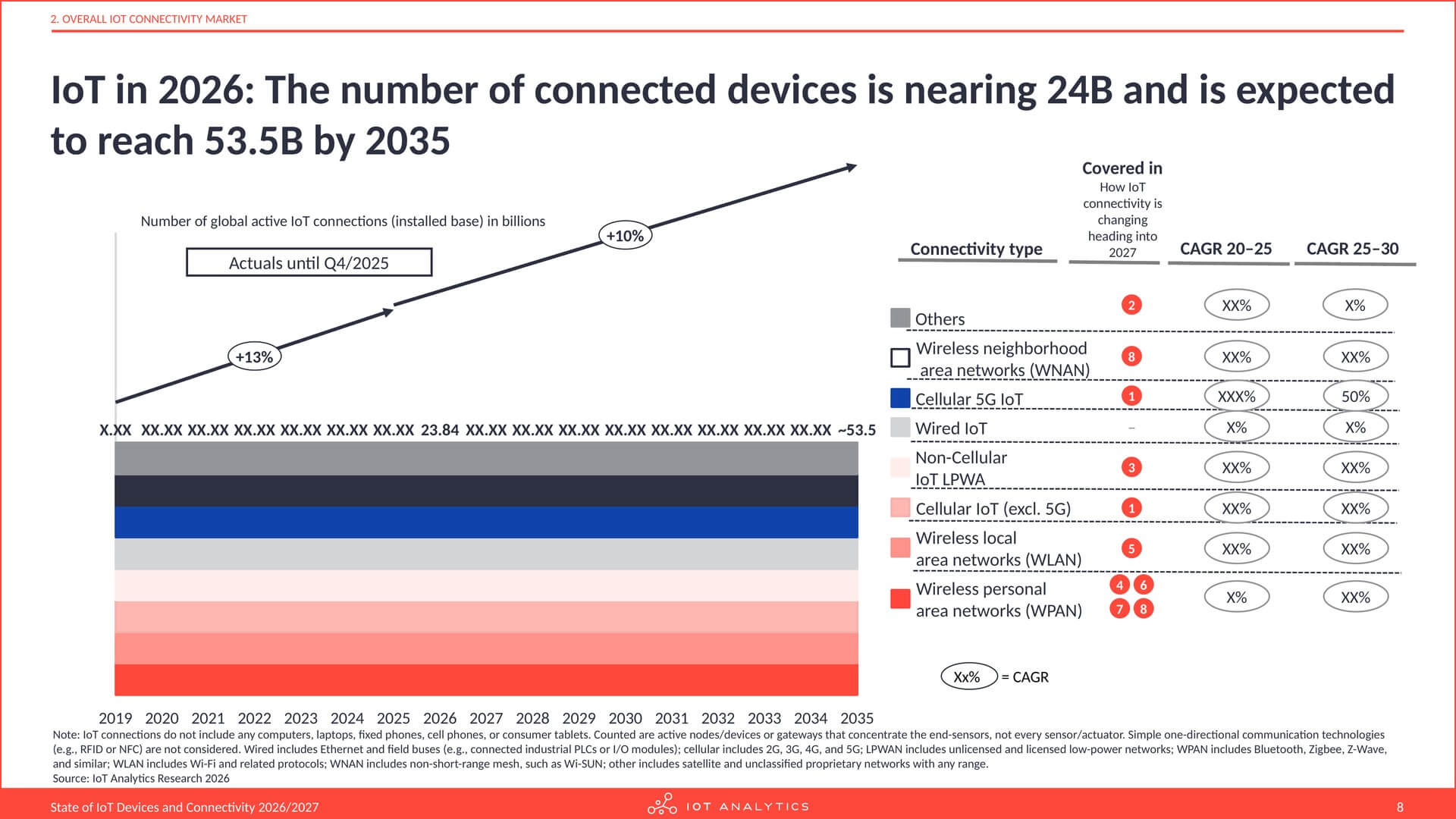
- IoT in 2026: The number of connected devices is nearing 24B and is expected to reach 53.5B by 2035
- Number of intelligent edge AI IoT devices
- Battery-powered enterprise IoT devices to 2030
- Number of IoT connections by industry
- Notable recent IoT projects by vertical (10 parts)
- IoT market by connectivity type
- Main wireless IoT connectivity technologies: Overview
- Wi-Fi (2 parts)
- Bluetooth (2 parts)
- Cellular IoT (5 parts)
- Zigbee (2 parts)
- Unlicensed LPWAN (2 parts)
- Z-Wave (2 parts)
- Satellite IoT (3 parts)
- How IoT devices are changing heading into 2027
- How are IoT devices changing in 2027?
- Device trend 1
- Device trend 2: Devices are gaining on-device AI (3 parts)
- Device trend 3 (2 parts)
- Device trend 4
- Device trend 5
- Device trend 6
- Device trend 7
- Device trend 8: Devices are becoming compliant (3 parts)
- Device trend 9
- Key IoT device maker challenges (2 parts)
- How IoT connectivity is changing heading into 2027
- The wireless connectivity landscape: 8 groups of technologies analyzed
- How is IoT connectivity changing in 2027?
- IoT connectivity overview: Roadmap to 2030
- eRedCap emerges as a potential 5G alternative to Cat 1 bis (2 parts)
- SGP.32 lets device owners switch operators themselves (2 parts)
- Industrial private 5G roll-outs become more targeted (2 parts)
- More cellular chips support satellite (NB-NTN) (2 parts)
- Cellular IoT modules add satellite fallback (2 parts)
- Satellite providers add sovereign connectivity options
- LoRaWAN integration becomes more standardized (2 parts)
- LoRaWAN deployments become more hybrid (2 parts)
- Battery-free LoRaWAN arrives but still needs backup power (2 parts)
- Channel Sounding brings distance measurement to Bluetooth (2 parts)
- Bluetooth asset tracking gets cheaper
- Battery-free Bluetooth tracking goes commercial
- First Wi-Fi 8 products reach the market
- Wi-Fi HaLow products mature
- Dedicated Wi-Fi networks for individual IoT devices
- Sub-GHz Zigbee for longer range comes to market (2 parts)
- Improving Zigbee–Matter interoperability
- Z-Wave Long Range nears large-scale rollout
- More chips support Z-Wave alongside other protocols (2 parts)
- More companies back DECT NR+ (2 parts)
- UWB becomes a standard for digital access
- High-rate UWB reaches prototype stage for wearables
- Deep dive: Smart water metering requirements
- Buying criteria: How are customer requirements changing?
- Buying criteria: Requirements by buyer country in 2026
- Buying criteria: Requirements development for water meters 2021–2026
- Buying criteria: What metering buyers specify in 2025 and 2026
- Buying criteria: Examples of water meter tenders
- Analyst opinions on key changes in the IoT market
- Analyst opinions: Overview
- Analyst’s take: Edge AI in 2026 (2 parts)
- Analyst’s take: Smart metering in 2026
- Analyst’s take: Robotics & Physical AI in 2026
- IoT strategy moves
- Strategic moves by IoT connectivity providers and chip vendors: Overview
- Strategic company moves in 2026: Key takeaways
- Strategic IoT moves: China Mobile
- Strategic IoT moves: China Telecom
- Strategic IoT moves: China Unicom
- Strategic IoT moves: Jio
- Strategic IoT moves: KORE Wireless
- Strategic IoT moves: Soracom
- Strategic IoT moves: Transatel
- Strategic IoT moves: Espressif
- Strategic IoT moves: NXP
- Strategic IoT moves: Qualcomm
- Strategic IoT moves: Quectel
- Strategic IoT moves: STMicroelectronics
- Investments and M&A activity
- Investments and M&A activity in 2026: Key takeaways
- Global funding of IoT companies: 2023 until Q3 2026
- New IoT unicorns in 2026
- Recent IoT-related acquisitions (2 parts)
- Deep dive: VEGA’s acquisition of akenza
- Methodology & market definitions
- Research methodology
- About IoT Analytics
Companies mentioned
A selection of companies mentioned in the report.
Amazon
ASUS
China Mobile
Cisco
Comcast
Diehl Metering
DSR
Globalstar
Hubble Network
imec
Iridium
Landis+Gyr
Locus Robotics
MDA Space
Morse Micro
Nokia
Nordic Semiconductor
NXP
OQ Technology
Particle
Qualcomm
Samsara
Semtech
Silicon Labs
Telit Cinterion
Wiliot
Wirepas
Zebra Technologies
Zenner
Related reading
A research article based on this report is coming soon.
Our insights are trusted by global industry leaders


Single License
- 1 named user within a particular department and country
- Complete report in PDF
- Market data in PDF (graphs within the report)
- Complete report in PPTX
- 1 hour discussion with the analyst team
Team License
- 1–5 named users within a particular department and country
- Complete report in PDF
- Market data in PDF (graphs within the report)
- Complete report in PPTX
- 1 hour discussion with the analyst team
Enterprise License
- Unlimited users within a particular business division globally
- Complete report in PDF
- Market data in PDF (graphs within the report)
- Complete report in PPTX
- 1 hour discussion with the analyst team
Get your free sample
Download the sample to learn more about:
- Report structure
- Select definitions
- Scope of research
- Market data
- Companies included
- Additional data points
Any questions?
Get in touch with us easily. We are happy to help!

Prajwal Praveen
Senior Sales Manager
Phone: +49 (0) 408 221 1722
Email: sales@iot-analytics.com