
In short
- Data Centre World London 2026 was in full swing in March 2026 in London, UK, with over 19,000 attendees.
- IoT Analytics conducted 50+ interviews on-site, producing a 36-page event and trends report with 26 individual data center trends.
- 7 of the standout data center trends are shared in this article, including the move to higher rack densities (1MW+), liquid cooling innovations, 800V DC architectures, and busbars replacing cables.
Why it matters
- Data Centers are one of the fastest-growing markets at the moment. The industry is undergoing major changes. Technologies showcased at events such as Data Centre World give insights into the future of data center infrastructure and equipment.
In this article
- Data Centre World 2026
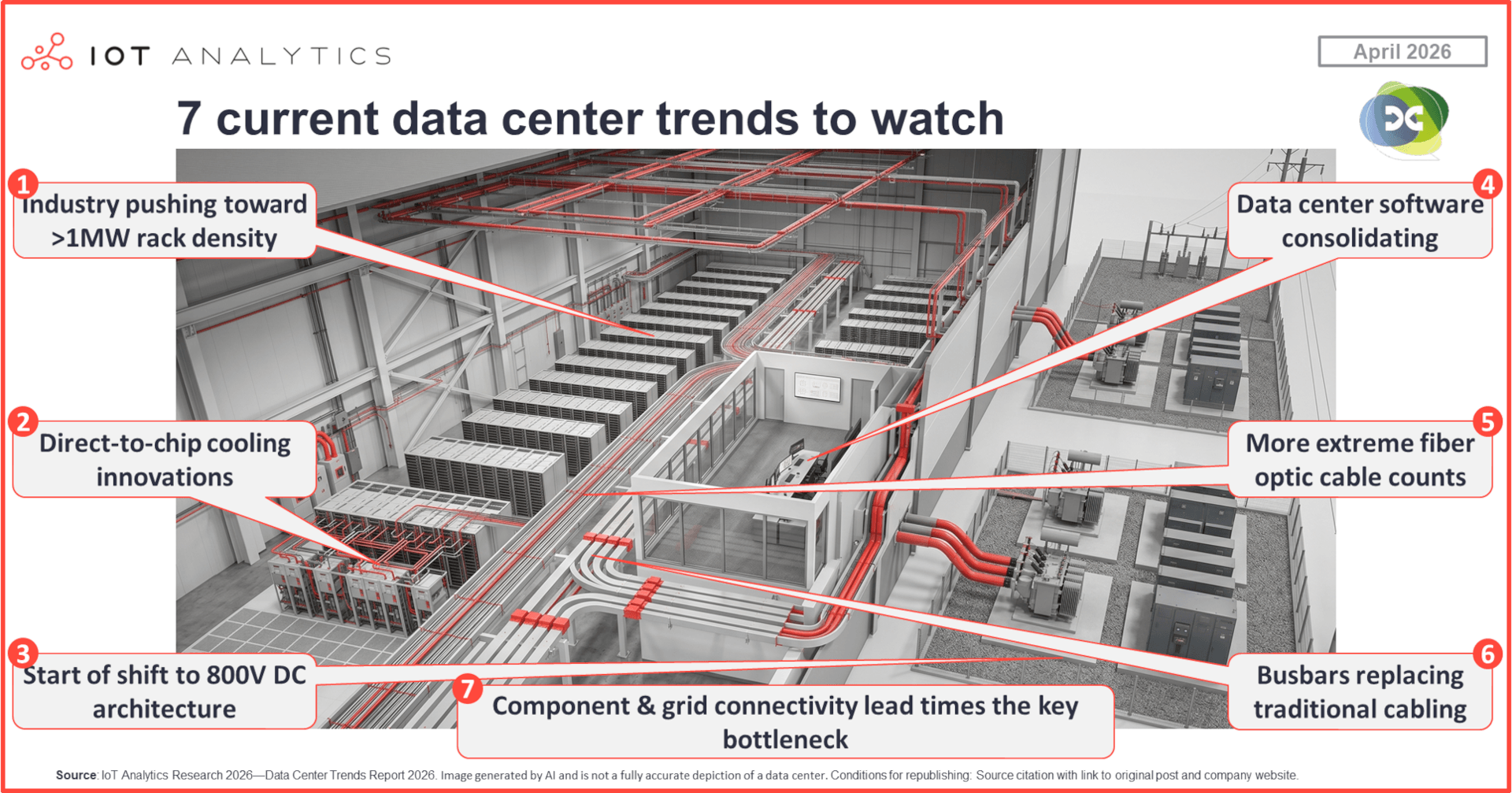
- 7 current data center trends to watch
1. AI workloads are pushing the industry toward >1MW rack density
2. Cooling technology: Direct-to-chip liquid cooling has become the industry standard
3. Electrical systems: Companies are getting ready to shift to 800V DC architectures
4. Data center software: Increasing consolidation into unified tools
5. Fiber cables: AI data density drives extreme fiber optic cable counts
6. Electrical cables: Busbars replace traditional cabling for enhanced flexibility
7. Lead times: Grid connectivity has become the biggest bottleneck in some regions - Further analysis
- All 26 data center trends as seen at Data Centre World London 2026 (Insights+)
- The 7 most insightful quotes from Data Center London 2026 booth visits (Insights+)
- Data center infrastructure market overview and outlook (Insights+)
- 10 key data center facility infrastructure vendors (Insights+)
Data Centre World 2026
AI drives data center surge as events tackle design challenges. With AI tools becoming the #1 CEO topic in corporate earnings calls and data centers the quasi-lifeblood of these tools, the data center industry has become one of the most-watched industries in a matter of a few years. On the back of that trend, industry events such as Data Centre World London 2026, which took place on March 4 and 5 in London, UK, have become crucial for the data center infrastructure and equipment industry—an estimated $500+ billion market in 2026, according to IoT Analytics’ 186-page Data Center Equipment & Infrastructure Market Report 2025–2030 (published November 2025).
The fair, with over 19,000 attendees, focused on all major aspects of data center design and build, including the practical challenges of AI-driven computing demand, sustainable operations, and facility design. The conference brought together operators, engineers, and suppliers to discuss modular design, renewable grid integration, and cooling systems.

IoT Analytics analysts were on the ground to investigate the latest trends and challenges, producing a 36-page event report—Data Center Trends Report 2026—with 26 data center trends drawn from discussions and observations at Data Centre World London 2026. Below, the team shares 7 of these 26 trends.
Insights from this article are derived from
Data Center Trends Report 2026
A 36-page report highlighting key trends from Data Centre World London 2026, with a focus on electrical systems, cooling, cabling, and data center software.

Already a subscriber? View your reports and trackers here →
7 current data center trends to watch
1. AI workloads are pushing the industry toward >1MW rack density
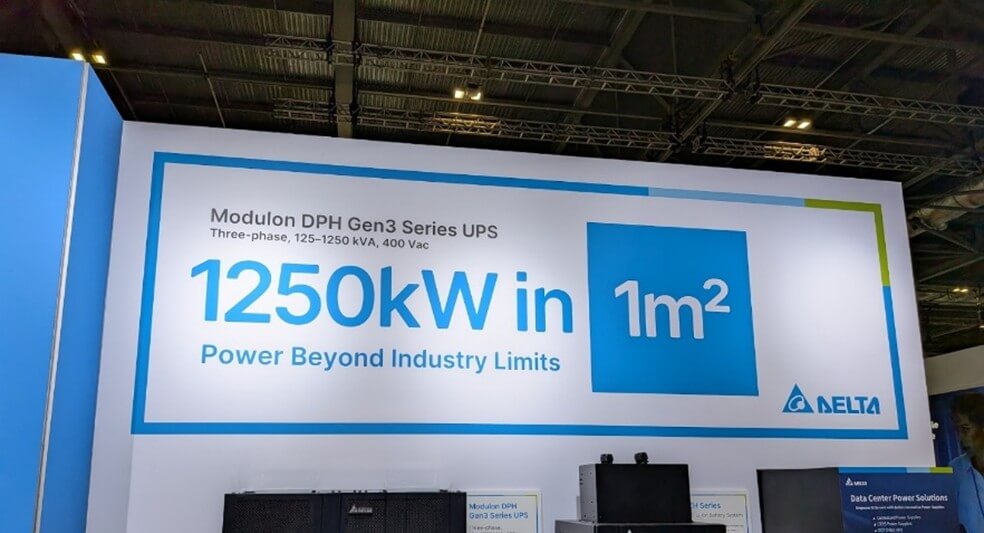
Vendors pushing aggressive rack densification despite skepticism. While legacy racks historically sat around 10kW, multiple vendors confirmed the aggressive push into extreme densification, though the definition of a “megawatt rack” was heavily debated:
- Data center consultants: Starting to design 2.2 MW racks. Several data center consulting companies noted that they are actively developing designs for US clients (with global deployment ambitions) who are preparing for single racks to draw 2.2 megawatts within a 5-year timeframe.
- Validation of the extreme density roadmap. Some exhibitors noted that NVIDIA was preparing a 600 kW test unit (the “Rubin Ultra” Kyber rack) slated for release around summer 2027, with Dell already exploring similar ultra-dense configurations.
- Mitsubishi Electric: Addressing the 5MW projection with caution. Mitsubishi acknowledged that NVIDIA has started talking about 5 megawatts per rack. However, their representatives noted that while 100 kW per rack was considered crazy just 5 years ago, the 5MW figures are currently “announcements” for highly specialized applications.
“5MW racks are announcements. And these are specific GPUs for very specific applications. However, 100 kilowatt per rack was 5 years ago; you would have to be called crazy, but there is always a gap between announcements and the real world.”
Mitsubishi Electric representative
2. Cooling technology: Direct-to-chip liquid cooling has become an industry standard
Liquid cooling the new standard. The market for liquid cooling has rapidly moved past the experimental phase and is now solidifying around direct-to-chip (DLC) architectures as a new industry standard for AI-centric, hyperscale deployments. Driven by the thermal demands of next-generation AI chips, suppliers are significantly scaling up their Coolant Distribution Units (CDUs) to manage extreme rack densities. Many data center operators are now future-proofing their facilities by building them with liquid cooling in mind from day one, preparing for an era where extreme heat generation becomes the norm. (Note: That does not mean that the entire market will shift to liquid cooling; air cooling is expected to remain relevant, especially for less AI-driven build-outs and outside the hyperscaler segment).
“I think this year we’re seeing a lot more mature liquid cooling market. It’s become a lot more established… There is not so many new developments with different options. We are seeing more standard liquid cooling. The CDU space has really grown as well with so many manufacturers now with a product ready for market.”
SWEP representative
- nVent’s high-capacity 1.8MW Coolant Distribution Units. nVent showcased their latest large-scale CDUs, specifically engineered to handle digital loads of up to 1.8 megawatts using a four-degree approach that aligns directly with NVIDIA’s reference architecture. To ensure continuous uptime in these mission-critical AI factories, the units feature integrated fluid-monitoring systems that maintain clean fluids and prevent manifolds from clogging.

- Rittal’s 1MW direct-to-chip cooling pods. Rittal demonstrated a massive 1-megawatt direct-to-chip cooling solution designed to service tightly packed clusters of AI racks. Capable of supporting densities up to 250kW per rack, the system integrates manifolds, power distribution, and cooling directly within the pod structure, showcasing the aggressive footprint scaling required to support modern compute demands.
3. Electrical systems: Companies are getting ready to shift to 800V DC architectures
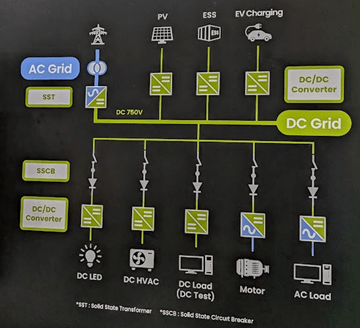
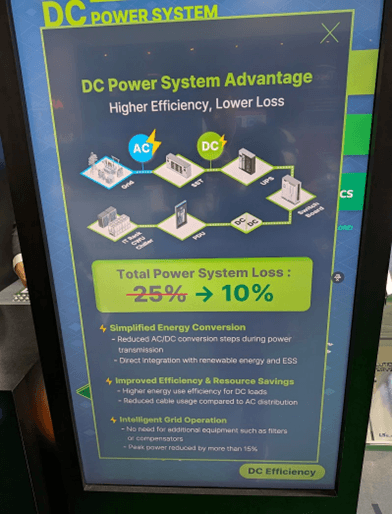
AI power demands driving a shift toward DC architectures. Driven by the relentless power density increases of AI racks, the industry has begun preparing to transition from traditional alternating current (AC) distribution to 800V direct current (DC) architectures. The primary motivation is efficiency; operators want to eliminate the energy losses inherent in multiple AC-to-DC conversion steps. While standards are still being finalized and many are awaiting NVIDIA’s next-generation chip requirements, major electrical vendors are actively prototyping solid-state transformers and DC-ready switchgear to support this fundamental architectural shift.
- LS Electric’s 800V DC architecture showcase. LS Electric displayed a future-ready 750V/800V DC power architecture featuring a solid-state transformer (SST) that replaces traditional UPS and AC/DC converter setups. While representatives noted that widespread adoption may not hit until 2030 due to a lack of global standards and the need for rigorous safety testing, the company is already running its own pilot projects.
“Whenever I go to customer meetings with the big IT companies, they are all saying the AC/DC conversion leads to a loss of energy. It’s clear that the common idea is to reduce the converting.”
LS Electric Co. representative
- Legrand’s Open Compute Project (OCP) power train. Legrand demonstrated high-density cabinets built around OCP standards, which extract the AC-to-DC conversion units from individual servers and consolidate them into a centralized DC “power train” at the rack level. By removing these converters from the servers, operators can significantly increase compute density, pushing cabinet capacities up toward 300kW.
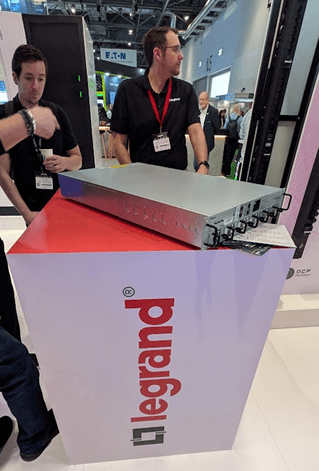
“Currently, the AC to DC conversion is in the cabinet. However, looking ahead to future architectures, the industry is moving toward bringing DC power from a UPS system all the way through to the cabinet.”
Legrand representative
- ABB believes it has a head start in DC power. ABB positioned itself as having a significant head start in the data center DC market by leveraging decades of DC experience from other heavy industries, such as rail and marine. Despite the push for DC in AI clusters, ABB stressed that AC is not going away. Traditional workloads, such as Microsoft 365 and standard cloud storage, will continue to rely on AC infrastructure. When evaluating the capital expenditure (CapEx) of moving to DC, ABB noted that while overall facility costs will increase, the primary financial driver will actually be advanced cooling systems rather than the electrical installation itself.
“It is simply massively more efficient to do the whole thing on direct current. Fewer conversions, fewer losses, better distribution, simpler installation, and smaller cable cross-sections.”
ABB representative
“The main driver is the power density of the racks is increasing, and you need more and more power… and you can only have that through DC.”
Eaton representative
4. Data center software: Increasing consolidation into unified tools
Operators consolidating fragmented data center controls. Data center operators are increasingly overwhelmed by the complexity of managing disparate tools across their facilities. Historically, operations have been siloed across building management systems (BMS) for cooling and general buildings control, electrical power management systems (EPMS) for power distribution, and supervisory control and data acquisition (SCADA) systems for rapid electrical switching.
A shift observed at the event is the consolidation of these distinct operational technology (OT) layers into unified, single-pane-of-glass software architectures, effectively blending traditional facility control with overarching data center infrastructure management (DCIM) capabilities.
- Schneider Electric’s EcoStruxure Foresight software launch. Schneider Electric previewed “EcoStruxure Foresight,” a new consolidated software platform scheduled for early release in December. This solution fundamentally eliminates the boundaries between their previous standalone software packages by merging their BMS (EBO), EPMS (PME), and SCADA (EPO) products into one comprehensive system, allowing operators to seamlessly track electrical waveforms alongside cooling performance without switching applications.
“What we’re doing, we’re changing this to Foresight. So that’s taking EBO, which is our BMS; PME, which is our EPMS; and EPO, which is our SCADA, and it’s bringing them together.”
Schneider Electric representative

- Mitsubishi combining separate software tools into a DCIM solution. Mitsubishi explicitly positioned the Iconics SCADA system (acquired in 2019) as a DCIM solution for data centers. Mitsubishi is combining the system with other critical capabilities, such as a recently acquired Nozomi Networks cybersecurity business (acquired in September 2025), to provide operators with a more comprehensive suite of oversight and protection.

5. Fiber cables: AI data density drives extreme fiber optic cable counts
AI workloads driving fiber densification. To support the massive data transfer rates required by AI GPU clusters, fiber optic cables are undergoing extreme densification. With high-performance compute power packing into tighter spaces, the physical pathways for data must rapidly condense. The industry is shifting toward ultra-high-fiber-count cables to optimize space while facilitating the “factory-like” data generation of modern AI workloads.
- Fujikura’s 13,000-fiber spider web cable showcase. Fujikura demonstrated a massive fiber-optic cable containing 13,000 individual fibers, bundled using a proprietary “rubbing tube” technology. Designed to interconnect data centers or tie them to external grids, this innovation optimizes physical space by densely packing the fibers into a spider-web-like configuration, directly addressing the physical spatial bottlenecks of AI data transmission.

“What happens with the AI? We need to compute much more data in a smaller space. So, we need to save space. Our cables are all going to high fiber counts.”
Fujikura representative
6. Electrical cables: Busbars replace traditional cabling for enhanced flexibility
AI power growth accelerating busbar adoption. As facility power densities surge to support AI, some operators are moving away from permanent, end-to-end power cabling in favor of modular busbar trunking systems. Busbars offer superior flexibility; operators can easily tap off a new connection or reconfigure power routes without the arduous task of running a completely new 100-meter cable from the main panel, marking a massive shift in grey space architecture.
- High-amperage grey space busbar installations. Data center consultants noted that approximately 70% of new data center projects are now utilizing busbars in the grey space instead of traditional cables. While the initial capital expenditure for busbars is slightly higher, the long-term operational flexibility (acting as a continuous, modular power panel that supports loads up to 4,000 amps) far outweighs the upfront costs.
“There is a trend nowadays that we end up relying a lot more on bus bars. You’ll save more flexibility because in the future, if you need to make a change, you replace it on the bus bar; you don’t need to be running a 100 m cable from the panel.”
Data center consultant

7. Lead times: Grid connectivity has become the biggest bottleneck in some regions
Below is a list of current component lead times as shared by various participants we talked to:
| Infrastructure category | Specific component/service | Estimated lead time | Strategic context & drivers |
|---|---|---|---|
| Utility & grid | High-voltage grid connections | 6–8 years | Highly congested European markets (e.g., Frankfurt) lack grid capacity, forcing operators to pivot to on-site generation models |
| Cabling infrastructure | High-voltage power cables | 1.5–2 years | Extreme delays are driven primarily by global manufacturing capacity limits, though the lead time for standard cables is very low |
| Electrical equipment | Mission-critical power elements | 1–1.5 years | Heavy electrical components, such as transformers, face prolonged delays due to widespread manufacturing constraints |
| Cabling infrastructure | High-density fiber optic cables | 1–1.2 years | Delays are constrained by raw material bottlenecks; the specialized glass required for these fibers is manufactured by only four companies globally |
| Power generation | Standby generator engines | 1 year | The engine block itself is currently the primary critical chokepoint for backup power |
| Power generation | Containerized modular generators | 1 year | This incorporates the 52-week engine lead time plus the time required to package it into a fully integrated module |
| Thermal management | High-density liquid cooling (1MW) | 0.5 years | Despite rapid industry scaling, high-capacity direct-to-chip liquid cooling hardware boasts much shorter procurement windows than heavy electrical equipment |
| Cabling infrastructure | Standard low/medium-voltage cables | 0.1 years | Standard power cable configurations remain largely unconstrained compared to specialized or high-voltage variants |
Further analysis
Below in our Insights+ section, we share more insights from the Data Center Trends 2026 report and analysis from our Data Center Equipment & Infrastructure Market Report 2025–2030, including:
- All 26 trends observed at Data Centre World London 2026 with key takeaways
- Data center infrastructure market overview and outlook
- 10 key data center facility infrastructure vendors
All 26 data center trends as seen at Data Centre World London 2026 (Insights+)
Access key market data for $99/month per user
The Insights+ Subscription unlocks exclusive facts & figures. You will gain access to:
- Additional analyses derived directly from our reports, databases, and trackers
- An extended version of each research article not available to the public
Full report access not included. For enterprise offerings, please contact sales: sales@iot-analytics.com
