

In short
- According to IoT Analytics’ latest What CEOs Talked About report, AI maintained the top spot in CEOs’ minds in Q1 2026, with discussions around physical and agentic AI increasing.
- The onset of armed conflict in the Middle East made discussions about Iran rise steeply.
- Talk about OpenClaw and SaaSpocalypse, too, had sharp increases.
- Discussions around AI bubble concerns, uncertainty, and tariffs declined.
Why it matters
- The prioritization of specific topics by CEOs may influence investment in these areas.
In this article
- The big picture
- Key rising themes in Q1 2026
- 1. Iran
- 2. Physical and agentic AI
- 3. OpenClaw
- 4. SaaSpocalypse
- Declining themes in Q1 2026
- 1. Tariffs and uncertainty
- 2. AI bubble
- What it means for CEOs
- Further analysis
- CEO digital agenda by sector (Insights+)
- How CEOs discuss AI (Insights+)
- Manufacturing challenges in Q1 2026 (Insights+)
The big picture
Iran
Iran conflict lifted oil prices and call mentions. In Q1 2026, many CEOs had what was (and still is) on the minds of many around the world: armed conflict between the US/Israel and Iran. While Iran was not the most-discussed topic on earnings calls, it experienced the largest quarter-over-quarter (QoQ) jump, up 550% to 3.3% of earnings calls. Coinciding with this, discussions about the Middle East rose 47% QoQ to 14% of earnings calls, and geopolitics appeared in 17.5% (up 53.8% QoQ).
Most notable to IoT Analytics is that this conflict has showcased a new type of warfare: Data centers-as-a-Target. In several instances, Iran has specifically targeted data centers in the UAE and Bahrain, indicating that data is now a new front in warfare. The strikes have led to structural damage at the sites and regional service disruptions.
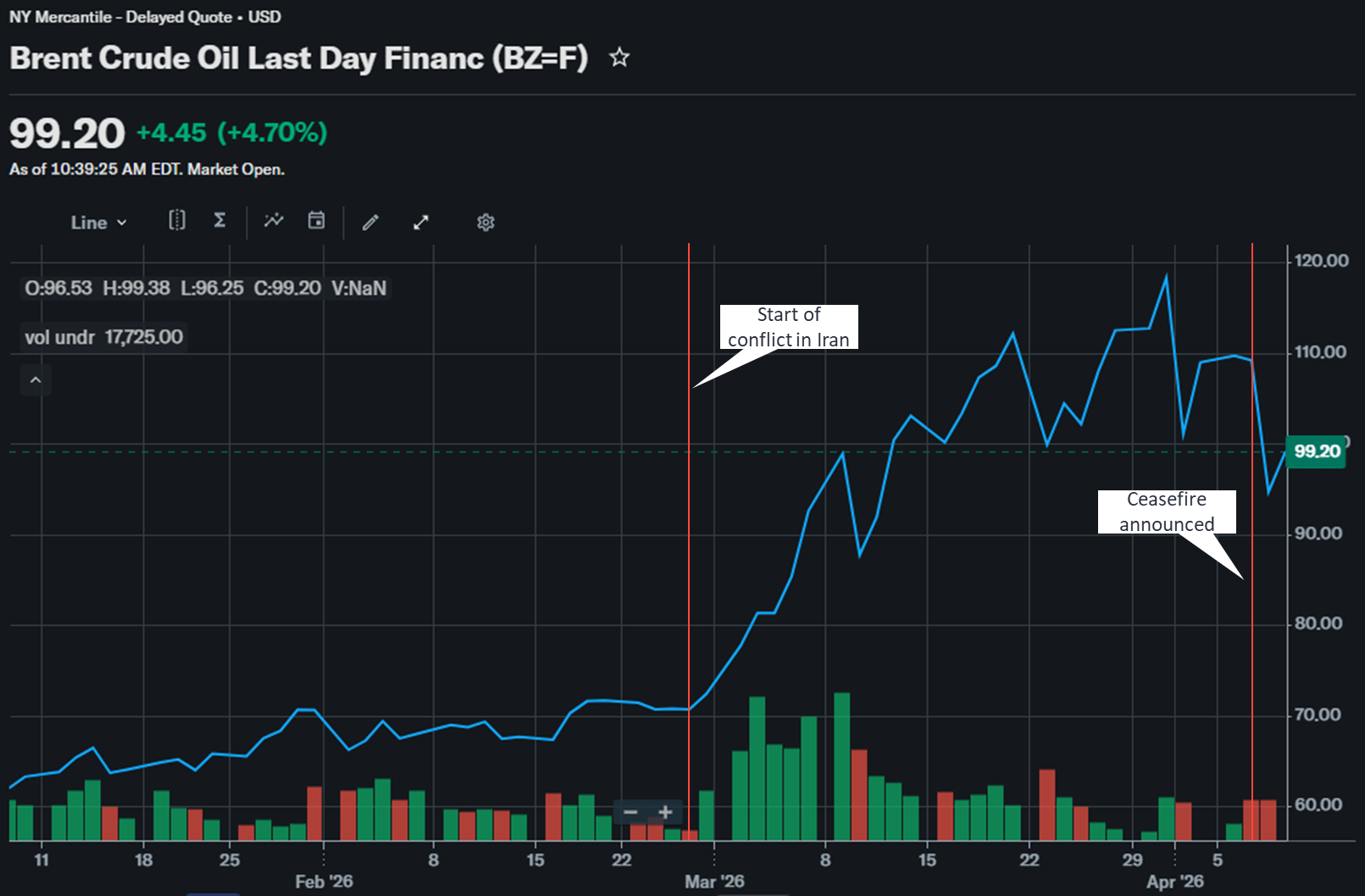
More notable in broader news about the war has been the effect on oil and gas costs. Since the start of the conflict in late February 2026, Brent crude has risen from around $72/barrel to over $110/barrel in early April, largely due to a near cessation of shipments (including oil) through the Strait of Hormuz. On April 7, 2026, the US and Iran agreed to a 2-week ceasefire, with free passage through the Strait being a condition. This announcement led to oil prices dropping to approximately $94/barrel, though some analysts question whether this ceasefire will withstand either negotiations planned to start on April 10 or the actions of other involved states. On April 8, the Strait had already been locked down again after Israel conducted attacks in southern Lebanon, and on April 9, oil prices were already creeping back up toward $100/barrel. Further, as of 9 am US Eastern, only 11 ships had crossed the Strait of Hormuz since the start of the ceasefire, according to the BBC, as companies look for assurances that their passage is safe.
AI
AI mentions rose as bubble fears eased. Discussions around AI continued to rise in Q1 2026, with increasing focus on physical AI (up 116.5% QoQ to 1.8% of calls) and agentic AI (up 15.8% to 6.4% of calls). On the AI tools front, mentions of US-based AI company Anthropic’s Claude LLM rose sharply, reaching 2.3% of earnings calls (up 161.3%). While it could be easy to pin its spike on the recent dispute between Anthropic and the US Department of Defense (with the threat of Anthropic being added to a national security blacklist), the mentions of the model actually saw the most year-over-year (YoY) rise in discussions, at +600%. Still, inclusion on a blacklist would not just hurt the company’s chances for US government contracts but also with companies that do business with the US government, so the dispute remains of key interest to many.
Meanwhile, concerns about an AI bubble appear to be subsiding to some degree, as mentions of the subject have dropped 34.5% QoQ to 1.6% of calls.
“[L]ooking at the AI as a whole, it’s fundamentally a data technology, the technology that fully leverages all forms of data accumulated throughout human history to generate the intelligence. And that is absolutely not a bubble, but a technological advancement that delivers tangible value.”
Yang Yuanqing, CEO, Lenovo, February 2026
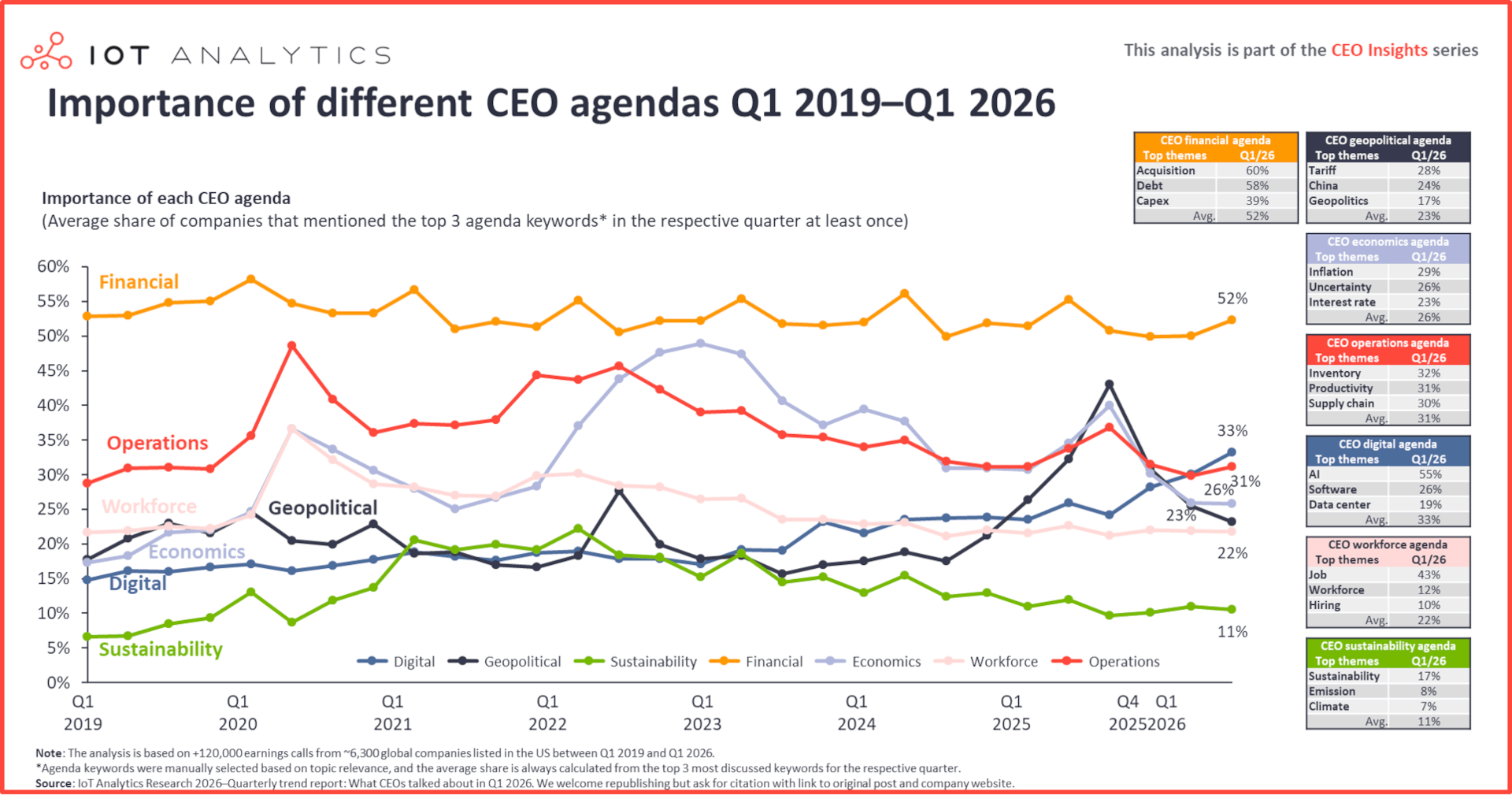
The CEO digital agenda surpasses the operations agenda. As discussions around AI continue to increase, so too does the average number of discussions of CEO digital agenda topics. As a matter of importance, the CEO digital agenda now ranks 2nd out of 7 for the first time ever. The agenda now only trails the financial agenda (which is likely to always be the top agenda item by nature).
Insights from this article are derived from
Quarterly Trend Report: What CEOs talked about in Q1 2026
A 68-page report on the trends that emerged in Q1 2026 earnings calls. The report is based on data from 120,000+ earnings calls of US-listed companies from Q1 2019 through Q1 2026.

Already a subscriber? View your reports and trackers here →
Key rising themes in Q1 2026
1. Iran

Iran conflict rattled oil markets and earnings calls. On February 28, 2026, the US and Israel initiated military operations against Iran, assassinating its long-time Supreme Leader Ali Khamenei and triggering Iranian missile responses across the Gulf States. Coinciding, mentions about Iran jumped 550% QoQ to 3.3% of earnings calls.
The conflict has also brought about concerns with regard to shipping, particularly oil through the Strait of Hormuz (mentioned in 0.8% of calls), which is 30 miles wide at its narrowest point and has even narrower passage routes, serving essentially as a chokepoint. While Iran has said it would not attack ships not associated with their adversaries in the conflict, many companies have chosen not to risk the voyage, leading to oil prices to surpass $100 a barrel and increased fuel prices.
Related terms also saw increases:
- Geopolitics: Up 53.8% QoQ to 17.5% of earnings calls
- Middle East: Up 47% QoQ to 14% of earnings calls
Regionally speaking, companies in Europe, the Middle East, and Africa (EMEA) discussed Iran the most, with 6% of earnings calls. North American companies discussed it in 2% of earnings calls, while Asia-Pacific companies mentioned it in only 1% of calls.
Key executive quote on Iran
“So, when you think about the conflicts in Iran, there are energy impacts. There will be some benefits there certainly within [] some of our companies, but there will be others that will be impacted: transportation, trucking, those sorts of places by higher energy prices to the extent that this is not transitory. So, we think about that.”
Michael Thomas, Executive VP, PNC, March 2026
2. Physical and agentic AI

Earnings calls spotlighted physical AI and agents. As AI continued its climb in the number of earnings calls mentioned in, 3 areas of AI saw marked growth:
- Physical AI: Up 116.5% to 1.8% of earnings calls
- AI agent: Up 27% to 6.5% of earnings calls
- Agentic AI: Up 15.8% to 6.3% of earnings calls
Perhaps not surprisingly, manufacturing and information and communications discussed physical AI the most, 4.3% (+144% QoQ) and 3.9% (+126% QoQ), respectively.
Key CEO quote on physical AI
“When you think about where the world is headed in terms of physical AI, whether that’s on ADAS solutions or it’s in cabin or it’s outside of automotive in robots or in drones, it’s how do you enable things to sense, think and act.”
Kevin Clark, CEO, Aptiv (manufacturing), February 2026
“Most of the physical AI world is being designed on Onshape and several new introductions and announcements are forthcoming. We’re seeing strength there.”
Neil Barua, CEO, PTC (information and communications, March 2026
When analyzing the calls mentioning AI agents and agentic AI, 3 key themes became apparent:
Building AI agent fleets for operations, where companies deploy purpose-built AI agents to handle operational tasks autonomously.
“We’re building a fleet of AI agents that can see the state of our customers’ fleets, understand what’s happening and take actions through our applications or APIs.”
Joe Creed, Group President, Caterpillar, January 2026
Securing the agentic enterprise, where companies are racing to address new identity, governance, and security challenges as AI agents enter the workforce and operate at machine speed.
“When AI agents start logging in at machine speed, logging in becomes a primary attack vector. We believe we are now the only company that can verify the who and secure the what simultaneously.”
Nikesh Arora, CEO, Palo Alto Networks, February 2026
Agentic AI reshaping customer engagement, where AI agents are seen as transforming commerce, professional services, and customer engagement, creating new revenue streams and new competitive moats.
“We see meaningful opportunity for sponsored discovery as retailers extend their agentic shopping experiences through retailer-owned apps embedded in LLM platforms. Together, these efforts position agentic commerce as a natural extension of our strategy.”
Michael Komasinski, CEO, Criteo, February 2026
3. OpenClaw
OpenClaw drew hype and security scrutiny. Mentions of the open-source, locally-run AI agent framework OpenClaw sharply climbed to 0.4% of earnings calls. The framework was released in November 2025 as ClawdBot and renamed as Moltbot after some trademark complaints by Anthropic before landing on its current name. It is designed to automate tasks by controlling browsers, files, and other system commands, and not long after its release, it began gaining the attention of cybersecurity and cloud companies. It has even caught the attention of Jensen Huang, CEO of NVIDIA, who offered a rather strong take on the new technology:
“OpenClaw is probably the single most important release of software, probably ever. And if you look at OpenClaw and the adoption of it, Linux took, right, some 30 years to reach this level. OpenClaw in, what is it, 3 weeks, has now surpassed Linux. It is now the single most downloaded open-source software in history, and it took 3 weeks.”
Jensen Huang, CEO, NVIDIA, March 2026
While the above shows excitement behind the framework, there are still security considerations, and some people (mostly non-tech savvy) appear to be concerned over how effective OpenClaw is.
Key CEO quote about OpenClaw and security
“OpenClaw comes out. Our customers immediately are looking at all of our technologies to be able to identify it, put controls around it and make sure that they can leverage these technologies in an efficient and compliant way. So that’s where AI meets — the rubber meets the road, is at the endpoint.”
George Kurtz, CEO, CrowdStrike, March 2026
Key CEO quote about OpenClaw adoption
“Even people who are not technically savvy, like some of my dear Board members, are calling and say, ‘Oh my God, I use OpenClaw, and now I’ve connected my e-mail and my calendars, and I don’t know what’s working. Can we please undo it? I’m worried.’ And so we see that real time, real life with people adopting it.”
Vincent Pilette, CEO, Gen Digital, February 2026
4. SaaSpocalypse
Boards weighed SaaSpocalypse as an AI threat. The portmanteau SaaSpocalypse—a term to describe a severe market downturn and structural crisis in the software-as-a-service industry, driven by the rapid adoption of agentic AI—has begun to enter boardroom discussions, at 0.1% of calls. While that may not seem like much, there appears to be a mix of nervousness and disregard.
Key CEO about SaaSpocalypse concerns
“Yes, SaaSpocalypse, let’s talk about it. Look, there’s a real issue here. This is not just a market tantrum. […] AI is advancing more quickly than most people expected and especially so in respect of tools that make coding easier. […] Some software companies are vulnerable to AI disruption as a result of this. […] We also think everybody needs to approach what’s going on with AI with a bit of humility. Nobody really has all the answers here. This is a new technology, and it’s been moving at a pace that even experts in the field have not expected.”
David B. Golub, CEO, Golub Capital BDC, February 2026
Key CEO quote disregarding the risk of SaaSpocalypse to their company
“You’ve all heard the thesis or theory that new companies coding quickly using AI will spell the death of SaaS. I don’t agree with that at all. […] Oracle is using the best AI coding tools and the best developers not only to accelerate our SaaS business, but to deliver solutions that enable entire ecosystems across numerous industries. […] By embracing AI with small engineering teams, we have just built 3 brand-new CX applications […] These are 3 products that salesforce.com does not have. […] That’s why we think the SaaSpocalypse applies to others but not to us.”
Mike Sicilia, CEO, Oracle, March 2026
Declining themes in Q1 2026
1. Tariffs and uncertainty concerns

Tariffs and uncertainty concerns drop. CEOs discussed tariffs and general trade uncertainty less in Q1 2026. Tariffs were discussed in 28% of earnings calls, down 16.8% QoQ, while uncertainty dropped 6.9% QoQ to 26% of calls. According to the analysis, tariffs remained heightened in the energy, manufacturing, and trade sectors.
Key CEO quote on tariff uncertainty
“The future impact of tariffs remains extremely fluid as the recently eliminated IEEPA tariffs have now been replaced with new global tariffs for at least the next 150 days. Our buyers continue to act with great agility and urgency, always with the goal of reducing the impact of tariffs on prices for our members.”
Ron Vachris, CEO, Costco, March 2026
2. AI bubble
AI bubble concerns ease. Discussions about an impending AI bubble appear to be waning, at least at the moment. Discussions about the topic dropped 34.5% QoQ to 1.6% of earnings calls.
Key CEO quote on the potential of an AI bubble
“Despite all these positive trends, there have been external narratives around bubbles and rising default across the credit markets. What we are seeing on the ground and across over 300 credits we are invested in is in direct contrast.”
Milton Maluhy Filho, CEO, Itaú Unibanco, February 2026
What it means for CEOs
5 key questions that CEOs should ask themselves based on the insights in this article:
- Are we stress-testing our supply chain against a prolonged Iran oil shock?
Iran mentions surged 550% in Q1, the fastest-growing keyword in the dataset. Brent crude rose 49% in March alone, with physical shortages expected through June. Map your exposure across energy costs, raw materials, and logistics now, before mid-April disruptions hit. - Is our business model resilient to the “SaaSpocalypse”?
CEOs are increasingly concerned that AI will commoditize traditional software and destroy seat-based pricing models. You should evaluate whether your organization needs to shift toward hybrid or tokenized pricing models to survive this industry-wide transition. - How are we securing our electronics supply chain against the AI-driven “memory shortage”?
AI cloud service providers are attempting to lock up the global DRAM and NAND supply through late 2026. With memory shortages already driving up input costs for industrial markets, you must validate that your hardware and device roadmaps are resilient to significant intra-quarter price increases. - Are we prepared for the security and compliance risks of OpenClaw?
OpenClaw surged from zero to 0.4% of earnings calls in a single quarter. CrowdStrike, Palo Alto, and Gen Digital all flagged it as a major new attack surface. Assess whether your security posture covers agentic AI frameworks that employees are already adopting, often without IT oversight. - Are we building toward Physical AI, or just digital AI?
Physical AI mentions more than doubled (+116%) in Q1, with APAC companies mentioning it twice as often as EMEA or North America. NVIDIA, Qualcomm, FedEx, and Infosys are all framing it as the next frontier. Evaluate whether your AI roadmap extends into the physical world—robotics, autonomous logistics, edge inference, or remains purely software-side.
Further analysis
Below in our Insights+ section, we share more analysis from the What CEOs Talked About Q1 2026 report, including:
- The CEO digital agenda by sector (with key digital themes and trends)
- How CEOs discuss AI and AI agents
- Common manufacturing challenges
IoT Analytics also offers tailored research and consulting services. Those interested in deeper or specific analysis of CEO earnings calls, such as industry-specific analysis, are encouraged to contact our account managers for more information.
CEO digital agenda by sector (Insights+)
Access key market data for $99/month per user
The Insights+ Subscription unlocks exclusive facts & figures. You will gain access to:
- Additional analyses derived directly from our reports, databases, and trackers
- An extended version of each research article not available to the public
Full report access not included. For enterprise offerings, please contact sales: sales@iot-analytics.com
