
In short
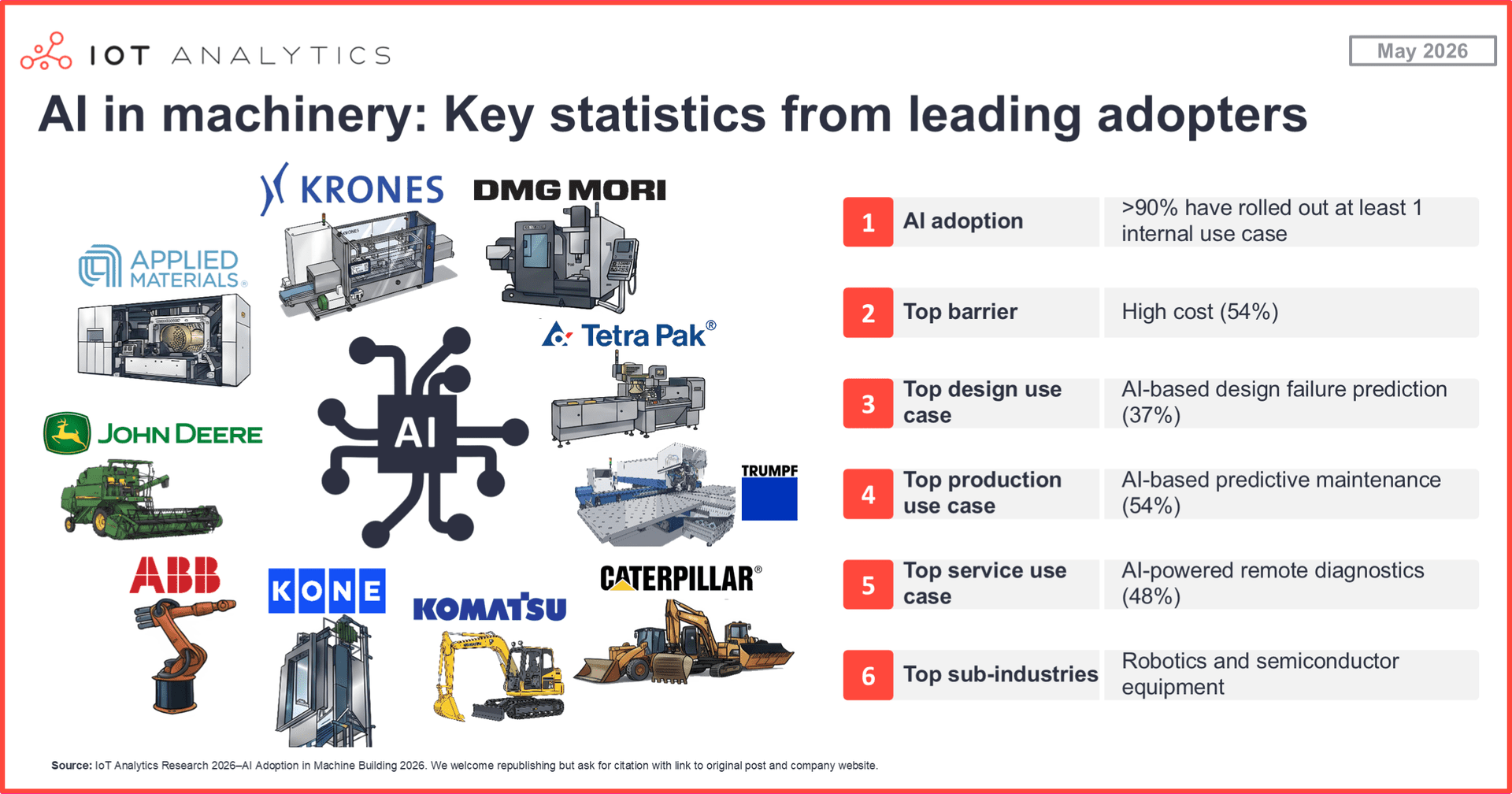
- 96% of machine builders are in some stage of AI, according to IoT Analytics’ 121-page AI Adoption in Machine Building 2026 report.
- Here, the IoT Analytics team shares 6 key findings from the report: 1) A breakdown of the 96% stat, 2) top AI adoption barriers, 3) top AI use cases in machine design, 4) top AI use cases in machine building, 5) top AI use cases in the smart machines these builders produce, and 6) which machine building sub-industries lead in AI adoption.
In this article
- Introduction: Widespread AI adoption among machine builders
- 6 key findings about AI adoption in the machine building industry
- Finding 1: Widespread internal AI adoption – 96% of machine builders are using AI
- Finding 2: Top barriers for AI adoption – High cost and data infrastructure
- Finding 3: AI in machine design – Design failure prediction a key use case
- Finding 4: AI in machine production – Predictive maintenance leads adoption
- Finding 5: AI in machine service – AI-powered diagnostics is the breakout use case
- Finding 6: AI in smart machines – Robotics and semiconductor equipment lead
- Analyst takeaway
- Further analysis
- Leading adopter companies by machinery sub-industry (Insights+ Exclusive)
- Leading adopter company profiles (Insights+ Exclusive)
Introduction: Widespread AI adoption among machine builders
AI use in the machinery industry is becoming widespread. 96% of machine builders have started to deploy AI in internal operations, and many have started to bring AI features into machine software and into the machines themselves, according to IoT Analytics’ 121-page AI Adoption in Machine Building 2026 report (published May 2026). The research, which surveyed 120 decision-makers directly involved in machine building across 22 machinery sub-industries, found that machine builders vary widely in their AI motivations and use cases, and that adoption rates vary widely by subindustry.
Below, the IoT Analytics team shares 6 key findings from the report.

Insights from this article are derived from
AI Adoption in Machine Building 2026
A 121-page report on how machinery companies from 22 subindustries and 3 regions are adopting AI across design, manufacturing, and smart machines.
6 key findings about AI adoption in the machine building industry
Primary research for the AI Adoption in Machine Building 2026 consisted of a survey of 120 respondents directly involved in machine building, numerous expert interviews, and attendance at specialized machinery events such as BAUMA 2025 (construction and mining machinery), EMO 2025 (machine tools), and automatica 2025 (robotics). The team also reviewed numerous company reports, press releases, and case studies to understand which machine-building companies are ahead in AI adoption.
For the report, AI is defined broadly, covering both classical ML/computer vision/predictive maintenance and newer generative AI, foundation models, edge AI, and agentic approaches.
Finding 1: Widespread internal AI adoption – 96% of machine builders are using AI
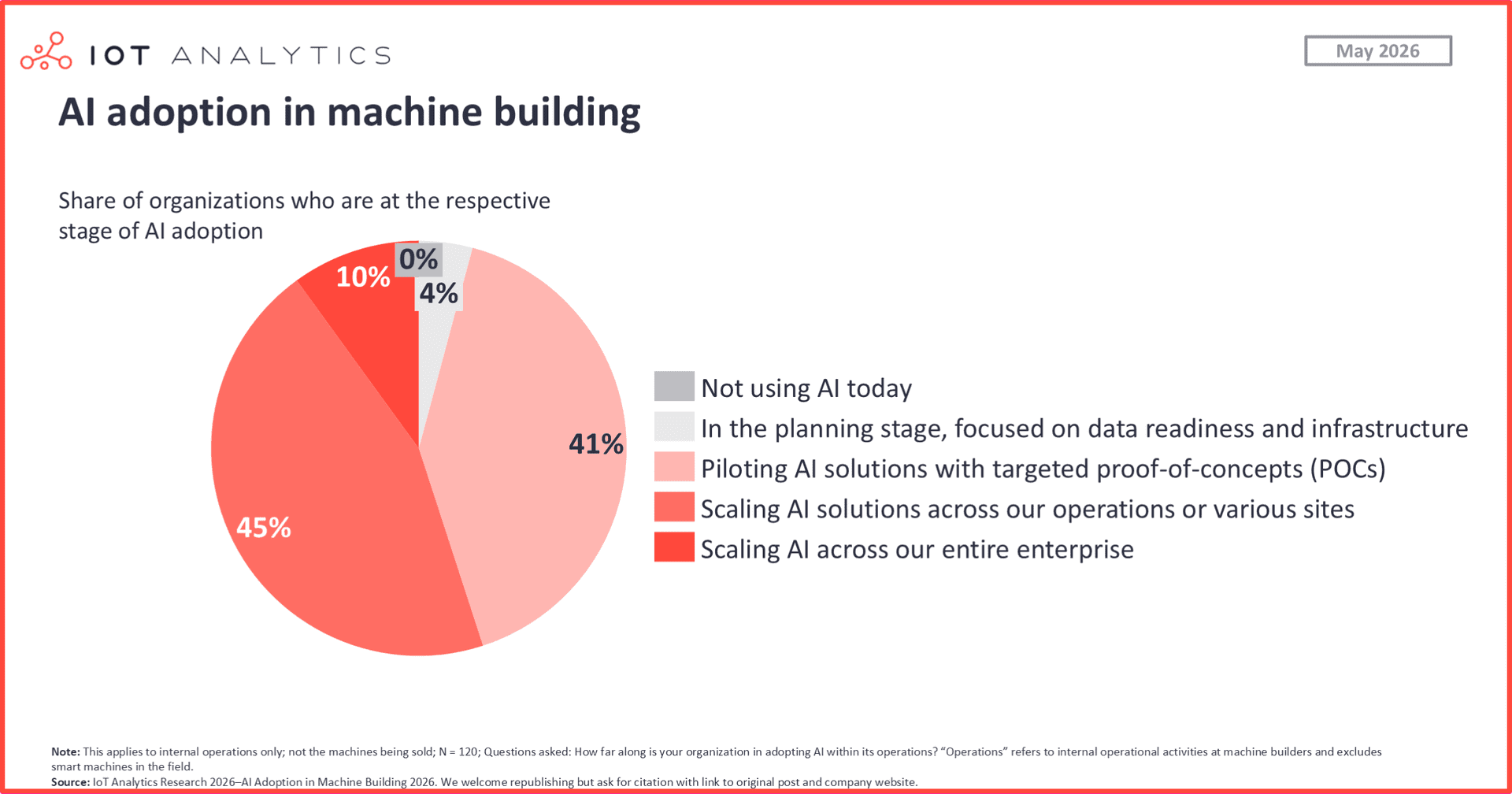
Nearly all machine builders are adopting AI in operations. AI has reached every corner of the machine-building industry: 96% of surveyed machine builders are in some stage of AI implementation internally across their operations. The nature of that adoption varies significantly:
- 55% have scaled a specific AI use case across individual operations, sites, or the entire enterprise
- 41% are running targeted proof-of-concept pilots
- 4% are in planning mode but not yet implementing
Adoption example: Deere & Co. scales AI across its enterprise

According to research for the report, US-based agricultural machinery maker Deere & Co. (broadly known as John Deere) is a company at the forefront of applying AI across its own design, manufacturing, and machine service operations. With a focus on vision systems, simulation tools, and real-time information access, John Deere is reporting measurable gains in several critical areas.
How Deere is using AI in its design & engineering
- AI-powered simulation to accelerate testing and validation. Deere & Co. uses AI models to simulate durability and reliability in early product design phases, reducing reliance on slow, expensive physical tests.
- GenAI for conceptual design and part configuration. GenAI tools assist in generating early design concepts and evaluating material combinations, reducing manual engineering time.
- Bill of materials (BOM) and cost forecasting. AI helps estimate machine cost impacts based on different part combinations, supporting better BOM planning during the early design phase.
How Deere is using AI in machine manufacturing
- Vision-based quality inspection for critical assembly steps. Fixed camera systems equipped with vision sensors check for correct part fitment, such as bearings. Trained image sets detect errors flagged through the MES to prevent defects from progressing.
- Optimize production plans to reduce inventory and improve flow. AI is used to identify optimal machine sequencing in production, helping minimize inventory levels and improve space utilization.
How Deere is using AI in service
- Service support via GenAI tools. Service engineers retrieve machine-specific parts and service data using GenAI-based assistants for faster response times.
Finding 2: Top barriers for AI adoption – High cost and data infrastructure
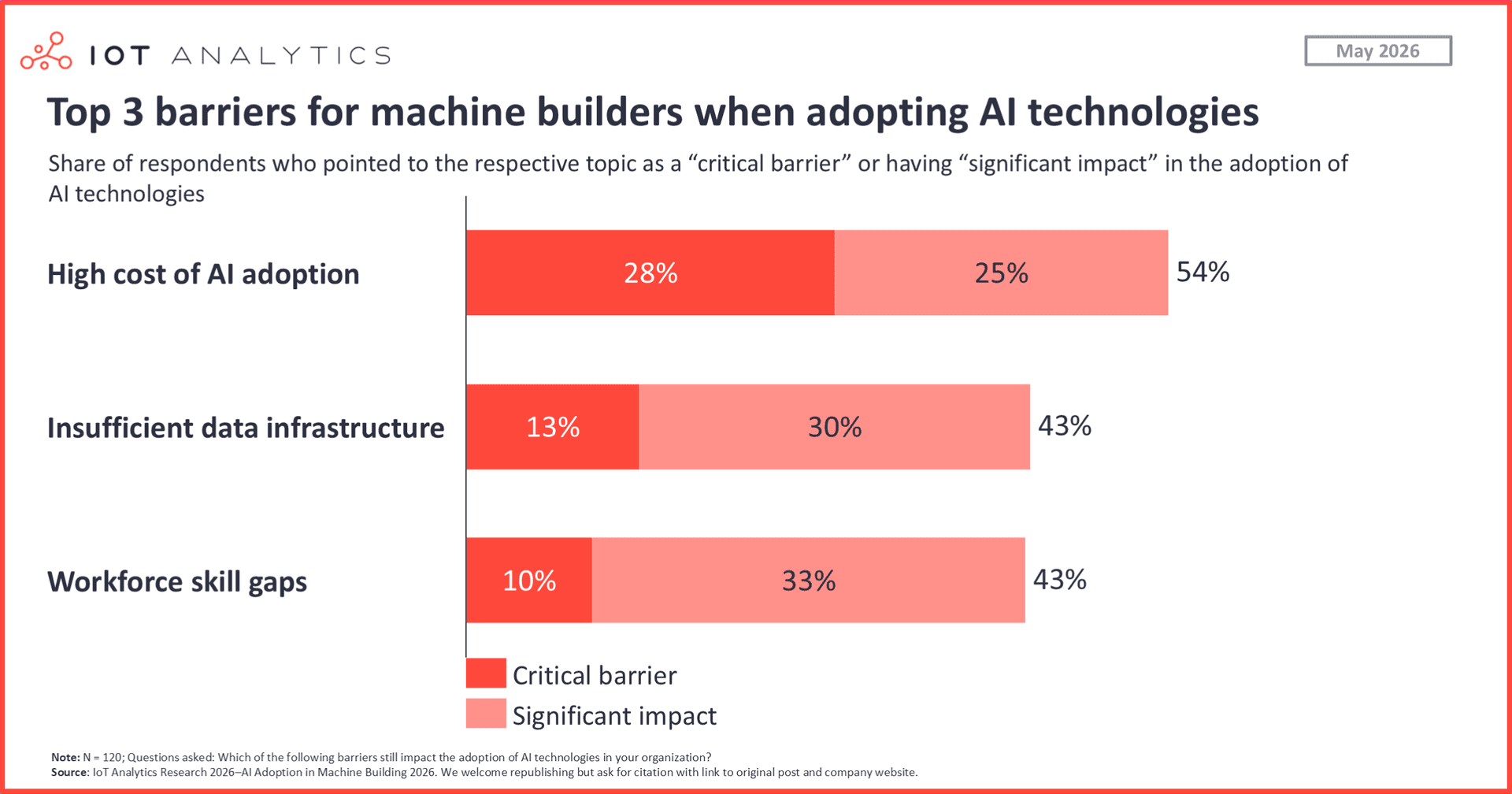
High AI costs a barrier for over half of machine builders. Despite near-universal adoption, machine builders face meaningful friction in scaling AI. 54% of machine builders cite high AI costs as a critical barrier, the single largest obstacle to adoption. Following it are insufficient data infrastructure at 43% of machine builders (13% critical, 30% significant) and workforce skill gaps also at 43% (10% critical, 33% significant)
In food and beverage machinery, data infrastructure gaps (80%) and poor data quality (70%) are especially acute. This is partly due to customer production data being proprietary and difficult for machine builders to access, even when it would improve their AI models.
Key quote on high cost barriers
“The high upfront investments required for AI, including costs for training, cloud infrastructure, and other resources, are a significant concern. Many organizations worry about the return on investment and the uncertainty around it, with management questioning whether the benefits will justify the costs.”
Technical director at a leading energy equipment manufacturer in the US
Finding 3: AI in machine design – Design failure prediction a key use case
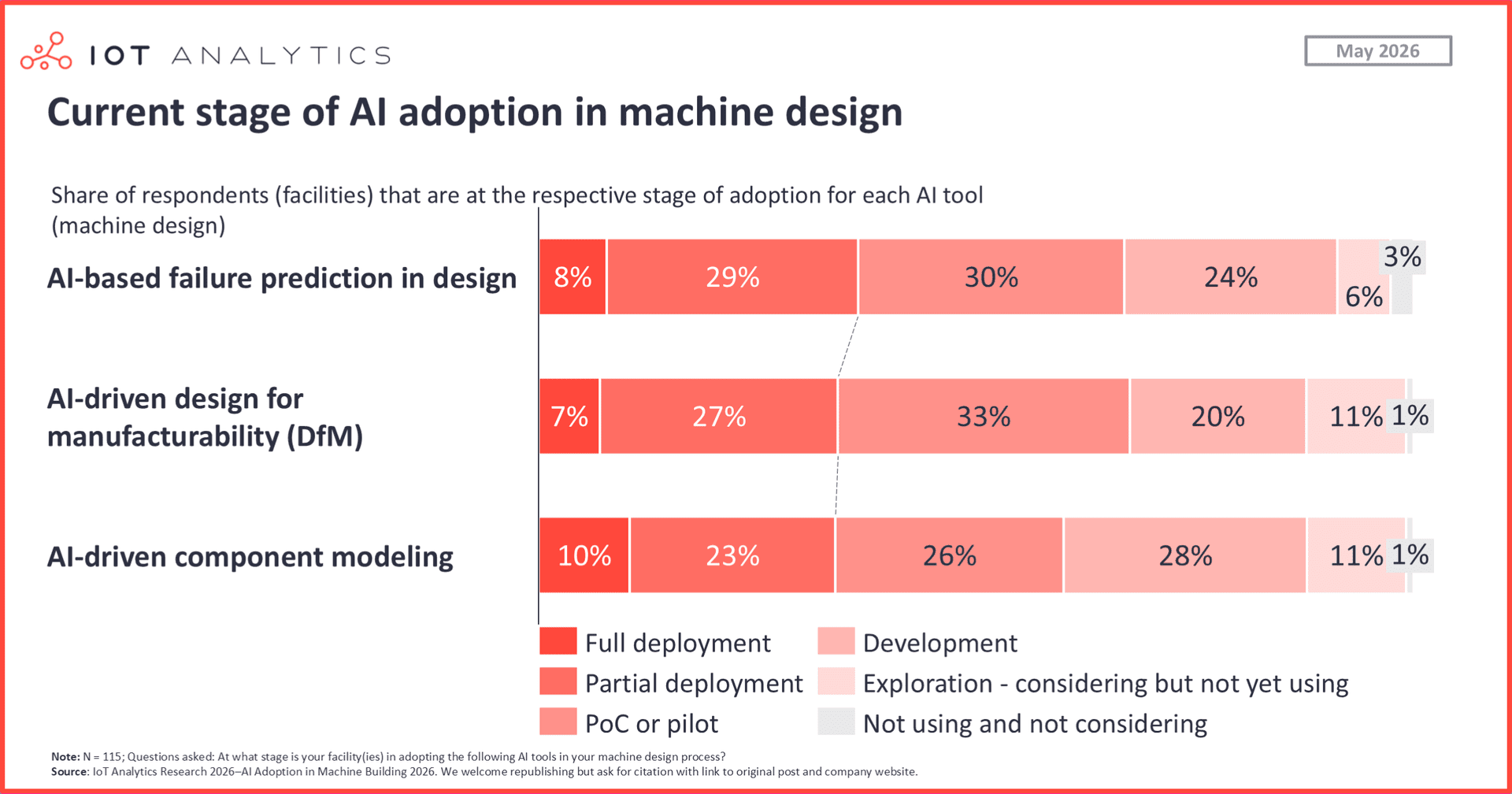
Over a third of machine builders deployed AI-based design failure prediction. Of the machine builders surveyed, 37% have either fully or partially deployed AI tools for AI-based failure prediction, making it the top use case for machine design. AI-driven component modeling (34%) and design for manufacturability (34%) follow in the most adopted design use cases.
Smaller firms accelerated in design AI adoption. The research found that smaller companies (5,000–10,000 employees) are outpacing their larger peers (>10,000 employees) in design AI adoption across nearly every tool. For example, 52% of smaller companies have either fully or partially deployed failure prediction vs 27% for larger firms. Based on IoT Analytics’ discussions with software vendors operating in this space, one explanation for the faster adoption of AI in machine design is that smaller companies are more likely to use cloud-based tools, which now tend to integrate AI natively.
Generative design adopted by a third of machine builders. Generative design remains early-stage but is gaining traction. 33% have adopted GenAI for CAD generation, and 25% for concept creation.
Adoption example: Krones uses AI to accelerate machine design & configuration
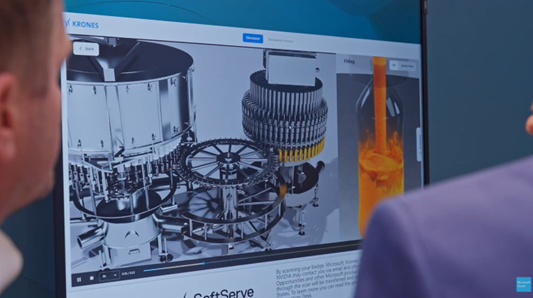
Germany-based filling, packaging, and processing machine builder Krones uses AI in machine design and engineering to manage the high complexity of packaging line configurations, in which 20–30% of customer orders require custom engineering. Traditionally, configuring these systems required extensive manual work, physical testing, and long iteration cycles. Working with Microsoft, Krones embedded AI into configuration, simulation, and commissioning workflows, reducing configuration time from several weeks to a few hours while improving accuracy and reducing engineering effort. In March 2026, Krones was the overall winner of the Microsoft Intelligent Manufacturing Award for developing a new generation of Agentic Digital Twins that help map and optimize its production process.
Changing production between bottle types can be really complex and can result in loss of liquid that you’re trying to fill in… The only way to do this today is by manually setting parameters for each production run or running complex simulations. Krones is able to run the simulation in real time and deliver it to the operations on the factory floor… Now we can react to changes in customer demand in real time and can run production with no losses. This is the power of AI applied to physical infrastructure on the factory floor.
Adam Bogobowicz, Senior Director of Product Marketing, Microsoft
“Our machine configurations are complex and can take weeks to prepare. By applying AI, we aim to shorten this to just hours while enhancing design outputs with 3D models and videos.”
Philipp Olenberg, Head of Artificial Intelligence at Krones AG
Finding 4: AI in machine production – Predictive maintenance leads adoption

Over half of machine builders have deployed predictive maintenance on their own shopfloor. When it comes to the machines they build in their own factories, 54% of machine builders have deployed AI-based predictive maintenance systems, with 18% fully deployed and 36% partially deployed. Deployment of these systems is significantly ahead of all other use cases, with AI-based workflow automation and AI-based machine vision systems at 37% and 35% deployment, respectively. Smaller companies, again, are moving faster: 64% have deployed predictive maintenance, compared to 48% of larger firms.
Adoption example: DMG MORI uses AI to transform operations and quality control

Metal cutting machine builder DMG MORI, based in Japan and Germany, uses AI on the factory floor mainly in quality inspection, issue detection, and technical support:
- AI-based visual inspection – used in quality inspections, especially visual inspection, to improve detection accuracy and reduce defects on the shop floor
- AI agents for autonomous plant operations – introduced to automate and optimize selected production processes as part of the company’s broader autonomous plant vision
- AI-based technical support – allows operators to query complex technical documentation through a conversational interface, helping them solve issues faster
- AI-supported root cause identification – uses production and defect data to identify quality issues more reliably and support faster root cause analysis
DMG MORI says these deployments helped cut manufacturing quality defects by 66.6% and reduce manufacturing preparation costs by 60% across a production footprint spanning 17 sites.
Finding 5: AI in machine service – AI-powered diagnostics is the breakout use case
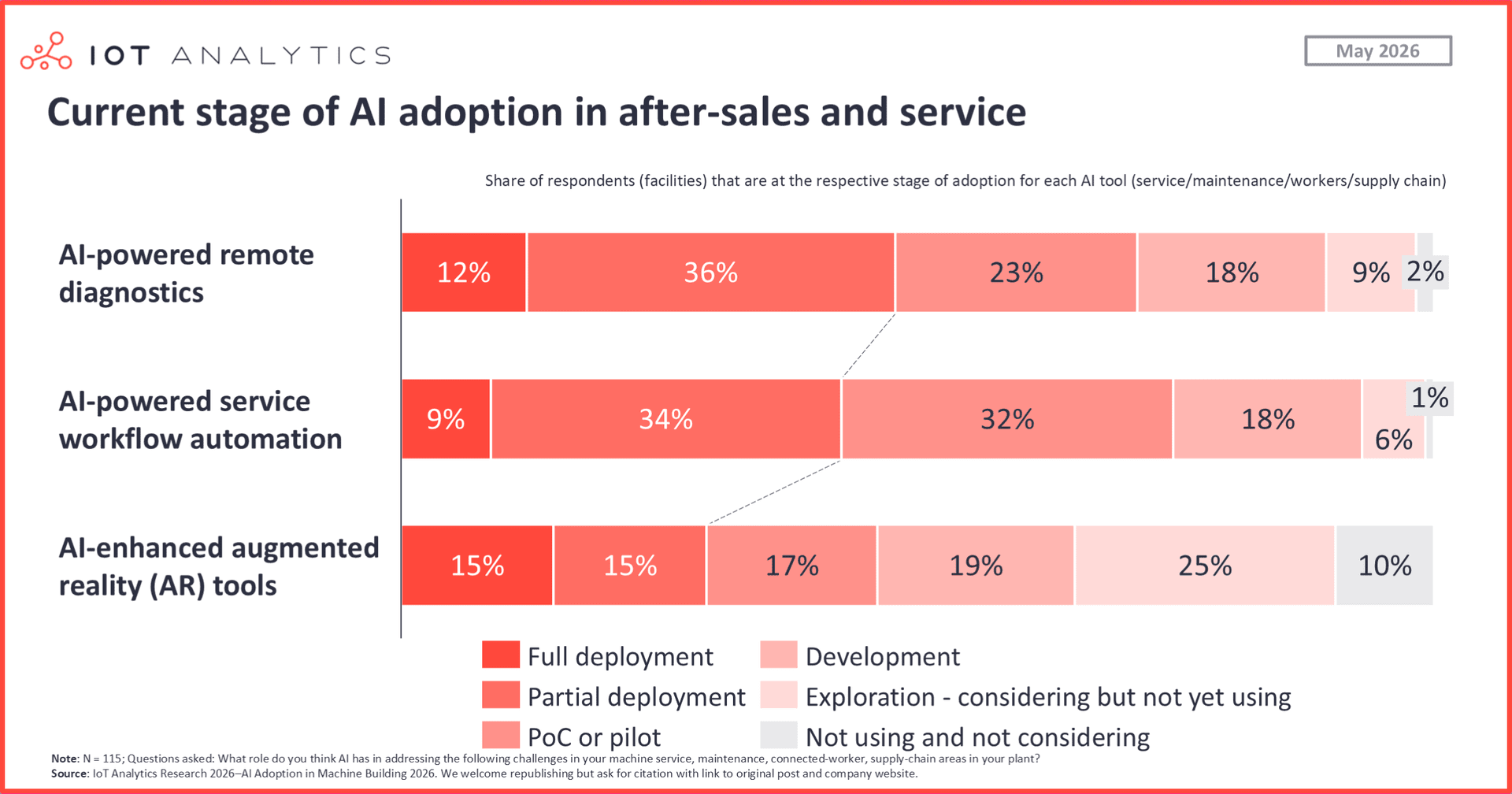
Nearly half of machine builders use AI for remote diagnostics. When it comes to the smart machines that machine builders sell to their customers, AI-powered remote diagnostics is the most adopted use case at 48%. This is followed by service workflow automation (43%) and AI-enhanced augmented reality tools (30%).
Agentic AI starting to appear in this space. 61% of respondents believe AI can significantly address technician skill gaps, the highest-rated AI impact area across the entire after-sales category. As experienced technicians retire and machines grow more complex, AI-assisted diagnostics and training tools are seen as a structural solution. To meet this need, companies like US-based CRM software company Salesforce are positioning AI agents that can automatically create service work orders with the right technician skills and parts attached, which can reduce wasted dispatch calls and improve first-time fix rates.
Adoption example: KONE uses AI to make elevator service more predictive and prescriptive
Finland-based elevator and escalator engineering firm KONE‘s AI strategy is focused on service reliability. The company connects elevators and escalators to cloud analytics so equipment issues can be predicted before users see failures. It is also adding GenAI for technicians so service teams can solve equipment issues faster with asset-specific guidance.
The company’s GenAI-based Technician Assistant, built on Amazon Bedrock to support field technicians, uses manuals, historical maintenance reports, and IoT data from connected devices to answer technical questions in natural language. This helps technicians solve issues without waiting for a technical help desk. The pilot had 100 users for 3 months with no opt-outs. It is now live in 11 countries with around 1,500 active users, with plans to reach 6,000 users and eventually support KONE’s 40,000 technicians.
“It’s saving a lot of time on-site. An elevator that isn’t functioning is a real pain point for the customer, so this decrease in downtime is a significant improvement for our customer service.”
–Tero Hottinen, Vice President of Strategic Partnerships, KONE (source)
Finding 6: AI in smart machines – Robotics and semiconductor equipment lead

Robotics sub-industry leads in adoption; textile machinery lags. IoT Analytics assessed AI adoption across 22 machinery sub-industries using publicly available data and expert interviews. The top 4 are:
- Robotics & automation
- Semiconductor manufacturing equipment
- Construction equipment
- Mining equipment
Meanwhile, the research found lower adoption levels in subindustries such as textile machinery and foundry machinery.
IoT Analytics found that each industry tends to have one or more leaders in AI adoption, often large market leaders that have built sizable digital teams over the past few years. ABB Robotics, for example, is among the leading adopters of AI in the robotics industry with tools such as AI vision (EyeMotion), autonomous navigation (Sevensense Visual SLAM), item picking at >99.5% accuracy, and natural-language robot programming via the RobotStudio AI Assistant rolled out to customers. Komatsu is one of the leading AI adopters in mining equipment, with its FrontRunner autonomous haul truck system (with 1,000 trucks commissioned and 11.5 billion metric tons moved) and Smart Construction Edge for AI-processed drone survey data. Applied Materials stands out in semiconductor machinery with AIx and ChamberAI for process tuning, SEMVision H20 for defect review, and prescriptive troubleshooting.
Analyst takeaway
Several IoT Analytics analysts contributed to the research found in the AI Adoption in Machine Building 2026 report, with analyst Raghav Kadian coordinating the effort. The team spoke with field experts, attended conferences, and reviewed numerous company reports and press releases during the research. Below are 3 key takeaways from the research, including a big picture look at the data, a comparison of small and large machine-building companies, and what is around the corner.
The big picture
- AI adoption patterns vary by machinery subindustry. The 22 sub-industries have fundamentally different customers, physics, business models, and AI rationales. That diversity has practical implications for anyone trying to understand or navigate this market.
- Every sub-sector has a different primary AI motivation. There is no universal playbook. KONE‘s AI strategy is built around service retention and uptime assurance, not cost-cutting. Komatsu is focused on removing human drivers from dangerous mining environments, while John Deere is trying to automate an entire farming season. These are distinct AI strategies shaped by distinct business pressures.
- 96% adoption does not mean uniformity. The near-universal headline figure reflects that every company has found at least one AI use case that fits its context, not that AI is uniformly embedded. Many of those deployments are still pilots, still confined to one site, or still limited to a single process. The hard work of scaling is still ahead for most.
Comparing small vs large companies
- Smaller builders outpacing larger ones in AI adoption. In addition to the 6 findings above, 1 pattern that runs consistently through the survey data is that smaller machine builders are ahead of larger ones in deploying AI across their internal operations, including design, production, and manufacturing use cases. This may reflect structural advantages: faster decision cycles, less legacy system debt, and greater reliance on cloud-native tooling that bundles AI by default.
- Larger firms showcase commercial AI productization more often. A different picture emerges when looking beyond the survey data. At major machinery trade fairs (including BAUMA, EMO, and automatica, or Interpack), some of the larger companies have consistently showcased the most mature, commercially developed AI capabilities in the machines they sell. Dedicated AI product lines, branded platforms, and at-scale customer deployments in the field appear more prevalent among larger firms, which have the resources to productize AI capabilities and bring them to market across a broad installed base.
What is next? Agentic AI and AI monetization
AI in machine building shifting toward autonomy and monetization. Looking ahead, the team observes 2 AI themes that machine builders are currently trying to solve.
The first is AI monetization. As AI features become standard in smart machines, the commercial question of how to price them remains largely unresolved. Bundle it with the machine? Sell it as a subscription? Tie it to outcomes? Many builders have no clear answer, and without one, AI investment in smart machines risks remaining a cost center rather than a revenue line. Some machinery companies in discussions with IoT Analytics have indicated that they view AI features as an add-on that makes buying from them more attractive (a competitive differentiator) and thus are not planning to charge for them. Others, however, clearly see a commercial angle and are planning to sell AI features as add-ons to their overall platform offerings.
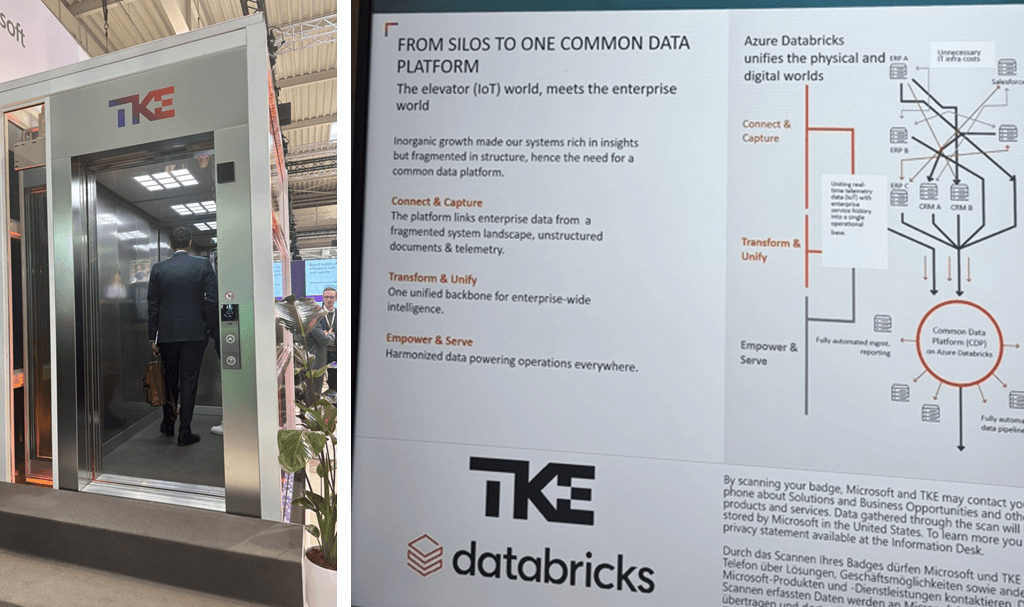
The second is agentic AI, systems that go beyond simply generating outputs to autonomously retrieve data, reason across sources, and act as part of the workflow. Very few machinery companies seem to have a full agentic strategy in place at this point. One of the few is TK Elevator, which at Hannover Messe 2026, showed a suite of agents for elevator service and maintenance. The company has, for example, rolled out voice-enabled briefing and debriefing agents to structure technician workflows so that service technicians arrive at an elevator prepared.
Further analysis
Below, in our Insights+ section, we share the companies leading in each of the 22 machinery sub-industries and profile 5 of them, all from the AI Adoption in Machine Building 2026 report.
Access key market data for $99/month per user
The Insights+ Subscription unlocks exclusive facts & figures. You will gain access to:
- Additional analyses derived directly from our reports, databases, and trackers
- An extended version of each research article not available to the public
Full report access not included. For enterprise offerings, please contact sales: sales@iot-analytics.com
