
In short
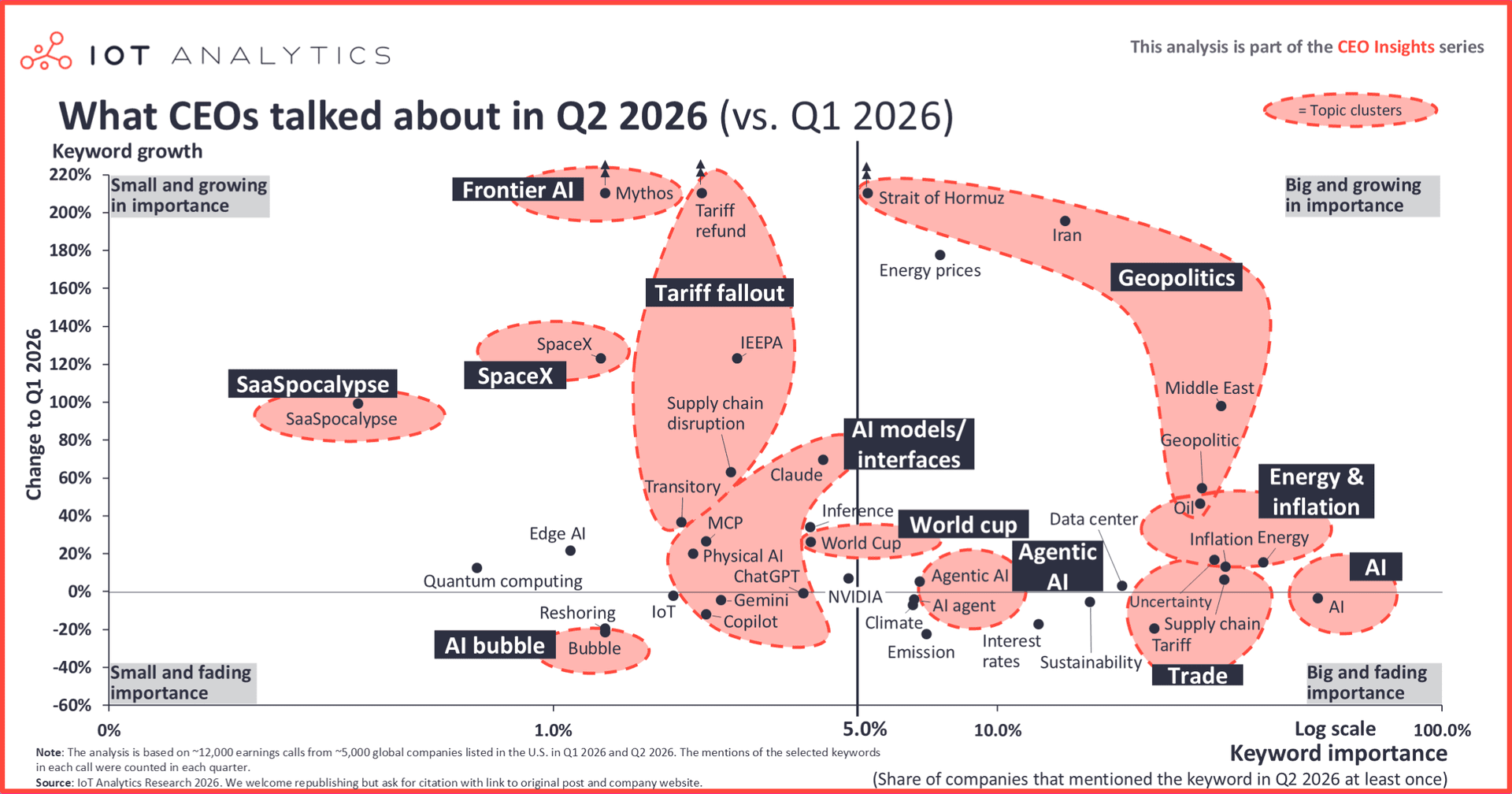
- According to IoT Analytics’ latest What CEOs Talked About report, AI remained the top topic in CEOs’ minds in Q2 2026, though it declined slightly quarter-over-quarter.
- Discussions about Iran and the Strait of Hormuz climbed sharply, as did related geopolitical and economic impact topics, including oil, energy, inflation, and uncertainty.
- Frontier AI model “Mythos” took the stage in corporate boardrooms, and mentions of Claude surpassed those of ChatGPT for the first time.
- Discussions around an AI bubble and sustainability continued to decline.
Why it matters
- The prioritization of specific topics by CEOs may influence investment in these areas.
In this article
The big picture
Iran, the Strait of Hormuz, and the economic impact
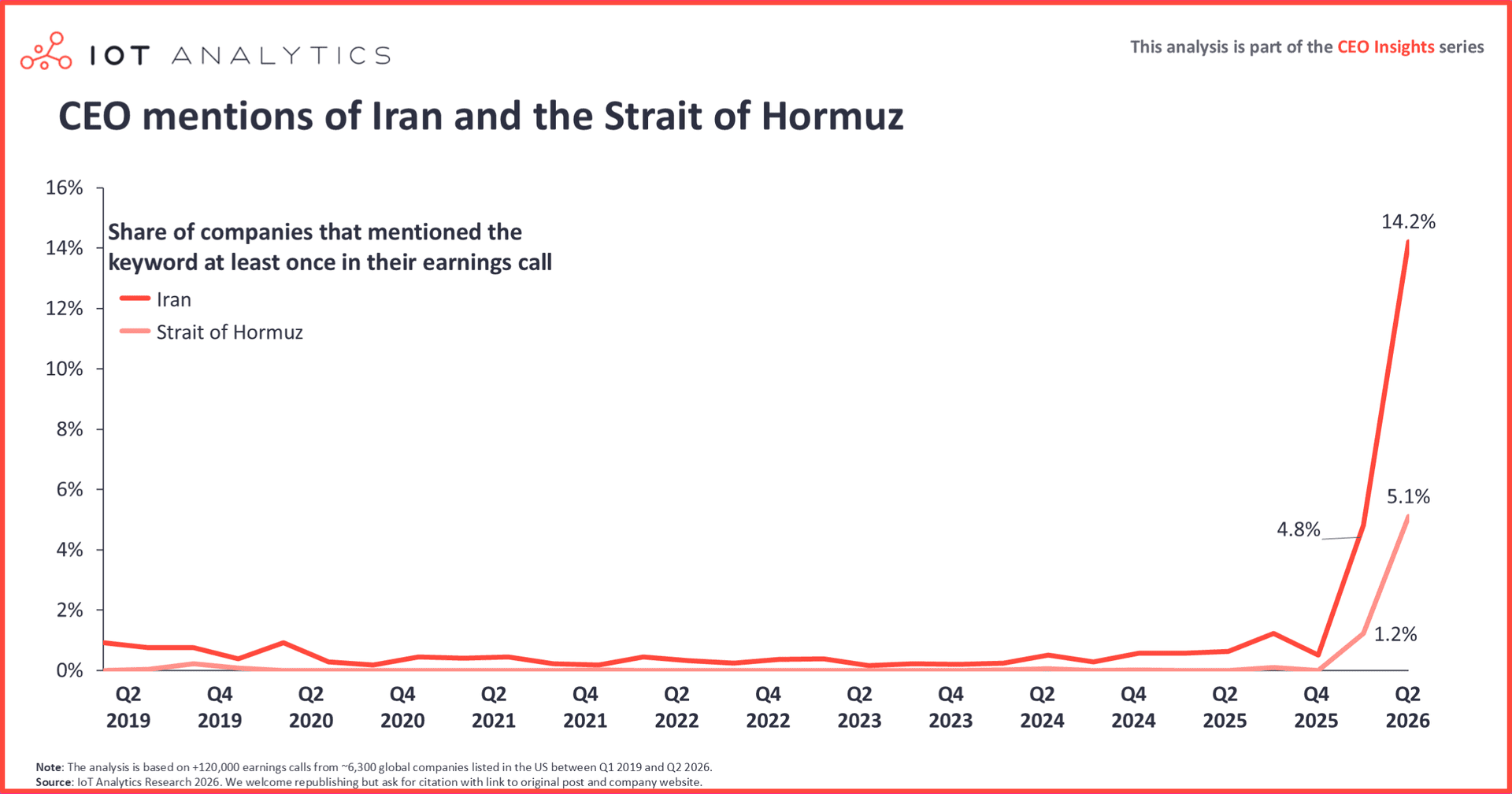
Ongoing conflict drives discussions about energy prices and inflation. The conflict between the US and Iran has lasted for more than 120 days and has been accompanied by elevated energy costs, inflation, and uncertainty. Corporate boardroom discussions around Iran have continued their sharp climb over Q1 2026, up 196% quarter-over-quarter (QoQ) to 14% of calls. Climbing with it were discussions around the Strait of Hormuz (up 200% QoQ to 5%), the world’s most critical maritime energy chokepoint, and with it, energy prices (up 178% QoQ to 40%) and oil (up 46% QoQ to 29% of calls).
As of this article, the Strait of Hormuz has reopened due to a memorandum between the US and Iran, though passage remains below pre-conflict levels and both countries have once again exchanged strikes. Prior to the strait reopening, however, countries have had to tap into their strategic oil reserves, with the US’s reserves being drained to their lowest levels in over 40 years.
Along with energy prices, the cost of goods has also gone up. The annual inflation in the US reached 4.2% in May, and CEOs discussed inflation in 33% of earnings calls (+13% QoQ). While CEOs discussed interest rates less in Q2 2026 (down 18% QoQ to 12% of calls), the US Federal Reserve—now chaired by Kevin Warsh—elected to maintain benchmark interest rates at 3.5%–3.75%.
The CEO digital agenda
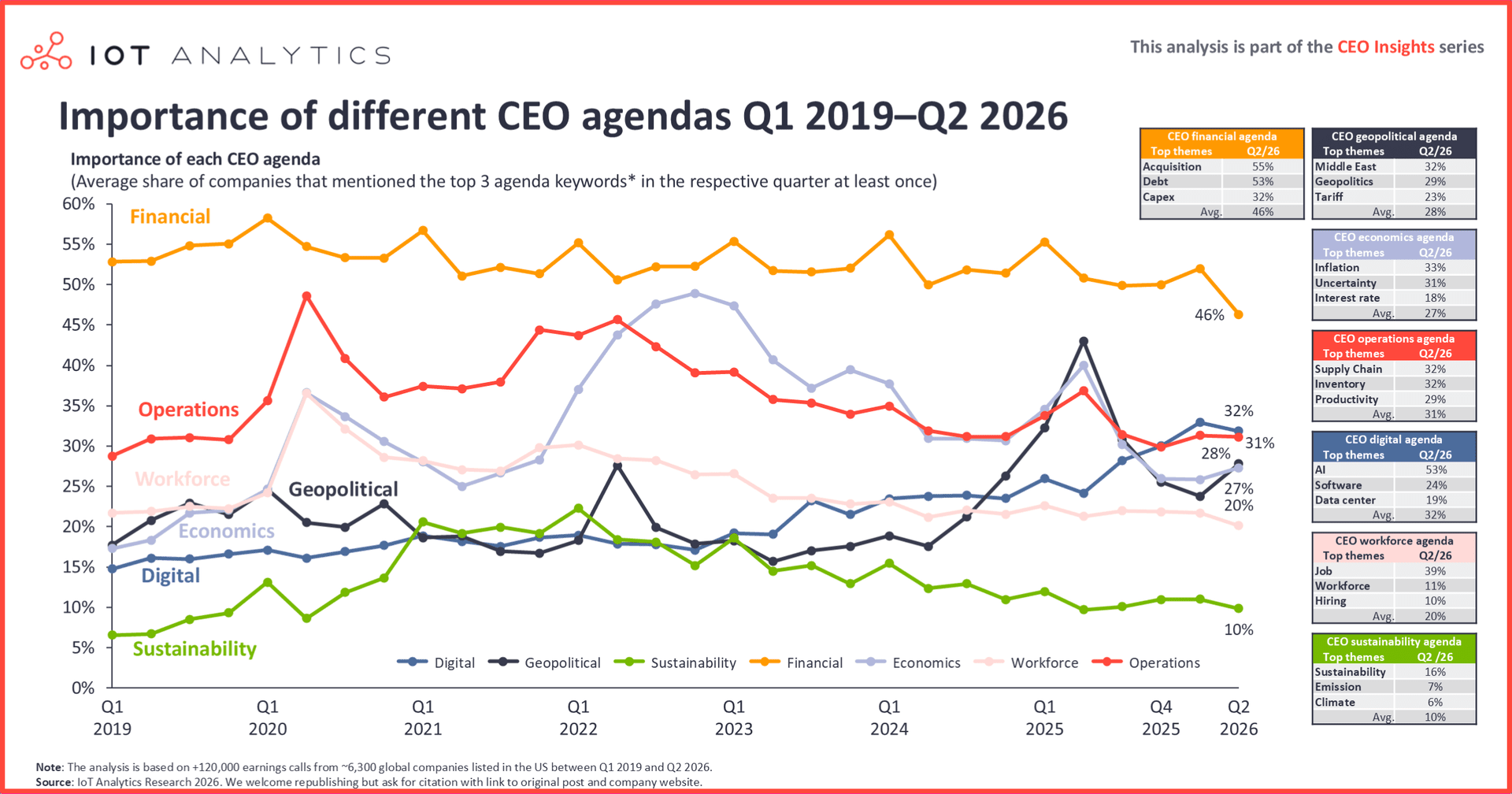
The digital agenda remains very important. CEOs continue to put a strong emphasis on digital topics during earnings calls. The CEO digital agenda remained the 2nd-highest agenda topic in Q2 2026, propped up by AI continuing to be the most discussed topic. However, the agenda ticked down 1 percentage point as attention turned toward geopolitical and economic discussions in light of the US–Iran conflict and the economic impacts. Within the CEO digital agenda, the top 3 digital topics were:
- AI – 53% of calls (down 4% QoQ)
- Software – 24% (down 7% QoQ)
- Data centers – 19% (up 3% QoQ)
Insights from this article are derived from
Quarterly Trend Report: What CEOs talked about in Q2 2026
A 73-page report on the trends that emerged in Q2 2026 earnings calls. The report is based on data from 120,000+ earnings calls of US-listed companies from Q1 2019 through Q2 2026.

Already a subscriber? View your reports and trackers here →
Rising topics
1. Geopolitics
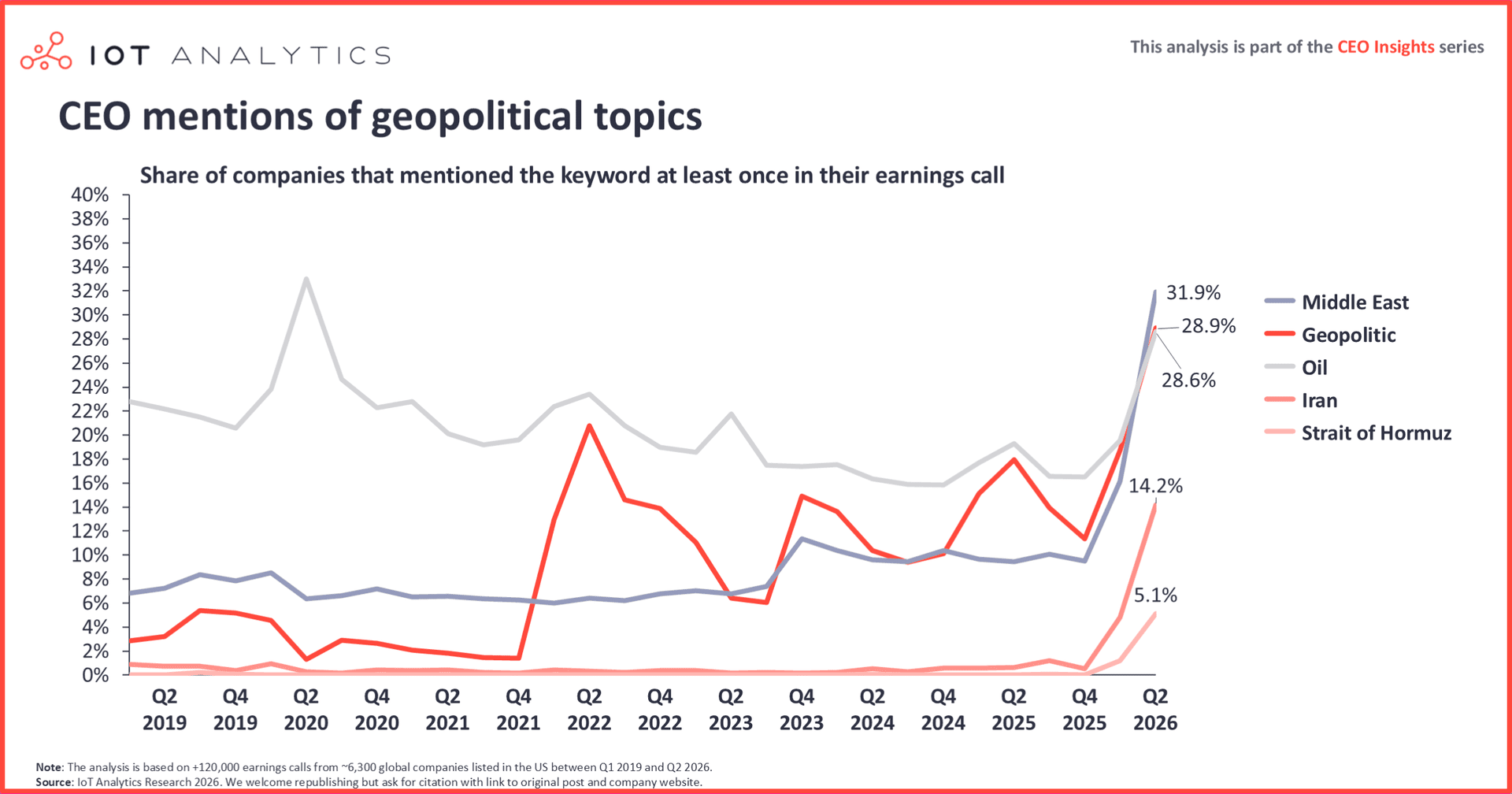
Ongoing conflict led to increased geopolitical discussions. Coinciding with Iran’s 196% rise to 14.2% of calls, there was a rise in mentions of other terms related to the US–Iran conflict:
- Middle East – Up 98% QoQ to 32% of calls
- Geopolitic – Up 54% QoQ to 29% of calls
- Oil – Up 46% QoQ to 29% of calls
- Strait of Hormuz – Up 200% to 5% of calls
3 key themes stand out from the calls that discussed these topics:
1. Rerouting and rationing supply around the closed Strait of Hormuz
With roughly a fifth of seaborne crude and LNG offline, operators are activating alternative routes, widening their supplier base, and curtailing output in reversible ways.
Key CEO quote
“Although the Strait of Hormuz remains effectively closed, our teams are implementing alternative routes […] we estimate a future rebuild and restart opportunity of approximately $100 million.”
Surendralal Karsanbhai, President & CEO, Emerson, May 2026
2. Holding guidance on a near-term reopening
Some companies declined to extrapolate the worst case, building plans around a resolution within weeks, while others warned that complacency is the real risk.
Key CEO quote
“There’s a lot of people being a little bit dismissive of what’s going on in the world […] geopolitical risk is absolutely the biggest risk that the world has […] the narrative of the story changes by the second.”
Terrence Duffy, Chairman & CEO, CME Group, June 2026
3. The same shock that hurts most creates clear winners
For defense-adjacent security, energy infrastructure, exchanges, solar and nitrogen players, the war is a demand catalyst.
Key CEO quote
“The war in Iran impacts these prices […] not only an increase in demand for [photovoltaic (PV)] only, but actually an increasing demand for PV plus storage […] both in [commercial & industrial] and in [residential].”
Yehoshua Nir, CEO, SolarEdge, May 2026
2. Energy & inflation
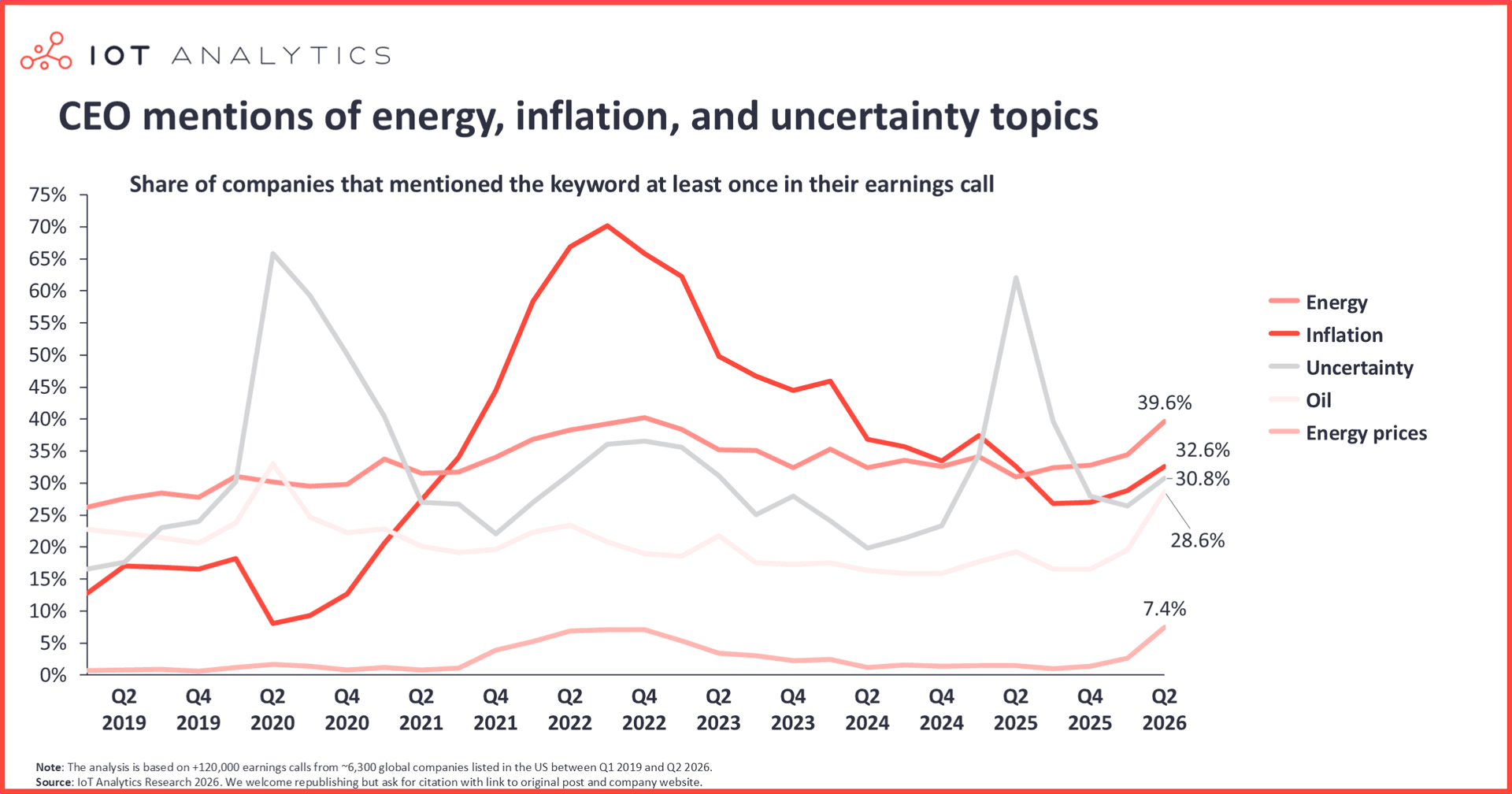
Economic discussions also rose amid conflict. Riding on the sharp rise in topics around the US–Iran conflict are increases in discussions about economic topics:
- Energy – Up 15% QoQ to 39.6% of calls
- Inflation – Up 13% QoQ to 32.6% of calls
- Energy prices – Up 178% QoQ to 7.4% of calls
- Uncertainty – Up 17% QoQ to 30.8% of calls
4 key themes stand out from the calls around energy and inflation:
1. Energy is the new inflation driver
CEOs see the renewed rise in inflation coming from the Iran conflict, flowing through oil, fuel, freight, and energy-linked raw materials, and most expect the cost impact to hit later in the year rather than now.
Key CEO quote
“Due to geopolitical conflicts, especially the Iran war, energy prices may be higher for longer, and this certainly has an impact on the entire inflation numbers […] it would certainly be higher than the 2%.”
Hans-Peter Kneip, CEO, CFO & Member of the Executive Board, Deutsche EuroShop, April 2026
2. Naming the specific input costs
CEOs are pointing to the specific cost lines under pressure, e.g., copper and silver, oil-based materials, plastics, freight, and electronic components, with server and memory costs standing out as a sharp, separate spike.
Key CEO quote
“End of last year, we had also an increase of raw material, for instance, in copper and silver. And this year […] the inflation cost of energy or indirect cost increase because of other materials impacted by the Middle East crisis […] we have to be much more reactive and much more tactical.”
Olivier Blum, CEO, Schneider Electric, April 2026
3. Offsetting inflation through pricing and productivity
The dominant mental model is a two-lever offset: Raise price where pricing power exists; otherwise grind out productivity, with some firms vowing to recover cost “dollar for dollar.”
Key CEO quote
“We are seeing an increase in input costs as a result of new tariffs, fuel and raw material prices. We expect to offset these headwinds dollar for dollar through supply chain actions, cost reduction and increased pricing […] an additional 2 points of pricing globally this year.”
David Gitlin, Chairman & CEO, Carrier, April 2026
4. The “transitory vs. sticky” debate
Management leans on “transitory” to frame the war-driven spike as temporary and acts accordingly, but “how much is permanent” is now the main question.
Key CEO quote
“The question obviously is, is this inflation more permanent in nature? Or is it more […] transitory in nature? […] We are about $65 million more inflation than originally anticipated […] part of it is probably going to be there for a while, given […] some capacity has been taken out of the market.”
Robbert Rietbroek, President & CEO, Graphic Packaging, June 2026
3. Frontier AI
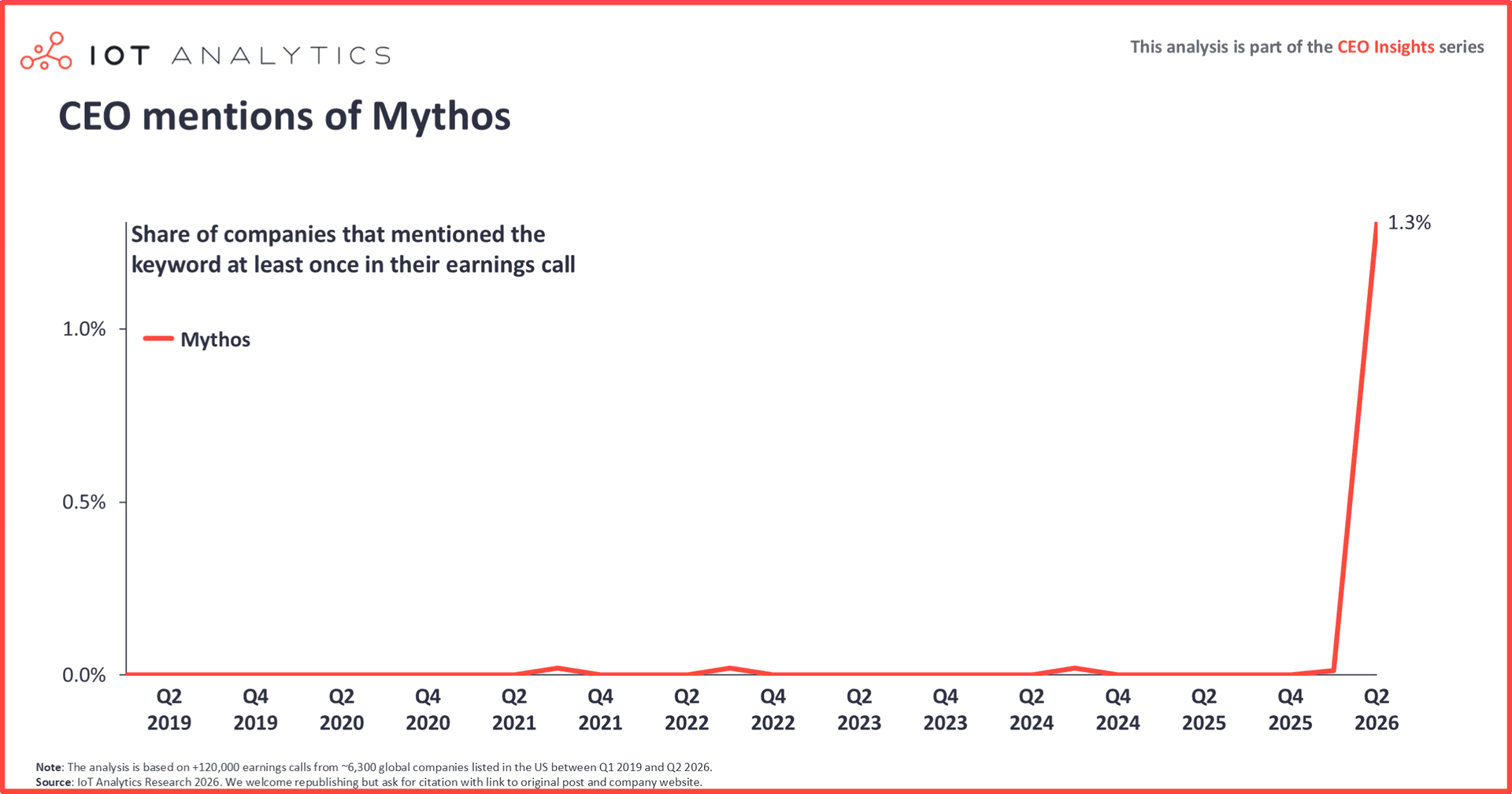
Anthropic’s newest model entered the discussions. Perhaps the biggest AI news in Q2 2026 was the release (then sudden restriction) of US-based AI company Anthropic’s Mythos 5 model. Billed as Anthropic’s most capable model for high-level reasoning and agentic work, Mythos surpassed competitor models on numerous benchmarks. CEOs began taking notice of Mythos as a frontier AI model, with discussions reaching 1.3% of earnings calls.
Mythos was deemed so powerful in its biological, chemical, and cybersecurity reasoning that Anthropic released a safeguarded version known as Fable 5, keeping Mythos limited to the US government, critical infrastructure providers, and trusted cybersecurity firms. However, Fable may not be as safeguarded as assumed. On June 12, 2026, the US government warned Anthropic about a jailbreak that allowed Fable to identify security flaws in code and function effectively like its Mythos counterpart. While great for developers trying to build secure software, it could also enable bad actors to circumvent software security. This led the US Department of Commerce to issue an export control directive, ordering that the model be kept from non-US persons, including Anthropic’s own foreign national employees. Since Anthropic did not have a nationality validation system in place, the company elected to simply cut off access to everyone.
As of this article, however, the US government lifted its export controls on Fable and Mythos, with broad access expected to resume on July 1, 2026. Questions still remained as to whether Fable’s supposed jailbreak was any worse than what is capable from other models that have not faced similar restrictions, especially in light of the US Department of Defense labeling Anthropic as a supply chain risk, something never before levied on an American company.
Nonetheless, one strong testament to the potential power of the overarching Mythos model arose in Q2 2026. On June 11, US Senator Mark Warner, vice chair of the Senate Intelligence Committee, shared that the director of the NSA and US Cyber Command, General Joshua Rudd, claimed that Mythos gained access into all of the NSA’s classified systems within hours during authorized, controlled testing (note: some outlets framed this as Mythos breaching NSA systems, without the context of it being controlled testing).
Key CEO quotes about Mythos
“I can tell you CEO after CEO who called their CISOs on the weekend saying, ‘Is this thing really a problem? What does it mean for us?’ […] this is from the back room to the boardroom.“
George Kurtz, Co-Founder, President, CEO & Director, CrowdStrike, June 2026
“Mythos does not represent a fundamentally new category of risk, but there is an acceleration of existing cyber threats through AI automation. So what really changes is the speed, not the nature of the attack […] with the same tools, trying to be much more agile.”
Jacobo Díaz, Chief Financial Officer, Bankinter, April 2026
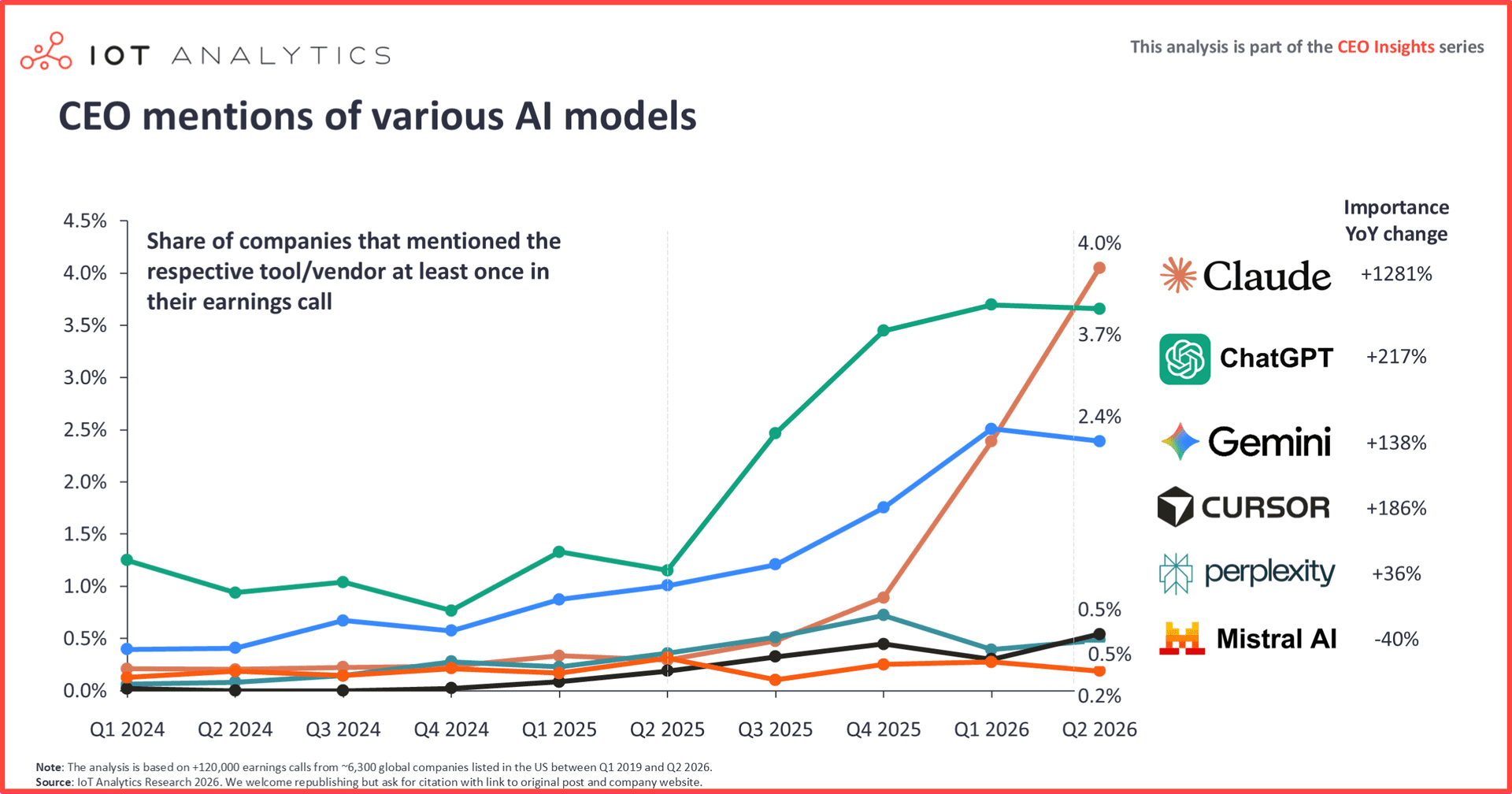
Coinciding with the increased attention on Mythos, mentions of Anthropic’s flagship model family, Claude (up 69% QoQ to 4% of calls), have surpassed mentions of ChatGPT (down 1% to 3.7% of calls) for the first time.
Declining topics
1. AI bubble
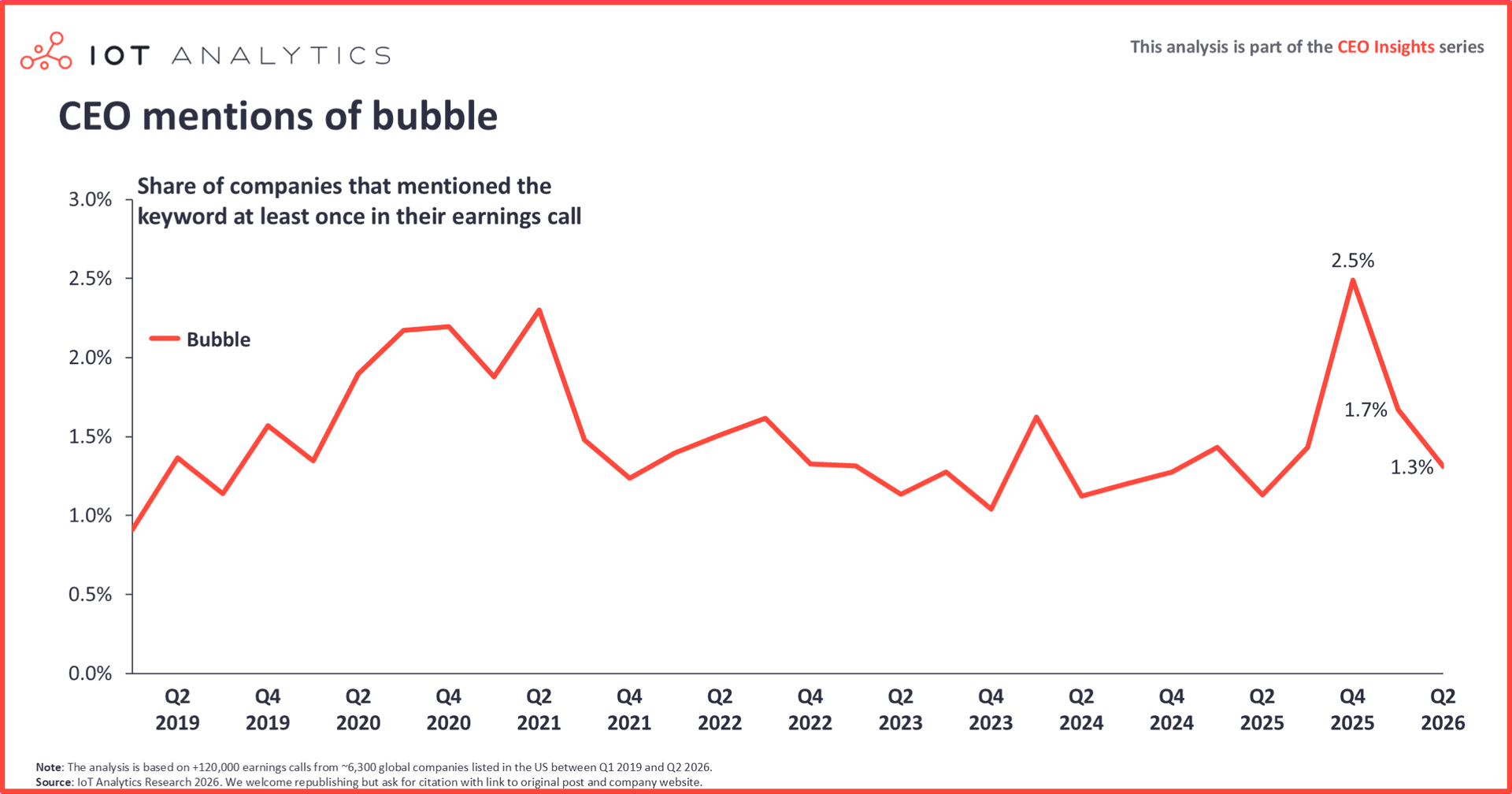
Concerns about an AI bubble appear to be easing. Mentions regarding a potential bubble dropped 22% QoQ to 1.3% of calls. The 2 main camps regarding the topic are those who believe the value or demand for AI outweighs the risk of a bubble, while others believe there is or will be a partial bubble.
Key CEO quote about the demand for AI
“This isn’t about an AI bubble when you talk to these customers. It’s about what’s coming, the demand is real. And again, they’re building to a demand signal that’s 2 and 3 years from now. And today, they’re asking us to go faster. So, I think that speaks to where the demand will be as we go forward.”
Christopher Stansbury, CFO, LUMEN, May 2026
Key CEO quote about there being a partial AI bubble
Well, I think it’s going to be a lot like the dot-com, except I don’t think we’re going to follow that type of bubble because most of the enterprises that are making these investments have $1 trillion balance sheets. They’re not start-ups. But what I would say is companies that adopted the Internet are the ones that have flourished from a technological perspective.”
David Steinberg, Co-Founder, Chairman of the Board & CEO, Zeta Global, May 2026
2. Sustainability
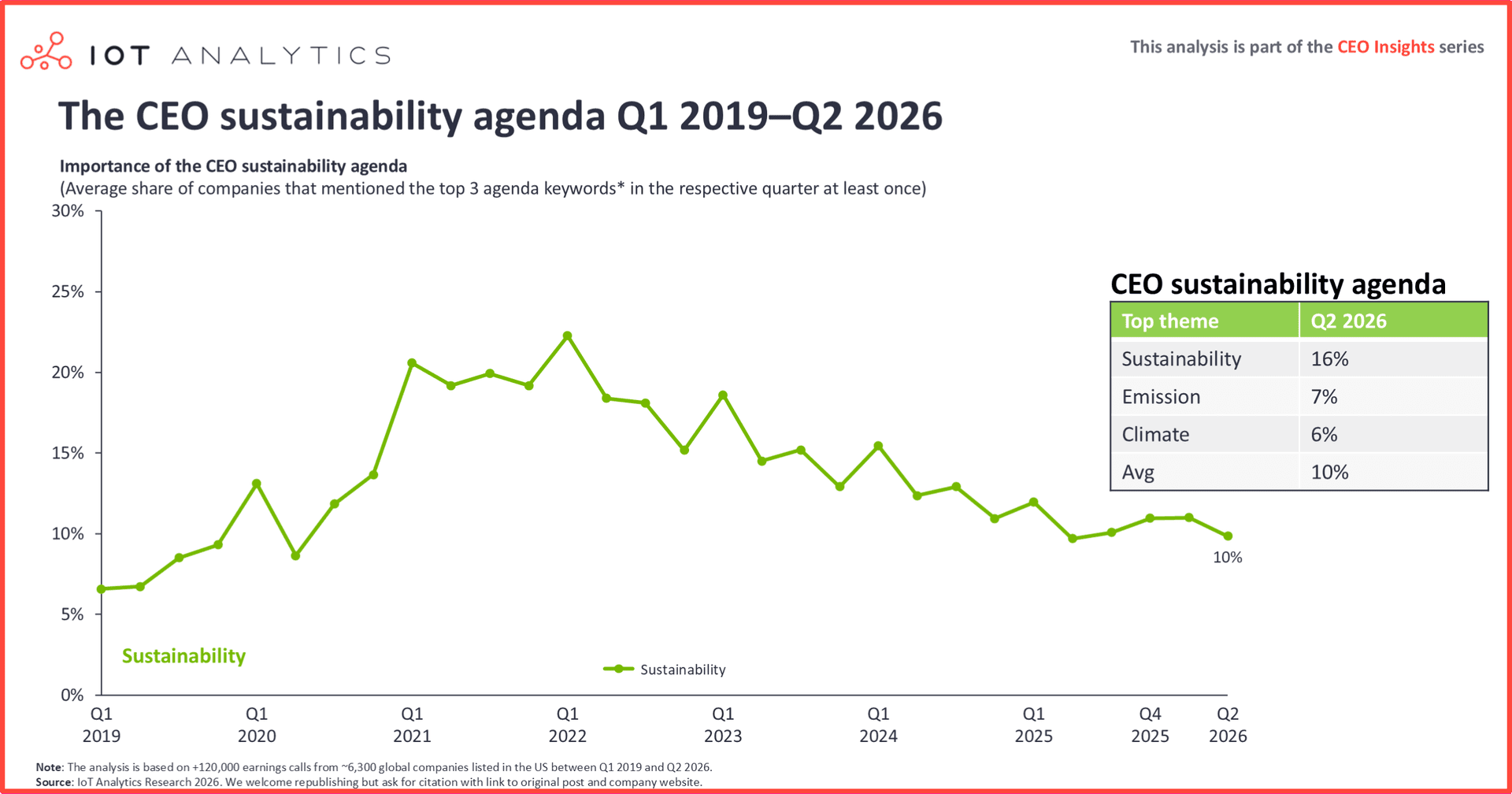
CEO sustainability agenda continued its gradual downward trend. In Q2 2026, the average share of calls on the top 3 sustainability-related topics—sustainability, emissions, and climate—was 10%. For reference, at the peak of the agenda in Q1 2022, the top 3 sustainability-related topics averaged 22%.
Further analysis
Below in our Insights+ section, we share more analysis from the What CEOs Talked About Q2 2026 report, including:
- The 10 key takeaways from the report
- The CEO digital agenda by sector (with key digital themes and trends)
- How CEOs discussed AI in detail
- Common manufacturing challenges discussed
Access key market data for $99/month per user
The Insights+ Subscription unlocks exclusive facts & figures. You will gain access to:
- Additional analyses derived directly from our reports, databases, and trackers
- An extended version of each research article not available to the public
Full report access not included. For enterprise offerings, please contact sales: sales@iot-analytics.com
