
In short
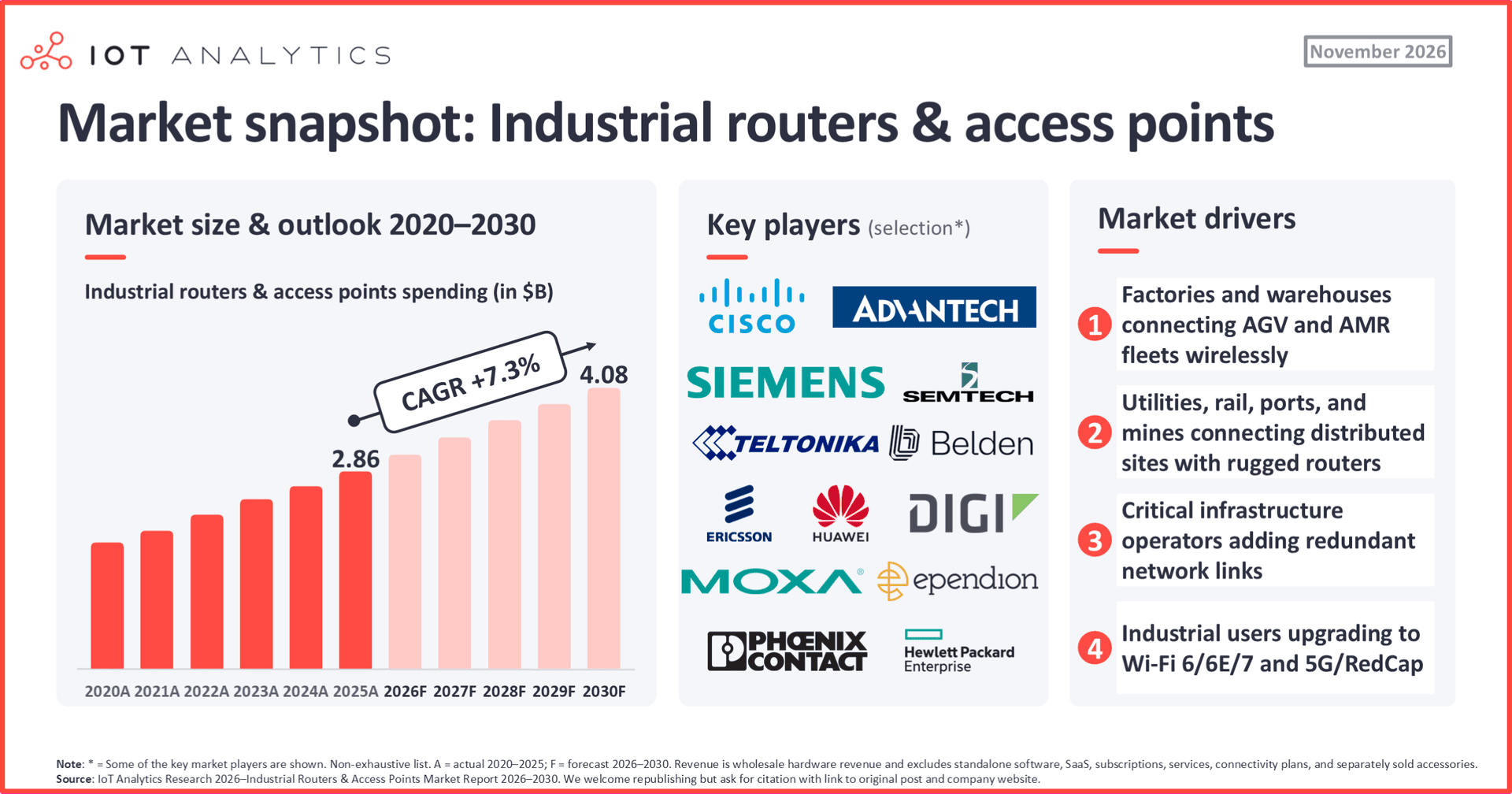
- Market expected to surpass $4 billion. According to IoT Analytics’ Industrial Routers & Access Points Market Report 2026–2030, the industrial router and access point market reached $2.86 billion in 2025 and is projected to grow at a 7.3% CAGR to $4.08 billion by 2030.
- Mobile automation and distributed sites drive demand. AGVs and AMRs in factories and warehouses, remote utility, rail, port, and mining sites, and redundant links at critical infrastructure multiply the connections that need industrial access hardware.
- Wi-Fi 6/6E and 5G lead the upgrade cycle. Wi-Fi 6/6E is expected to account for nearly 70% of industrial Wi-Fi revenue by 2030, while 5G/RedCap is expected to reach 59.2% of cellular revenue.
In this article
- Industrial router and access points market snapshot and outlook
- 4 industrial routers and access points market drivers
- 1. Factories and warehouses deploying AGVs and AMRs that need wireless coverage and on-board connectivity
- 2. Utilities, rail, ports, and mines connecting distributed sites with rugged routers
- 3. Critical infrastructure operators adding redundant network links
- 4. Industrial users replacing aging hardware with Wi-Fi 6/6E, Wi-Fi 7, and 5G/RedCap equipment
- Frequently asked questions about the industrial routers and access points market
- Further analysis
- Industrial routers and access points spending by region (Insights+ Exclusive)
- Industrial routers and access points competitive landscape (Insights+ Exclusive)
Industrial routers and access points market snapshot and outlook
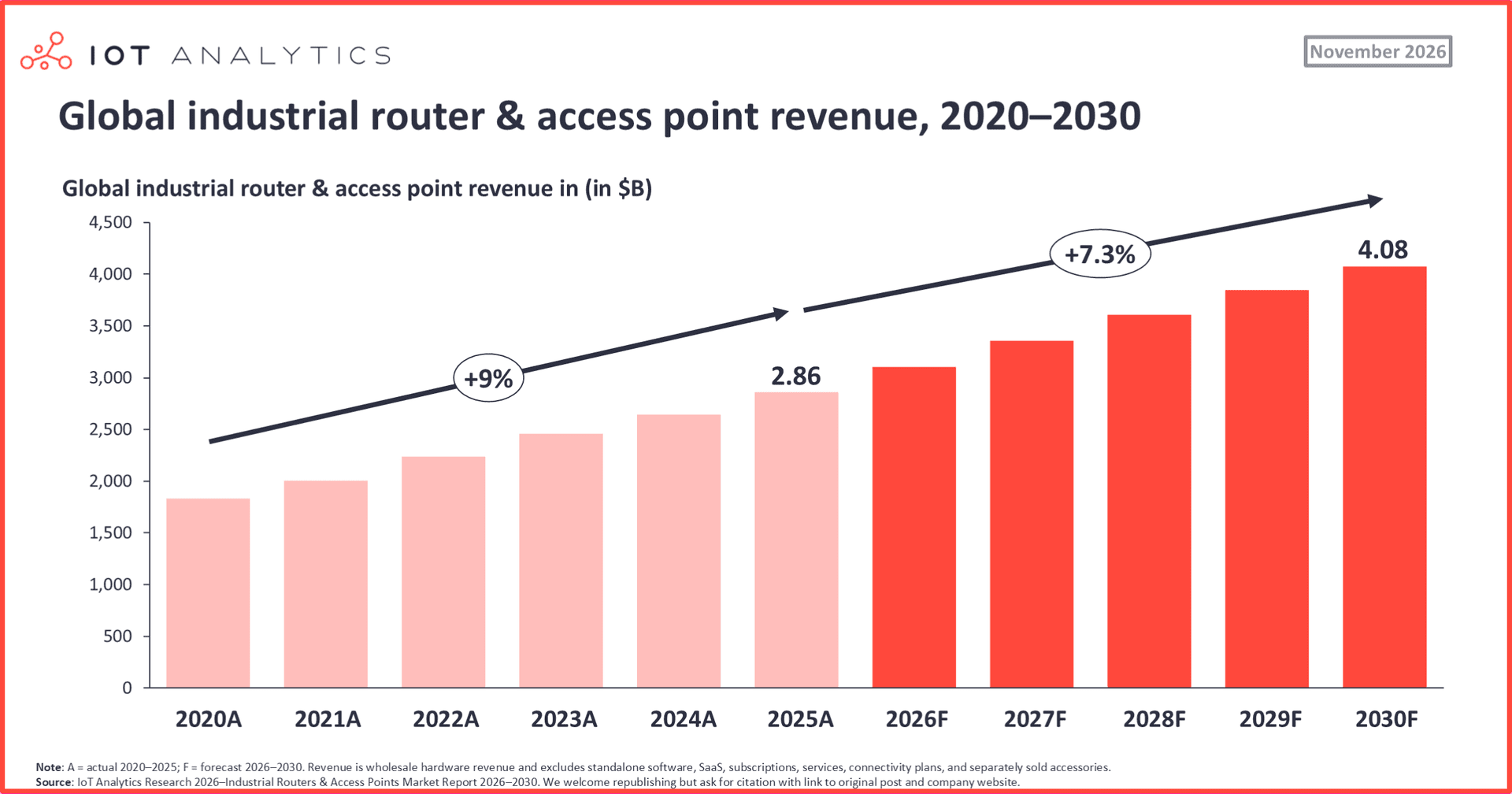
Market growth slowing but still adding $1.21 billion by 2030. Industrial router and access point market revenue reached $2.86 billion in 2025 and is forecast to reach $3.11 billion in 2026, according to IoT Analytics’ 54-page Industrial Routers & Access Points Market Report 2026–2030 (published October 2026). The report projects a 7.3% CAGR through 2030, reaching $4.08 billion. This is lower than the 9% CAGR between 2020 and 2025, but the market adds more revenue in the forecast period, $1.21 billion compared with $1.03 billion.
Wi-Fi drives most additional hardware shipments, while cellular benefits from higher-value equipment. Annual shipments are forecast to increase from 4.6 million in 2025 to 6.6 million in 2030, while blended ASP remains nearly unchanged at approximately $620. Wi-Fi accounts for around 75% of incremental shipments, while the growing share of higher-priced 5G/RedCap routers supports faster cellular revenue growth.
The market covers 3 device classes. The industrial access points market includes:
- Industrial Wi-Fi access points, clients, and bridges
- Industrial cellular routers and CPE
- Wired industrial routers
Revenue covers wholesale hardware only and excludes IoT gateways, industrial Ethernet switches, firewalls, private 5G infrastructure, software, and services.
Insights from this article are derived from
Industrial Routers & Access Points Market Report 2026–2030
A 54-page report on the industrial routers and access points market, with market sizing, forecasts to 2030, technology trends, and vendor analysis. Also available as a premium bundle with the Industrial Access Points Market Tracker and Forecast, which provides revenue, shipments, and ASP for 2020–2030 by vendor, connectivity type, Wi-Fi and cellular generation, region, and industry vertical.
Already a subscriber? View your reports and trackers here →
4 industrial routers and access points market drivers
Demand for industrial access hardware grows with how operations are designed, not just how many sites are built. Mobile automation and distributed operations multiply the number of points that need a connection, resilience requirements add redundant links at critical sites, and the move to newer Wi-Fi and 5G generations accelerates replacements.
The following 4 drivers increase demand for industrial access hardware through greater mobile connectivity requirements, more connected sites, redundant network links, and replacement of aging equipment.
1. Factories and warehouses deploying AGVs and AMRs that need wireless coverage and on-board connectivity
Mobile automation increases demand for industrial WLAN infrastructure and client hardware. Factories and warehouses are deploying more AGVs, AMRs, and other mobile assets that require reliable wireless coverage and on-board connectivity. Hardware demand therefore depends on coverage, topology, and the number of mobile endpoints, rather than scaling one-for-one with robot installations.
Select recent market development: Cisco is extending enterprise Wi-Fi infrastructure into industrial mobility applications.
In an April 2026 webinar, US-based network hardware company Cisco demonstrated how its Ultra-Reliable Wireless Backhaul (URWB) technology operates on industrial IW9165 and IW9167 access points and selected enterprise Wi-Fi 6/6E/7 models. This lets the same wireless infrastructure support both conventional Wi-Fi clients and moving industrial assets, including AGVs and forklifts, using shared network management tools. By bringing industrial mobility capabilities into enterprise WLAN products, Cisco is increasing competition with traditional OT networking vendors.
2. Utilities, rail, ports, and mines connecting distributed sites with rugged routers
Distributed industrial operations require additional rugged connectivity at remote and mobile sites. Utilities, rail networks, ports, mining operations, and other geographically dispersed environments use industrial cellular routers and wireless links to connect field assets and sites. New sites, network extensions, and resilience requirements increase demand for access hardware.
Select recent market development: Teltonika is extending rugged 5G connectivity to mobile transport applications.
In July 2025, Lithuania-based Teltonika Networks introduced its first 5G transport router, the ATRM50, designed to connect onboard equipment in rail and other transport vehicles to external networks. The router combines 5G connectivity with EN 50155 and EN 45545 rail certifications and operates from -40°C to 75°C. This illustrates the need for rugged cellular connectivity across mobile industrial operations.
3. Critical infrastructure operators adding redundant network links
Critical infrastructure operators deploy additional routers to improve network resilience. In a modernization project involving 1,000+ existing-site migrations and 4,000+ new sites, a European energy distribution company selected Taiwan-based industrial IoT and edge computing company Advantech‘s ICR-2431 LTE router. While standard sites use dual-SIM routers for network redundancy, critical locations use 2 LTE routers operating across separate mobile networks in hot-standby mode, with satellite connectivity as a 3rd backup path. This illustrates how resilience requirements increase hardware demand beyond the primary connection.
4. Industrial users replacing aging hardware with Wi-Fi 6/6E, Wi-Fi 7, and 5G/RedCap equipment
Wi-Fi 6/6E remains the main industrial WLAN upgrade, while 5G increases cellular hardware value. Industrial users are replacing aging Wi-Fi and cellular equipment, but the technology transitions differ. Wi-Fi 6/6E and Wi-Fi 7 together are forecast to account for 79.1% of industrial Wi-Fi revenue by 2030, up from 40.4% in 2025. However, Wi-Fi 6/6E accounts for nearly 70% of 2030 revenue, compared with approximately 9% for Wi-Fi 7. In cellular, 5G/RedCap is expected to account for 59.2% of revenue by 2030, while 4G/LTE still represents approximately half of shipments.
This shows that Wi-Fi 6/6E remains the main WLAN replacement generation through 2030, whereas 5G adoption increases the share of higher-value cellular equipment. Revenue, shipments, and ASP for Wi-Fi 4, 5, 6/6E, and 7 and for 4G/LTE and 5G/RedCap, by year to 2030, are available in the tracker.
Analyst opinion on the industrial router & access point market

Satyajit Sinha is a senior principal analyst in our Hamburg, Germany office. He leads the hardware and connectivity research team, focusing on IoT components, chips, modules, and other hardware, as well as IoT connectivity and security.
Legacy equipment compatibility may be a bigger challenge for industrial wireless upgrades than hardware pricing. Industrial routers and access points generally require less memory than industrial PCs and compute-intensive gateways, potentially limiting their exposure to memory-price inflation. IoT Analytics forecasts only a 0.5% cumulative increase in blended ASP between 2025 and 2030. However, as IT departments upgrade industrial wireless networks to newer Wi-Fi generations and security standards such as WPA3, older OT devices may struggle to remain connected. This could make backward compatibility and cross-vendor interoperability more important purchasing criteria than wireless performance alone.
Frequently asked questions about the industrial routers and access points market
The industrial router and access point market reached $2.86 billion in 2025 and is projected to grow at a 7.3% CAGR to $4.08 billion by 2030, according to IoT Analytics’ Industrial Routers & Access Points Market Report 2026–2030. Annual shipments are forecast to increase from 4.6 million units in 2025 to 6.6 million units in 2030.
4 drivers increase demand: factories and warehouses deploying AGVs and AMRs that need wireless coverage; utilities, rail, ports, and mines connecting distributed sites with rugged routers; critical infrastructure operators adding redundant network links; and industrial users replacing aging hardware with Wi-Fi 6/6E, Wi-Fi 7, and 5G/RedCap equipment.
5G/RedCap is expected to account for 59.2% of industrial cellular revenue by 2030. However, 4G/LTE is still expected to represent approximately half of cellular shipments, as higher-priced 5G/RedCap routers drive revenue growth faster than unit growth.
Further analysis
Below, in our Insights+ section, we take a regional look at industrial access point spending and share the market competitive landscape, all from our Industrial Routers & Access Points Market Report 2026–2030 and the accompanying Market Tracker and Forecast.
Access key market data for $99/month per user
The Insights+ Subscription unlocks exclusive facts & figures. You will gain access to:
- Additional analyses derived directly from our reports, databases, and trackers
- An extended version of each research article not available to the public
Full report access not included. For enterprise offerings, please contact sales: sales@iot-analytics.com
