
In short
- Cellular IoT module shipments grew 15% year-over-year (YoY) in H1 2026, according to IoT Analytics’ Global Cellular IoT Module and Chipset Market Tracker & Forecast (updated September 2026).
- Growth accelerated in Q2, with shipments rising 20.9% YoY and 15% quarter-over-quarter (QoQ).
- LTE Cat 1 bis shipments grew approximately 34% YoY in H1 2026 and accounted for 56% of total incremental shipment growth. Between Q1 and Q2, Cat 1 bis shipments increased 45.3% and contributed approximately 76% of the sequential market increase.
- Chinese module vendors continued to strengthen their global position, with the top 5 largest global cellular IoT module vendors by shipment volume in H1 2026 being from China.
- H1 2026 blended module ASP increased approximately 2.5% YoY, returning to growth after 4 consecutive quarters of YoY decline. Rising memory and component costs contributed to renewed pricing pressure, although rapid growth in lower-priced Cat 1 bis modules continued to limit the increase in overall blended ASP.
Why it matters
- Q2’s shipment acceleration, rising component costs, and shifting vendor positions affect module sourcing, pricing, and technology planning. Network operators, device and module manufacturers, and component players should study market projections to make informed decisions.
In this article
- The big picture: Cellular IoT module shipment growth is concentrating around newer, lower-power technologies
- Cellular IoT module shipments: H1 2026 growth accelerated sharply in Q2
- Cellular IoT module vendor actions: Spin-offs, mergers, and sales
- Cellular IoT module competitive landscape: Chinese companies take top 5 vendor spots; Chinese vendors gain ground in automotive
- Cellular IoT module market outlook: H2 2026 is expected to remain strong as pricing and technology dynamics shift
- Further analysis
- Cellular IoT module revenue vs shipments (Insights+ Exclusive)
- Cellular IoT chipset revenue (Insights+ Exclusive)
- Revenue growth across the top 5 verticals by shipment (Insights+ Exclusive)
The big picture: Cellular IoT module shipment growth is concentrating around newer, lower-power technologies
Cellular IoT connectivity is moving onto a new generation of low-power technologies, and shipment volumes are following. As mobile operators switch off their 2G and 3G networks, a wave of new device deployments is settling on a small set of newer, lower-power, and lower-cost categories, led by LTE Cat 1 bis.
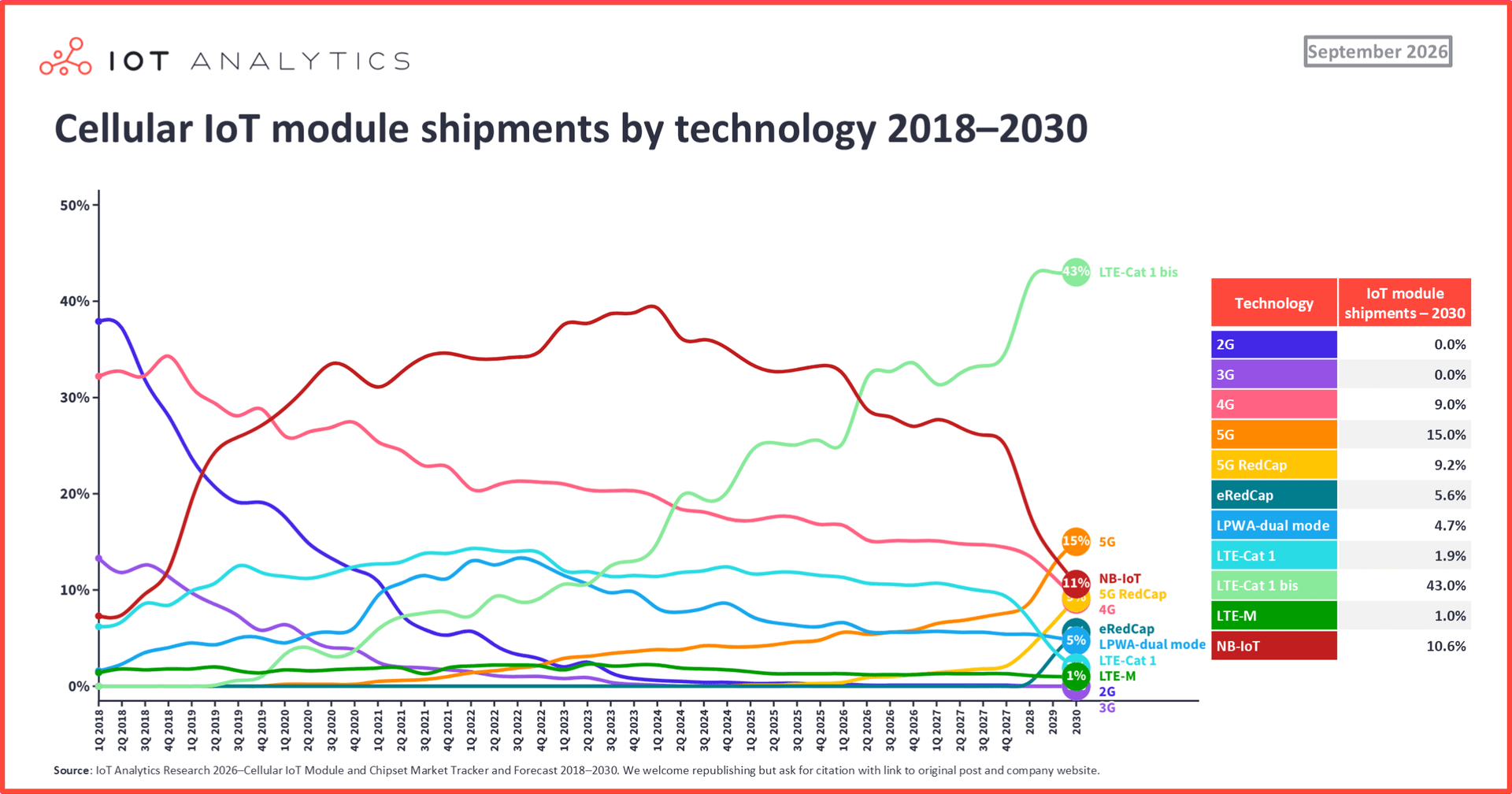
LTE Cat 1 bis has become the largest technology by shipment share. According to IoT Analytics’ Global Cellular IoT Module and Chipset Market Tracker & Forecast (updated September 2026), Cat 1 bis is the fastest-growing technology by volume, forecasted to reach roughly 43% of cellular IoT module shipments by 2030. Tracking, POS terminals, cameras, and metering are driving it. As it climbs, NB-IoT shipment share is easing back from its Q1 2024 peak, while 2G and 3G continue declining toward negligible shipment share. Meanwhile, 5G is arriving more gradually and unevenly: full 5G stays concentrated in higher-value applications. RedCap and eRedCap (together forecast at around 15% of shipments by 2030) are only beginning to move from roadmap into volume as device availability and 5G standalone coverage improve.
Geographic shifts and supply pressures are also changing module economics. Underneath the above technology shift, several other dynamics are intensifying at once:
- Demand is broadening geographically beyond China
- The supplier landscape is both concentrating and changing hands
- Supply-side pressure on memory and components is re-entering the conversation (for the first time in a while)
Below, we dive into the cellular IoT module market, sharing H1 2026 shipment performance and drivers, the current competitive landscape, and the growing weight of Chinese vendors. We also provide our H2 outlook, where pricing, supply, and technology migration increasingly matter as much as raw shipment volume.
Cellular IoT module shipments: H1 2026 growth accelerated sharply in Q2
Double-digit YoY growth in the 1st half of 2026. Cellular IoT module shipments increased 15% YoY in H1 2026. Q1 shipments grew 8.9% YoY before accelerating to 20.9% YoY in Q2. Looking quarterly, shipments increased 15% between Q1 and Q2 2026, compared with only 3.7% the same period last year. 3 developments help explain the stronger Q2 performance.
1. LTE Cat 1 bis was the primary volume driver
Cat 1 bis shipments increased 45.3% between Q1 and Q2 2026, accounting for approximately 76% of total sequential shipment growth. Direct vendor feedback points to increasing deployment across high-volume applications such as IP cameras, tracking, POS terminals, and smart metering. In our discussions with numerous cellular IoT module vendors, 1 specifically identified IP cameras and trackers as its 2 largest Cat 1 bis growth applications.
2. Rising memory and component costs added procurement pressure as lead times extended
Memory emerged as the most significant supply-side issue during Q2, particularly for modules using external DDR3 and other higher memory. A module vendor reported that the cost of 1 high-end DDR3 component had increased by roughly 7x compared with Q1. The same vendor also highlighted pressure from resistors, capacitors, PCBs, and other components, but described memory as the deciding constraint for products with higher memory content. As lead times lengthened and suppliers warned of further price increases, some customers brought orders forward or sought additional supply, adding procurement urgency to Q2 demand.
Lead times have nearly doubled across several module categories
“For LPWA and Cat 1 bis, we came from around 12 weeks, moved it to 16 weeks, and now we are more close to 22 weeks. For the higher memory products, we are talking about 24 weeks, but these parts are already on allocation. We went back to our customers and asked them to give us a year of visibility.”
Senior executive at a cellular IoT module vendor, Q2 2026
A second module vendor reported a similar deterioration in supply conditions. Cat 1 lead times had increased from approximately 1.5 months to 3 months. The company had started building inventory and informing customers in advance about longer lead times and upcoming price increases.
Cat 1 lead times doubled as suppliers warned of price increases
“We already talked to our customers in advance that there will be longer lead time and there will be price increases. For Cat 1, the lead time was about a month and a half before, but now it has doubled to 3 months.”
Senior executive at a cellular IoT module vendor, Q2 2026
However, not all vendors saw forward ordering as a major source of Q2 demand. Another module vendor said that most orders continued to reflect underlying customer demand and project ramps, although it was seeing some customers attempt to secure additional supply:
Most Q2 demand still reflected normal business and project ramps
“Majority of backlog and orders we are having is normal business from customers or normal run rate or running business we are having with these guys. There’s projects kicking in, so we have a couple of new projects ramping, but we don’t see a massive panic. We see some opportunistic requests that people are trying with short time to order parts, but this is something we are rejecting.”
Senior executive at a cellular IoT module vendor, Q2 2026
3. Growth broadened outside China, with India standing out
China leads in shipments, but India shipments grew the fastest. China remained the largest market and the largest contributor to absolute shipment growth (more on this below). However, rest-of-world shipments grew approximately 23.7% YoY in Q2, compared with 19.6% growth in China. India was the fastest-growing major region from a smaller base, with Q2 shipments nearly doubling YoY and H1 shipments increasing approximately 54%. Expanding demand for smart metering, POS terminals, tracking devices, and connected 2-wheelers is supporting the growth. Q2 vendor activity also included India-specific Cat 1 bis modules for smart metering and distribution automation, alongside new products targeting connected 2-wheelers.
Cellular IoT module vendor actions: Spin-offs, mergers, and sales
The Cellular IoT module market continues to evolve, driven by ongoing consolidation and strategic realignments. Over the past few years, a series of mergers and acquisitions has reshaped the competitive landscape.
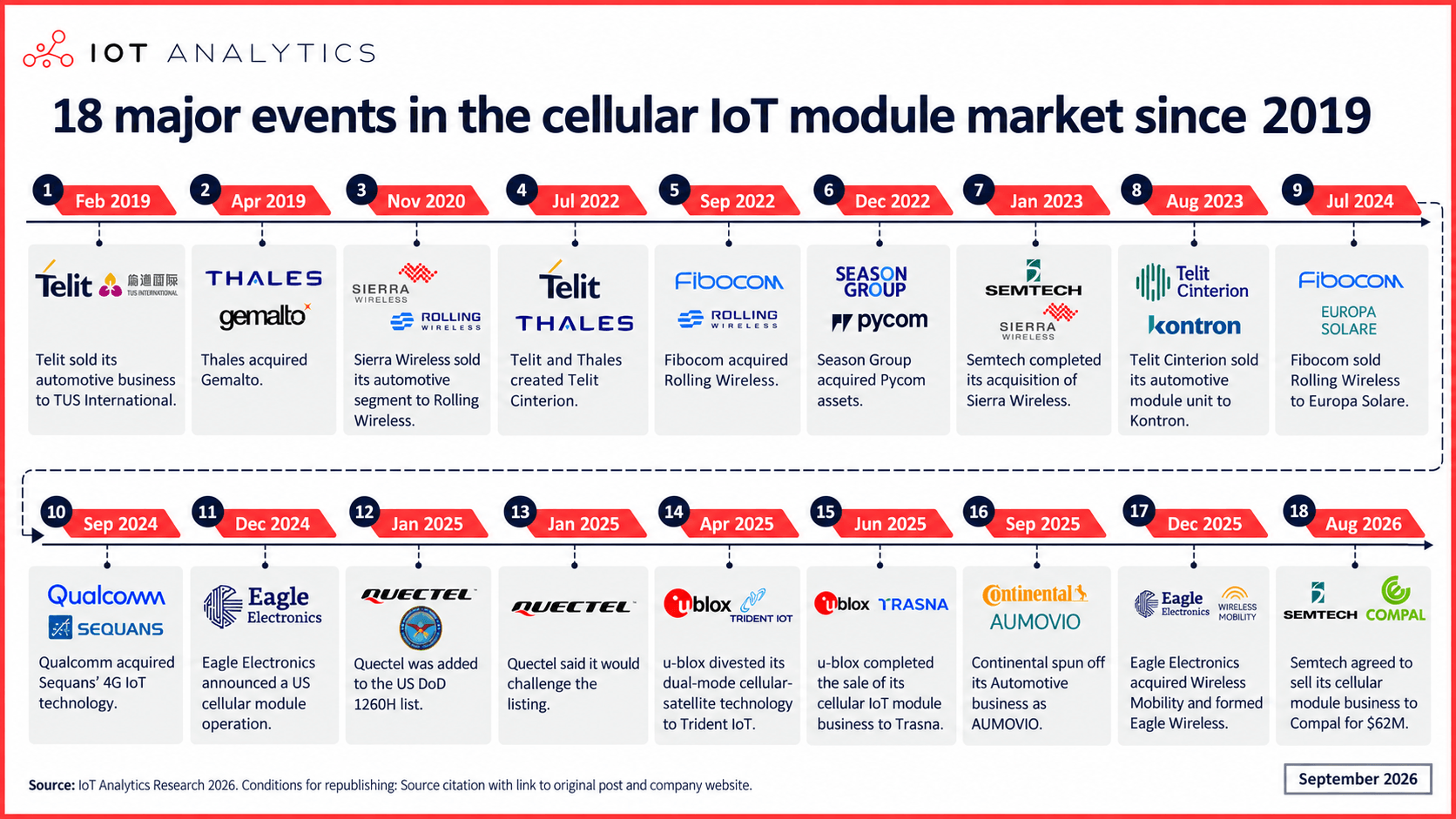
In IoT Analytics’ July 2025 cellular IoT market analysis, we focused largely on geopolitical and regulatory impacts on cellular IoT module vendors, aside from several market exits and ownership changes. Since then, the 3 most notable vendor actions have involved spin-offs, mergers, and sales.
1. Continental separated its automotive connectivity business into AUMOVIO
In September 2025, Continental completed the spin-off of its automotive business, and AUMOVIO began operating as an independent listed company. The former Continental Automotive cellular connectivity and telematics activities moved with the new company, including its automotive network access device (NAD) and telematic control unit (TCU) portfolio. For the cellular IoT module market, this represents a change in supplier identity rather than an exit or discontinuation of the underlying module portfolio.
2. Eagle Electronics acquired Wireless Mobility and formed Eagle Wireless
In December 2025, Eagle Electronics combined its US manufacturing activities with Wireless Mobility‘s existing cellular module business and automotive experience. The new company subsequently raised $30 million in February 2026 to expand R&D and US production, bringing its total capital raised to $44 million. The transaction therefore added a newly combined supplier with activities across both IoT and automotive cellular modules.
3. Semtech agreed to sell the former Sierra Wireless cellular module business to Compal
In August 2026, Semtech entered into a $62 million agreement to sell substantially all assets and operations of its cellular module business to Compal Electronics, including intellectual property, customer relationships, and personnel. The business largely originates from Sierra Wireless, which Semtech acquired in 2023. If completed, the transaction will put much of the former Sierra Wireless module operation under its 3rd corporate owner within a few years.
Cellular IoT module competitive landscape: Chinese companies take top 5 vendor spots; Chinese vendors gain ground in automotive
Chinese vendors now occupy all 5 leading positions in the global cellular IoT module market by shipments in H1 2026:
- Quectel
- China Mobile
- Lierda
- Fibocom
- Sunsea AIoT
This is a significant change from our July 2025 cellular IoT market update, as China-based Lierda entered the list while US-based Telit Cinterion (then the only Western vendor) dropped off.
Chinese vendors gaining share outside their domestic market. The combined share of rest-of-world module shipments from all Chinese cellular IoT module vendors increased from about 35% in 2018 to approximately 59% in H1 2026. This increase means the rise of Chinese suppliers is no longer explained solely by the size of the China market.
However, the international expansion is concentrated among a few vendors, and Quectel has been the main driver. Its share outside China increased from roughly 13% in 2018 to about 38% in H1 2026, making it the largest module supplier in the rest-of-world market. Fibocom also built a sustained international position, increasing from below 5% share in 2018 to almost 10% in H1 2026. Sunsea AIoT also remained among the leading suppliers outside China.
China Mobile and Lierda have risen rapidly in the ranking, but their current shipment bases remain more concentrated in China. China Mobile was the 2nd-largest supplier globally in H1 2026 yet accounted for a small share of international shipments outside China. Lierda ranked 3rd globally but had only a small share of international shipments. The global rise of Chinese vendors therefore does not translate into the same level of international expansion for every supplier.
Automotive remains one of the clearest non-Chinese strongholds, but Chinese vendors are gaining ground quickly. AUMOVIO and Rolling Wireless remain focused almost entirely on embedded automotive connectivity, while Kontron, WNC, and LG Innotek also have meaningful exposure to automotive NADs, TCUs, and related connectivity platforms. However, shipments from Chinese module vendors in the embedded automotive segment grew about 33% YoY in H1 2026, compared with roughly 12% for the segment overall, lifting their share from around 28% to 34%. The current forecast points to a further increase toward 39% by 2030.
Cellular IoT module market outlook: H2 2026 is expected to remain strong as pricing and technology dynamics shift
IoT Analytics Senior Principal Analyst Satyajit Sinha conducted the research and analysis found in the Global Cellular IoT Module and Chipset Market Tracker & Forecast. Below is his assessment of where the cellular IoT module market is headed.
Rising component costs starting to change the module revenue outlook. H1 2026 blended module ASP increased approximately 2.5% YoY, returning to growth after 4 consecutive quarters of YoY decline. Meanwhile, sequential price increases were already visible across several technologies. This effect is partly masked by the rapid growth of low-priced Cat 1 bis modules, which are increasing their share of total shipments. Multiple vendor feedback suggests memory pressure could remain elevated in H2 2026, particularly for modules with higher memory content. However, we expect pressure to spread into lower-memory technologies such as Cat 1 bis and LTE-M.
H2 demand remains supported, but Q2’s growth pace is unlikely to be repeated every quarter. Customer project ramps and technology migration continue to support module demand. At the same time, longer lead times and component allocation could increasingly limit how quickly that demand converts into shipments. Vendor expectations are also not uniform. For example, based on our discussions with cellular IoT vendors, a few expect the overall market to remain broadly flat sequentially in Q3. This suggests that H2 can remain healthy even if quarterly growth normalizes after the unusually strong Q2 increase.
Technology migration will remain an important growth driver through 2027. Cat 1 bis is expected to remain the main near-term volume driver, supported by 2G and 3G replacement and expanding use in applications such as metering, tracking, POS terminals, and cameras. RedCap is still much smaller in shipment terms, but commercialization is broadening across module portfolios. China remains ahead because of its more developed 5G SA infrastructure, while limited SA coverage could slow RedCap adoption in some markets outside China. Full 5G remains particularly important for higher-value applications such as FWA, automotive connectivity, and enterprise networking.
The cellular IoT module market’s growth profile becoming more complex. H1 2026 was primarily a shipment-growth story, led by Cat 1 bis and a sharp Q2 acceleration. Going into H2 2026 and 2027, shipment growth is likely to remain important, but pricing, component availability, RedCap commercialization, and changing vendor positions will have a greater influence on market performance. Chinese vendors are also likely to continue expanding internationally, while specialist segments such as automotive remain more balanced. Together, these factors suggest that revenue growth and shipment growth may increasingly follow different trajectories.
Further analysis
Below in our Insights+ section, we take a closer look at several updates in the Global Cellular IoT Module and Chipset Market Tracker & Forecast, including quarterly module and chipset revenue growth data and module shipment growth across the top 5 verticals by shipments.
Access key market data for $99/month per user
The Insights+ Subscription unlocks exclusive facts & figures. You will gain access to:
- Additional analyses derived directly from our reports, databases, and trackers
- An extended version of each research article not available to the public
Full report access not included. For enterprise offerings, please contact sales: sales@iot-analytics.com
