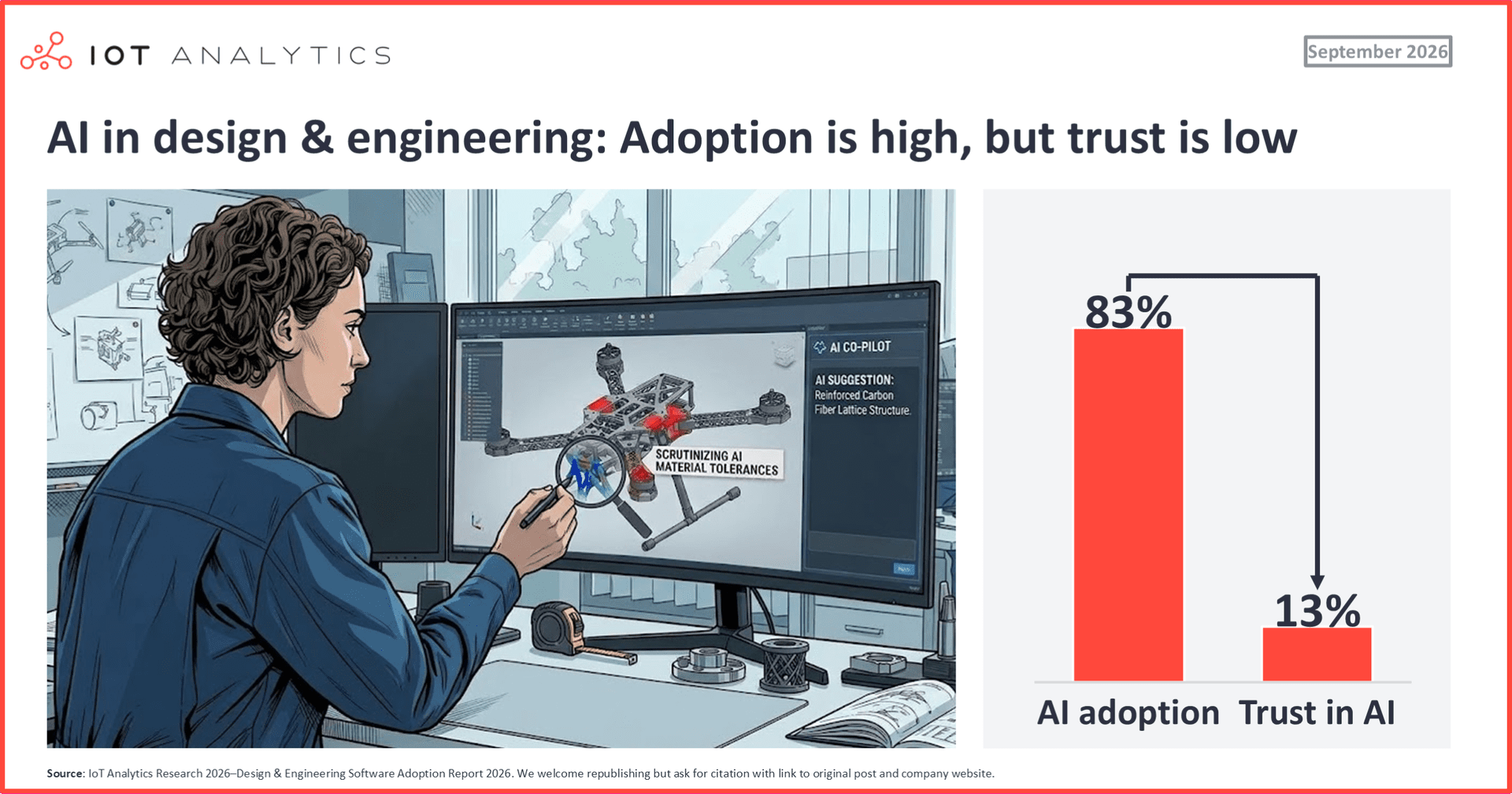
In short
- 87% of engineering decision-makers expect AI to be embedded in their core design and engineering software, according to IoT Analytics’ Design & Engineering Software Adoption Report 2026.
- While they see value in activities like simulation preprocessing & results interpretation and documentation & requirements generation, they show low trust in AI handling decisions, such as generating simulation inputs (17% trust) or decision support for design or part selection (13% trust).
Why it matters
- For design & engineering software vendors: Engineering leaders overwhelmingly expect AI to become embedded in core design & engineering software. Vendors must overcome distrust in AI output to gain a competitive advantage.
- For engineering decision-makers: AI is expected to become part of core design & engineering software. Engineering decision-makers must understand the risks and what to look for in solutions to improve trust in AI output.
In this article
- AI’s role in design and engineering software
- Where decision-makers expect AI to pay off in design and engineering
- Trust in AI output
- What to watch in AI in design and engineering software
- FAQ about design & engineering software and AI’s role within it
- Further analysis
- Role of AI in design and engineering by region, industry, and company size (Insights+ Exclusive)
- Where AI adds value in design and engineering: By region, industry, and company size (Insights+ Exclusive)
- Trust in AI in design & engineering: By region, industry, and company size (Insights+ Exclusive)
- Agentic AI orchestration battle among design and engineering software vendors (Insights+ Exclusive)
- Design and engineering competitive landscape 2026 (Insights+ Exclusive)
AI’s role in design and engineering software
AI is becoming a baseline expectation in design and engineering software. According to the IoT Analytics 150-page Design & Engineering Software Adoption Report 2026 (published August 2026), based on a survey of design and engineering decision-makers at 120 manufacturers, 87% of respondents expect AI to be embedded into their core CAD, PLM, and ALM platforms as a standard capability.
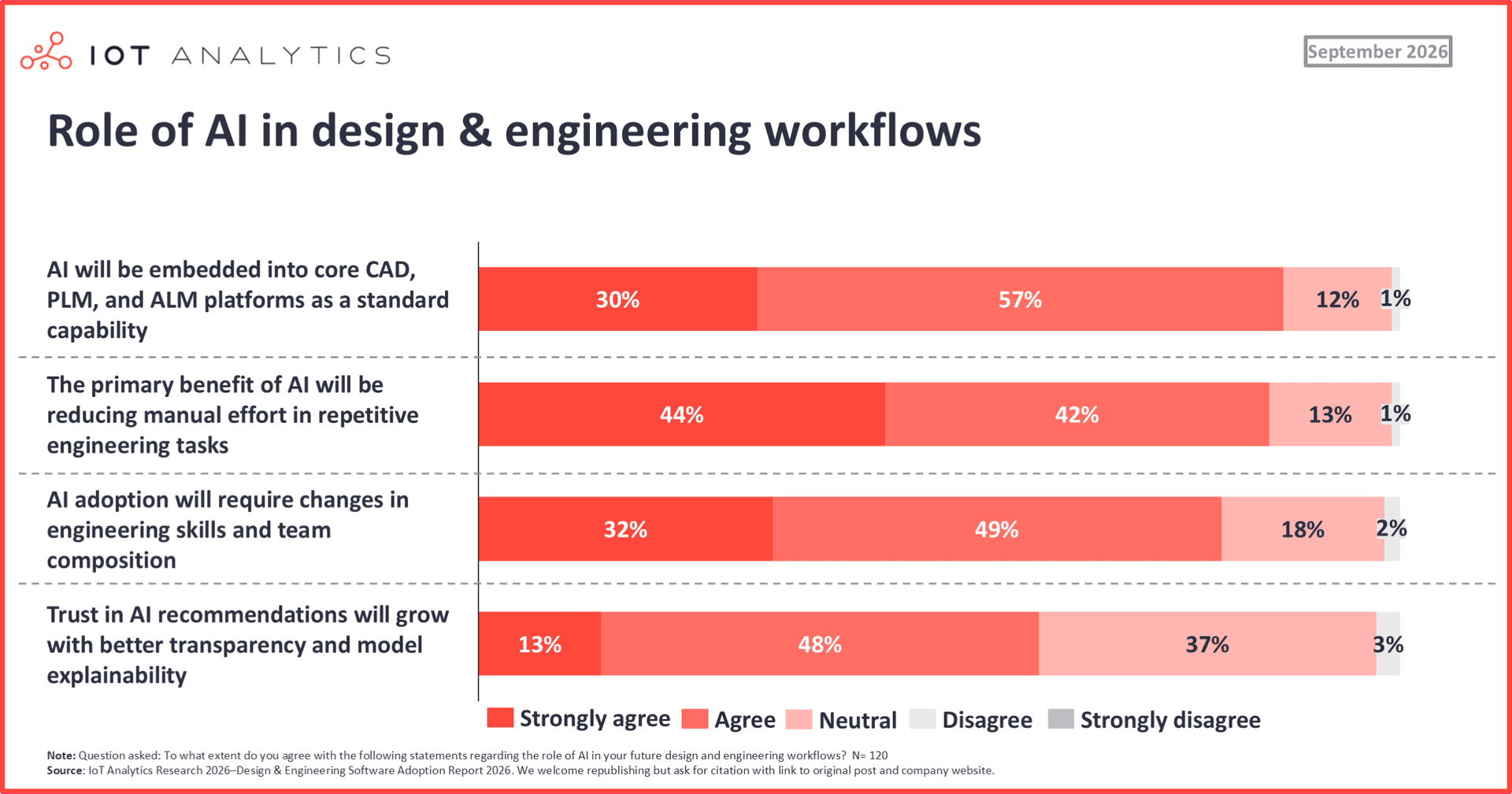
Respondents also feel strongly that AI tools can help ease repetitive tasks. 86% see AI’s primary benefit as reducing effort in repetitive engineering tasks, like time spent reconciling documents, chasing requirements, and re-running routine setup. 44% strongly agree, the firmest endorsement of any statement we tested about AI’s role, with 42% agreeing.
AI adoption affects the design & engineering organization.
These decision-makers also expect AI adoption to reshape their organizational charts. 81% say AI adoption will require changes in engineering skills and team composition, suggesting they see adoption as a structural change rather than the simple acquisition of a new tool.
Insights from this article are derived from
Design & Engineering Software Adoption Report 2026
A 150-page report on the design and engineering software market, focusing on the adoption of MBSE, shift-left, cloud, AI, and digital threads.
Already a subscriber? View your reports and trackers here →
Where decision-makers expect AI to pay off in design and engineering
Simulation activities are AI’s clearest engineering use case. 78% of design and engineering decision-makers expect AI to deliver critical or high value over the next 2–3 years in simulation preprocessing & results interpretation. It is the only activity more than 3/4 of respondents place at the top of the scale.
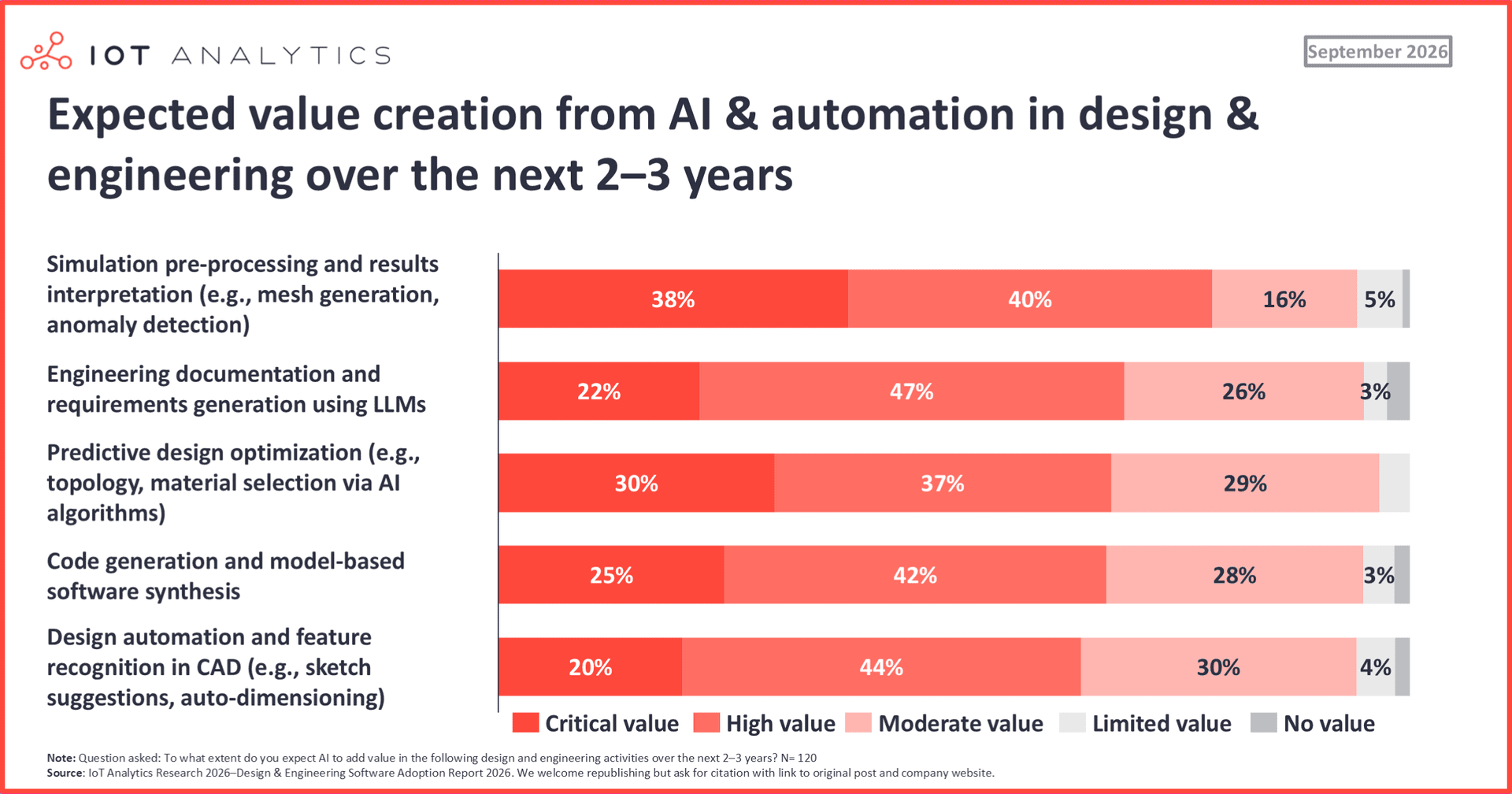
Several other engineering use cases are expected to deliver high value. 69% of respondents place critical or high value on LLM-generated documentation & requirements generation, 67% on both predictive design optimization and code generation, and 64% on design automation & feature recognition in CAD.
“Using AI to synthesize and distill those requirements—we call it ‘shredding the spec’—breaking a hundred-page specification into the two pages the mechanic needs. That’s the number-one value proposition for AI for us right now.”
Senior R&D engineering leader at a major aerospace & defense OEM
AI gains favor when augmenting engineering efficiency and effectiveness. The spread from top to bottom shows that enthusiasm runs highest where AI assists an expert, such as preparing a simulation, distilling a requirement, or surfacing an optimization, all keeping a human in the loop.
Trust in AI output
Trust in AI output is low. Although design and engineering leaders expect widespread AI adoption, their trust in the output is low across every activity we measured. Even the most-trusted use case does not clear a quarter of respondents. Just 24% report high trust in AI for generating documentation or specifications, which is the safest, most forgiving case.
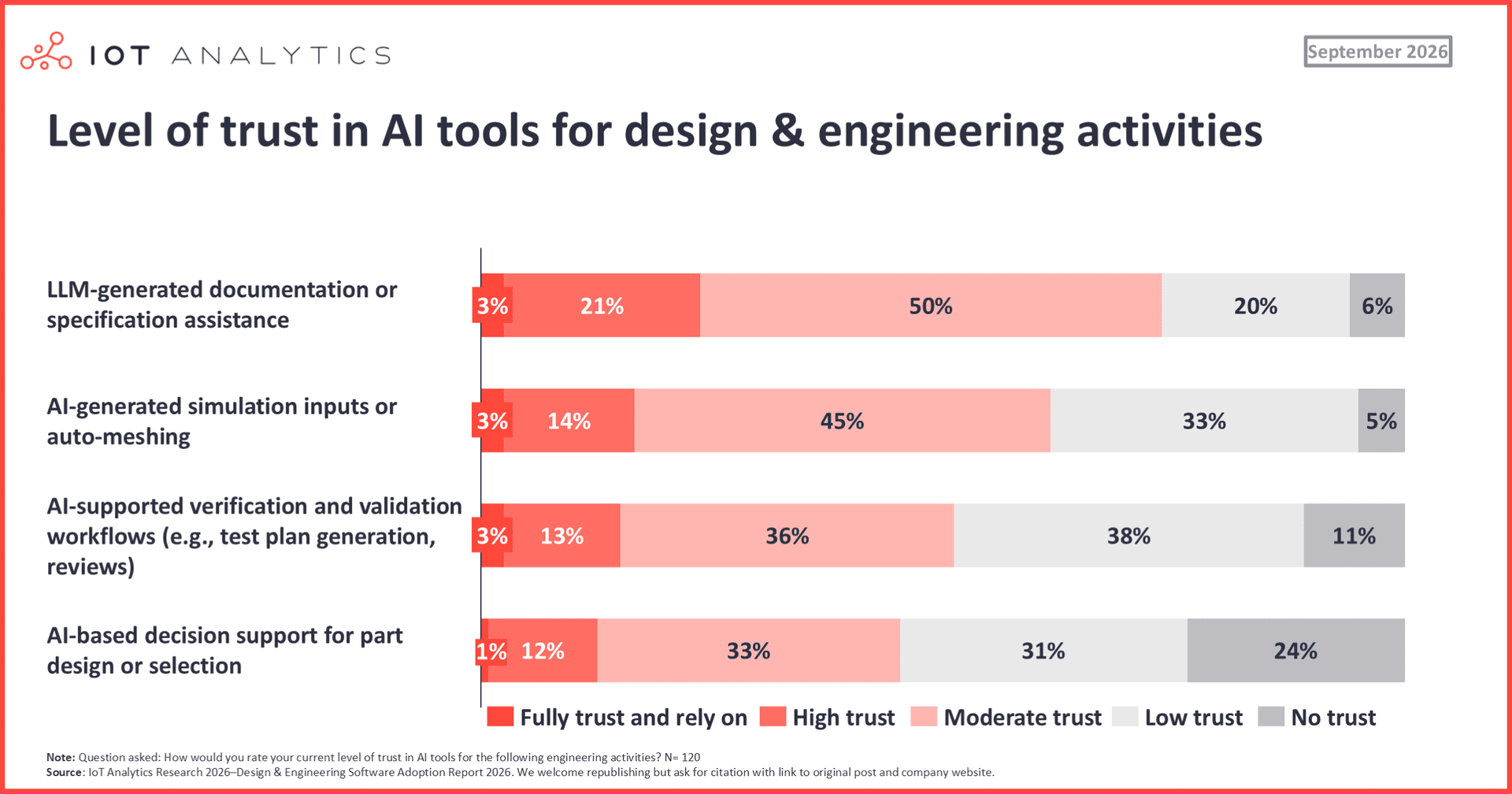
“Fully trust and rely on” does not exceed 3% for any activity: unconditional reliance on AI is, for now, seemingly nonexistent. Our data show that limited trust in AI is strongest in heavily regulated industries, with aerospace manufacturers the most skeptical of AI trust of all industries surveyed.
Trust levels for key design and engineering use cases:
- AI-generated simulation inputs and auto-meshing – 17% trust
- AI-supported verification and validation – 16% trust
- AI-based decision support for part design or selection – 13% trust
“We’ve all heard about AI hallucinating… you’ve got to verify and validate that the data maintains the design intent. The [US Federal Aviation Administration] is going to ask what gives you the authority to build that part.”
Senior R&D engineering leader at a major aerospace & defense OEM
This is where an interesting contrast arises. For example, take the earlier-mentioned simulation preprocessing & results interpretation activity. It drew the highest expected value of any activity, at 78%. Yet, in terms of trust, AI-generated simulation input or auto-meshing earns only 17%. The area where manufacturers want AI to help most for the greatest value is also the area where they are least willing to rely on it. Adoption, it appears, is advancing faster than trust.
Across the 4 activities we asked about, trust seems to revolve around a single variable: consequence. AI is more trusted to draft a document, text a human can read, check, and correct in minutes. However, it is distrusted to choose a load-bearing part, a call that is costly to reverse and must be defended long after it is made.
What to watch in AI in design and engineering software
IoT Analytics senior analyst Harsha Anand and CEO Knud Lasse Lueth conducted the research behind the Design & Engineering Software Adoption Report 2026. While their research established that manufacturers are already using AI to a large degree and expect high value from AI in the coming years, they are not ready to trust it with making decisions, which would be the next logical step in the agentic AI journey.
The team shares 4 things to watch for that can improve trust in AI in design and engineering software in the coming months:
- Outputs that can be checked, not just explained. AI should show its work in a way engineers can verify, like giving a range of uncertainty and letting the solver double-check the result, rather than just producing an answer with a rationale. This keeps a human in the loop, which appears to build trust. 61% of respondents stated that trust in recommendations would grow with both transparency and explainability, helping keep engineers in the decision-making process.
- Outputs that verify the design requirements. For AI to be trusted in formal approvals, its actions need to connect back to requirements and show verification evidence to establish a paper trail.
- AI Agents that write back to the PLM toolchain. Instead of AI just making suggestions in a chat, it should make actual tracked, auditable changes in the PLM system that one can review and roll back.
- Validated domain models. Engineers will trust purpose-built engineering AI (with documented training data, tested against real physical results) more than general-purpose chatbots.
Example of how vendors are starting to build user trust: PTC’s Codebeamer AI keeps a human in the loop
One example of a vendor working to build trust in its AI offerings is US-based industrial software company PTC. The company launched 2 AI assistants as part of Codebeamer AI, an add-on to its application lifecycle management platform Codebeamer in January 2026. The Requirements Assistant checks requirements against INCOSE and ISTQB guidance and flags quality issues such as ambiguity, while the Test Case Assistant generates test cases directly from requirements. Rather than acting on their own, both suggest improvements that engineers review and approve, keeping a human in the loop.
FAQ about design and engineering software and AI’s role within it
Design and engineering is a function that combines technical and creative processes to transform user needs and conceptual ideas into functional, manufacturable, market-ready, and serviceable physical products.
There are 5 categories for design and engineering software:
1. Computer-aided design (CAD)
2. Computer-aided engineering (CAE)
3. Product lifecycle management (PLM)
4. Software development lifecycle (SDLC)
5. D&E cloud platform services
Most of them. 87% of design and engineering decision-makers expect AI to be embedded in their core CAD, PLM, and ALM platforms as a standard capability, according to IoT Analytics’ Design & Engineering Software Adoption Report 2026.
Less repetitive work. 86% of decision-makers see AI’s main benefit as reducing effort on repetitive engineering tasks, such as reconciling documents, chasing requirements, and re-running routine setup. 44% strongly agree, the firmest endorsement of any AI statement in the survey.
Simulation. 78% of decision-makers expect AI to deliver critical or high value in simulation preprocessing and results interpretation over the next 2–3 years. It is the only activity that more than three-quarters of respondents rate at the top of the scale. Next come documentation and requirements generation (69%), then predictive design optimization and code generation (67% each).
Mostly not yet. Even the most-trusted use case, AI-generated documentation or specifications, gets high trust from only 24% of respondents. No more than 3% “fully trust and rely on” AI for any activity measured.
Yes. 81% of decision-makers say adopting AI will require changes to engineering skills and team composition. That suggests they see AI as a structural change, not just a new tool.
Transparency and explainability. 61% of decision-makers say their trust in AI recommendations would grow if the AI were more transparent and explainable, which keeps engineers involved in decisions.
Further analysis
Below, in our Insights+ section, we take a closer look at what our respondents said about AI’s role, where decision-makers expect AI to pay off, and trust in AI, broken down by region, industry, and company size. We also share insights into the agentic AI orchestration battle among design and engineering software vendors and their competitive landscape.
Access key market data for $99/month per user
The Insights+ Subscription unlocks exclusive facts & figures. You will gain access to:
- Additional analyses derived directly from our reports, databases, and trackers
- An extended version of each research article not available to the public
Full report access not included. For enterprise offerings, please contact sales: sales@iot-analytics.com