
In short
- IMTS 2026 drew 91,295 registrants. North America’s largest manufacturing technology show grew 2.6% on 2024 and, for the first time, had a dedicated Industrial AI Arena.
- A new industrial AI stack is forming. Based on more than 30 interviews at the show, IoT Analytics sees knowledge graphs, AI agents, and new interfaces such as MCP forming a stack that the traditional ISA-95 automation pyramid does not describe.
- MCP servers are now a must-have, and hardware is next. Industrial software vendors are adding MCP servers fast, while Anthropic’s new Model Hardware Standard (MHS) aims to do the same for machines.
Why it matters
- For industrial software and automation vendors: The new stack determines where value sits in the AI era, and vendors that own data context are better positioned than those that only move data.
- For manufacturers: “AI-ready” claims are not equal, so buyers should test what sits beneath a vendor’s MCP server before they commit.
In this article
- International Manufacturing Technology Show 2026
- IMTS 2026 at a glance
- 3 of 7 industrial technology trends from IMTS 2026
- Analyst opinion
- Frequently asked questions about IMTS and manufacturing technology
- Further analysis
- All 15 key takeaways from IMTS 2026 (Insights+ Exclusive)
- 8 selected vendor highlights (Insights+ Exclusive)
- 5 industrial technology developments to watch through 2027 (Insights+ Exclusive)
International Manufacturing Technology Show 2026
AI moves onto the machine tool show floor. The International Manufacturing Technology Show (IMTS), North America’s largest manufacturing technology show, took place on September 14–19, 2026, at McCormick Place in Chicago, US. The show has historically centered on CNC machine tools, additive manufacturing, and fabrication. In 2026, however, cloud providers, AI companies, and industrial software vendors were among some of the most visible exhibitors. US-based hyperscaler Google brought its AI pitch to the factory floor, US-based AI research company OpenAI showed an agentic maintenance system, and the organizer, The Association for Manufacturing Technology (AMT), added a dedicated Industrial AI Arena for the first time.
Why IoT Analytics attended IMTS. IoT Analytics attended IMTS to understand where industrial software, AI, and robotics are heading in North America. Over 3 full days, we held more than 30 interviews, visited booths, and attended keynotes. We did not cover machine tools. The result is IoT Analytics’ 40-page IMTS 2026—The Latest Industrial Technology Trends report (published October 2026), which covers 3 focus areas: industrial software and AI, maintenance and asset performance, and robotics and physical AI. The report includes 14 vendor highlights, 7 trends, and 15 key takeaways. Below, we present 3 of the 7 trends.
This article is derived from IMTS 2026—The Latest Industrial Technology Trends
Get insights from the world’s leading industrial technology exhibitions
Full IMTS 2026 coverage is available to IoT Analytics corporate subscribers. Throughout 2026, subscribers will receive 10 post-conference reports from major industrial technology fairs, including Hannover Messe, SPS, IMTS, and Automate.
Corporate subscription access includes:
- 10 comprehensive post-conference write-ups
- Key market numbers and market reports
- Analysis of trends, vendor strategies, and more

Already a subscriber? View your reports and trackers here →
IMTS 2026 at a glance
The show grew in visitors but not in floor space. According to AMT, IMTS 2026 recorded:
- 91,295 registrants. This is 2.6% more than the 89,020 registrants in 2024.
- 1,788 exhibiting companies. This is 2.9% more than in 2024, and 400 of them exhibited for the first time.
- 1.17 million square feet of exhibit space. This is about 5% less than in 2024.
- Visitors from 123 countries. In 2024, visitors came from more than 110 countries.
A machine tool show with an AI layer on top. IMTS runs every 2 years at McCormick Place, the only US venue that can carry its floor loads. The 2026 edition covered 10 technology sectors, from metal removal and additive manufacturing to software and automation, plus the new Industrial AI Arena.
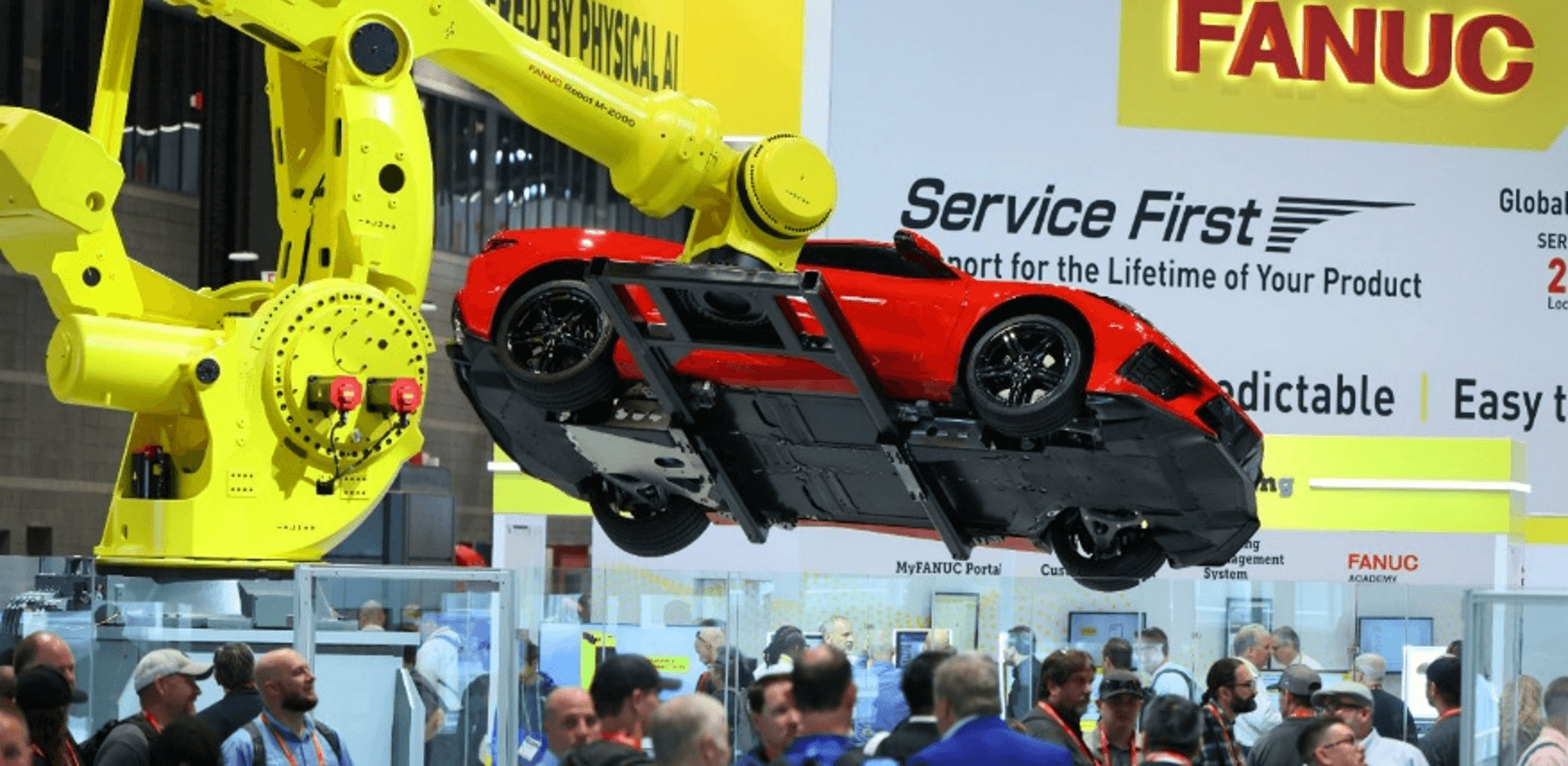
| Analyst view IMTS feels like a CNC and 3D printing show with cloud and AI layered on top. Because North America lacks another unified Industry 4.0 show, this setup works surprisingly well. |
3 of 7 industrial technology trends from IMTS 2026
Our IMTS 2026 event report identifies and explores 7 trends, 3 of which we share below.
- Trend 1: A new industrial AI stack is forming – Knowledge graphs, DataOps, and agents take a prominent role (covered below).
- Trend 2: Industrial software vendors are adding MCP servers – Vendors open their platforms to AI agents (covered below).
- Trend 3: Anthropic’s MHS aims to do for hardware what MCP did for software – A new standard could let AI agents address machines directly (covered below).
- Trend 4: Industrial software vendors are repositioning to win in the AI era – Vendors are betting differently on where value will sit in the new stack.
- Trend 5: CIOs are taking over industrial software buying – IT and security leaders increasingly decide which shop-floor software gets deployed.
- Trend 6: CMMS and predictive maintenance vendors try to close the same loop – Both sides want to own the path from sensor alert to completed repair.
- Trend 7: Maintenance vendors differ sharply on AI autonomy – Vendors disagree on how much AI may decide on its own.
Trend 1: A new industrial AI tech stack is forming
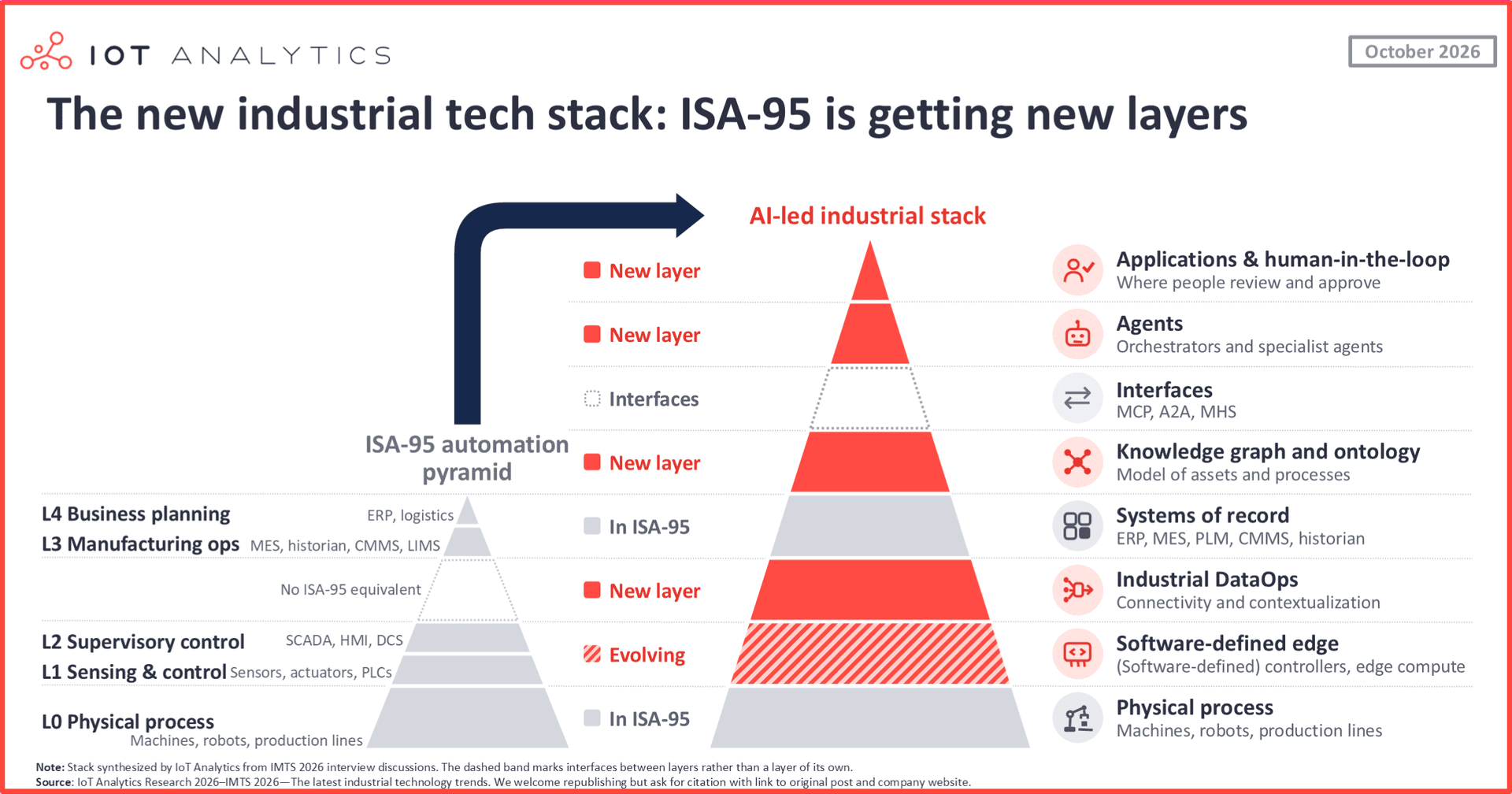
The ISA-95 pyramid is getting new layers. Since the 1990s, the ISA-95 automation pyramid has described how industrial software is organized: sensors and PLCs at the bottom, then SCADA, then MES and historians, with ERP at the top. Our conversations at IMTS suggest that a new, AI-led stack is forming. It keeps the systems of record but adds layers that have no ISA-95 equivalent. From bottom to top, we see 8 future layers:
- Physical process – Machines, robots, and production lines remain the stack’s base.
- Software-defined edge – Software-defined controllers and edge computers run containerized apps and AI models close to the machine.
- Industrial DataOps – Connectivity and contextualization software collects machine data and maps it to data models.
- Systems of record – ERP, MES, PLM, CMMS, and historians remain the source of truth for transactions and records.
- Knowledge graph and ontology – A model of assets, processes, and their relationships gives AI the context it needs.
- Interfaces – Protocols such as MCP (Model Context Protocol), A2A (Agent2Agent), and MHS connect agents to software, to other agents, and to machines.
- Agents – Orchestrators and specialist agents plan and carry out tasks across systems.
- Applications and human-in-the-loop – People review and approve the work, increasingly in apps that AI builds.
Knowledge graphs replace the data lake. The most notable change sits in the middle of the stack. For years, hyperscalers advised manufacturers to centralize plant data in a cloud data lake before analyzing it. At IMTS, US-based hyperscaler AWS argued the opposite. Its Industrial Data Fabric architecture uses knowledge graphs (through Amazon Neptune) to connect and contextualize data where it lives, across MES, SAP, PLM, and OT historians. AWS also showed an orchestrator that queries MCP servers for ERP, MES, CMMS, PLM, and its SiteWise historian and builds a knowledge graph on the fly.
“When we launched the industrial data fabric, the knowledge graph was always part of the framework. We saw it at the time as giving context to the industrial IoT data, like associating data from the MES or SAP, to really enrich that data and provide the relationships. Now, with Amazon Bedrock Agent Core, we have GraphRAG. So the agent can directly interface with the knowledge graph to be able to provide reasoning and get answers from interconnected data to whatever the question is.”
Steve Blackwell, Head of Product Engineering & Services, CoE, AWS (September 2026)
Context becomes the moat. Vendors increasingly see the knowledge graph as their main differentiator. US-based industrial software company MachineMetrics, which started as a machine monitoring company 12 years ago and now positions its MaximaOS platform as a manufacturing execution system (MES), made this point most clearly.
“Our knowledge graph is our moat. It’s our data schema and context and the platform. And that’s what really matters right now in the age of AI. That’s the differentiator… Anyone can build a front end. It’s the data models.”
Graham Immerman, Chief Revenue Officer, MachineMetrics (September 2026)
Trust needs observability. Agents only create value if engineers trust them. AWS showed an Engineering Assistant that displays each step of the agent’s reasoning, the systems it queried, its data sources, and its confidence scores. This addresses a problem our surveys show repeatedly: engineers do not want to assume that an agent is right.
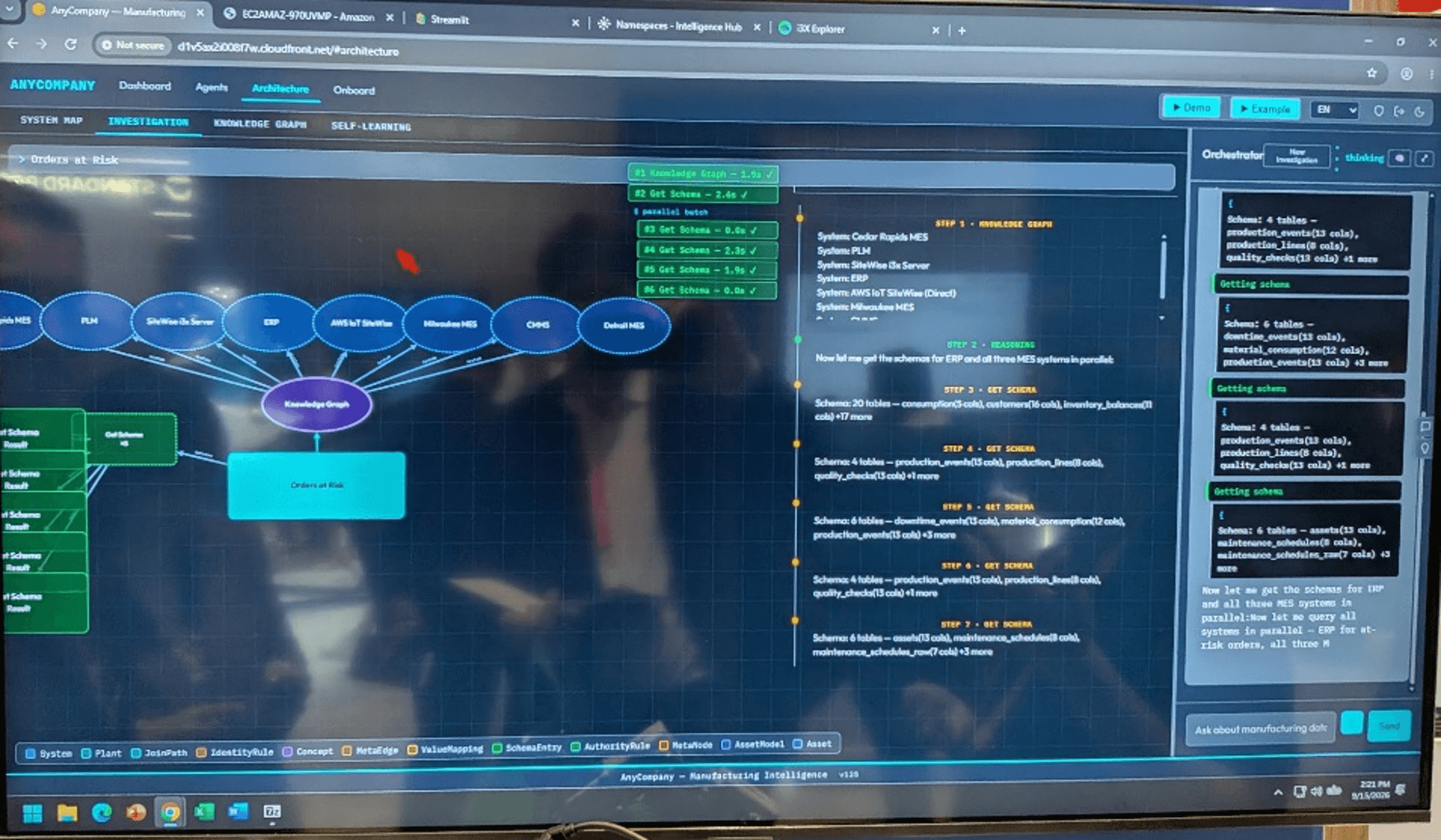
| Analyst view The call for decentralized architectures reverses what hyperscalers promoted for years. MachineMetrics and Tulip, 2 vendors we spoke to at length, are placing very different bets on this new stack (Trend 2). Who ends up owning the knowledge graph (software vendors, hyperscalers, or data platforms) is one of the 5 open questions we discuss in the report’s outlook. |
Trend 2: Industrial software vendors are adding MCP servers
MCP replaces the copy-first model. With traditional APIs, manufacturers ran extract, transform, load (ETL) jobs to copy data from siloed systems into a cloud data lake before they could analyze it. MCP, the open protocol that US-based AI research company Anthropic introduced in November 2024 and now under the Linux Foundation, lets AI agents query systems where the data resides and act on live operational data. At IMTS, many industrial software vendors presented new MCP servers. Examples include:
- MachineMetrics turns plant data into apps – Its new Carbide framework, built on a free MCP server, links AI coding tools such as Claude Code, Cursor, and Lovable to a knowledge graph of the plant, so users can describe a workflow and get a working app.
- PTC lets AI build CAD features in Onshape – The Onshape FeatureScript MCP Server, launched in August 2026, lets Claude, ChatGPT, or Gemini build, test, and debug custom CAD features, and PTC expects Creo and Windchill to follow.
- Rockwell Automation adds domain expertise – Its free Emulate3D MCP server ships “skills” that encode domain expertise and standards.
- Limble exposes maintenance work to AI tools – The CMMS vendor’s MCP server, part of its Winter 2026 release, lets AI agents read work orders and analytics and suggest repairs.
- Vention lets coding agents program machines – Its free, official MCP server covers designs, the hardware catalog, and the digital twin.
“We created an official Vention MCP… You can use Claude Code to code it. You can use the MCP to pull down the geometry of the design, the configuration of the design. It’ll program it, upload it, and run it on the digital twin.”
Brendan Sterne, Chief Product Officer, Vention (September 2026)
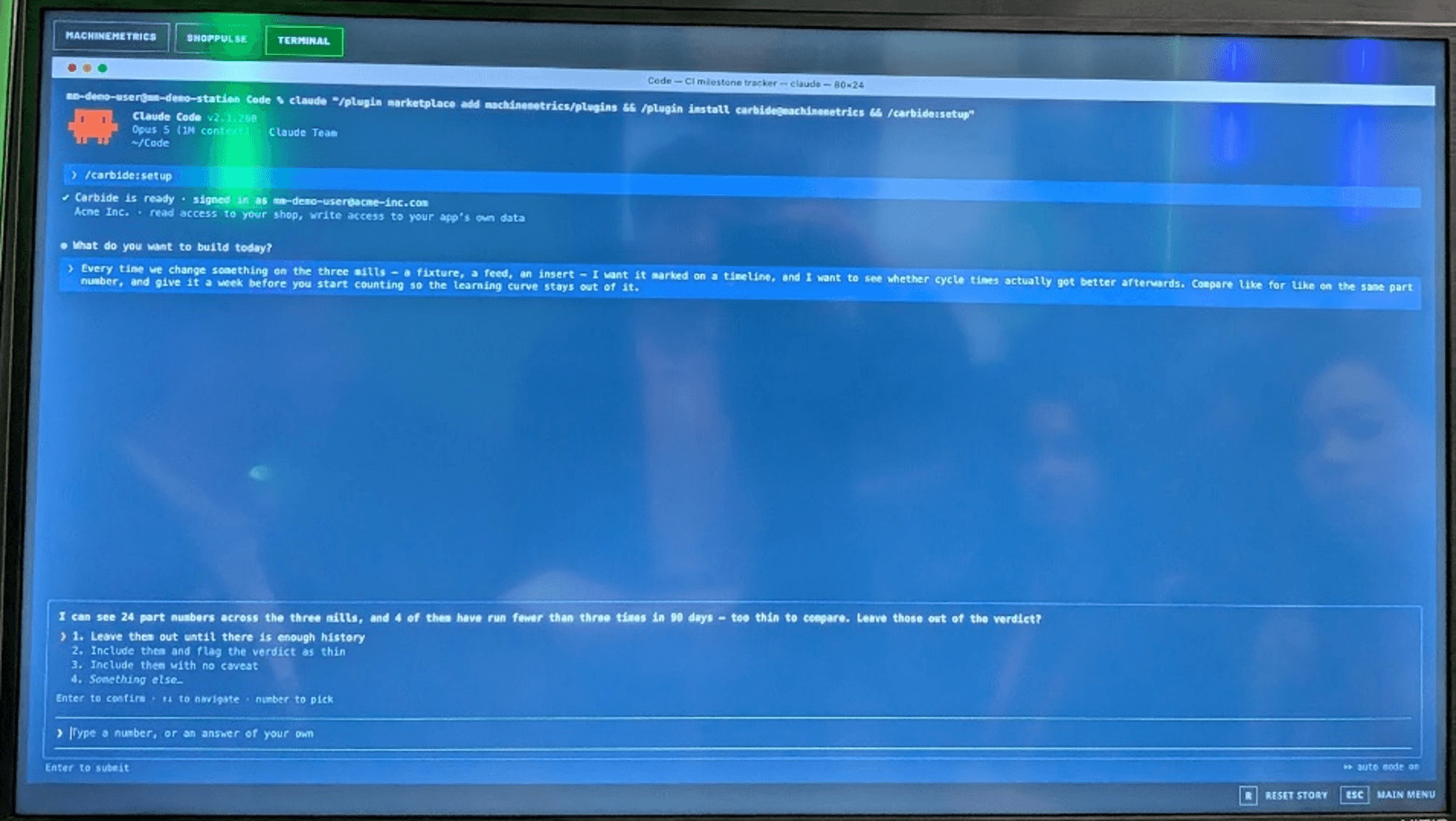
Not every MCP server is equal. Native MCP servers expose the application logic, so agents can change and run things inside the application. MCP wrappers on closed APIs often stay read-only, and some new servers only move data between systems with no knowledge underneath.
| Analyst view An MCP server is now a must-have for industrial software companies. Buyers should test what sits beneath it: an ontology, a knowledge graph, and the ability to write back to the application. Some vendors give MCP access away to win share, while others plan to sell it as a license. How this plays out is another question we address in the report’s outlook. |
Trend 3: Anthropic’s MHS aims to do for hardware what MCP did for software
A standard driver for machines. On August 27, 2026, Anthropic released a research preview of the Model Hardware Standard (MHS), a specification that lets AI agents discover and operate physical equipment such as robot arms, sensors, and test instruments. MHS gives each device a standard driver with simple “read” and “write” commands and a plain-language description of its capabilities and safety limits. An agent can then control the device without custom integration code. Anthropic claims this “cuts integration work from weeks or months to hours or minutes.” Early partners are mostly laboratories, but vendors like Universal Robots (Denmark), Doosan Robotics (South Korea), and AWS are adding support.
| MCP | MHS | |
|---|---|---|
| Connects AI to | Software data and tools | Software data and tools |
| Launched | November 2024 | August 2026 (research preview) |
| Status | Industry standard, now under the Linux Foundation | Gated research preview; open source planned |
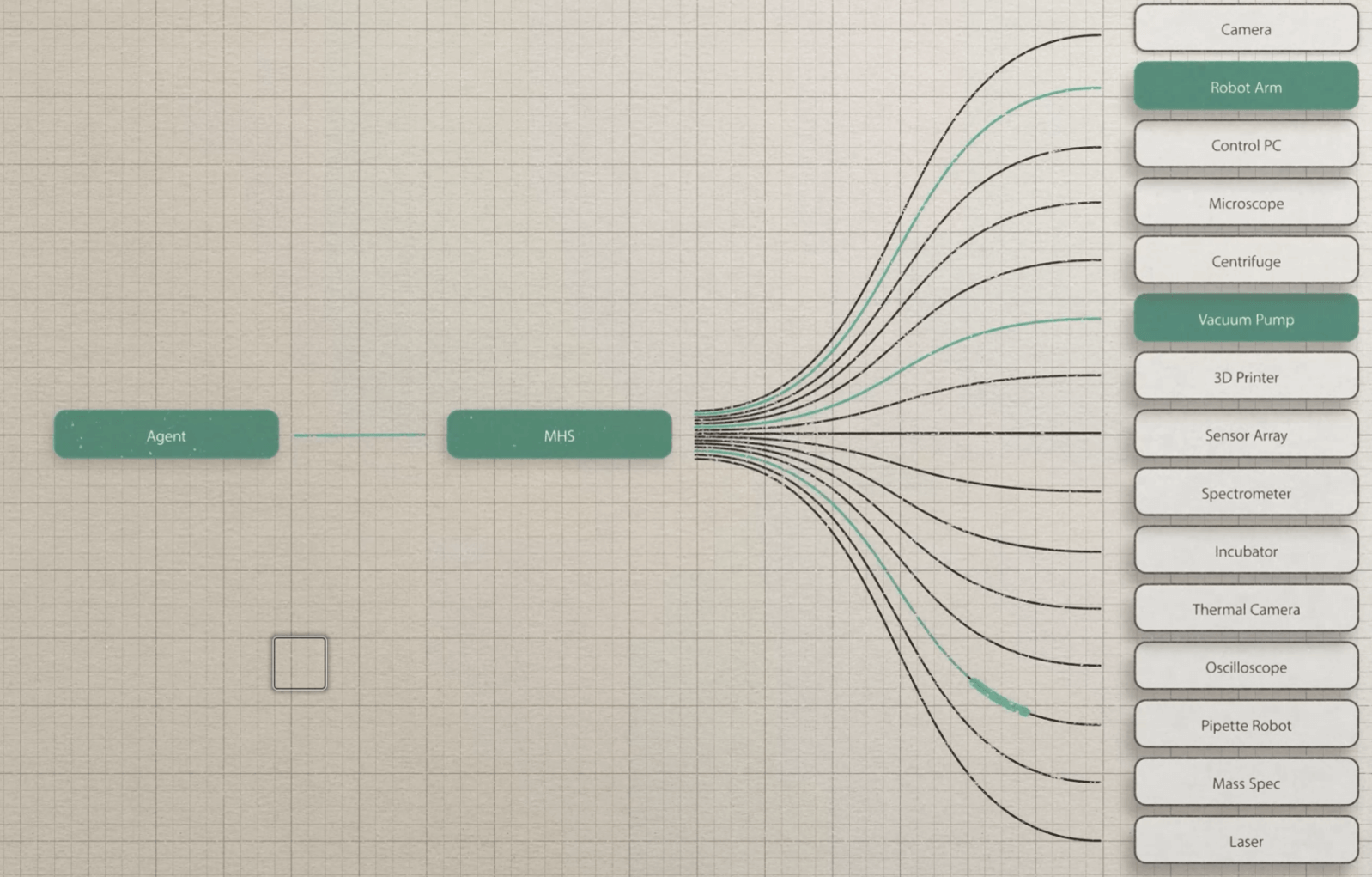
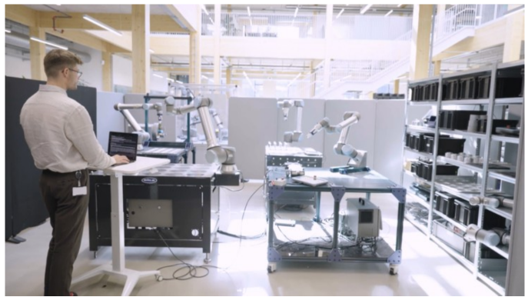
Universal Robots tests MHS in practice. Universal Robots, which launched its Gen 7 cobot at IMTS, is one of the first robot makers to test MHS. In a first test, Universal Robots built an agent on Claude Opus 4.8 in Claude Code and connected it to 4 Universal Robots cobots through PolyScope X, the company’s API-first control system. From plain-language instructions, the agent discovered the robots and their capabilities, configured them, and ran them as one cell, handing payloads from robot to robot within each device’s declared limits. Universal Robots gave no performance figures and called the setup a proof of concept. It did not show MHS on the show floor but discussed its benefits with us.
“It’s kind of like [MCP], but for hardware connection. [It] allows you to do natural language tasking of a robot, and basically provisioning a robot natively through Claude.”
Chris Savoia, Head of Ecosystem, Universal Robots (September 2026)
Vention, which builds robot cells mostly around Universal Robots arms, described MHS similarly: “an introspection and control framework” that tells an AI model which sensors and actuators it is working with.
| Analyst view If machines ship with MHS drivers, AI agents could bypass part of today’s connectivity and contextualization layer. Connectivity software vendors would then need to move further up the stack, toward context and governance. However, IoT platforms promised plug-and-play connectivity a decade ago, and they did not deliver at scale. We do not expect MHS to spread as fast as MCP did. Determinism, safety, and the installed machine base remain the main hurdles. |
Analyst opinion
IoT Analytics CEO Knud Lasse Lueth attended IMTS 2026 and held more than 30 interviews with industrial software, AI, maintenance, and robotics vendors. Here are his main conclusions:
IMTS 2026 showed where the AI battlegrounds are. Knowledge graphs provide the context, MCP servers let customers build their own apps, and converging software closes loops, such as the one between maintenance management (i.e., CMMS) and predictive maintenance, that AI may one day run. For now, humans stay in the loop.
Incumbents are moving, at different speeds. At Automatica 2025, Japan-based automation company Fanuc would not discuss physical AI. At IMTS 2026, it showed 2 physical AI demos with Google and AWS, even though both are still in R&D. In contrast, Universal Robots is already way further on the journey. The company launched its Gen 7 cobot at the show as an open platform for AI apps.
Not every vendor wants to be first. “Our goal is to be a half step behind,” Nick Haase, cofounder of US-based CMMS platform MaintainX, told us. How far vendors let AI act on its own was one of the clearest dividing lines we saw at the show.
Frequently asked questions about IMTS and industrial technology
– Trend 1: A new industrial AI stack is forming – Knowledge graphs, DataOps, and agents take a prominent role (covered below).
– Trend 2: Industrial software vendors are adding MCP servers – Vendors open their platforms to AI agents (covered below).
– Trend 3: Anthropic’s MHS aims to do for hardware what MCP did for software – A new standard could let AI agents address machines directly (covered below).
– Trend 4: Industrial software vendors are re-positioning to win in the AI era – Vendors are betting differently on where value will sit in the new stack.
– Trend 5: CIOs are taking over industrial software buying – IT and security leaders increasingly decide which shop-floor software gets deployed.
– Trend 6: CMMS and predictive maintenance vendors try to close the same loop – Both sides want to own the path from sensor alert to completed repair.
– Trend 7: Maintenance vendors differ sharply on AI autonomy – Vendors disagree on how much AI may decide on its own.
The new stack keeps ERP, MES, and historians as systems of record. It adds layers that ISA-95 has no equivalent for: a software-defined edge, industrial DataOps, knowledge graphs and ontologies, interfaces (MCP, A2A, MHS), AI agents, and human-in-the-loop apps. Knowledge graphs are replacing the centralized data lake as the place where data gets its context.
The Model Context Protocol (MCP) is an open protocol that Anthropic introduced in November 2024. The Linux Foundation now oversees it. MCP lets AI agents query industrial systems where the data lives, so they no longer have to copy data into a data lake first. At IMTS 2026, MachineMetrics, PTC (Onshape), Rockwell Automation (Emulate3D), Limble, and Vention all presented MCP servers.
MHS is a specification that lets AI agents discover and operate physical equipment such as robot arms, sensors, and test instruments. Anthropic released it as a research preview on August 27, 2026. Each device gets a standard driver with “read” and “write” commands, plus a plain-language description of what it can do and its safety limits. Universal Robots, Doosan Robotics, and AWS are among the vendors adding support. Universal Robots has already tested it with 4 cobots.
Further analysis
Below, in our Insights+ section, we share all 15 key takeaways from our IMTS 2026—The Latest Industrial Technology Trends report, 8 selected vendor highlights with our analyst view on each, and 5 developments to watch through 2027.
Access key market data for $99/month per user
The Insights+ Subscription unlocks exclusive facts & figures. You will gain access to:
- Additional analyses derived directly from our reports, databases, and trackers
- An extended version of each research article not available to the public
Full report access not included. For enterprise offerings, please contact sales: sales@iot-analytics.com
