
Generative AI & Agentic AI Market Report 2026-2032
A 283-page report sizing the generative & agentic AI market to 2032, incl. vendor market shares, enterprise use cases, adoption, and trends.
Key Data Snapshot:
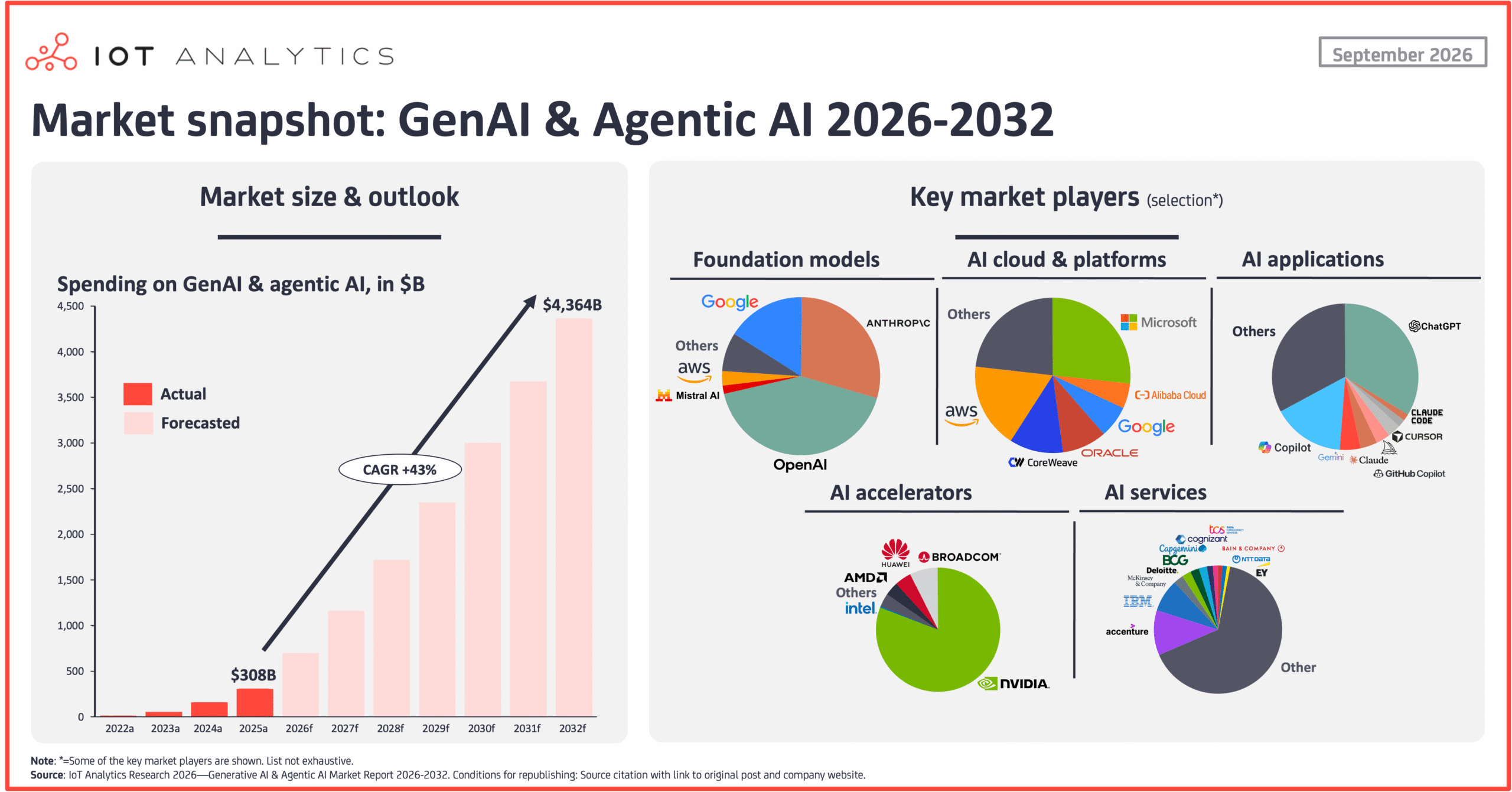
- 2025 Market Size: $308 billion
- 2032 Forecast: $4.4 trillion
- Key Players: AMD,AWS,Accenture,Alibaba Cloud,Anthropic,Capgemini,Google,Intel,Microsoft,Mistral,Nvidia,OpenAI
Generative AI & Agentic AI Market Size, Trends, and Leader 2026-2032
Generative AI & Agentic AI Market Overview
IoT Analytics research indicates that the global Generative AI & Agentic AI market reached $308 billion in 2025. Based on enterprise adoption metrics and technology investment allocations, the market is forecast to reach $4.4 trillion by 2032, representing a compound annual growth rate (CAGR) of 46% between 2025 and 2032. Enterprise adoption reached mainstream levels in 2025, with 88% of surveyed organizations utilizing generative AI technologies. Market expansion correlates with an operational transition from human-prompted assistance toward autonomous agentic workflows that execute multi-step processes under human oversight.
This report outlines the five core segments comprising the technology stack:
- AI Accelerators: Comprises GPUs, TPUs, LPUs, and custom ASICs used for model training and inference.
- AI Cloud & Platforms: Comprises rented compute infrastructure, model development environments, runtime operations, and agent orchestration layers.
- AI Services: Comprises strategy consulting, system integration, custom agent design, and managed services.
- AI Applications: Comprises end-user software including chatbots, coding tools, and domain-specific enterprise applications.
- Foundation Models: Comprises API usage, fine-tuning, and private model deployments.
Key Trends & Market Leaders
Multi-step agentic workloads require repeated model calls, tool interactions, and memory retrieval, making inference the dominant cost driver across AI infrastructure. Data indicates that multi-step reasoning workflows consume up to 20x the amount of inference compute for every unit of training compute. Concurrently, open standards such as the Model Context Protocol (MCP) and Agent-to-Agent (A2A) protocols are establishing common interfaces to connect AI applications, enterprise data sources, and independent software agents. Parallel to this, enterprises are increasing the deployment of specialized small language models (SLMs) to reduce latency and contain token consumption costs.
Regarding market share, infrastructure spending flows primarily to NVIDIA for AI accelerators and Microsoft for AI cloud and platforms. Within software and foundation models, leadership in 2025 was held by OpenAI for foundation models and AI applications, alongside Accenture for AI services. Data for H1 2026 indicates that Anthropic expanded its foundation model market share, driven by API adoption across coding and reasoning workloads.
What is in this report?
This 283-page analysis published in September 2026 details granular market sizing across 5 tracked segments and 15 industry verticals, an empirical analysis of 1,533 enterprise AI projects, competitive market shares across all stack layers, 7 enterprise case studies, and an evaluation of implementation blockers, security concerns, and financial bubble risks.
Key Questions Addressed
- What is GenAI and agentic AI, how are they connected, and what are the technological components?
- Which use cases are enterprises prioritizing, and how autonomous are deployments becoming?
- What is the current market size, and how is the market expected to grow to 2032?
- How large are the 5 tracked segments (AI accelerators, foundation models, AI cloud & platforms, AI applications, AI services), and how is the segment mix shift expected to develop?
- What are the market shares of key players, and who leads in each of the 5 segments?
- Which are the leading AI applications, and which application categories grow fastest?
- How are leading enterprises deploying GenAI and agentic AI?
- What are the important implementation considerations and adoption blockers?
- What are the current and next trends — from inference costs to MCP/A2A and AI regulation?
- Are we in an AI bubble? What do ROI, CapEx payback, and valuations say?
Table of Contents
GenAI & Agentic AI Market Report 2026-2032 (PDF)
- Executive summary
- The GenAI & agentic AI market: What has changed since our last report?
- Executive summary (6 parts)
- Introduction
- Key action items from this report
- Chapter overview: Introduction
- Starting point: Defining GenAI and its relationship with AI, ML, and DL
- The new paradigm: Agentic AI
- How we got here (2 parts)
- Anthropic’s rise marked the commercial breakthrough of agentic AI
- Funding for GenAI & agentic AI companies reached record values
- In the meantime, (Gen) AI has surpassed human capabilities in many tasks
- Enterprise usage is now mainstream
- AI investments are expected to increase strongly
- Agentic AI usage is expected to increase strongly
- GenAI & agentic AI may put existing software and services at risk…
- … but it also benefits a number of downstream industries
- … and those companies report strong top-line revenue growth
- Fundamentals of agentic AI
- Chapter overview: Fundamentals of agentic AI
- Agentic AI extends GenAI from producing outputs to pursuing goals
- How AI agents work
- The agentic AI evolution: From tool-using workflows toward autonomous and multi-agent systems
- Deep-dive: Multi-agent systems
- Example software development: From traditional development to multi-agent software development
- Illustrative operating model: Humans and specialized agents collaborate across supply-chain workflows
- Impact on AI hardware/inference: Agentic AI extends task horizons but can increase inference consumption per completed workflow
- In order to build agents, it requires: 1) a framework, 2) a builder environment, and 3) an orchestration platform
- Market and competitive landscape overview
- Chapter overview: Market and competitive landscape overview
- The GenAI & agentic AI landscape
- GenAI & agentic AI market scope: What is included and what is not (3 parts)
- GenAI & agentic AI market: Total market overview
- GenAI & agentic AI market: Segment mix shift
- GenAI & agentic AI market: Quarterly view
- General drivers and inhibitors for the generative & agentic AI market
- Competitive landscape: Market share overview
- How the main players are positioned across different market segments
- AI accelerators
- Chapter overview: AI accelerators
- AI accelerators overview
- Types of AI accelerators and their capabilities
- Selected AI accelerator power consumption
- Training vs. inference chips (2 parts)
- Data center infrastructure for AI acceleration (4 parts)
- AI Accelerator market (5 parts)
- Leading AI accelerator companies
- AI accelerators: NVIDIA (4 parts)
- AI accelerators: AMD (4 parts)
- AI accelerators: Broadcom (4 parts)
- AI accelerators: Intel (4 parts)
- AI accelerators: Cerebras (4 parts)
- Foundation models
- Chapter overview: Foundation models
- The basis of foundation models: The transformer architecture
- How input is processed in transformer models
- How inference generates outputs
- How models are optimized
- Where model development is heading: Reasoning and world models
- Open models: Open source vs. open weights
- Importance of small language models
- Model development is no longer a one-way race to scale
- Foundation models market (5 parts)
- Leading foundation model companies
- Popular open-weight models that are often not directly monetized
- Foundation models: OpenAI (4 parts)
- Foundation models: Anthropic (4 parts)
- AI cloud & platforms
- Chapter overview: AI cloud & platforms
- Cloud AI & platforms: The AI platform stack (2 parts)
- Databases & data platforms (2 parts)
- Vector vs. graph databases
- IaaS & GPU cloud platforms (2 parts)
- FM development platforms (5 parts)
- AI runtime & operations platforms: Overview
- Agentic dev. & orch. platforms (4 parts)
- AI cloud & platforms market (6 parts)
- AI cloud & platforms key players
- Key players market share
- AI cloud & platforms: Microsoft (4 parts)
- AI cloud & platforms: AWS (4 parts)
- AI cloud & platforms: GCP (4 parts)
- AI applications
- Chapter overview: AI applications
- AI applications market (3 parts)
- AI applications competitive landscape: Top applications
- AI applications: Horizontal categories and industry verticals
- AI application categories: Size and growth
- AI applications competitive landscape: Breakdown
- Top movers took market share
- Widely used AI apps that are currently not monetized
- AI services
- Chapter overview: AI services
- AI services market (5 parts)
- Enterprise spending on AI services
- Key players market share
- AI services: Accenture (3 parts)
- AI services: IBM (3 parts)
- AI services: Deloitte (3 parts)
- End-user adoption
- Overarching takeaways of the GenAI & agentic AI project analysis: What has changed versus prior years
- Analysis of GenAI & agentic AI projects: Methodology
- Analysis of GenAI & agentic AI projects: Definitions (2 parts)
- Analysis of GenAI & agentic AI projects: Analysis overview
- GenAI & agentic AI projects by department
- GenAI & agentic AI projects by activity
- Set of GenAI & agentic AI sample projects from the database
- GenAI & agentic AI projects by activity: Adoption now strong in primary activities
- GenAI & agentic AI projects by industry
- GenAI & agentic AI projects by industry & department
- GenAI & agentic AI projects by type of GenAI and agentic AI
- GenAI & agentic AI projects by autonomy
- Our view on GenAI adoption by industry: Adoption has crossed the chasm into mainstream
- Our view on agentic AI adoption by industry: Technology companies are leading the way, but the chasm has not been crossed yet
- Adoption examples: Chapter overview
- Overarching insights from the GenAI & agentic AI adoption examples
- Example 1: AI at Thomson Reuters (8 parts)
- Example 2: Iberdrola (3 parts)
- Example 3: Baker Hughes (3 parts)
- Example 4: Total Energies Italia (2 parts)
- Example 5: CASMT (Changzhou) Automation (2 parts)
- Example 6: Merck
- Example 7: Autodesk (3 parts)
- Market & technology trends
- Key trends in the GenAI & agentic AI landscape
- Trend 1 (2 parts)
- Trend 2
- Trend 3
- Trend 4 (2 parts)
- Trend 5
- Trend 6
- Trend 7 (2 parts)
- Trend 8 (2 parts)
- Adoption challenges & AI bubble risk
- Chapter overview: Adoption challenges & AI bubble risk
- Challenge 1
- Challenge 2 (2 parts)
- Challenge 3 (2 parts)
- Challenge 4 (2 parts)
- AI bubble risk overview
- Enterprise ROI bubble: Is there ROI in enterprise AI?
- Enterprise ROI bubble: Enterprise AI renewals as a leading indicator
- AI capability expectation bubble: How fast will capability improve?
- CapEx payback bubble: Does the revenue justify the CapEx?
- CapEx payback bubble: The bull case
- CapEx payback bubble: The bear case
- CapEx payback bubble: The bear case – Circular financing deep dive
- CapEx payback bubble: What our model says
- CapEx payback bubble: What history tells us
- Equity valuation bubble: Where do we stand?
- Overall verdict: Are we in a bubble? The IoT Analytics view
- Methodology & market definitions
- Research Methodology
- Definition of technology stack
- Definition of industries for the market model & outlook
- Definition of industries used to classify projects in the end user adoption chapter
- Countries in APAC
- Countries in EMEA
- Countries in the Americas
- About IoT Analytics
Frequently Asked Questions
What is the Generative AI & Agentic AI market size?
Who are the leading companies in the Generative AI & Agentic AI market?
What is the top trend in the Generative AI & Agentic AI market?
Companies mentioned
A selection of companies mentioned in the report.
AMD
AWS
Accenture
Alibaba Cloud
Anthropic
Broadcom
Capgemini
Coreweave
Huawei
IBM
Intel
Microsoft
Mistral
NVIDIA
OpenAI
Oracle
Related reading
A research article based on this report will be pusblished soon.
Our insights are trusted by global industry leaders


Single User License
- 1 named user within a particular department and country
- Complete market report in PDF
- Market data in PDF (graphs within the report)
- Market model data in EXCEL
- Generative AI & Agentic AI Projects List in EXCEL
- Complete market report in PPTX
- 1 hour discussion with the analyst team
Team User License
- 1–5 named users within a particular department and country
- Complete market report in PDF
- Market data in PDF (graphs within the report)
- Market model data in EXCEL
- Generative AI & Agentic AI Projects List in EXCEL
- Complete market report in PPTX
- 1 hour discussion with the analyst team
Enterprise Premium License
- Unlimited users within a particular business division globally
- Complete market report in PDF
- Market data in PDF (graphs within the report)
- Market model data in EXCEL
- Generative AI & Agentic AI Projects List in EXCEL
- Complete market report in PPTX
- 1 hour discussion with the analyst team
Get your free sample
Download the sample to learn more about:
- Report structure
- Select definitions
- Scope of research
- Market data
- Companies included
- Additional data points
Any questions?
Get in touch with us easily. We are happy to help!

Prajwal Praveen
Senior Sales Manager
Phone: +49 (0) 408 221 1722
Email: sales@iot-analytics.com