
In short
- Based on IoT Analytics’ Generative AI & Agentic AI Market Report 2026–2032 (published September 2026) and the corresponding AI data center CapEx payback model, we do not see a widespread AI bubble, contrary to the prevailing mood.
- There are 4 potential AI bubbles which often get confused: 1) AI capability, 2) enterprise ROI, 3) infrastructure payback, and 4) equity valuations. The infrastructure build-out is the most systemic of the 4.
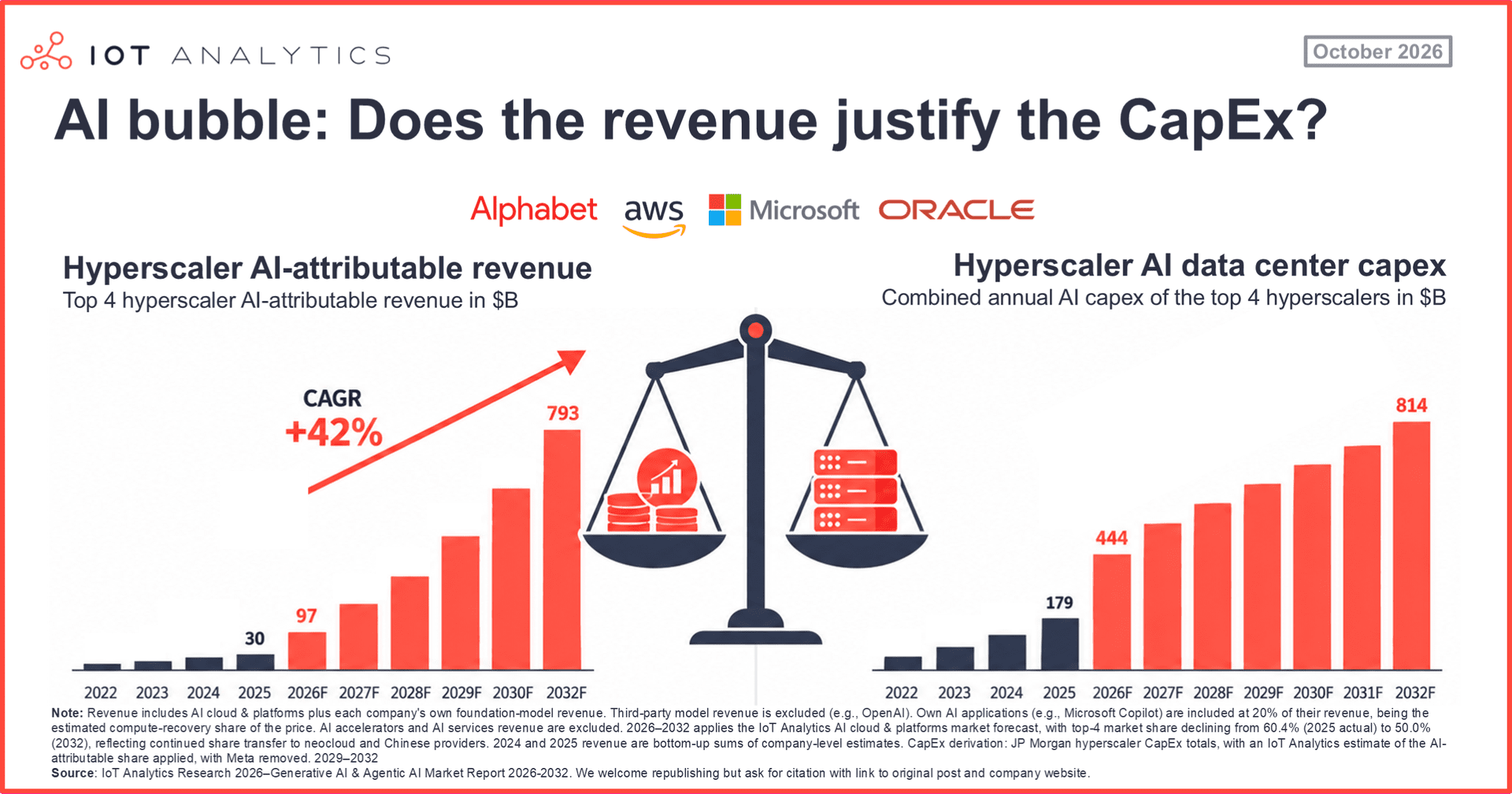
- Regarding infrastructure payback, our data center CapEx bubble model shows hyperscaler AI returns dropping below 0% by 2031, a write-down the hyperscalers can absorb, not a wider bubble popping.
Why it matters
- For AI vendors, infrastructure providers, and investors: The AI data center CapEx bubble is the one that matters most. Knowing that we are not currently in a bubble, and when returns may come under pressure, can inform infrastructure decisions and support strategic planning for the coming years.
- For enterprises adopting AI: It is important to understand which bubble is being discussed. Headlines about a CapEx bubble say little about whether AI pays off for an individual enterprise. That depends on cost discipline and scaling the right use cases.
In this article
- So are we really in an AI bubble?
- What is an “AI bubble” and when does it “pop”?
- How many potential AI bubbles are there?
- Bubble 1: The AI capability expectation
- Bubble 2: Enterprise RoI
- Bubble 3: CapEx payback
- Bubble 4: Equity valuations
- Analyst takeaway and further reading
- Frequently asked questions about AI bubble
- Further analysis
- Generative and agentic AI total market overview (Insights+ Exclusive)
- AI competitive landscape (Insights+ Exclusive)
- AI applications segment landscape (Insights+ Exclusive)
- Most-used non-monetized AI applications (Insights+ Exclusive)
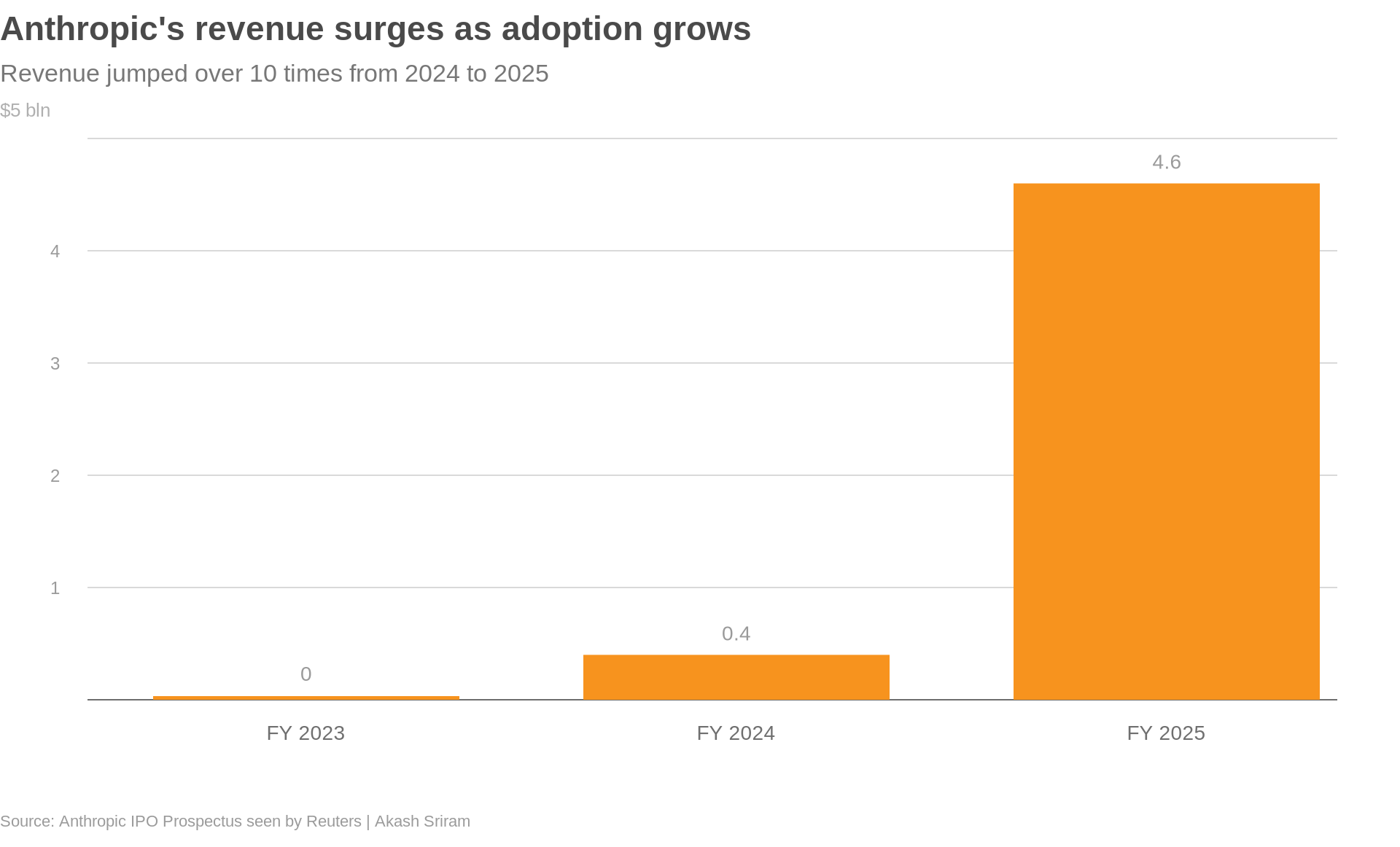
On 28 September, financial details from Anthropic’s IPO preparations surfaced in a prospectus seen by Reuters: just $4.6 billion in 2025 revenue, an operating loss of more than $8 billion, and a potential valuation above $2 trillion. The verdict by many: “AI bubble!”
So are we really in an AI bubble?
According to IoT Analytics’ 283-page Generative AI & Agentic AI Market Report 2026–2032 (published September 2026), global spending on generative and agentic AI (including hardware, software, and services) reached $308 billion in 2025, nearly double the previous year. We forecast the market will reach $700B in 2026 and $4.4 trillion by 2032.
If the market is growing this fast, why the bubble talk? Because on the other side of the ledger sit record infrastructure investments, record stock valuations, reports of circular financing, and enterprises stuck in “pilot purgatory.” The question is whether the 2 sides balance out. The result of our analysis runs against the prevailing mood: we do not believe we are in an AI bubble today.
We explain our reasoning below and will dive deeper into our findings during our October 7, 2026, webinar, “Agentic AI: Where is the value?“
| Why does IoT Analytics analyze AI bubbles? Over the last 6 months, several clients have asked us for our take on the AI bubble discussion. Over the last 5 years, IoT Analytics has grown well beyond its IoT market research roots into a broader provider of market intelligence for industrial technology markets. Today, we track both the AI markets and the data center infrastructure it runs on, covering the models and applications as well as the chips, cloud capacity, and capital spending behind them. This is the basis for the view we share here, though not everyone on our team agrees with every assumption made and shown. |
What is an “AI bubble” and when does it “pop”?
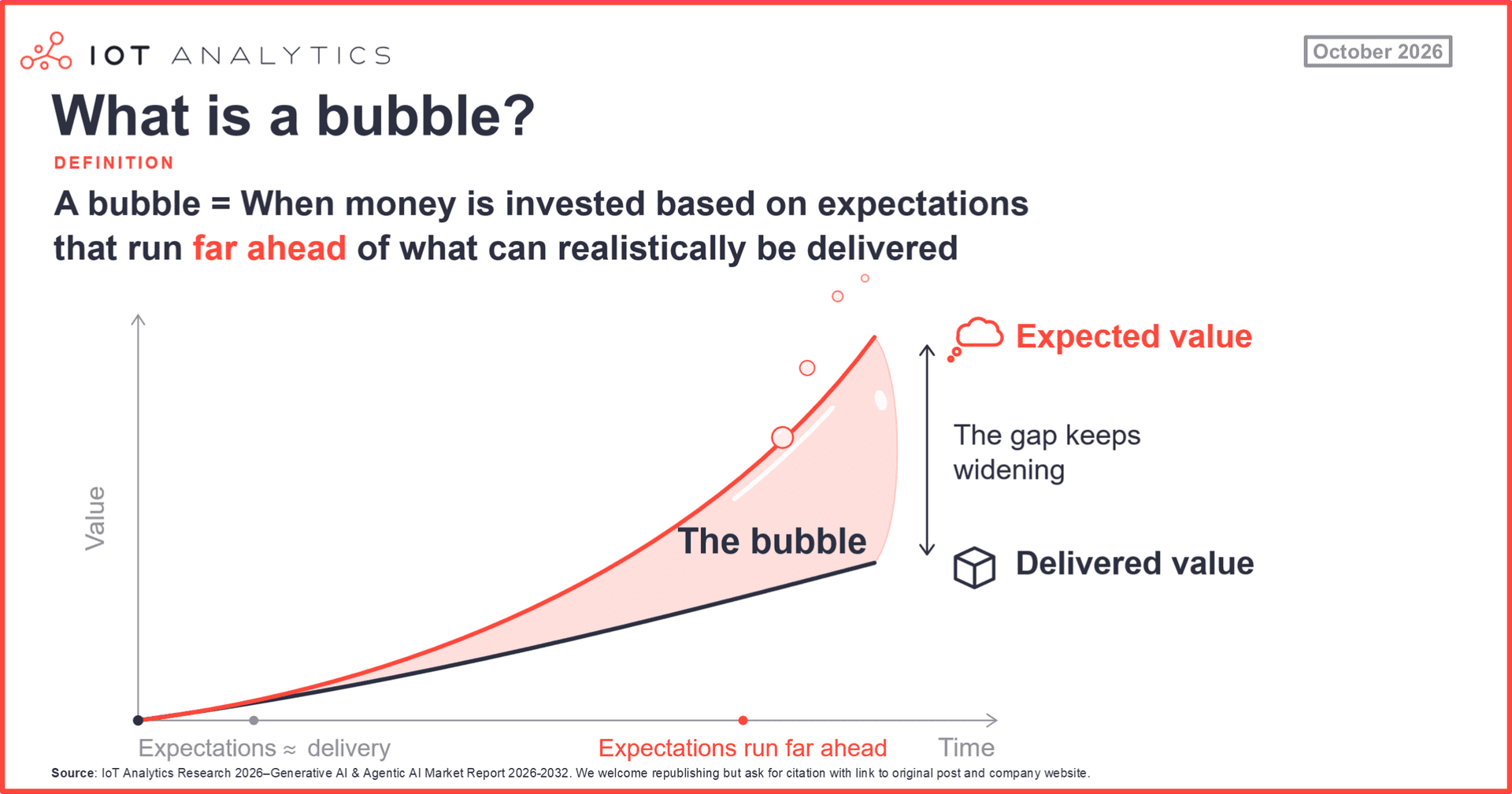
Bubble = When money is invested based on expectations that run far ahead of what can realistically be delivered.
Investing ahead of results is normal for any new technology. Investors regularly fund companies, products, and infrastructure before the revenue exists, betting that demand will catch up. As long as real progress (capabilities, adoption, and revenue) keeps closing the gap to those expectations within a reasonable time, that is early-stage investment, not a bubble.
A bubble is different. A bubble forms when the gap between expectations and what can realistically be delivered keeps widening instead of closing. Money keeps flowing in mainly because prices and investment levels are rising, not because results justify them. Prices then reflect what investors expect others to pay later, not the cash the underlying assets will ever generate.
A well-known example is the dot-com bubble of the late 1990s. Investors poured money into internet start-ups valued on traffic and growth promises, many with little or no revenue. When the hype faded in 2000, funding dried up, many of these companies went bust, and the Nasdaq lost nearly 80% of its value by 2002.
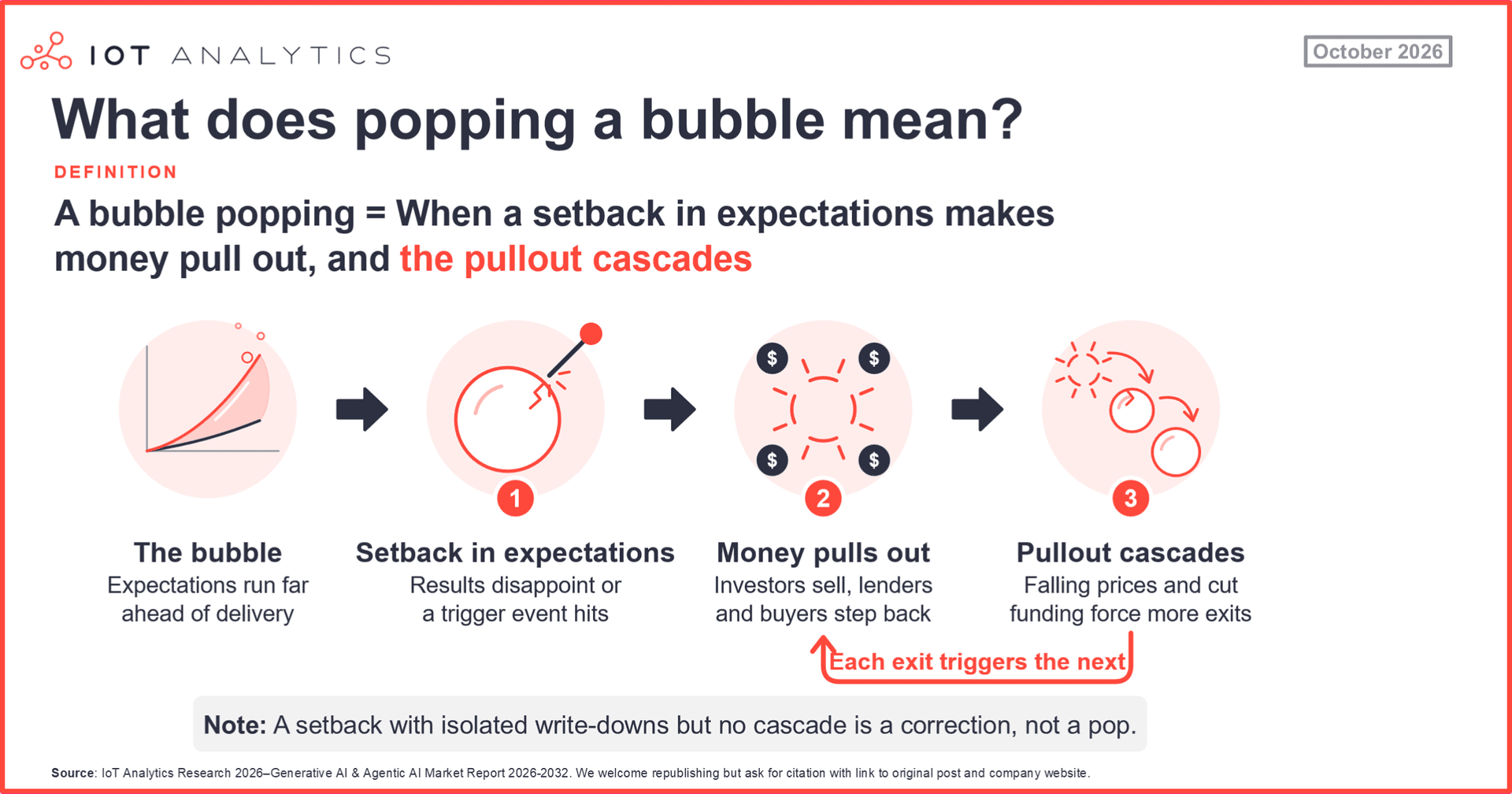
Popping = When a setback in expectations makes money pull out, and the pullout cascades.
Investments that fail to earn back their cost are common in any infrastructure build-out. When those losses fall on companies with the cash flow and balance sheets to absorb them, the result is a write-down. It is painful and shows up in earnings, but it stays contained and slowly deflates the bubble, rather than popping it.
A bubble that pops is different. A bubble pops when the resulting losses hit players who cannot absorb them, forcing asset sales, defaults, or canceled commitments that spread to everyone connected to them, often resulting in a market-wide collapse in prices, investment, and credit.
A recent example is the Lehman Brothers’ 2008 collapse during the housing bubble of the early 2000s. Lehman had borrowed heavily to buy mortgage-backed securities. When house prices fell, its lenders pulled out, and it went bankrupt, which froze credit markets and turned a housing downturn into the global financial crisis.
We apply the above definitions of bubble and popping to the wider AI market, thus calling it the potential AI bubble.
How many potential AI bubbles are there?
In our view, there are 4 different potential AI bubbles. They are all linked, but public discussions often confuse them or use them interchangeably.
- Bubble 1: The AI capability bubble – Is AI becoming capable enough to do work people will pay for?
- Bubble 2: The enterprise ROI bubble – Are enterprises getting a return on that spending?
- Bubble 3: The CapEx payback bubble – Does the resulting revenue pay back the massive infrastructure build-out?
- Bubble 4: The equity valuation bubble – Are company valuations running ahead of all of it?
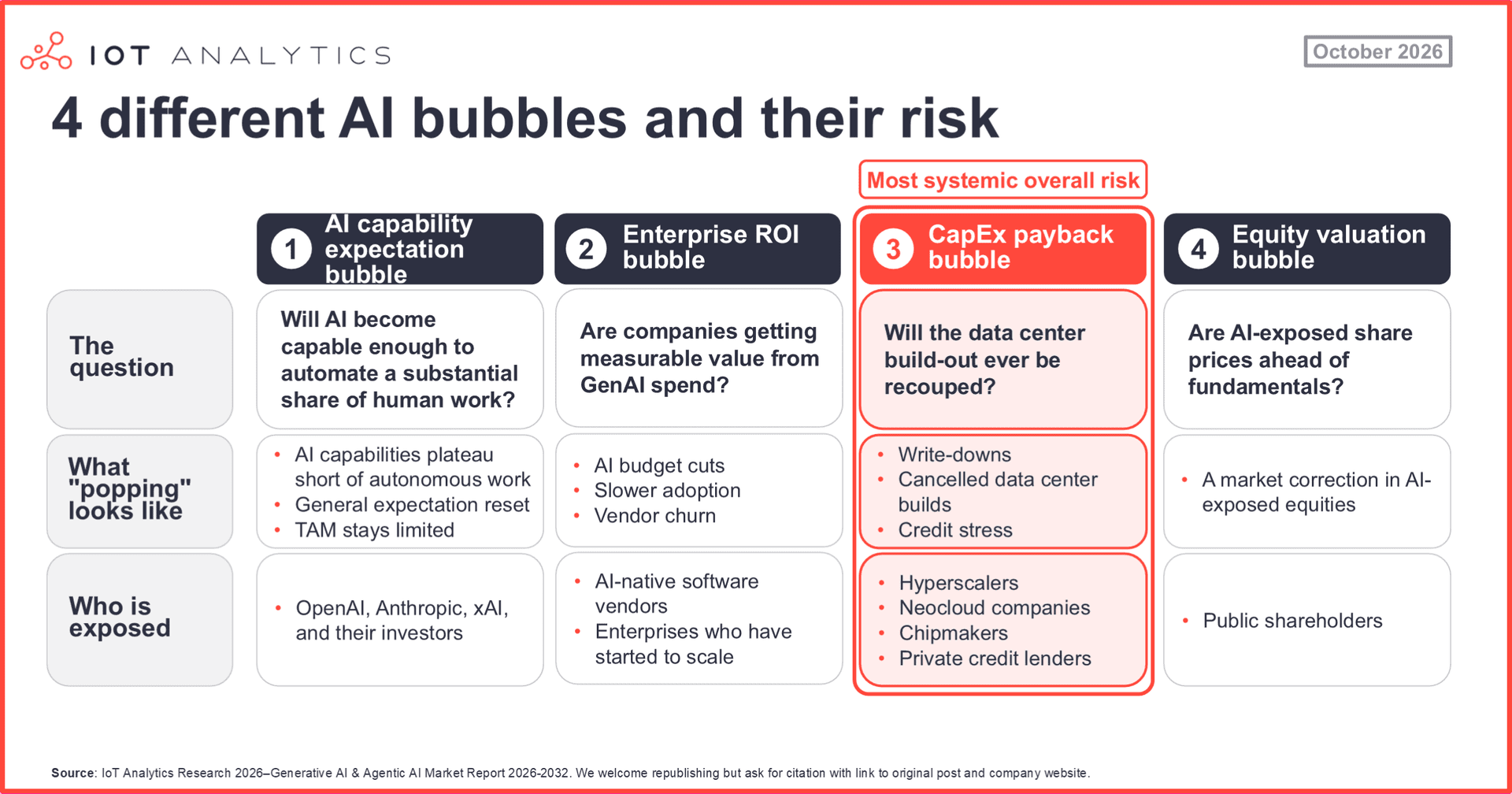
Each bubble represents a different type of expectation, but ultimately, all 4 bubbles are linked:
- If AI does not become capable enough to do work people will pay for (Bubble 1), enterprises cannot earn a return (Bubble 2).
- If enterprises do not earn a return, the spending that flows to model developers and cloud providers stalls.
- Without that revenue, the data center build-out cannot be paid back (Bubble 3).
- And valuations, which price in everything above them, would eventually adjust (Bubble 4).
A weakness at any link moves downstream and could lead to all 4 bubbles popping, but each bubble does have its own dynamics and risks also.
Each link also exposes a different group of players. Model developers and their investors carry most of the capability risk. Enterprises and AI-native software vendors depend most on ROI. Hyperscalers, neoclouds, chipmakers, and the lenders financing them are tied to CapEx payback. And public and private shareholders hold the valuation risk.
Of the 4 bubbles, Bubble 3 (data center CapEx payback) is the one we watch most closely because we believe it is the most systemic. If this bubble pops, it has the widest effects on the ecosystem, including lenders and equity holders.
Below, we dive into each bubble, give our verdict on each, and share our overall assessment.
Bubble 1: The AI capability expectation
The capability debate is usually framed around artificial general intelligence (AGI, the ability for an AI system to match or exceed human cognitive abilities across any domain): Can we get there, and how quickly? Although the market does not need AGI to avoid a bubble, it is useful to measure AI capability progress. US-based AI evaluation and research non-profit METR, for example, measures the length of tasks an AI model can complete with 50% reliability, with task length defined by how long the same task takes a skilled human professional. That time horizon has been growing exponentially, doubling roughly every 7 months since 2019, and possibly faster since 2024.
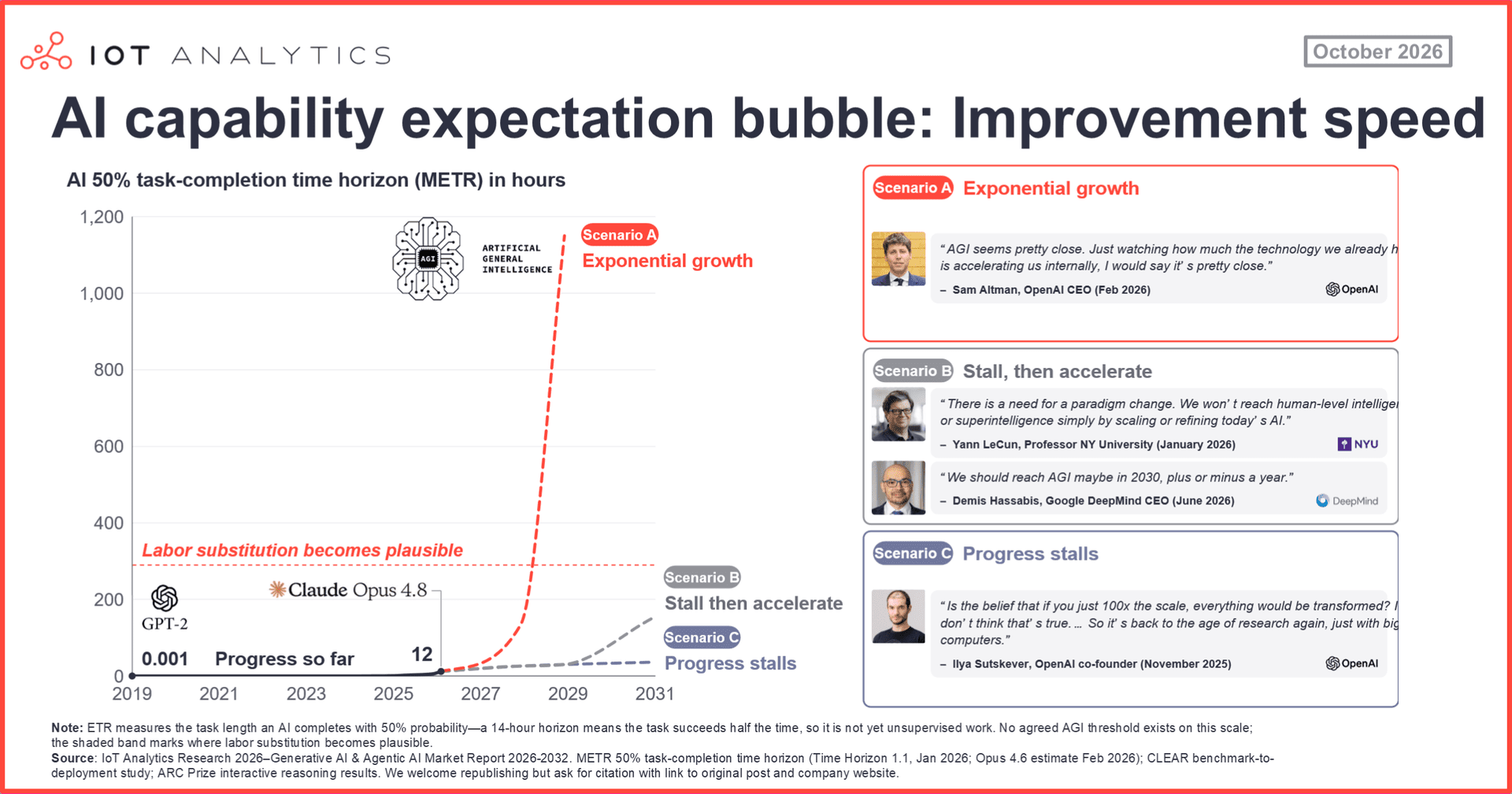
The open question is which of the following 3 paths it takes from here:
- Continued exponential growth
- A stall followed by renewed acceleration
- A stall in progress
Leading AI voices disagree on the pace ahead:
OpenAI’s Sam Altman expects rapid progress toward highly capable systems
“AGI seems pretty close. Just watching how much the technology we already have is accelerating us internally, I would say it’s pretty close.”
Sam Altman, CEO, OpenAI (February 2026)
New York University professor and “AI godfather” Yann LeCun and Safe Superintelligence’s Ilya Sutskever argue that current approaches will need new research breakthroughs and think it will take much longer
“There is a need for a paradigm change. We won’t reach human-level intelligence or superintelligence simply by scaling or refining today’s AI.”
Yann LeCun, Professor, New York University (January 2026)
“Is the belief that if you just 100x the scale, everything would be transformed? I don’t think that’s true. … So it’s back to the age of research again, just with big computers.”
Ilya Sutskever, Co-founder and CEO, Safe Superintelligence Inc (November 2025)
Our verdict: Not possible to evaluate. Unlike the other 3 bubbles, we cannot judge this because no data lets us compare what the market expects from AI capabilities with what is actually achievable. What we can say is that capabilities have advanced remarkably fast over the last 3+ years, so fast that many organizations still struggle to adopt at scale capabilities that were introduced more than a year ago. That adoption gap acts as a cushion: even if progress slowed, there would still be plenty of value left to capture from what already exists.
Bubble 2: Enterprise ROI
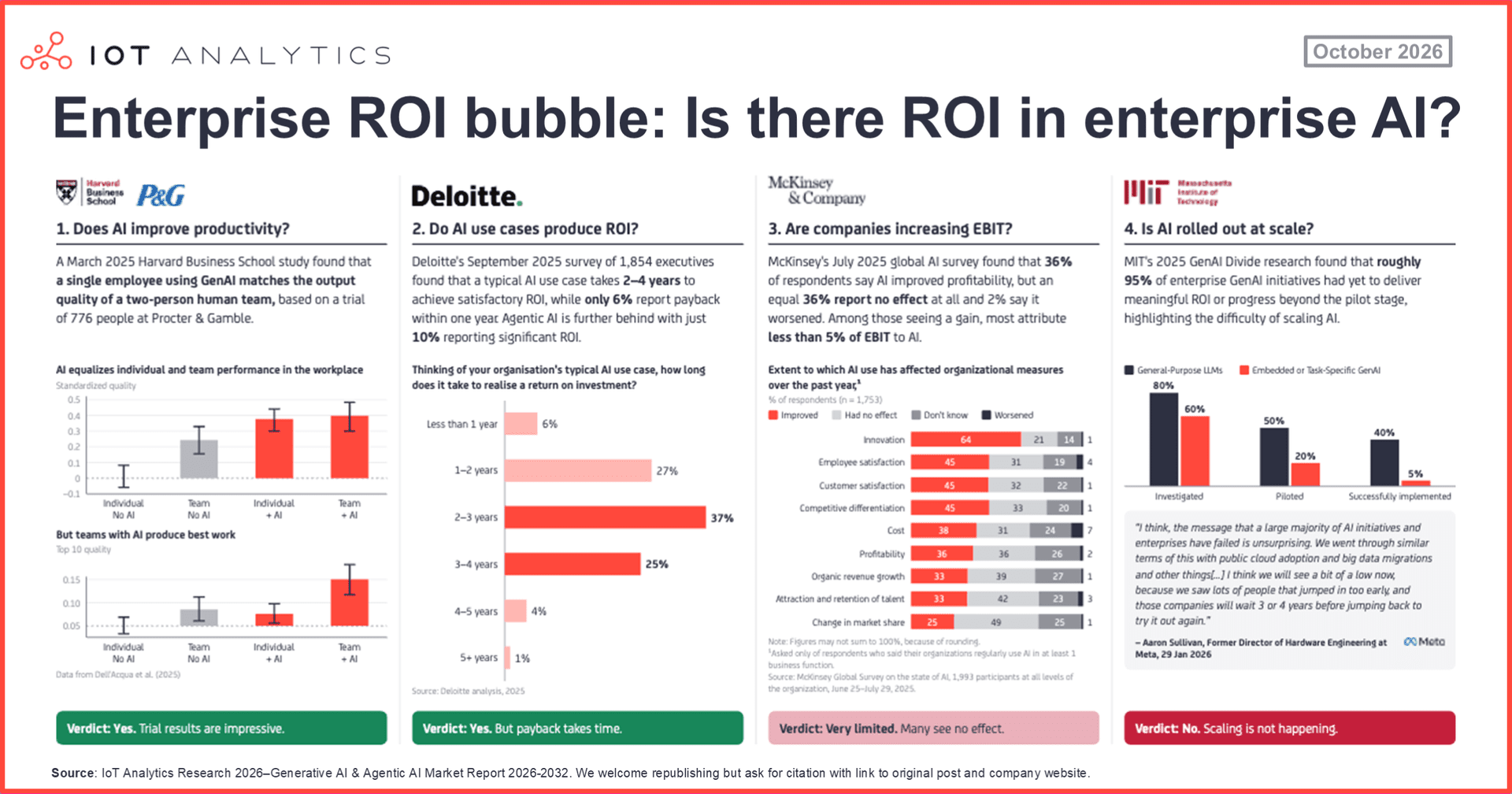
Capability only matters if it pays off. If AI is becoming capable enough, the next question is whether companies are actually earning a return.
Does AI improve productivity?
At the level of individual tasks, the evidence is strong. In a March 2025 Harvard Business School field experiment with 776 Procter & Gamble professionals, individuals using generative AI performed about as well as 2-person teams working without it.
Do AI use cases produce ROI?
Turning those task-level gains into company-wide results is harder. Deloitte‘s October 2025 survey of 1,854 executives found that a typical AI use case takes 2–4 years to reach a satisfactory return, and only 6% pay back within a year. This analysis does show payback, but not necessarily in the time that some people would expect.
Is AI rolled out at scale?
Most initiatives have yet to pay off. MIT‘s widely discussed July 2025 article on the state of AI in business is more pessimistic, estimating that roughly 95% of enterprise generative AI initiatives have yet to deliver meaningful returns.
Are companies increasing EBIT?
The profit impact is mixed. McKinsey‘s August 2026 results on the state of AI are evenly split: 36% of organizations report improved profitability from AI, while the same share reports no effect.
The cost of adopting AI has become a new complication. Most AI is priced by usage, so bills grow with every task an agent runs. As agentic workloads scale, some enterprises have found their spending growing faster than the value they can prove. Uber reportedly exhausted its 2026 AI budget within 4 months, and buyers are increasingly pushing vendors for flat-fee pricing. Getting a return on AI is now as much about controlling costs as capturing value.
Some executives are starting to describe AI’s payoff in terms of headcount, though. One key theme regarding AI in Q3 corporate earnings calls (which IoT Analytics reported in its What CEOs Talked About in Q3 2026 report, published September 2026) was growth being decoupled from headcount. Several CEOs noted that AI allowed revenue and output to grow while headcount remained flat or shrunk, with some framing this as slower hiring, not mass layoffs.
Key CEO quote about AI and headcount
“In operations, supply chain, and our corporate functions, AI is helping us ramp faster, drive meaningful improvements in productivity, and scale our revenue significantly faster than our headcount.”
Gary Dickerson, President & CEO, Applied Materials, Aug 2026
Our verdict: likely not a bubble. The value of AI is real, and spending is holding up, but the impact on profits is still limited and increasingly depends on cost discipline. Our discussions with AI adopters and also public data points from the last 6 months do point to AI starting to have a larger impact on enterprise ROI.
Bubble 3: CapEx payback
Enterprise AI spending ultimately becomes hyperscaler revenue. If enterprises see a return on AI, they will keep investing in building AI applications and agents and consume the cloud infrastructure and tokens needed to run them. That spending turns into AI revenue for the hyperscalers, namely AWS, Google Cloud, Microsoft, and their Chinese counterparts such as Alibaba Cloud. To capture that revenue, however, these companies first need to invest in massive data center capacity, which brings us to what we consider the most systemic of the 4 bubbles: the forecasted ~$750B hyperscaler data center build-out just in 2026 alone.
The key question: Will the massive spend on new and upgraded data centers earn investors the returns they expect?
The case for why we are not in a bubble
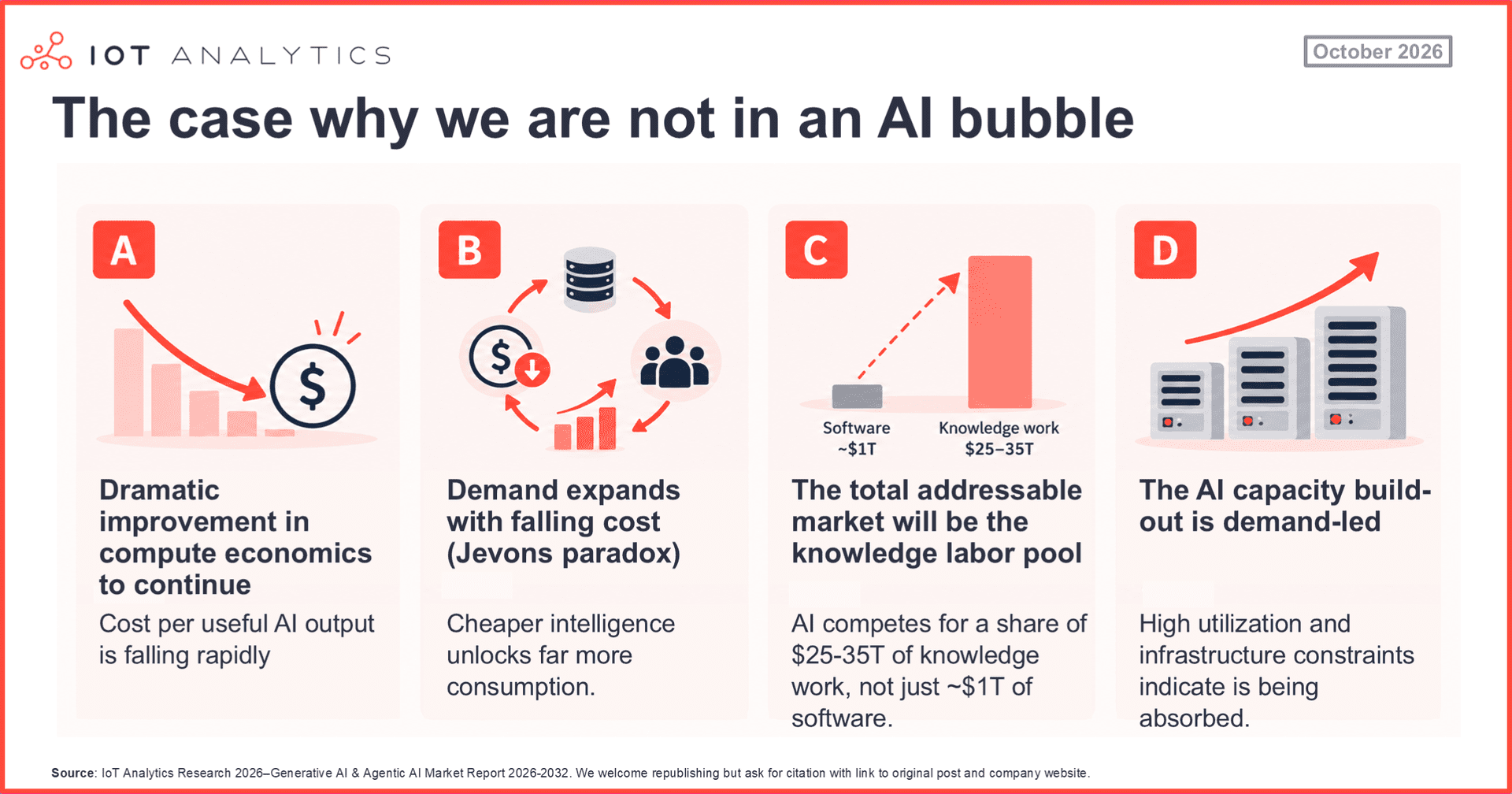
Optimists point to 4 key arguments for why the data center build-out will pay for itself:
- The build-out is demand-led – High utilization, infrastructure constraints, and hyperscaler demand indicate that new capacity is being absorbed. CoreWeave, for example, ended 2025 with a $66.8 billion contracted revenue backlog, 4.5x the $15 billion of a year earlier.
- The addressable market is knowledge work, not software – AI competes for a share of the $25–$35 trillion global knowledge-worker wage bill, not just the roughly $1 trillion enterprise software market. The total addressable market (TAM) is therefore much bigger than some people think.
- Compute economics keep improving dramatically – The cost per useful AI output is falling rapidly. OpenAI’s token prices, for example, have dropped by more than 90% over the last 3 years, so each CapEx dollar buys more output and serves more paying workloads.
- Demand expands as cost falls – Cheaper intelligence unlocks far more consumption. This follows the Jevons paradox: when a resource gets cheaper, total consumption rises rather than falls, as happened with coal once steam engines became more efficient.
Key optimist quotes
“Computing cost is coming down, which causes more developers to come up with more ideas, which drives more demand.”
Jensen Huang, Founder & CEO, NVIDIA (June 2024)
“The [total addressable market] that AI addresses is not software revenue… The TAM is actually human labor.”
David Cahn, Partner, Sequoia Capital (August 2026)
The case for why we are in a bubble
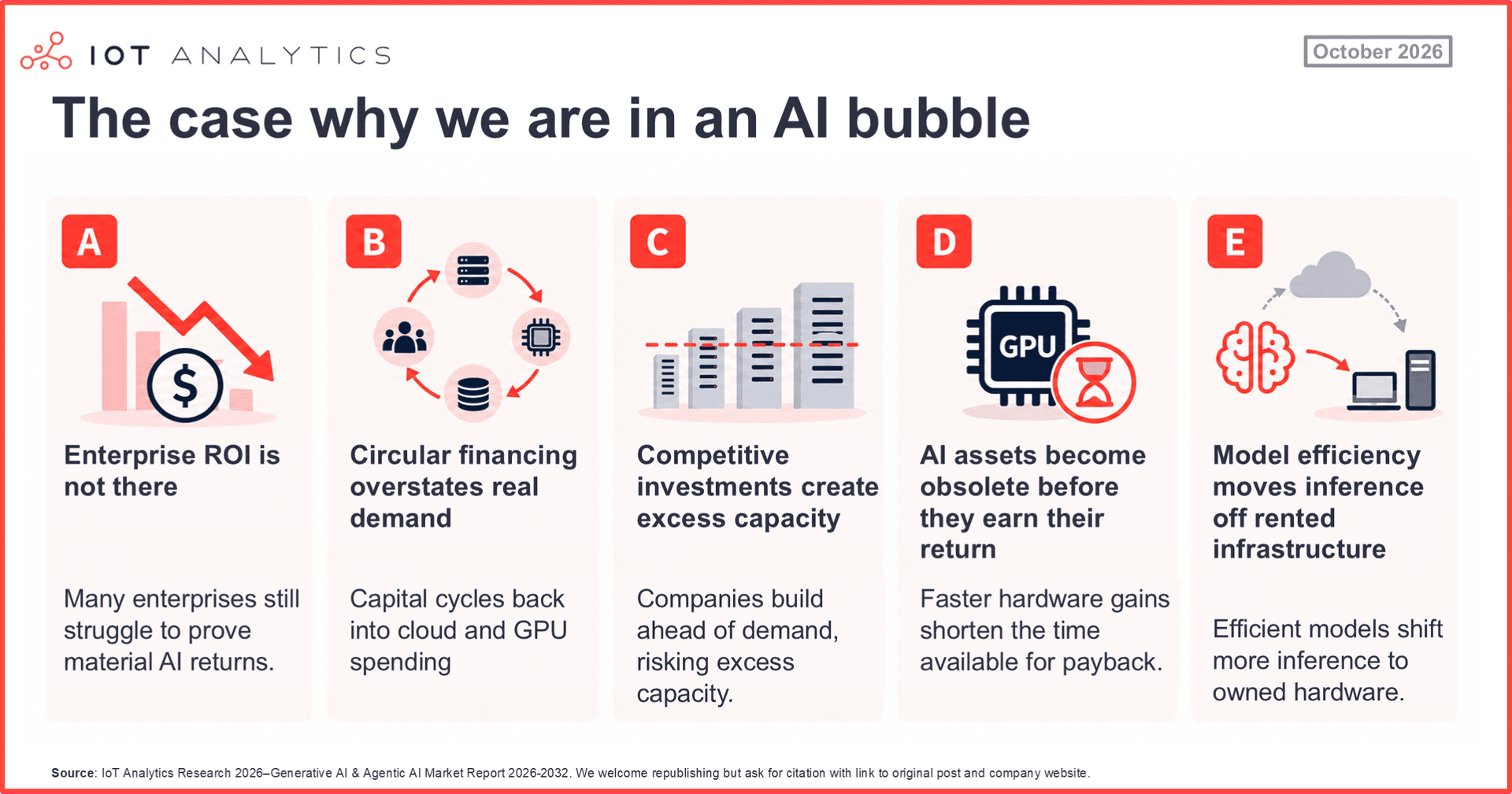
Skeptics point to 5 key arguments for why the data center build-out may not pay for itself:
- Enterprise ROI is not there yet. Many enterprises are still struggling to show material revenue gains or short payback periods from their AI investments (see Bubble 2).
- Circular financing overstates real demand. Hyperscalers, AI labs, chip vendors, neoclouds, and financiers increasingly fund one another, and that capital is spent back on cloud and GPU capacity. As a result, some of what suppliers count as demand is money they put into the market themselves. OpenAI is the clearest example: about $12.6 billion in 2025 revenue set against more than $550 billion in cloud commitments.
- Competitive investments create excess capacity. Companies like Microsoft, Google, Amazon, Meta, Oracle, and others all have rational reasons to secure compute ahead of their competitors. Taken together, however, this race risks building more capacity than the market needs.
- AI assets become obsolete before they earn their return. Rapid improvements in performance per watt and per dollar shorten the economic life of existing GPUs, giving them less time to pay back their cost.
- Model efficiency moves inference off rented infrastructure. Small, quantized open-weight models increasingly run on commodity or already-owned hardware, diverting routine, high-volume inference away from rented data center capacity.
Key skeptic quote
“Investments into scaling AI [are] the greatest capital misallocation in history.”
Gary Marcus, Professor, New York University (June 2026)
What the IoT Analytics AI bubble model says
Our model tests whether AI revenue can pay back AI CapEx. To move beyond the bull and bear arguments, we built our own AI data center CapEx payback model. It starts with the AI revenue that hyperscalers and neoclouds actually report today and projects it forward, using both company forecasts and the growth rates we consider realistic. On the other side of the ledger, it takes the reported CapEx on the AI data center build-out and extends it using J.P. Morgan‘s forecast of how that spending will continue. On top of this, we layer what we believe are reasonable assumptions for AI server asset lifetimes, data center operating costs, and many other factors. The result is a year-by-year view of whether the revenue generated by AI infrastructure is enough to earn back what is being invested in it.
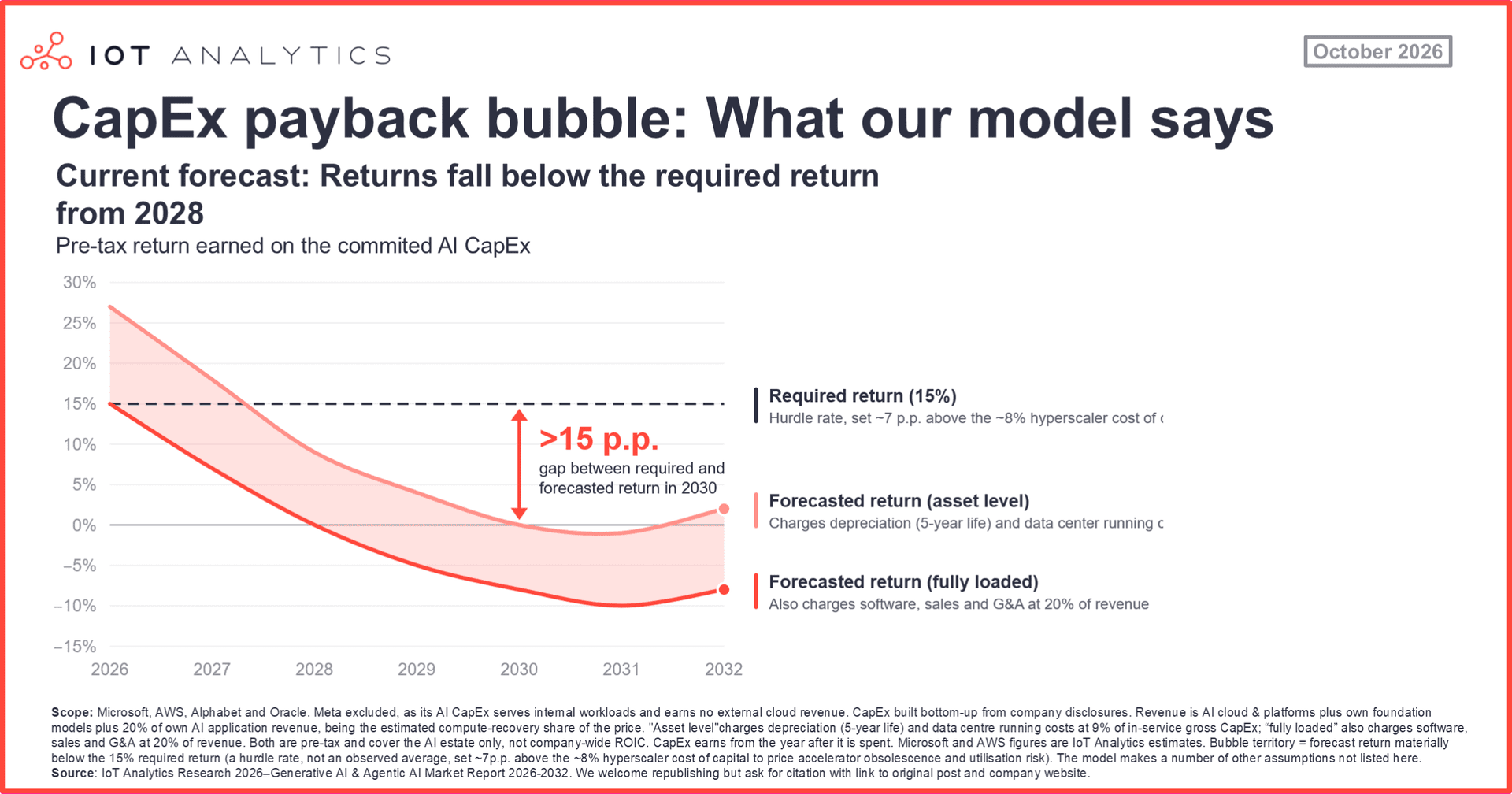
2 cost views bracket the hyperscaler return. Our model calculates the pre-tax return Microsoft, AWS, Alphabet, and Oracle earn on their committed AI CapEx, within upper and lower bounds. The upper bound (“asset level”) only charges the direct costs of the AI estate: depreciation of the servers over a 5-year life and the running costs of the data centers. The lower bound (“fully loaded”) also charges the software, sales, and general and administrative costs needed to sell AI services, which we estimate at 20% of revenue. Meta is excluded, as its AI CapEx serves internal workloads rather than external cloud customers.
Today, returns clear the 15% hurdle. Based on what has been invested so far and on the explosion in AI demand in 2026 (Anthropic alone went from an annualized revenue run-rate of $9B in December 2025 to an estimated $100B in September 2026), hyperscalers are currently on track for a pre-tax return above 15%. We consider 15% the required return for this type of investment: roughly 7 percentage points above the hyperscalers’ ~8% cost of capital, to price in the risk of AI accelerators becoming obsolete or underutilized.
From 2028, returns fall below the hurdle. That picture changes over the coming years. CapEx keeps rising steeply this year and next, while, in our view, the AI market cannot sustain the growth rates needed to keep pace. As a result, returns fall below the 15% hurdle from 2028 onward, and in our model, they drop below 0% by 2031.
The required AI revenue run-rates look hard to reach. How quickly this happens depends largely on how much hyperscalers actually earn from AI. To make this tangible, we translated the 15% hurdle into the annualized AI revenue run-rates (a metric both now report) that the 2 largest hyperscalers, Microsoft and AWS, would need to reach over the next 3 years. Based on our forecast of the AI application and other markets in our Generative AI & Agentic AI Market Report 2026–2032, and assuming the J.P. Morgan hyperscaler CapEx forecast holds, we believe these numbers will be hard to meet.
Annualized AI revenue run-rate: What Microsoft and AWS need to earn for a 15% return vs. what we forecast
| Microsoft: Needed for 15% return | Microsoft: IoT Analytics forecast | AWS: Needed for 15% return | AWS: IoT Analytics forecast | Combined gap (forecast minus needed) | |
|---|---|---|---|---|---|
| Last reported | $37B (Q1 2026, +123% YoY) | — | >$25B (Q2 2026) | — | — |
| Q4 2026 | $45B | $56B | $32B | $36B | +$15B |
| Q4 2027 | $92B (+104% YoY) | $96B | $64B (+100% YoY) | $61B | +$1B |
| Q4 2028 | $159B (+73% YoY) | $144B | $111B (+73% YoY) | $92B | –$34B |
By 2028, the gap could reach $34 billion. Based on our forecast, by Q4 2028, Microsoft and AWS could face a combined annualized revenue shortfall of roughly $34 billion: together, they would need an AI revenue run-rate of about $270 billion to meet the 15% hurdle, versus the roughly $236 billion we forecast.
Why a 0% return does not mean a popping bubble. Who absorbs the losses matters more than the losses themselves. We built our model around the hyperscalers because they currently account for more than 80% of the AI compute build-out. Hyperscalers fund most of their build-out from operating cash flow, so they can take a write-down and keep going.
Neoclouds such as CoreWeave and Nebius do not have that cushion: they finance much of their expansion with debt secured against their GPUs and customer contracts (CoreWeave alone reported $35 billion in total debt as of June 2026), which makes them more exposed if returns fall. Because neoclouds account for a much smaller share of the build-out, however, losses there would be far less systemic.
Our model only covers the hyperscalers, and the losses it projects for them look manageable given their cash reserves. We would go further: in return for securing a leading position in AI compute for the next decade, hyperscalers would likely accept that some of their capacity earns a 0% return, where capital earns nothing but is not destroyed either.
Our verdict: likely not a bubble, but losses are likely coming. We expect a write-down rather than an unwind. Our view would change if losses shift to players who cannot absorb them or if the CapEx build-out further accelerates from 2027 onwards.
Bubble 4: Equity valuations
If the AI CapEx does not earn the returns investors expect, they will eventually lower the stock valuations of the companies behind it. This brings us to the last of the 4 bubbles: equity valuations. IoT Analytics is not an equity research firm, and we will leave the definitive valuation call to the investment banks. What we can do is look at the most common yardstick, forward price-to-earnings ratios, and compare today with the dot-com peak.
That comparison in our view is more positive than some public discourse currently suggests. Although many AI stocks have risen sharply since early 2025, earnings for many of these have kept pace. Most of the largest AI companies, including Alphabet, Meta, Microsoft, and NVIDIA, trade at roughly 22 to 25 times forward earnings as of October 5, 2026. That is at or just above the Nasdaq-100 average of about 22. In comparison: At the 2000 dot-com bubble peak, Cisco traded at around 200 times. However, valuations do look stretched in a few individual companies, such as Palantir and AMD (which trade at ~85x and ~40x forward P/E, respectively, as of October 5, 2026), and in debt-funded neoclouds.
Private markets are harder to judge. OpenAI‘s valuation and Anthropic‘s IPO preparations, reportedly based on projected 2028 revenue of $190 billion to $200 billion, rest on growth that has yet to happen. Given the limited amount of information, these 2 companies are not part of our equity valuation analysis.
Our verdict: no broad equity valuation bubble. A handful of names look stretched. Our view would change if earnings fail to keep pace while multiples climb well above market averages.
Analyst takeaway and further reading
Our overall answer: we are not in an AI bubble today, but losses are likely coming. Taking the 4 potential bubbles one at a time, our verdicts are:
- Bubble 1 – AI capability: not possible to evaluate. Progress has been so fast that adoption, not capability, is today’s bottleneck.
- Bubble 2 – Enterprise ROI: likely not a bubble. Returns are real but slow, and increasingly depend on cost discipline.
- Bubble 3 – Infrastructure payback: likely not a bubble, but losses are likely coming. Our model expects hyperscaler returns to fall below the 15% hurdle from 2028 onward, but the hyperscalers can absorb a write-down.
- Bubble 4 – Equity valuations: no broad valuation bubble. Most of the largest AI companies trade at or below market multiples; only a handful of names look stretched.
Our model is sensitive to its assumptions. The results depend heavily on how fast AI revenue grows, how CapEx develops from here, and how long GPUs remain economically useful. Changes in any of these could materially shift the picture. Not everyone on our team agrees with every assumption, and we see this analysis as our best current estimate, not a final word.
AI has proven its critics wrong before. Capability progress has silenced critics several times. A year ago, hallucinations were one of the most cited reasons why AI was not ready for business use. Today, they have largely disappeared from the public debate, and the challenges have shifted to cost control, integration, and scaling use cases.
Most large build-outs have burned money along the way. The railway build-outs of the 19th century and the telecom and fiber build-out of the late 1990s and early 2000s both left many investors with heavy losses, yet the infrastructure they created powered decades of growth. We would not be surprised if parts of the AI build-out follow a similar pattern.
Many unknowns and risks remain. From a capability plateau to a break in circular financing or new regulation, plenty could still change our view. One of the biggest perceived risks is open models running on companies’ own or edge infrastructure instead of rented data center capacity. So far, this has not slowed spending down, but it could reduce demand for the very capacity being built today. 2008 showed how a single failure, Lehman Brothers, can bring down an entire system. We will keep tracking the evidence and update our view if it changes.
Our report goes deeper. The Generative AI & Agentic AI Market Report 2026–2032 analyzes this bubble in more depth and provides an overview of 5 markets: AI chips, AI platforms, AI services, AI foundation models, and AI applications, including the dynamics and leading companies in each. It also provides a view of current enterprise adoption based on a proprietary analysis of 1,500+ public case studies of generative and agentic AI.
Frequently asked questions regarding AI bubble
An AI bubble is when money goes into AI based on expectations that run far ahead of what can realistically be delivered. Investing ahead of results is normal for a new technology. It becomes a bubble when the gap between expectations and real progress keeps widening, and money keeps flowing in because prices are rising, not because results justify them.
No, not today, according to IoT Analytics. Its Generative AI & Agentic AI Market Report 2026–2032 and its AI data center CapEx payback model find that AI revenues are growing too fast, and capabilities are improving too quickly, to call this a bubble. Some data center investments will likely not earn a return, but IoT Analytics sees that as a write-down, not a bubble.
A bubble pops when a setback in expectations makes money pull out and the pullout spreads. That happens when losses hit players who cannot absorb them, forcing asset sales, defaults, or canceled commitments that spread to everyone connected to them. When the losses fall on cash-rich companies instead, the result is a contained write-down.
IoT Analytics identifies 4 linked but distinct potential AI bubbles:
– AI capability: Is AI capable enough to do work people will pay for?
– Enterprise ROI: Are companies earning a return on AI?
– CapEx payback: Will AI revenue pay back the data center build-out?
– Equity valuations: Are company valuations running ahead of all of this?
Not all of them. IoT Analytics’ model shows that hyperscaler AI investments currently clear a 15% pre-tax return hurdle. Returns fall below that hurdle from 2028 and below 0% by 2031. By Q4 2028, Microsoft and AWS could face a combined annualized AI revenue shortfall of about $34 billion against what a 15% return requires.
Partly. Task-level productivity gains are well documented, but company-wide returns take time. A Deloitte survey found a typical AI use case takes 2–4 years to reach a satisfactory return. McKinsey found 36% of organizations report improved profitability from AI, while the same share report no effect. IoT Analytics rates enterprise ROI as unlikely to be a bubble, but increasingly dependent on cost discipline.
Mostly no. Alphabet, Meta, Microsoft, and NVIDIA trade at roughly 18 to 24 times forward earnings, at or below the Nasdaq-100 average of about 25. At the 2000 dot-com peak, Cisco traded at around 200 times. A few names, such as Palantir and AMD, and debt-funded neoclouds do look stretched.
Further analysis
Below, in our Insights+ section, we share the total market size for generative and agentic AI, the AI competitive landscape across several sectors (e.g., AI accelerators), an overview of the AI applications segment, and the most-used non-monetized AI applications.
Access key market data for $99/month per user
The Insights+ Subscription unlocks exclusive facts & figures. You will gain access to:
- Additional analyses derived directly from our reports, databases, and trackers
- An extended version of each research article not available to the public
Full report access not included. For enterprise offerings, please contact sales: sales@iot-analytics.com
