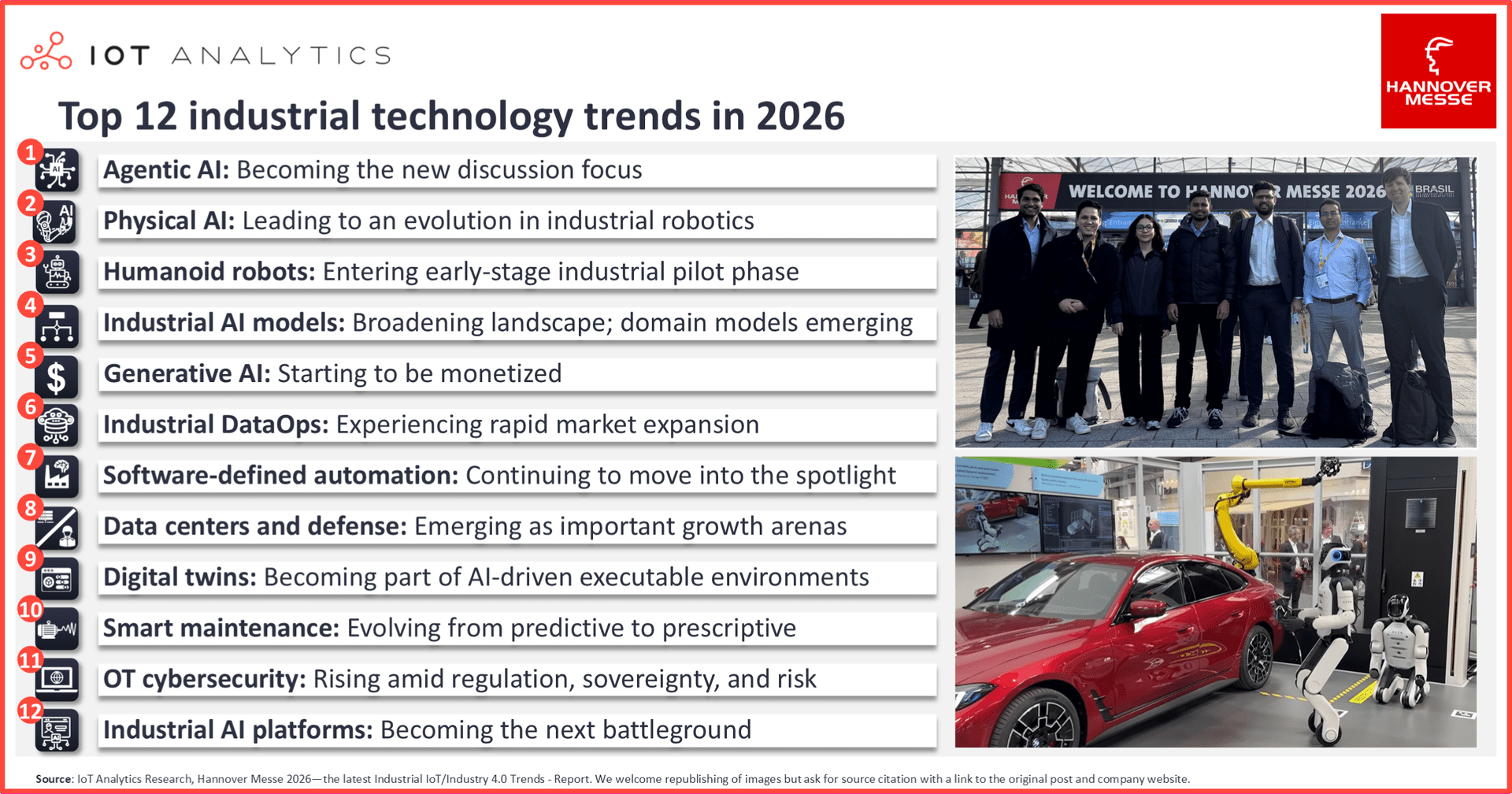
In short
- Agentic AI, physical AI, and domain-specific industrial models are among the key industrial technology trends to watch in 2026.
- IoT Analytics identifies 12 key industrial technology trends affecting smart manufacturing and industrial automation, based on field observations at Hannover Messe 2026.
- A central tension is emerging: Vendors are starting to monetize autonomous AI decision-making on the shop floor before many manufacturers have solved the trusted, contextualized data foundation needed to execute those decisions safely.
- IoT Analytics published a 197-page Hannover Messe 2026 event report with 50 in-depth insights and over 150 topic/vendor examples from the fair.
Why it matters
- Hannover Messe remains the world’s most important global industrial fair. Technologies showcased there are widely applicable to any industrial company.
In this article
- Introduction: Hannover Messe 2026
- The top 12 industrial technology trends
- Trend 1. AI discussions are moving beyond generative AI towards industrial agentic AI
- Trend 2. Physical AI is leading to an evolution in industrial robotics
- Trend 3. Humanoid robots are entering early-stage industrial pilot phases
- Trend 4. Industrial vendors are developing domain-specific world AI or industrial foundation AI models
- Trend 5. Industrial software vendors are starting to monetize GenAI features
- Trend 6. Industrial DataOps vendors experience rapid commercial growth as manufacturers demand AI-ready contextualized data
- Trend 7. Vendors continue to promote software-defined automation and virtual PLCs
- Trend 8. Data centers and defense are emerging as adjacent growth arenas for industrial technology vendors
- Trend 9. Digital twins are evolving from standalone tools toward being part of AI-driven, closed-loop executable environments
- Trend 10. Predictive maintenance is becoming prescriptive
- Trend 11. OT cybersecurity urgency is rising as regulation, sovereignty, and operational risk reinforce each other
- Trend 12. Looking ahead: Industrial agentic AI platforms as the next battleground
- Outlook: 7 developments to watch in the coming 12 months
- Further analysis
- Market background: The current smart manufacturing market (Insights+ Exclusive)
- Select company highlights from Hannover Messe 2026 (Insights+ Exclusive)
- Agentic AI solutions deep dive (Insights+ Exclusive)
Hannover Messe 2026
Hannover Messe (or Hannover Fair) is one of the top global industrial trade shows, giving great insights into the rising trends in industrial technology. The fair was back in action this year in Hannover, Germany, from April 20 to April 24, 2026, and IoT Analytics had a team of 12 on the ground to uncover the latest industrial technology trends. Our team visited over 400 booths, conducted over 300 individual interviews, and attended a number of presentations to gauge and assess the state of industrial technology amid the ever-changing AI landscape driving the CEO digital agenda.
Attendance was short of 2025’s numbers at approximately 110,000 visitors, and the number of exhibitors dropped to approximately 3,000, well below pre-COVID levels. Still, the fairgrounds were energetic and filled with senior executives from many leading industrial hardware, software, and service providers.
In all, the conference remains one of those rare fairs where you randomly walk into senior executives, like a head of engineering for a major industrial conglomerate, and not only the pre-sales representatives giving you the usual pitch.
“Competitiveness is built where innovations are rapidly put into practice. At HANNOVER MESSE, attendees experience firsthand how to deploy AI productively and create real, tangible added value.”
Jochen Köckler, CEO of Deutsche Messe at Hannover Messe 2026
Every year, since Hannover Messe 2019, the IoT Analytics team produces one of the most comprehensive industrial technology reports on the Hannover fair, covering all major angles of the technology on display. IoT Analytics corporate subscribers eagerly await this recurring flagship report every year, and this year, the 197-page Hannover Messe—The latest industrial IoT/Industry 4.0 trends is available for standalone purchase.
Insights from this article are derived from
Hannover Messe 2026—The latest industrial technology trends
197-page report highlighting key insights from the leading industrial technology fair.
The top 12 industrial technology trends
Below, the IoT Analytics team presents the top 12 industrial technology trends based on these insights (with select exhibitor examples where pertinent). At 3,000 words, these only scratch the surface of the more than 50 individual insights, keynote summaries, key announcements, and end-user signals found in the full event report.
Trend 1. AI discussions are moving beyond generative AI towards industrial agentic AI
Industrial AI agents moving from advice to execution. The industry is moving away from AI models that merely provide textual suggestions toward autonomous systems capable of executing complex workflows. IoT Analytics identified 29 industrial agentic AI solutions at the event, plus 7 non-agentic generative AI (GenAI) solutions. Most solutions exhibited are now model-agnostic, with maintenance & troubleshooting as the leading agentic AI use case.
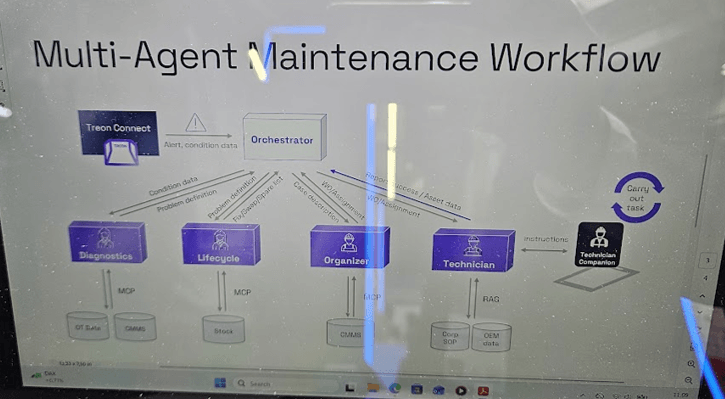
Example: Treon’s multi-agent workflow for prescriptive maintenance
Finland-based predictive maintenance IoT company Treon showcased a model-agnostic, multi-agent maintenance workflow built on AWS Bedrock Agent Core, where sensor data collected via Treon Connect feeds into a central orchestrator agent. The Orchestrator receives alert and condition data from Treon Connect and coordinates 4 agents:
- Diagnostics agent – pulls from OT telemetry and CMMS data to identify faults and define the problem
- Lifecycle agent – queries stock data to manage spare parts requirements
- Organizer agent – writes work order assignments and case descriptions back into CMMS
- Technician agent – retrieves corporate SOPs and OEM manuals via RAG to generate step-by-step repair instructions, which are then delivered to the technician through the Companion app on the shop floor
According to Treon, the company is moving beyond traditional predictive maintenance toward prescriptive maintenance that helps determine what action should happen next.
Trend 2. Physical AI is leading to an evolution in industrial robotics
Physical AI pushing robotics toward autonomous execution. The industrial automation (and specifically robotics) sector is experiencing a fundamental paradigm shift with the advent of physical AI, transitioning operations from rigid, rule-based programming toward autonomous, goal-oriented execution. By embedding vision-language-action (VLA) models and multi-sensor fusion directly into local edge hardware, modern robotic systems can now dynamically perceive unstructured environments, reason through unexpected variabilities, and execute precise physical actions without requiring step-by-step human coding.
Example: Siemens’s cobot arm with VLA for flexible packaging
Germany-based industrial automation company Siemens demonstrated a Universal Robot collaborative robot arm packing flexible textile items (like shoes) into boxes. There are no pre-programmed trajectories in this cobot; instead, the robot runs a VLA model that processes visual input in real time, places the soft item, and self-corrects its motion if the item doesn’t land cleanly. The variability of soft goods (e.g., unpredictable shape, weight distribution, or landing position) is exactly what traditional rule-based programming cannot handle.
“With physical AI, you move from a rule-based to a goal-based automation, so you tell the automation system to grab this shoe and put it there, and you don’t write a line of code because the system is smart enough.”
Rainer Brehm, COO Automation business & CTO Siemens DI, Siemens at Hannover Messe 2026

Trend 3. Humanoid robots are entering early-stage industrial pilot phases
Humanoid robots entering the Hannover Messe stage. In 2026, the IoT Analytics team identified 22 robot makers showcasing humanoid capabilities, a stark contrast to 2025, when no humanoids were on display at the fair. A selection of the 22 exhibitors includes:
- Agile Robots
- Duatic Alpha
- Galbot
- Hexagon Robotics
- Igus
- NEURA Robotics
- Unitree
- Zoomlion
Other ecosystem participants also presented solutions, often based on Unitree or Boston Dynamics robots. While scaled mass production is still developing, industrial operators and logistics providers are actively initiating targeted pilot projects to assess the operational viability of humanoid robots in industrial environments.
The supply chain for humanoid robots is also building up: Schaeffler discussed how it is building integrated linear rotary actuators specifically designed to serve as the articulation points and joints for humanoid robots.
“We are moving from being a supplier to the automotive industry towards a motion technology company.”
Klaus Rosenfeld, CEO at Schaeffler AG (at Hannover Messe 2026)
Example: Hexagon Robotics’s AEON humanoid robot
Sweden-based industrial automation company Hexagon‘s AEON robot was one of the few humanoids at the show with verifiable industrial deployment rather than a lab demo. It is currently running pilot programs at Germany-based automotive manufacturer BMW‘s battery cell production facilities for inspection and logistics, and it demonstrated precision metrology (scanning a BMW) live at the Hexagon booth. AEON uses a wheeled base (not bipedal legs), a deliberate engineering choice: wheels deliver superior stability, energy efficiency, and higher payload capacity than legs, making them better suited to factory-floor realities.
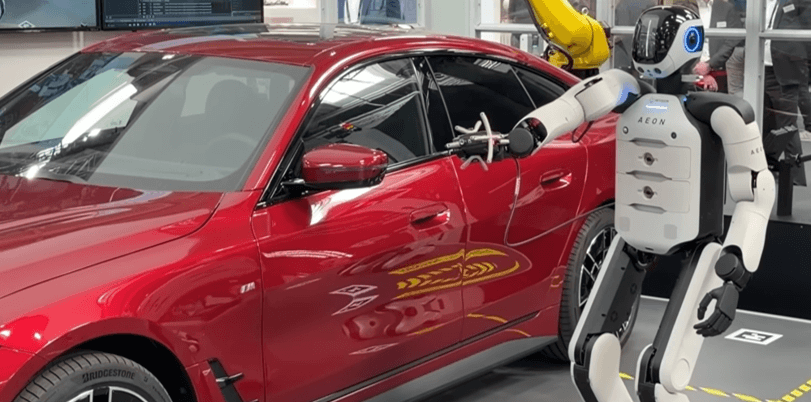
Further, Germany-based motion technology company Schaeffler has committed to purchasing 1,000 AEON units for deployment across its global factory network over 7 years, serving as clear evidence that humanoids are going to come to factories. That is not a pilot intent; it is a signed direction of travel.
Trend 4. Industrial vendors are developing domain-specific world AI or industrial foundation AI models
Industrial foundation models filling LLMs’ plant data gap. Vendors are noting a practical limitation of general-purpose LLMs in industrial settings. These models are trained primarily on publicly available text and code, while plant operations depend on proprietary, structured, temporal, and equipment-specific data. Relevant inputs include historian records, PLC logs, vibration data, process parameters, asset hierarchies, and 3D engineering specifications. Some companies, in response, have begun training their own industrial foundation models.
Examples: SUPCON’s use of real-world plant training data
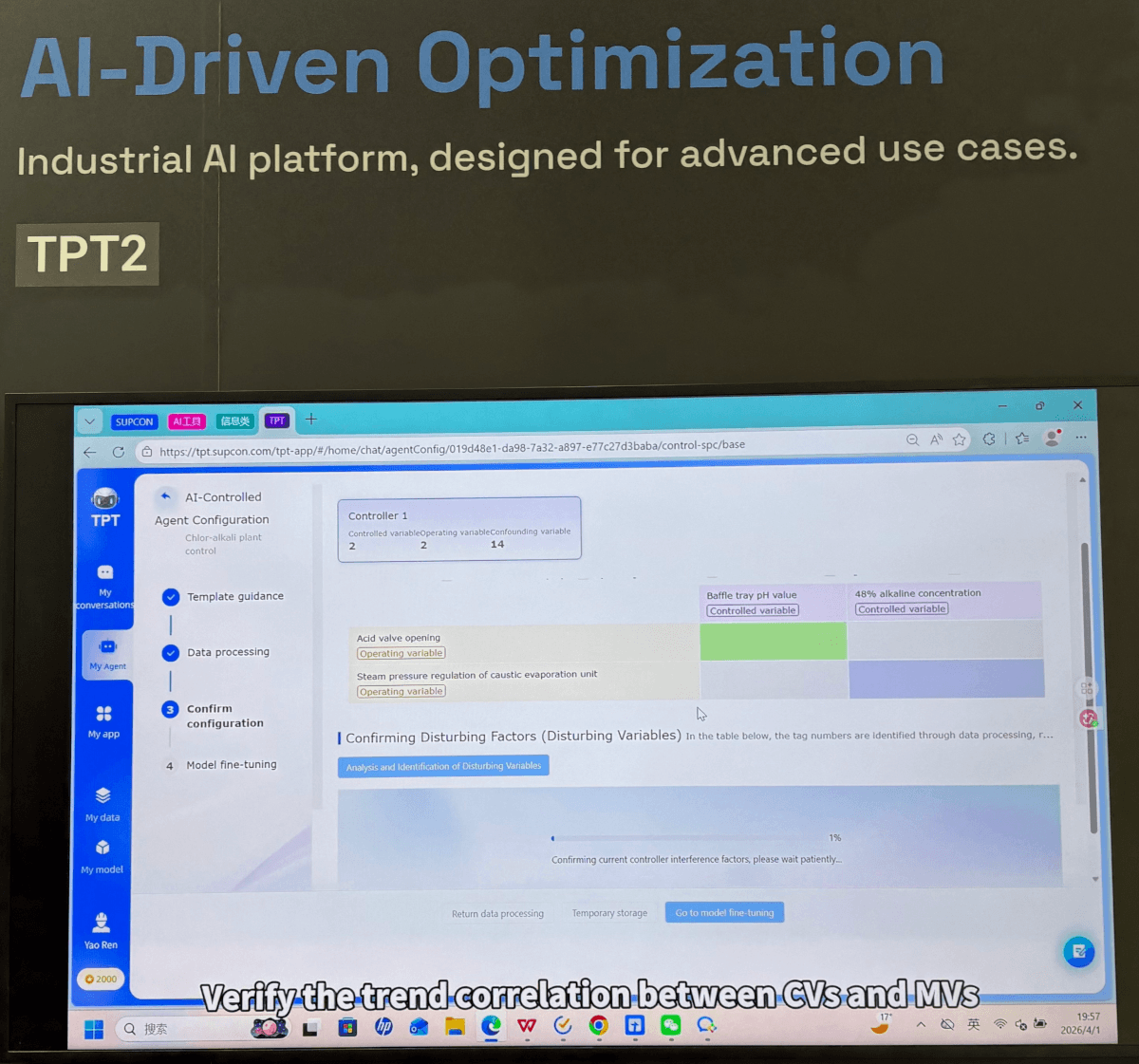
China-based industrial automation company SUPCON presented TPT2, a time-series model trained on data from more than 1,000 chemical and petrochemical plants. The model uses a MoE architecture that activates the parameters most relevant to the controlled process unit. It can be deployed in a closed-loop process control setup, with the model writing APC and PID optimization parameters directly to factory equipment.
Trend 5. Industrial software vendors are starting to monetize GenAI features
Industrial AI copilots moving from free pilots to monetization. Over the last 2 years, industrial software providers have added dozens of free copilots/assistants. They are now concluding the initial free pilot phases for their GenAI assistants/copilots and are actively implementing commercial monetization structures for their generative and agentic AI capabilities. Pricing strategies vary greatly, with some vendors adopting fixed-rate subscriptions and others adopting consumption-based credit systems or hybrid embedded models.
Example: 4 leading industrial technology vendors’ monetization strategies
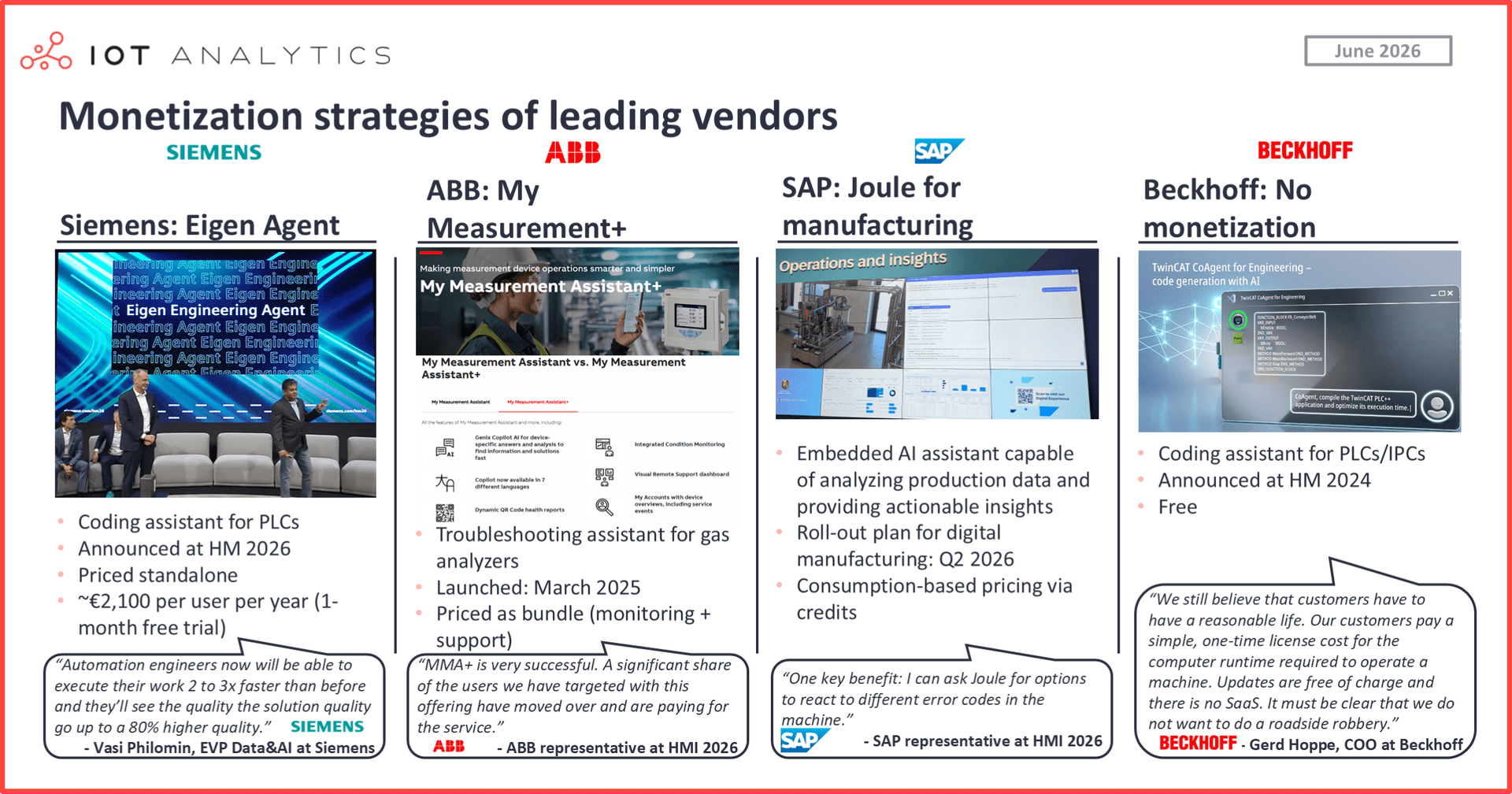
The report shares 4 monetization strategies from leading industrial automation and software companies:
- Siemens Eigen Agent: €2,100/user/year fixed subscription (1 month free trial). Deliberately not token-based; Siemens cites European customer demand for predictable costs. Announced at HM 2026.
- ABB My Measurement Assistant+: Bundled pricing (monitoring + support). Launched March 2025. An ABB representative shared that “a significant share of the users [ABB] targeted have moved over and are paying.”
- SAP Joule for manufacturing: Consumption-based credit model. Q2 2026 rollout for digital manufacturing. Customers draw down credits each time the assistant executes a query.
- Beckhoff: Explicitly free, no SaaS. COO Gerd Hoppe calls token-based pricing “roadside robbery.”
Trend 6. Industrial DataOps vendors experience rapid commercial growth as manufacturers demand AI-ready contextualized data
Semantic data layers gaining momentum from industrial AI. The widespread push to deploy generative and agentic AI across the shop floor has exposed the limitations of raw operational telemetry, forcing manufacturers to aggressively invest in structured semantic layers. As a result, industrial DataOps providers, such as Cybus (Germany), Highbyte (US), Litmus (US), Soffico (Belgium), and United Manufacturing Hub (or UMH; Germany), are experiencing strong commercial momentum as they help customers automate the contextualization of IT and OT data from PLCs, MES, and ERP systems and organize them into unified knowledge graphs.
Example: Litmus continues to see strong commercial growth, continues to deliver new products
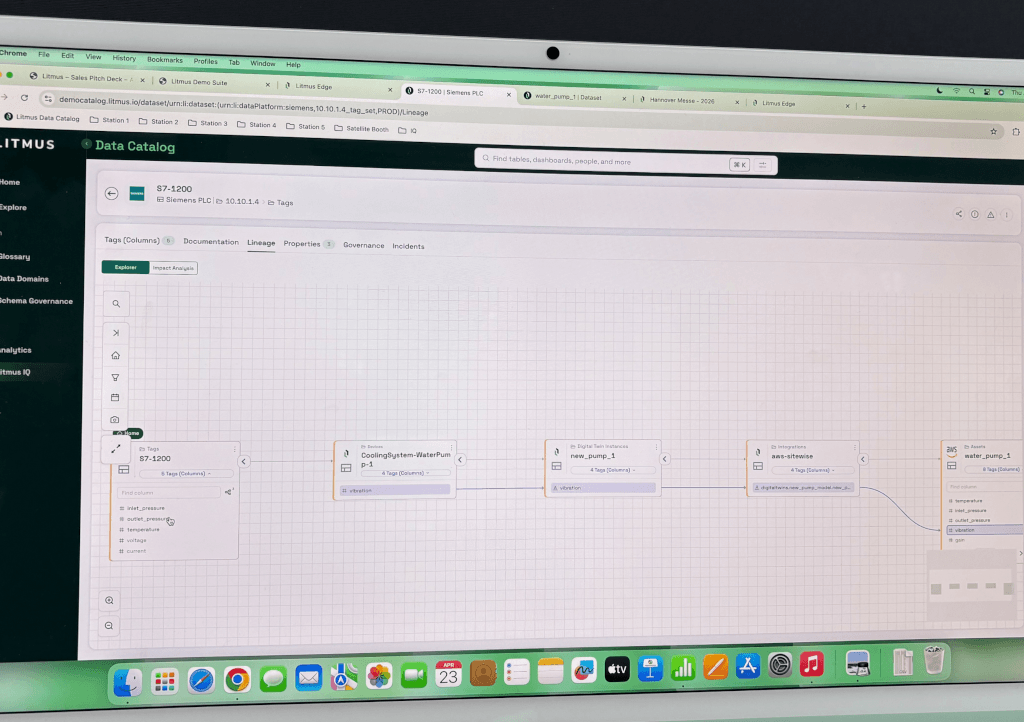
US-based industrial edge data platform Litmus is in its 3rd year of near-triple-digit growth. At the fair, the company launched its Litmus Data Catalog, an OT data-asset catalog product that can run independently of Litmus Edge. Data Catalog provides a structured, visual inventory of data-producing and data-consuming assets on the factory floor. It maps what OT assets exist, how they are connected, where data flows across them, and flags governance and security issues. The company claims the product fills a white space that IT-side catalog tools have never addressed: the OT layer.
Core features as described by Litmus leadership and observed in the product’s demonstration at the Hannover Fair:
- Asset discovery and inventory: Identifies and catalogs OT data assets across a facility using multiple ingestion methods
- Data lineage visualization: Traces data at the tag level from source device (e.g., a Siemens PLC) through every intermediate system, all the way to the endpoint (e.g., AWS)
- Schema drift alerting and governance: Establishes a “golden copy” of tag and schema configurations; alerts when any tag or schema is modified, and routes the change through an approve/reject workflow
Data Catalog is currently in private preview with ~20 beta customers, with general availability expected soon.
Trend 7. Vendors continue to promote software-defined automation and virtual PLCs
Software-defined automation (SDA) reducing hardware lock-in. Automation vendors such as Schneider Electric, Phoenix Contact, and Siemens continue to promote software-defined automation ecosystems that allow IT-like engineering practices (e.g., CI/CD pipelines, unit testing) to be applied to operational technology, and hardware-software decoupling that reduces hardware dependency and vendor lock-in.
Example: Schneider’s software-defined DCS
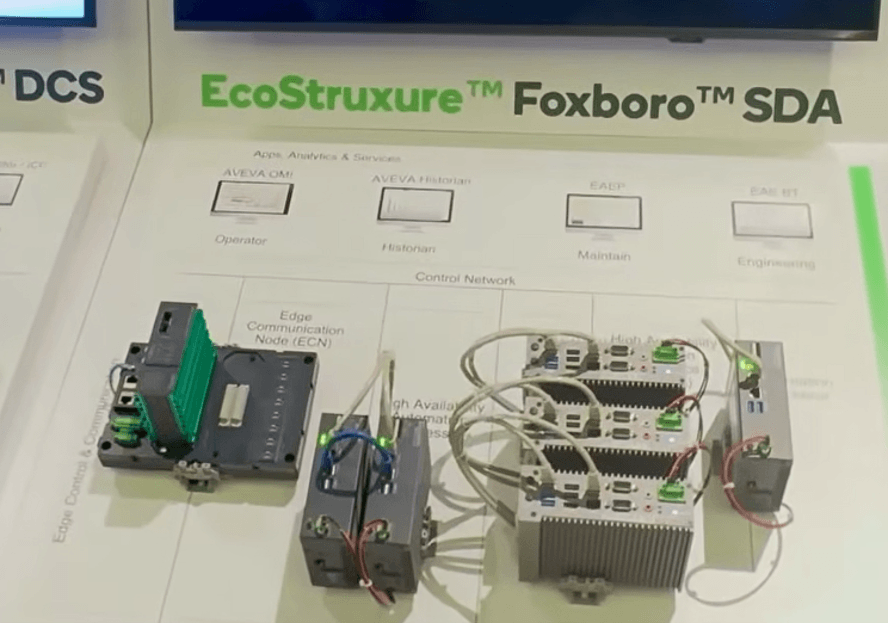
France-based industrial automation company Schneider Electric debuted its Foxboro DCS at Hannover Messe 2026, having formally announced it in February 2026. Schneider claims the Foxboro DCS is the industry’s first open, software-defined DCS for hybrid and process industries. By decoupling software from underlying proprietary hardware, Schneider claims the system allows factories to execute lower-risk, step-by-step modernizations that eliminate the need for traditional rip-and-replace upgrade cycles.
Trend 8. Data centers and defense are emerging as adjacent growth arenas for industrial technology vendors
Data centers
AI compute demand pulling vendors into data center infrastructure. AI infrastructure demand is pulling industrial vendors into data center-related topics such as liquid cooling, DC power distribution, and edge data centers. As rack densities push beyond 100 kW, air-only cooling is giving way to direct-to-chip liquid and hybrid air-liquid architectures. Meanwhile, higher-voltage DC distribution is gaining traction as a way to reduce conversion losses, shrink cabling requirements, and reclaim space in increasingly dense compute environments.
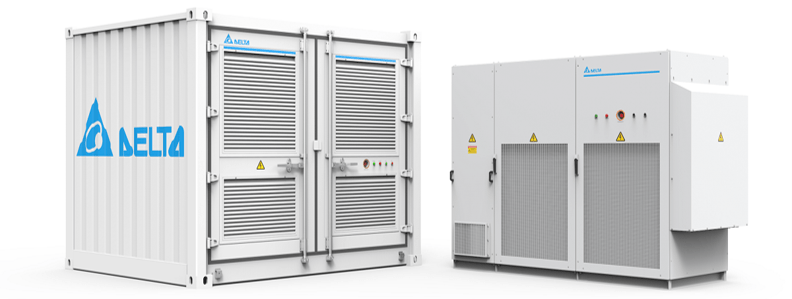
Example: Delta Electronics’ solid-state transformers and cooling solutions
At Hannover Fair, Taiwan-based power management solutions company Delta Electronics showcased solid-state transformers to reduce AC/DC conversion losses and liquid-to-liquid cooling solutions designed for 400 and 800 V DC environments.
“We are showing a model of the solid-state transformers that we are bringing to the industry. These solid-state transformers have 98.5% efficiency and a completely modular design. They will be needed more and more in AI data centers, especially when discussing high-voltage DC data centers at 800 V, as well as other energy-intensive industries and applications. By using solid-state transformers, significant amounts of energy can be saved by reducing the multiple power conversions required in other systems.”
Dalip Sharma, President and General Manager at Delta Electronics EMEA at Hannover Fair 2026
Defense
Defense demand pulling industrial suppliers toward dual-use markets. The defense sector is creating new demand for civilian industrial suppliers, with an entire hall at the event dedicated to the defense sector. Commercial vendors are actively adapting existing robotics, software, and power systems for military applications. Defense digitalization is also reinforcing the broader sovereignty trend. Vendors are positioning on-premises infrastructure, offline AI, and defense-grade cybersecurity as alternatives to cloud-first architectures that are seen as unsuitable for sensitive operational environments.
Example: AKA Energy Systems’ marine power system
Canada-based systems integrator and engineering company AKA Energy Systems is extending its high-reliability offshore and marine power-system expertise into defense, positioning proven dual-use technology for naval applications.
“There’s a movement right now through a lot of the NATO countries, and it focuses on dual use. And, that quite simply is if there is an adjacent industry or a like environment—what is working there from a technological perspective, and is there a possibility that with additional testing (whether it be vibration testing, shock testing, or additional enhancements)—is there a way to take that technology that is maybe at a [technology readiness level] of a 5 or 6 and take it to 9, where it is operationally employed.”
Robert Houle, Director of Business Development, Defence, at AKA Energy Systems at Hannover Messe 2026
Trend 9. Digital twins are evolving from standalone tools toward being part of AI-driven, closed-loop executable environments
Digital twins evolving into autonomous control engines. In an AI-led world, there’s a new paradigm for digital twins: those that form a part of an active, real-time computational engine. By fusing physics-based simulation with AI, industrial vendors are creating executable environments that predict operational outcomes and autonomously execute closed-loop control and provide the synthetic training grounds required for next-generation robotics.
Example: Dell’s use of digital twins for autonomous execution
US-based information technology company Dell showcased a digital twin solution using the XMPro platform integrated with NVIDIA’s Omniverse at Hannover Messe 2026. Live PLC data from a brewery’s centrifuge digital twin fed an LLM to detect boundary violations and trigger small SCADA-level adjustments within human-defined limits.

Trend 10. Predictive maintenance is becoming prescriptive
Maintenance platforms shifting from prediction to prescription. The term predictive maintenance is increasingly viewed as outdated, with the market transitioning toward prescriptive or smart maintenance. Offerings have evolved beyond basic vibration monitoring to incorporate multimodal inputs, including audio anomaly detection and machine vision. Instead of simply triggering alerts that require manual investigation, vendors have begun promoting AI agents that provide highly accurate root cause analyses and prescriptive remediation steps, and that integrate directly with CMMS.
Note: IoT Analytics plans to release its Smart Manufacturing Market Report 2026 in Q3 2026. Those interested in being notified of its release can sign up for the Research Newsletter.
Example:
US-based predictive maintenance company Infinite Uptime showcased its PlantOS platform, which extends predictive maintenance beyond anomaly detection by adding specific maintenance recommendations. When the system identifies an equipment issue, the platform supports the diagnosis with validated action plans, such as replacing a specific bearing or adjusting lubrication, showing how maintenance platforms are moving from predicting failures to prescribing the next best action.
“The industry is evolving from predictive maintenance to prescriptive maintenance. This shift is becoming more common in the market as the terminology and approach continue to develop.”
Infinite Uptime representative at Hannover Messe 2026
Trend 11. OT cybersecurity urgency is rising as regulation, sovereignty, and operational risk reinforce each other
Regulation and sovereignty hardening OT security priorities. Industrial organizations are increasingly compelled to modernize their OT security architectures to comply with stringent, impending regulatory mandates such as the EU’s NIS2 directive and the Cyber Resilience Act (CRA). The event also showed that the OT security is maturing: managed services are becoming a common model, zero trust is moving toward machine-level access, and Level 0/1 visibility is improving.
Simultaneously, geopolitical dynamics and corporate risk assessments are driving a strict prioritization of data sovereignty. This is forcing manufacturers to adopt infrastructure solutions that guarantee localized control and jurisdictional independence.
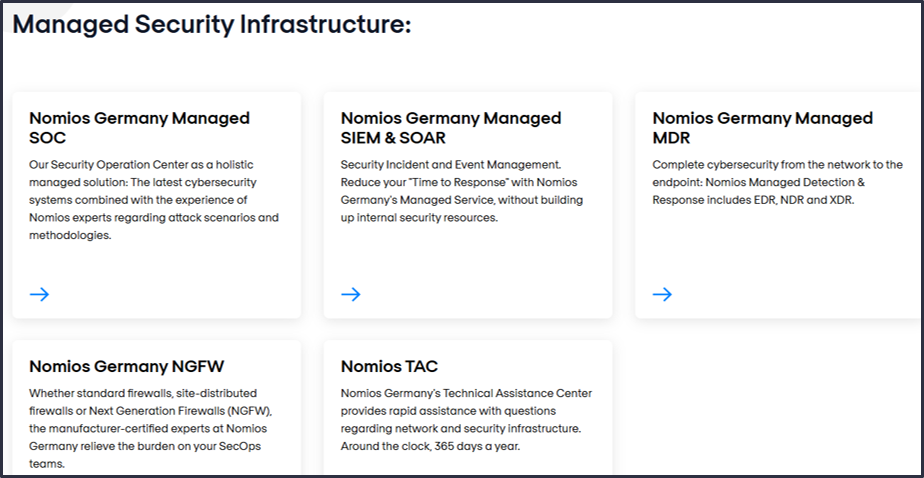
Example: Nomios prioritizes managed services
Nomios, a Netherlands-based cybersecurity firm, has made services a key part of its OT security business model. By offering 24/7 monitoring and audits alongside product sales, the company extends its role beyond resale and remains involved in ongoing security operations.
“Services are key. It has always been the case that you make more money with services than by selling boxes. If I sell this box, I may make 10%–30% margin, but if I provide the service, I have 100% margin. We integrate, sell services, monitor, and provide 24/7 support. We conduct audits for customers, and we do not only perform the audit; we also offer them a solution afterward.”
Security Architect at Nomios Deutschland at Hannover Messe 2026
Trend 12. Looking ahead: Industrial agentic AI platforms as the next battleground
Agent orchestration emerging as smart manufacturing battleground. IoT Analytics believes that beyond the robotics market, agentic AI platforms represent the largest new market opportunity in the smart manufacturing market. As agents move from single tasks to workflows across systems, vendors are competing to control the layer that decides how agents access data, call tools, and sequence actions. The competition is coming from several directions:
- Hyperscalers argue that orchestration needs cloud scale, security, and managed infrastructure.
- IT platform vendors argue that agents should run close to the data lake or warehouse where permissions and guardrails already exist.
- Industrial software vendors argue that reliable agents need structured engineering and operations context, not just raw enterprise data.
- New edge and OT startups argue that they provide vendor-independent orchestration and allow for orchestration to happen close to the plant floor, where latency, uptime, and native machine connectivity matter.
The market is still open, but customer architecture choices now will influence who controls agentic workflows over time.
Example: The lay of the field

Hyperscalers
AWS Bedrock Agentcore, Microsoft IQ, and Google Cloud Vertex AI are key hyperscaler offerings, each targeting enterprise-wide orchestration.
Key vendor quote
“Any type of agent orchestration across fleets or federations requires a secure and intelligent enterprise platform, such as Azure and Microsoft Fabric.”
Microsoft representative at Hannover Messe 2026
IT platforms
Commercial examples of IT platforms include Palantir’s AIP agents, Snowflake’s Cortex, and Databricks Mosaic AI. In these platforms, agents are tied directly to the data lake/warehouse with built-in guardrails.
Key vendor quote
“We are creating the operating system for the enterprise to enable humans and/or AI to take decisions and then capture those decisions. We orchestrate the change.”
Palantir representative at Hannover Messe 2026
Industrial domain software
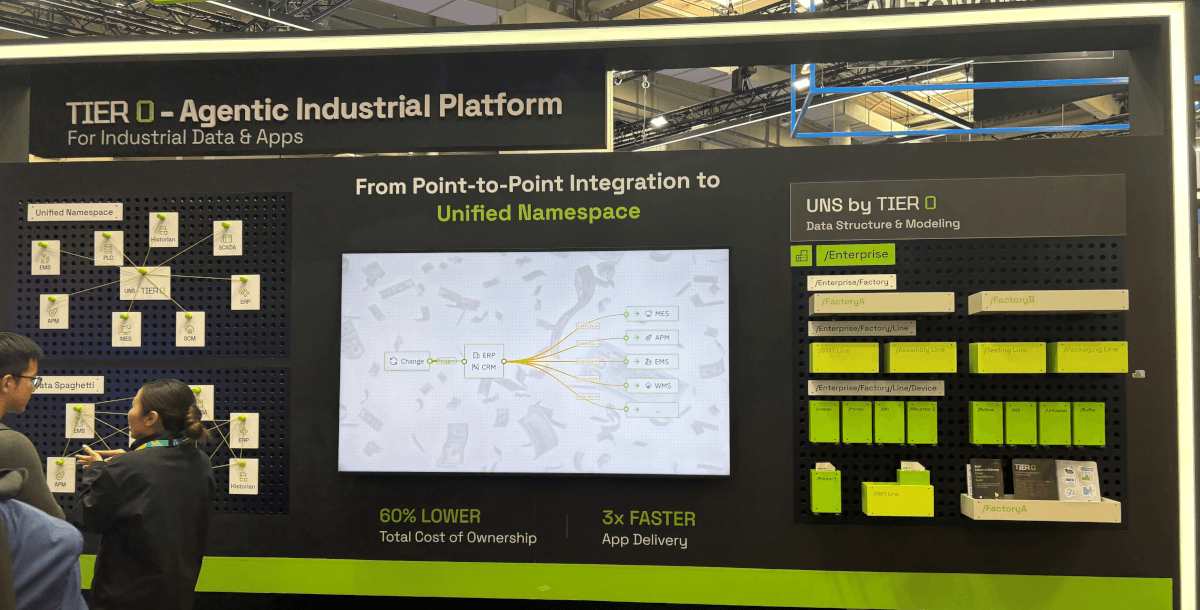
A few industrial software vendors were showcasing agentic workflow platforms at the Hannover Fair. One such vendor was Chinese automation company SUPCON, which launched its cloud-based Tier0 Agentic Industrial Platform built on UNS at the fair. Previously known in the market as SupOS, the platform underwent a significant evolution in 2025, when the company reconstructed its backend architecture to replace outdated technologies. Tier0 features a natural-language app-builder, advanced analytics on contextualized UNS data, and agentic AI orchestration.
Key vendor quote
“Industrial AI has reached a critical turning point. It is no longer just about generating insights, but about embedding them within closed-loop controls to achieve peak performance. Our role is to provide the industry with an open, reliable foundation that allows our customers to scale at their own pace, ensuring that today’s investments remain future-proof for decades of innovation ahead.”
Kenneth Lim, Director of Strategy and Marketing, International Business, at SUPCON (source)
Startups
For startups like Litmus and Cognite, native plant-floor connectivity is the differentiator.
“We have the best access to data on the plant floor due to native connections to all kinds of systems. Therefore, we can execute based on what the agent needs versus having multiple layers that it needs to go through, and then that whole chain will break.”
John Younes, COO & Co-founder at Litmus Automation at Hannover Messe 2026
Outlook: 7 developments to watch in the coming 12 months
While the 12 trends cover what vendors are doing in the industrial technology space today, the team also compiled 7 developments to watch over the next year. These outlooks are based not only on the 50 individual insights and vendor booth visits found in the Hannover Messe—The latest industrial IoT/Industry 4.0 trends report but also on IoT Analytics’ ongoing research into industrial technology and AI.
1. Where will industrial AI workflows live?
Our view: Many of the larger industrial technology/software vendors will introduce agentic workflow platforms as extensions to their software in the coming months, and agentic workflow coordination between these different tools will likely get messy.
2. Will AI-ready data foundations become the bottleneck?
Our view: It will take years for the average manufacturer to invest in additional data acquisition tools and reorganize their existing silos into a future-ready AI data pool. So yes, it will be the bottleneck.
3. How fast will physical AI and humanoid robotics scale?
Our view: It will take a few years for humanoid robots to overcome some of their development challenges, specifically related to hardware (gripping, dexterity, …) as well as related to reliability and safety testing. Wheeled or task-specific form factors are likely to scale faster than full humanoids.
4. Can software-defined automation gain share in brownfield environments?
Our view: Software-defined automation is one of the industry’s most profound changes in the coming years, and adoption will gradually pick up pace. But not every company will be as ambitious as Audi in ripping out and replacing IPCs in brownfield settings. SDA does not work cleanly with decades-old equipment, and the average manufacturer is unlikely to change a running setup.
5. Will general frontier models lose the industrial race to physics-aware, domain-specific models?
Our view: New domain-specific models will become successful in robotics or CAD design, but we do not believe they will win where frontier models such as Claude are already strong. Notably, this includes code generation and may also apply to coding for OT automation.
6. Will data centers and defense become structural growth markets for industrial technology vendors?
Our view: Data centers and defense will take a larger share of industrial technology demand, but growth could moderate if AI infrastructure spending slows (e.g., the AI bubble pops) or geopolitical tensions ease
7. Will the “SaaSpocalypse” kill seat-based software licensing?
Our view: Only some industrial software segments are at risk, not systems of record such as PLM. The risk for seat-based categories such as CAD is real and can reduce the addressable market unless software vendors successfully transition to token- or outcome-based monetization strategies, which only a few have started to try so far.
Further analysis
We believe that every executive who is serious about strategic foresight and data-driven decision-making for products, go-to-market, or sales motions should study an industry-leading event like Hannover Fair in depth, and we see this as exactly our purpose here: Providing all the main insights into a 197-page industrial technology report so you can stay ahead of the changes in the industry.
Below in our Insights+ section, we go beyond the top 12 industrial technology trends, sharing additional insights from the Hannover Fair 2026 report and the recently released Industry 4.0 & Smart Manufacturing Market Report 2026–2030, including an overview of the smart manufacturing market, along with select Hannover Fair company highlights from Siemens, AWS, and Critical Manufacturing. We also include our deep dive into agentic AI solutions found at Hannover Messe 2026.
Access key market data for $99/month per user
The Insights+ Subscription unlocks exclusive facts & figures. You will gain access to:
- Additional analyses derived directly from our reports, databases, and trackers
- An extended version of each research article not available to the public
Full report access not included. For enterprise offerings, please contact sales: sales@iot-analytics.com