
In short
- Knowledge loss has become a fundamental challenge for industrial asset maintenance.
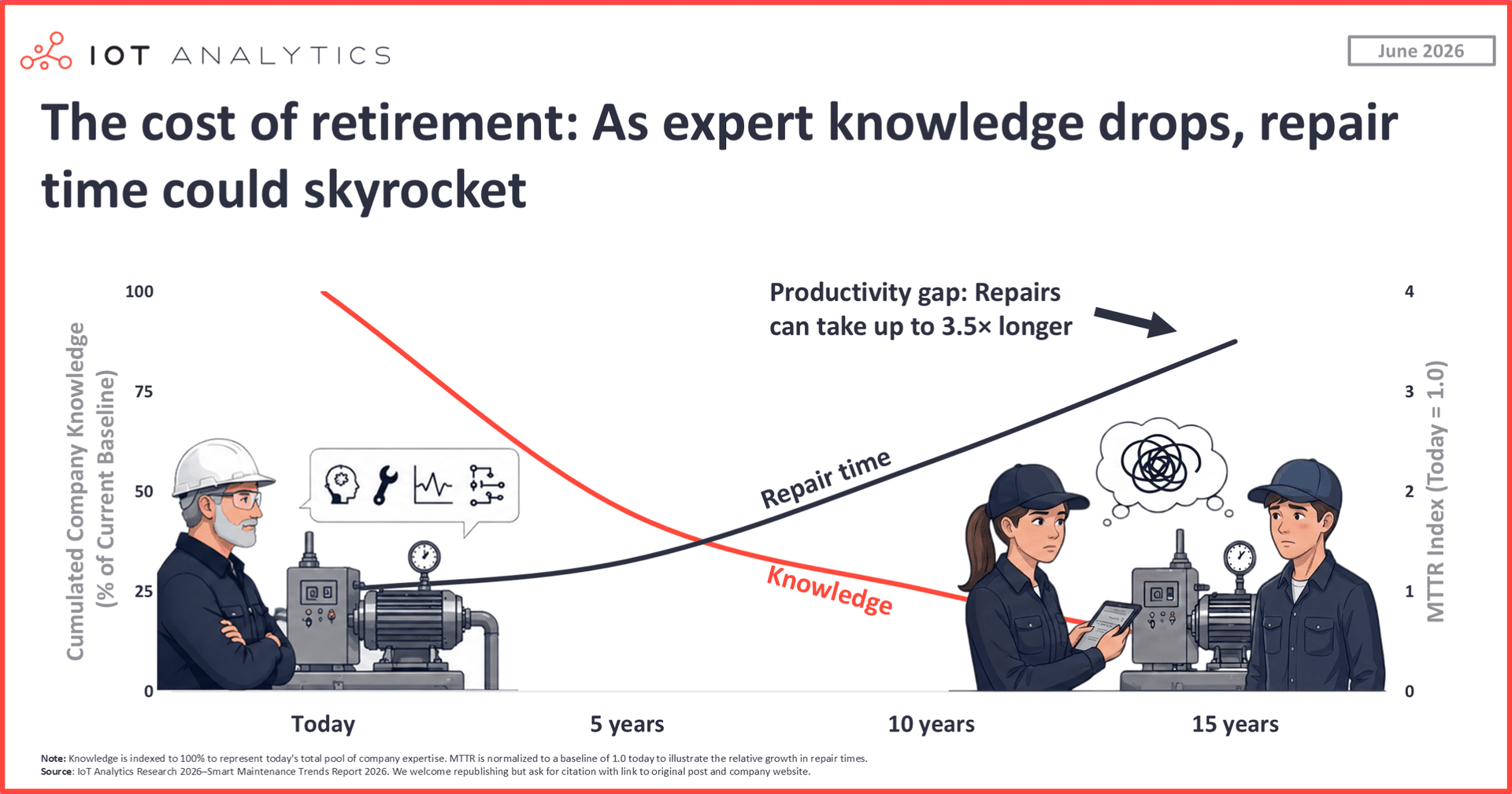
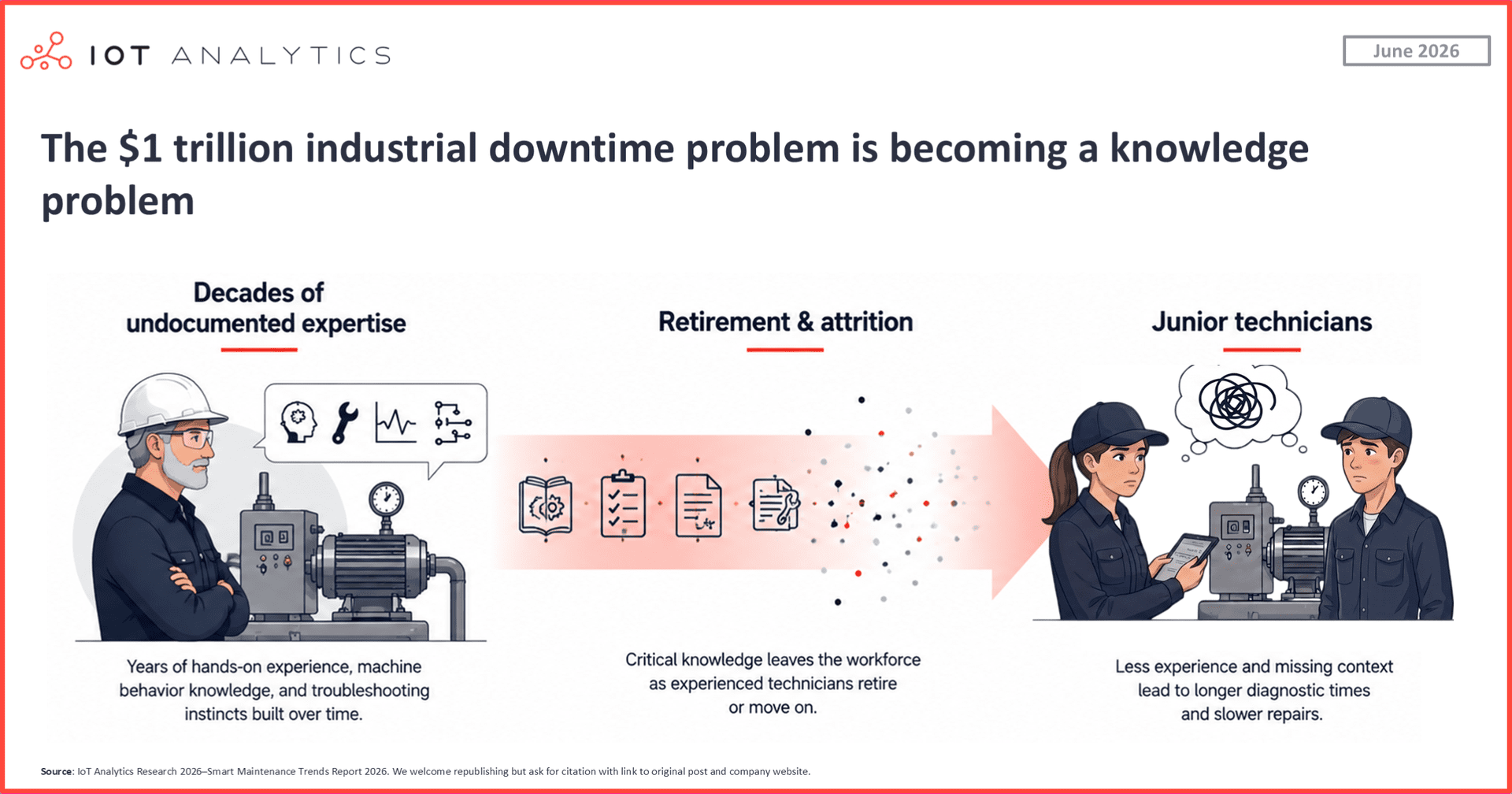
- While predictive maintenance has had promising success in reducing downtime (which costs manufacturers an estimated $1 trillion/year), there is a much bigger challenge to solve: Veteran technicians are retiring and taking their years of necessary knowledge to fix industrial assets with them.
- AI can help manufacturers keep critical maintenance know-how from walking out the door, but only if they act now. These systems take years to build, validate, and embed into frontline workflows, while experienced technicians are already retiring.
Why it matters
- For smart maintenance vendors: Manufacturers are losing years, even decades, of knowledge as senior technicians and engineers retire. Vendors should look to integrate knowledge-loss solutions in their products for a competitive advantage.
- For manufacturers: Knowledge loss is a serious problem in asset maintenance. It is vital to understand the solutions that peers are adopting to avoid costly downtime.
In this article
- Maintenance experience is leaving the factory floor
- Knowledge loss has become the biggest strategic risk, and AI is potentially the only viable answer
- Data quality is the biggest barrier to wider AI adoption in maintenance
- Wireless sensing is expanding the maintenance knowledge base
- Asset-health ecosystems are emerging
- Are prescriptive systems that suggest corrective actions the fix to the knowledge problem?
- Cloud hesitancy persists—is it an issue?
- Verdict: How big is the knowledge loss problem actually, and can AI save it?
- Further analysis
- 7 other notable smart maintenance observations at Maintenance Dortmund 2026 (Insights+ Exclusive)
- The rise of closed-loop maintenance and the MaintainX consolidation wave (Insights+ Exclusive)
Maintenance experience is leaving the factory floor
Every year, unplanned industrial downtime costs manufacturers an estimated $1 trillion globally, according to IoT Analytics upcoming Smart Maintenance Market Report 2026 (which will be previewed in our June 18, 2026, webinar on the evolution of asset maintenance). For decades, the industry’s approach to bandaging the trillion-dollar hemorrhage has been a straightforward premise: set a smart alert threshold, or even better, predict the failure before it happens. Deploy sensors, collect data, train a model, and catch the fault before the asset goes down. It took a while to develop the technology, but in recent years and with AI advances, we have seen very promising and reliable solutions, some of which reach F1 scores well beyond 80%.
However, the maintenance problem is evolving in ways that pure prediction cannot solve. Today, on the factory floor, a more fundamental challenge is hiding beyond the asset health dashboards: the people who know how to fix things are leaving, and they are taking irreplaceable knowledge with them.
The question in smart manufacturing now is no longer simply, “Can we predict the failure?” It has become, “Do we know what to do when it happens?”
Based on IoT Analytics’ observations and discussions at Maintenance Dortmund 2026 (event report is available for Team and Enterprise subscribers) and Hannover Messe 2026 (releasing mid-June 2026)—alongside ongoing research in this space—maintenance technology vendors are working to answer this question by building tools that capture, structure, and operationalize this knowledge across the maintenance workflow.
Knowledge loss has become the biggest strategic risk, and AI is potentially the only viable answer
Skilled trades workers aging out across every major industrial economy. As veteran technicians retire, manufacturers lose more than labor hours. They lose the undocumented repair procedures, the machine-specific fault knowledge, and the practical troubleshooting instincts that were never written into any manual because they did not need to be. The expert was always there.
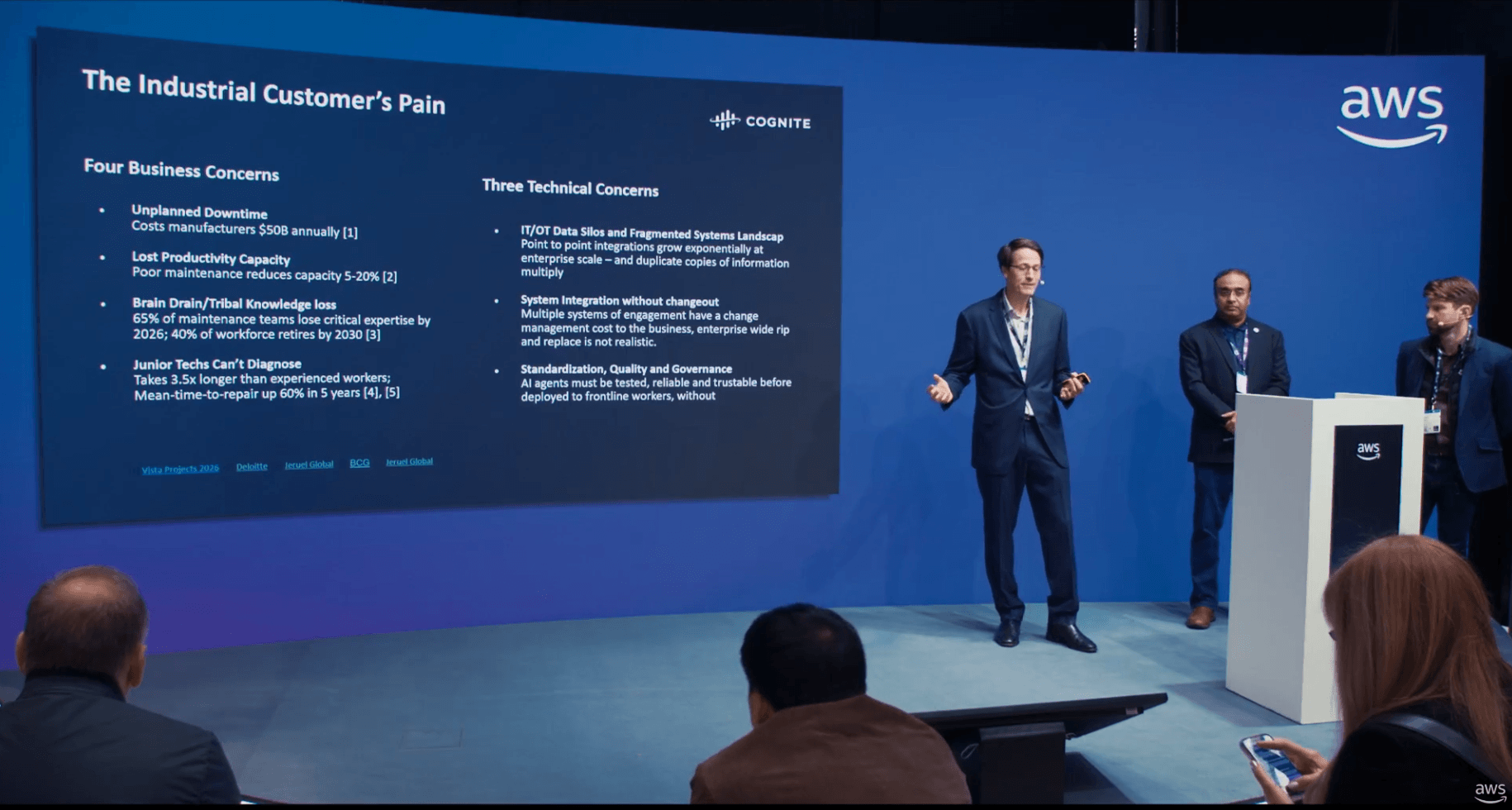
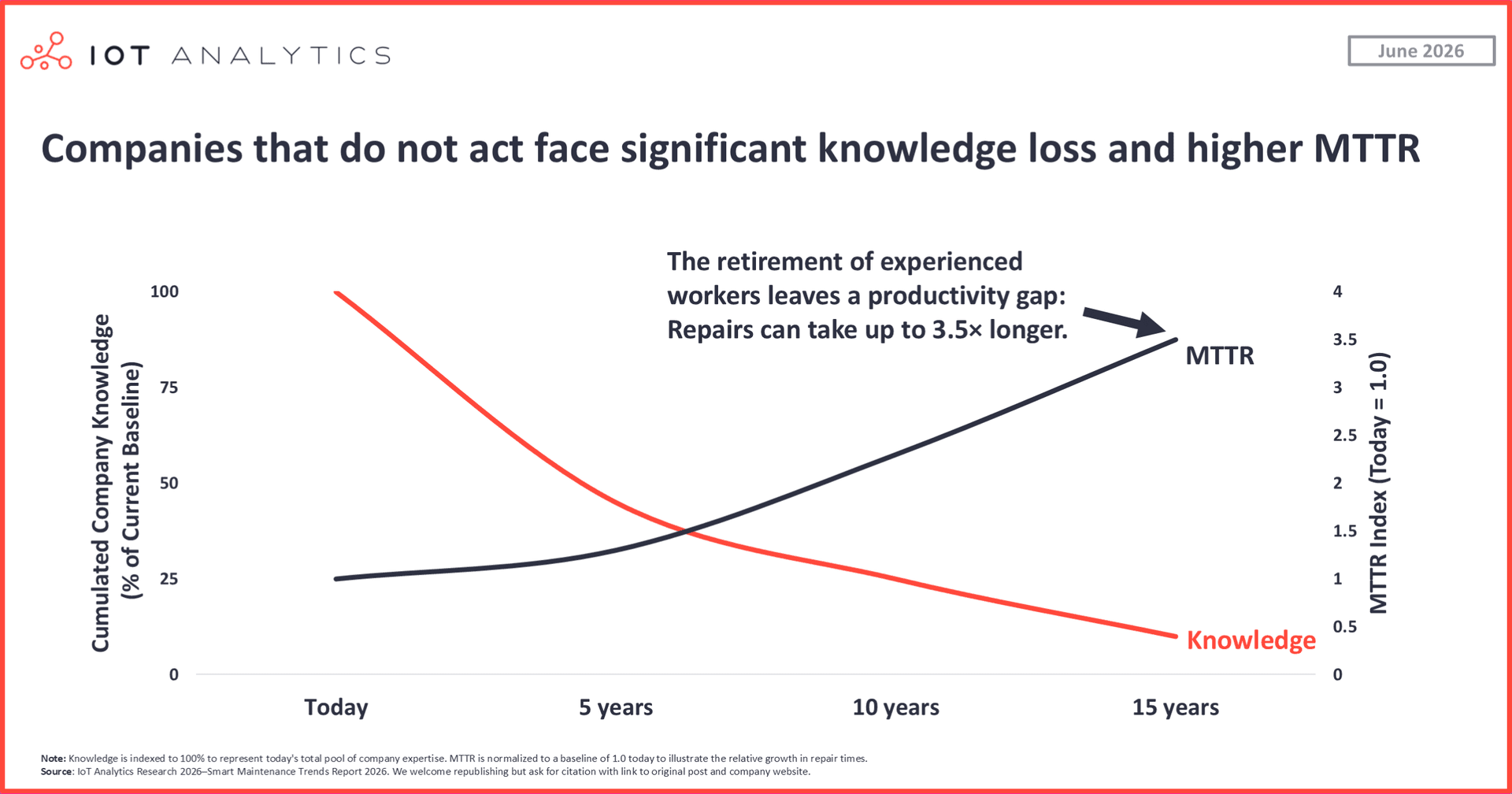
That era is ending. At Hannover Messe 2026, Dr. Rajesh Gomatam, Principal Solution Architect for Industry Solutions at US-based hyperscaler AWS, put a number on the exposure: 65% of manufacturing maintenance teams are expected to lose critical knowledge, making some form of AI agent or assistant for troubleshooting effectively a prerequisite for managing that loss. US-based industrial IoT company Cognite (formerly in Norway) noted the productivity gap: junior technicians can take 3 to 3.5 times longer to diagnose and repair equipment than their experienced counterparts.
“We expect 65% of maintenance teams in manufacturing to lose critical knowledge, so we require some kind of agent or assistant for troubleshooting purposes.”
Dr. Rajesh Gomatam, Principal Solution Architect, AWS Industry Solutions at Hannover Messe 2026 (source)
Kenji Onishi, lead of the O-Beya AI platform at Japan-based Toyota Motor Corporation, captured the field situation well:
“[Powertrain] experts are relatively senior. When they retire, their knowledge will be gone. The mission here is to prevent it from happening. So we’d like to transfer this knowledge to the next generation.”
Kenji Onishi, O-Beya AI platform lead, Toyota Motor Corporation (source)
Vendors are digitizing technician know-how. Vendors at Maintenance Dortmund 2026 named knowledge retention as one of the most urgent operational pressures they are fielding from customers. France-based software company Bassetti Group debuted TEEXMA for Maintenance, a modular CMMS platform that positions knowledge retention explicitly as a core feature, designed in part to help organizations manage the operational risk of technician retirements, where undocumented procedural knowledge represents a recurring vulnerability.
Sweden-based industrial technology conglomerate Hexagon went further. Its team highlights the use of AI to transcribe and curate video recordings of veteran technicians, turning experienced hands-on know-how into searchable, keyword-queryable digital assets that new hires can access independently. The knowledge does not leave when the person does.
Meanwhile, Germany-based industrial AI company Augmented Industries’ Flow Tool converts machine manuals and SOPs into interactive troubleshooting guides. The company cited a reduction in diagnostic search time from hours to seconds. The maintenance expertise is still there—it has just been structured and made accessible.
AI tools like these are seemingly the only answer, and they show great promise. It also seems like AI advances in this space are coming at the right time, before most of the knowledge has left the workforce.
Data quality is the biggest barrier to wider AI adoption in maintenance
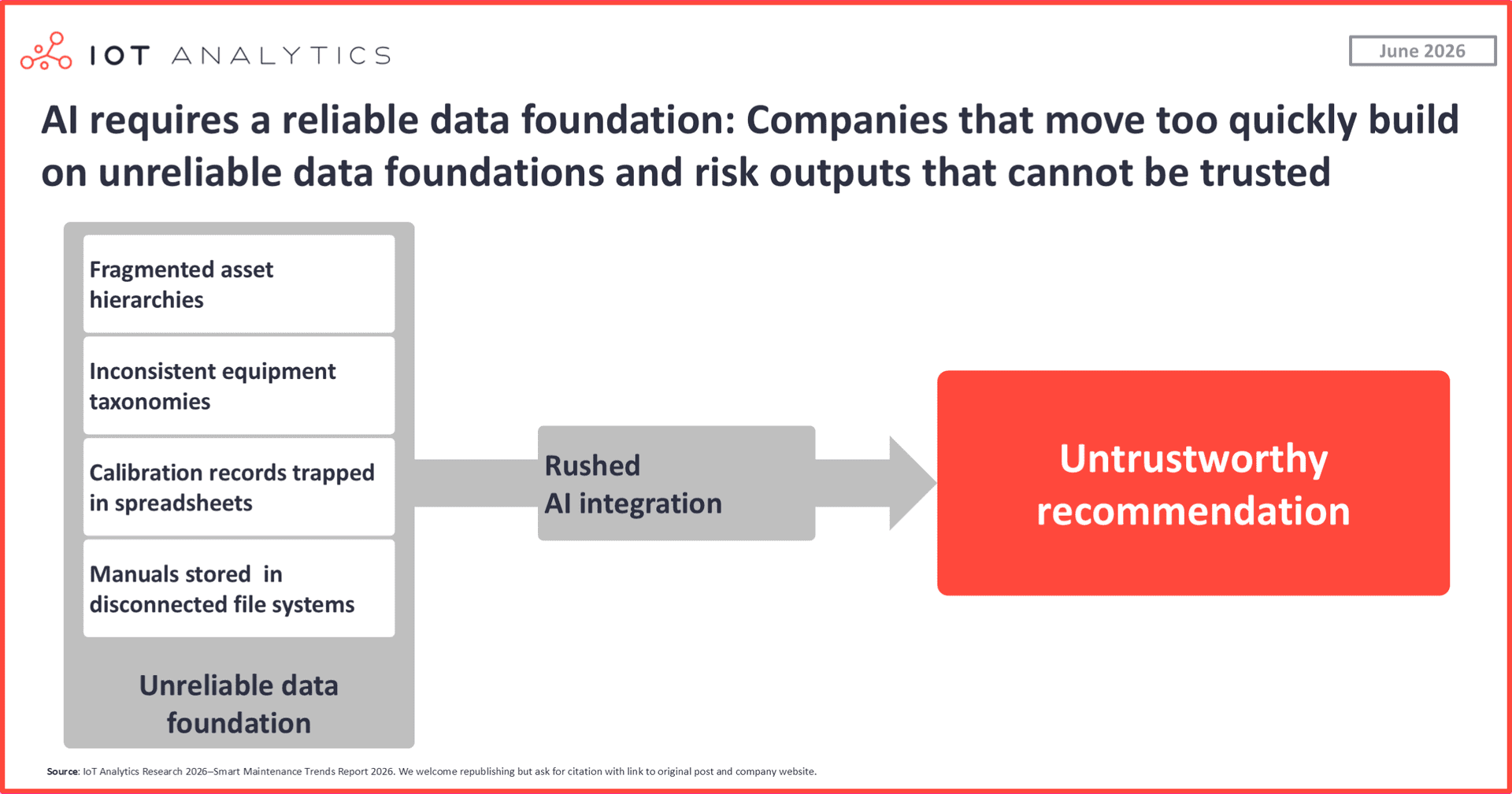
Poor data foundations constrain maintenance AI deployment. Fixing the knowledge problem is not as easy as it sounds. There is a persistent assumption in discussions of industrial AI that the bottleneck is algorithmic, i.e., that better models will unlock better outcomes. Companies in the field repeatedly tell us a different story: the primary barrier to AI deployment is not model capability but the quality and structure of the underlying data.
The real obstacles are fragmented asset hierarchies, inconsistent equipment taxonomies, calibration records trapped in spreadsheets, and manuals stored in disconnected file systems. Companies that move too quickly to AI features built on unreliable data foundations risk outputs that cannot be trusted. In industrial maintenance, an untrustworthy recommendation can be worse than no recommendation at all.
US-based asset management software company IndySoft states that it is not integrating external LLM tools into its platform. Rather, its current focus is on building accurate internal records (e.g., calibration histories and equipment trend data) so that future AI capabilities can operate from a verified internal source of truth. The company’s bet is that the quality of the information layer matters more than the sophistication of the inference layer.
Hexagon‘s team is restricting its AI from freely accessing proprietary customer data until hallucination risk has been fully managed. The current iteration assists with system navigation only. Feature expansion comes later, once the trust baseline is established.
These examples show vendors that take a deliberate, data-first approach treat taxonomy standardization and asset-hierarchy cleaning not as prerequisites for AI, but as the AI project itself. Getting the information right is the work.
Wireless sensing is expanding the maintenance knowledge base
Wireless monitoring broadening maintenance coverage. Prediction and action can only work where data exists. For most industrial facilities, continuous monitoring still covers a fraction of operating assets, usually the most critical, most expensive, most accessible machines. The long tail of auxiliary equipment, secondary lines, and legacy assets remains largely dark. That is changing, driven by improvements in battery technology, low-power radio, and retrofit economics that are bringing the cost of continuous monitoring within reach for a much broader asset base.
As a result, the wireless vibration monitoring segment is among the fastest-growing segments in the smart maintenance market. According to preliminary data for our upcoming Smart Maintenance Market Report 2026 (estimated Q3 2026), the segment’s market size has surpassed $1 billion, with 30%+ growth projected for 2026.
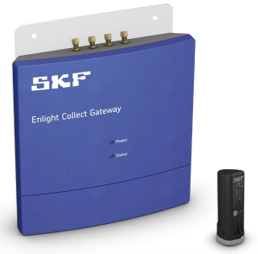
Within wireless vibration monitoring, one of the biggest challenges is balancing measurement frequency against battery life. Sweden-based industrial technology company SKF‘s Enlight Collect IMx1 sensor achieves a 4- to 5-year battery life by spending most of its operating time in a low-power sleep state, waking once per week for a full diagnostic spectrum measurement. Meanwhile, Germany-based precision machine-measuring technology company Status Pro Maschinenmesstechnik is promoting miniature wireless sensors by El-Watch, which take readings every 2 minutes and maintain a 10-year battery life by transmitting via 868 MHz radio frequency. This frequency protocol combines very low energy consumption with long range and avoids the power drain of continuous high-frequency data streaming.
Germany-based industrial measurements company WIKA is addressing the legacy asset problem directly. As a strategic partner and majority stakeholder of Asystom, it is promoting the AsystomSentinel sensor. The sensor connects legacy analog valves to cloud-based monitoring using low-power wide-area protocols, while adding ultrasonic detection of internal valve leakage, a failure mode that vibration sensing alone cannot detect. This approach makes retrofitting existing infrastructure, rather than replacing it, viable.
Asset-health ecosystems are emerging
Sensing competition shifting to ecosystems. The competitive differentiation in wireless sensing has shifted, with ecosystem depth, not battery life, becoming a primary battleground.
Germany-based industrial technology company Schaeffler‘s OPTIME ecosystem physically co-locates vibration sensors and smart lubricators on the same assets and communicates via a mesh network, where each node acts as both a transmitter and a receiver. The system monitors machine health and tracks lubricator cartridge levels simultaneously, generating proactive notifications if either a mechanical fault or a lubrication shortfall is detected.
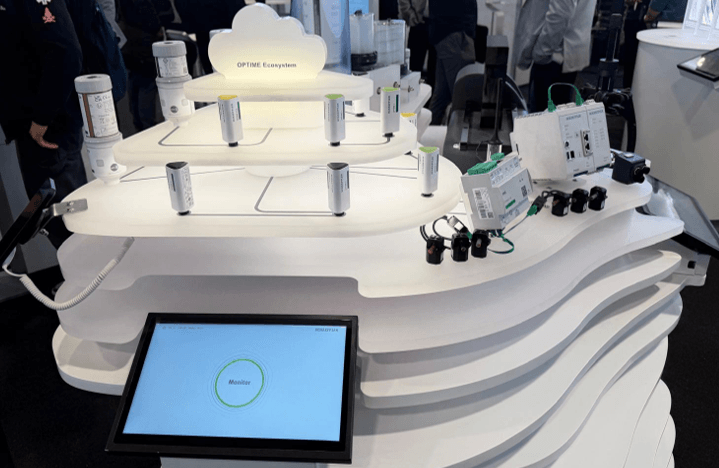
Schaeffler’s FAG OPTIME E-CM, introduced at the 2026 Maintenance Dortmund fair, is an electrical condition-monitoring module for 3-phase motors that adds detection of current imbalance and insulation degradation to the existing OPTIME ecosystem. These are failure modes that vibration-based monitoring does not reliably detect. Schaeffler frames the product as a direct response to motor failures that mechanical-only setups miss, and positions it to integrate directly with the existing OPTIME app interface rather than requiring a separate management system.
Meanwhile, Switzerland-based industrial automation and measurements company Endress+Hauser sees Advanced Physical Layer (APL) ethernet-based connectivity as the most significant near-term shift in wired process instrumentation. A single APL-connected device can now simultaneously output readings for flow, temperature, viscosity, density, and concentration, replacing the 40-year-old 4-20 mA standard that limited devices to a narrow data channel. More data per device means a richer picture of asset health without additional infrastructure.
“The most upcoming trend is the APL technology. The devices themselves get faster and faster. You can easily put out more and more data from the devices themselves.”
Representative from Endress+Hauser at Maintenance Dortmund 2026
Wired sensing is not going away. Regulatory requirements still explicitly prohibit wireless transmission in Safety Integrity Level environments, and wireless MEMS sensors face hard technical limits under high-temperature and highly variable-load conditions. The wired and wireless layers are complementary, not competitive, and both are getting smarter.
“Wired is more for applications with a big variation. This [wireless] sensor cannot measure very often because there’s a battery inside. If it measures every second, the battery will die. That’s the reason why it’s necessary to have both. That’s the reason why we have both. The customer [does] not decided. The customer explains to us the application, and we decide what is the best solution. Therefore, we have those different technologies.”
Representative from Schaeffler at Maintenance Dortmund 2026
Are prescriptive systems that suggest corrective actions the fix to the knowledge problem?
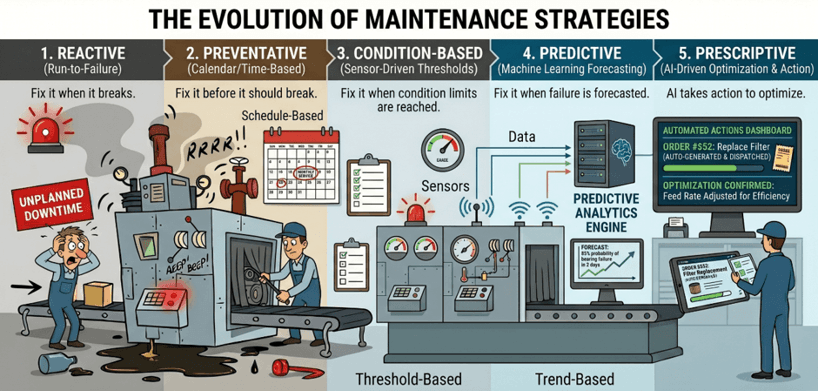
Modern maintenance analytics platforms are becoming prescriptive systems. For years, the promise of predictive maintenance software was detection: identify the anomaly, alert the team, and let the humans take it from there. Vendors are now extending that model, with platforms beginning to generate the “from there” part.
These extended platforms still predict failures but also independently suggest or execute specific repair strategies. They interpret complex asset data to automatically produce step-by-step repair instructions, recommend interval changes, or modify established maintenance schedules based on real-time performance data.
India/US-based industrial AI and IoT company Infinite Uptime’s PlantOS platform extends predictive maintenance beyond anomaly detection by adding specific maintenance recommendations. When the system identifies an equipment issue, the platform supports the diagnosis with validated action plans, such as replacing a specific bearing or adjusting lubrication, showing how maintenance platforms are moving from predicting failures to prescribing the next best action.
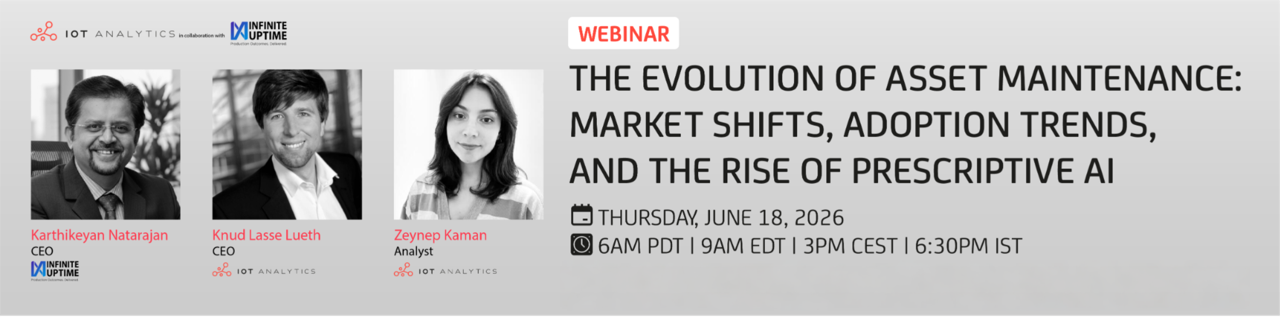
Join Infinite Uptime’s CEO Karthikeyan Natarajan, IoT Analytics CEO Knud Lasse Lueth, and IoT Analytics analyst Zeynep Kaman on June 18, 2026, as they discuss the current state of asset maintenance, its technical viability, and how prescriptive AI improves plant reliability.
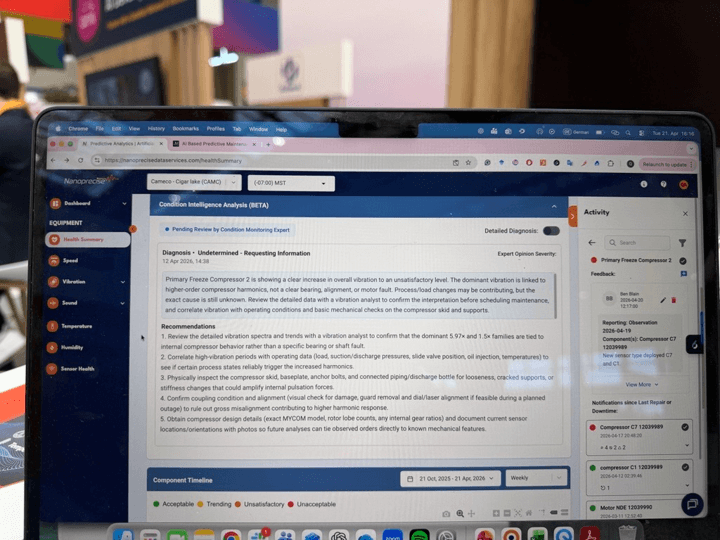
Canada-based predictive maintenance software company Nanoprecise has recently been showcasing its upcoming product, Condition Intelligence Analysis, which uses an LLM-based analysis layer to support prescriptive maintenance. In its Hannover Messe 2026 demo, the system connected equipment health issues to a diagnosis and specific recommended actions, such as reviewing vibration spectra, checking operating conditions, inspecting the compressor skid, and confirming coupling alignment.
US-based industrial automation and instrumentation company Emerson’s framework lets plant operators build custom AI agents to analyze all available data streams and generate cross-plant operational recommendations. The company characterizes autonomous AI control of plant operations as an upcoming industry shift rather than a current native offering, a candid take about where the trajectory is pointed and how far it still has to go.
Yes, prescriptive systems would fix the knowledge problem. Recent advances and discussions with both end-users and vendors show that AI-based prescriptive systems can indeed be the answer to the industry’s knowledge problem. The companies that have started to implement such systems report strong ROI. For example, at Hannover Messe 2026, German automotive company Volkswagen stated that by having implemented AI assistants/agents for plant maintenance (in collaboration with Ireland-based professional services company Accenture and US-based hyperscaler AWS), they saw a meaningful “decrease in mean time to repair and an increase in output because the information was instantly there.”
Cloud hesitancy persists—is it an issue?
Cloud resistance driving smart maintenance architectures workarounds. Though there is a push toward localized intelligence and edge AI, most vendors currently require cloud connectivity to leverage AI models for prediction and prescription. However, resistance to cloud adoption remains significant, particularly among industrial operators in Europe, despite the operational benefits of cloud-based smart maintenance systems.
The concern is not over technical issues but over company cybersecurity or data sovereignty. Even if a company elects to store its asset and operational data in the cloud, it may not want its internal IT infrastructure connected to third-party cloud services (or the approval process may be demanding). Alternatively, a company may be hesitant to place such data in a public cloud, choosing instead to store it in on-premises servers. In response to these concerns, vendors are designing connectivity architectures that either avoid customer IT infrastructure altogether or route the data directly to a company’s private database.

For example, Schaeffler‘s wireless condition-monitoring gateways use cellular connectivity (via SIM cards) to transmit sensor data directly to the cloud, bypassing the customer’s internal network entirely. The approach removes internal IT approval as a deployment blocker, making it a practical workaround to a constraint that would otherwise stall deployments indefinitely.
Status Pro Maschinenmesstechnik offers an MQTT split configuration for customers unwilling to route data through any third-party platform. Their solution funnels raw sensor data directly into a customer’s own private servers. The company notes this is a frequent requirement in Germany, where data ownership concerns are especially prevalent.
“In Germany, there are many companies with concerns about data security… I can always say: ‘Your data, it’s only temperature, it’s only vibration.’”
Representative from Status Pro at Maintenance Dortmund 2026
For technology vendors in the space, the requirement of powerful AI means that deployment architecture is no longer a simple backend infrastructure consideration. Instead, it is a product feature as it needs to consider on-premises options, private data routing, cellular gateways, and IT-bypass network designs.
Cloud hesitancy raises deployment complexity. We do not see cloud hesitancy as a fundamental blocker, but it does increase solution complexity and cost. Vendors can work around it using edge, on-premises, or hybrid architectures, but this creates fragmented, customized data pathways rather than scalable, centralized ones. As a result, cloud resistance is less about preventing adoption and more about affecting how industrial data solutions are architected and deployed.
Verdict: How big is the knowledge loss problem actually, and can AI save it?
The industrial maintenance knowledge gap is already material and accelerating, driven by the rapid retirement of experienced technicians and the loss of tacit know-how. Corey Dickens, a principal solutions consultant at US-based asset and facility management cloud software company Brightly (acquired by Siemens in 2022), shared in September 2023 that he had taken over maintenance at a textile plant where the previous team of senior technicians had left 6 months prior, taking over 35 years’ worth of undocumented knowledge with them. The remaining team had little to no knowledge about preventative maintenance cycles and optimal machine settings, leaving them unable to carry out these important tasks. Ultimately, the company gave up on repairing one of their 21 critical narrow fabric weaving looms, and the machine was stripped for parts, all because the knowledge of how to fix it had walked out the door.
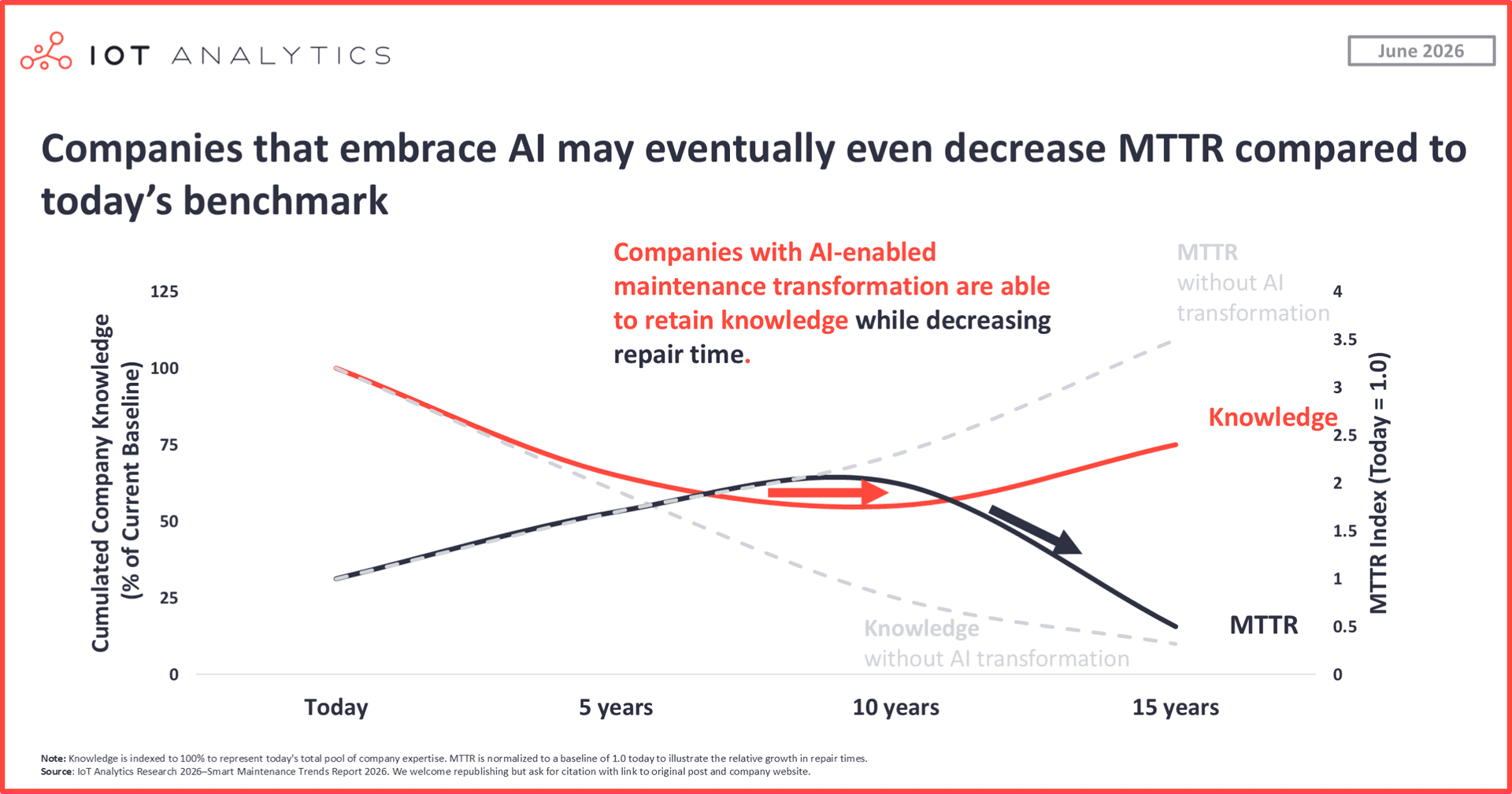
However, we believe AI is already beginning to meaningfully narrow this gap by capturing tribal knowledge, guiding less experienced technicians through copilots, and enabling advanced diagnostics from complex machine data.
Taken together, these developments suggest AI can materially improve knowledge retention and reduce dependence on retiring experts. However, we believe that there will be 2 types of companies: Those that embrace AI for knowledge retention (Group 1) and those that do not (Group 2).
- The companies embracing AI will see significantly higher knowledge retention rates, progressively close the experience gap, and, over time, decrease the mean time to repair (MTTR) relative to today’s benchmark.
- The companies not embracing AI will see a large chunk of their knowledge move out of the company and will never even get a chance to catch up, with MTTR significantly trending upwards in the coming years. Better prediction may still be possible for them.
For companies that do not fall into the second group, we believe there are 3 things to prioritize:
- The integration of siloed OT and IT data into a unified, context-rich knowledge layer
- The mindset and leadership buy-in to embrace both prediction and prescription and move on from the industry-standard preventative maintenance workflow
- Strong frontline adoption driven by intuitive, low-friction tools
Overall, we expect a widening divergence in operational knowledge retention between AI- and non-AI-enabled maintenance organizations over the coming years, with direct implications for the ability to preserve and transfer critical maintenance know-how. This gap in knowledge retention, rather than general operational performance, will be the primary differentiator shaping outcomes across the industry.
Further analysis
IoT Analytics analysts regularly attend industrial technology and connectivity conferences as part of their ongoing research. Many of the example technologies and solutions above were observed at Maintenance Dortmund 2026 (February 25–26) and Hannover Messe 2026 (April 20–24), both of which have event reports that corporate subscribers can access.
On Jun 18, 2026, IoT Analytics CEO Knud Lasse Lueth and analyst Zeynep Kaman, along wth Infinite Uptime CEO Karthikeyan Natarajan, will be hosting a webinar discussing the evolution of asset maintenance, including market shifts, adoption trends, and the rise of prescriptive AI. Much of the information will be based on research for IoT Analytics’ upcoming Smart Maintenance Market Report 2026, as well as insights from the following reports:
- Industry 4.0 and Smart Manufacturing Market Report 2026–2030
- Smart Maintenance Trends Report 2026
- Industrial AI Market Report 2025–2030
- Asset Performance & Predictive Maintenance Market Report 2023–2028
Below, in our Insights+ Exclusives, we share 7 other notable observations in the smart maintenance space. We also discuss the rise of closed-loop maintenance and what the acquisition of CMMS provider MaintainX by Autodesk, a US-based 3D design and engineering software company, means for smart maintenance.
Access key market data for $99/month per user
The Insights+ Subscription unlocks exclusive facts & figures. You will gain access to:
- Additional analyses derived directly from our reports, databases, and trackers
- An extended version of each research article not available to the public
Full report access not included. For enterprise offerings, please contact sales: sales@iot-analytics.com
