
In short
- Process manufacturers anticipate reducing total annual plant operating costs by 12% as a result of their digital transformation initiatives in the coming 3 years, according to IoT Analytics’ Digital & AI Adoption in Process Manufacturing 2026 report (published May 2026).
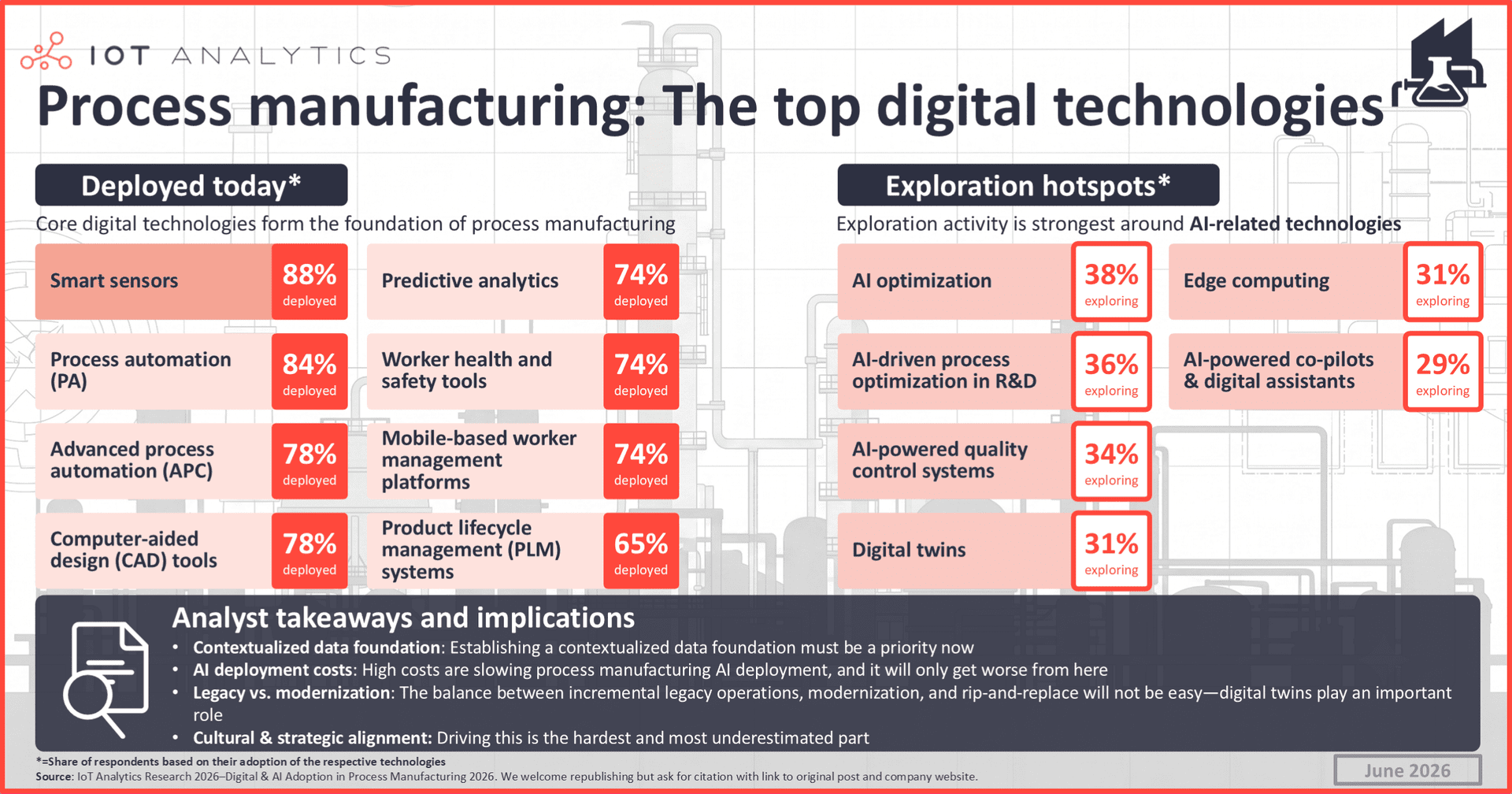
- The top 3 technologies process manufacturers have deployed to date are 1) smart sensors, 2) process automation, and 3) advanced process control.
- The top 3 technologies that manufacturers are currently exploring are all AI-based: 1) AI optimization, 2) AI-driven process optimization in R&D, and 3) AI-powered quality control.
Why it matters
- For industrial automation vendors: Process manufacturers are adopting solutions that help lay the data foundation needed for eventual AI adoption. Vendors need to understand both the digital and AI-based technologies being sought by these manufacturers to remain competitive.
- For process manufacturers: With an average of 12% savings anticipated from digital transformation initiatives, process manufacturers should understand where peers are placing their focus to both learn and remain competitive.
In this article
- Introduction
- Technologies that process manufacturers are deploying: Smart sensors, process automation, and process control
- Technologies that process manufacturers are actively exploring: AI leads the pipeline
- Analyst takeaways
- Further analysis
- Where process manufacturers expect plant cost savings (Insights+ Exclusive)
- Key action items for strategists, product managers, marketers, and salespeople (Insights+ Exclusive)
- Unique characteristics of select process industries (Insights+ Exclusive)
- Software applications by deployment type (Insights+ Exclusive)
Introduction
Over 12% savings expected through digital transformation. Manufacturers that operate in process industries (e.g., chemicals, oil & gas, and basic metals) expect an average of 12% in total annual plant operating costs savings from their digital transformation initiatives within 3 years, according to IoT Analytics’ 112-page Digital & AI Adoption in Process Manufacturing 2026 report (published May 2026). According to the research, based on a survey of 120 senior stakeholders at process manufacturers across 7 industries, North American process manufacturers expect higher at 13.4%, while Europe and APAC expect lower, at 11.7% and 10.1%, respectively.
How process manufacturing differs from discrete manufacturing
Process manufacturing produces goods through continuous or batch chemical and physical transformation (e.g., mixing or refining) of raw materials, while discrete manufacturing produces distinct units using step-by-step assembly, machining, or fabrication.
Typical characteristics of process manufacturing
- Produces bulk materials using formulas/recipes
- Measured by yield, consistency, and compliance
- Uses DCS, SCADA, and recipe management for production control
- Relies on long-lifespan, specialized assets (20–50 years)
Typical characteristics of discrete manufacturing
- Has a structured bill of materials
- Measured by unit count, cycle time, and throughput
- Uses PLC, MES, and ERP for production control
- Relies on machines with moderate asset lifespans (5–20 years)
Key process manufacturing industries:
- Oil & gas
- Chemicals
- Metals
- Pulp & paper
- Rubber & plastics
The report and this article solely focus on process manufacturing.
Process manufacturers turning data foundations into AI returns. Prior IoT Analytics research, specifically on IoT use cases, has found that process manufacturers typically lag behind discrete manufacturers in adopting digital technologies. This is largely due to long asset replacement cycles (more than 50 years in some cases), among other reasons. Oil & gas, though, is often regarded as ahead of other process industries due to its remote nature, with established SCADA and remote connectivity architectures.

But in the last few years, some process manufacturers have been investing in a solid data foundation to start applying AI to specific, high-value problems and are reporting large returns. For example, Germany-based chemical company BASF built an enterprise data lake that serves as a single source of truth across production, supply chain, and R&D data. According to interviews conducted with former BASF employees for the study, the data foundation enabled AI deployments at scale, leading to a reduction in demand forecasting costs by over 90%. Selected molecular enhancement timelines in R&D dropped from 6 months to 6–8 weeks.
This is just 1 of the 7 process manufacturer examples discussed in depth in the report. Below, the IoT Analytics team shares what technologies companies in the process industry are deploying and currently exploring. At the end, subscribers to IoT Analytics’ Insights+ (a deeper dive into the research behind the articles) can see a breakdown of the specific areas where the savings are expected to come from, key action items for key stakeholders, unique characteristics of select process industries, and software applications by deployment type within process manufacturing.

Insights from this article are derived from
Digital & AI Adoption in Process Manufacturing 2026
A 112-page report on how process manufacturers (chemicals, metals, pulp & paper, etc.) are adopting digital tools across their operations with a focus on AI adoption.
Technologies that process manufacturers are deploying: Smart sensors, process automation, and process control

Smart sensors top the list of most deployed technologies for process manufacturers. Smart sensors lead deployment at 88%, reflecting the necessity of machine data for digital transformation in this industry. Most notably, 98% of European process manufacturers have deployed smart sensors.
As devices with embedded processing capabilities that collect and transmit operational data in real time, smart sensors go beyond basic measurement by enabling local data processing at the device level, which reduces the need to send all raw data upstream for analysis. In a process manufacturing plant, this includes instruments that monitor temperature, pressure, flow, and chemical composition, which can flag anomalies or transmit structured data directly to control systems or data platforms.
Examples of field smart sensors from industrial instrumentation and automation companies include:
- Emerson Electric (US): The Rosemount series of sensors for pressure, temperature, and level measurements, and the Micro Motion series for mass flow, density, and viscosity measurements
- ABB (Switzerland): The LWT300 Series of guided-wave radar level sensors
- Endress+Hauser (Switzerland): The iTHERM ModuLine series of modular thermometers and thermowells
Companies are also adopting bolt-on wireless sensors, such as US-based industrial AI company Augury’s bolt-on Halo sensors, which monitor machine parameters such as vibration, temperature, and magnetic field data and transmit insights to the cloud for AI-driven analysis. The IoT Analytics team has identified over 30 companies in the field of wireless smart sensors, which will be covered in the upcoming Smart Maintenance report (expected Q3/Q4 2026; subscribe to the research newsletter for notifications of new reports).
Process automation and advanced process control follow for most deployed technologies. The 2nd- and 3rd-most-deployed technologies by process manufacturers are process automation at 84% (13% pre-deployment) and advanced process control at 78% (20% pre-deployment). Process automation systems like distributed control systems (DCSs) and advanced process control are mature technologies in process manufacturing.
The data shows, though, that innovation in these categories has not stopped. Pre-deployment rates of 13% for process automation and 20% for advanced process control indicate that a meaningful share of manufacturers are still expanding or upgrading their capabilities in both areas. For example, France-based industrial automation company Schneider Electric‘s EcoStruxure Foxboro software-defined DCS, which was released in February 2026, is the company’s next innovation in this space and aims to decouple control software from hardware. Schneider argues this gives customers greater vendor independence, interoperability, and flexible architectures.
Additionally, AI is increasingly becoming part of that next innovation layer. For example, UAE-based petrochemical company Borouge started collaborating with Japan-based industrial automation company Yokogawa Electric in August 2025 on a proof-of-concept for AI-powered autonomous control room operations at Borouge’s Ruwais facility in Abu Dhabi. The goal is to explore how autonomous control room operations can enhance efficiency and optimize overall plant performance
Technologies that process manufacturers are actively exploring: AI leads the pipeline
AI is being explored for operational efficiency. When process manufacturers look ahead, 3 AI technologies dominate the exploration pipeline:

- AI optimization (38%): Leveraging artificial intelligence to enhance operational efficiency by analyzing complex operational patterns
- AI-driven process optimization in R&D (36%): Applying AI to optimize research and development processes, improving speed and efficiency
- AI-powered quality control (34%): Systems that use AI to automatically inspect products and detect defects in real time
It is also worth noting that AI-powered co-pilots and digital assistants (29%) rank 6th for most-explored technologies, after edge computing and digital twins, both at 31%.
IoT Analytics’ 406-page Industry 4.0 & Smart Manufacturing Report 2026–2031 (published March 2026) shares several examples of companies pursuing AI optimization. One process manufacturer example is Saudi Arabia-based petroleum and natural gas company Aramco, which partnered with Yokogawa Electric to deploy multiple autonomous control AI agents at its gas plant in Fadhili, Saudi Arabia, in October 2025. The agents control and optimize acid gas removal operations using a reinforcement learning approach. Yokogawa integrated the agents with its CENTUM VP control system to use existing plant safety functions. Yokogawa reported initial results, including a 10% to 15% reduction in amine and steam usage, a 5% reduction in power usage, improved process stability, and reduced operator manual intervention.
Frontline worker tools fall toward bottom of technologies under exploration. Tools like augmented reality (AR) for maintenance and operations, AR for training and safety, and wearables are the least-explored technologies by process manufacturers. Notably, the 2 AR technologies also have the lowest interest rankings: 48% of respondents are not using or considering adopting AR for maintenance and operations, and 35% said the same for AR for training and safety. It appears that process manufacturers are focusing on technologies that directly improve operational efficiency and production quality rather than on digital worker-assistance tools.
Analyst takeaways
The analyses in the Digital & AI Adoption in Process Manufacturing 2026 were performed by IoT Analytics Principal Data Analyst Dimitris Paraskevopoulos, Principal Analyst Anand Taparia, and CEO Knud Lasse Lueth. The following are 4 of their takeaways from the research and implications for process manufacturers.
1. AI is here—establishing a contextualized data foundation must be a priority now
Process manufacturing has generally been regarded as a laggard in adopting digital technologies. However, as many of these companies explore AI for process optimization and quality control, they are now forced to establish the backbone they need to support these technologies.
The primary hurdle for process manufacturers is the fragmented and siloed nature of legacy data architectures. Raw telemetry and time-series data stored in traditional historians lack the necessary business context to be useful for AI applications. Manufacturers must implement an industrial DataOps layer to structure, standardize, and contextualize this data.
By combining machine states with transaction data (such as bills of materials, recipes, maintenance history, and operator inputs), companies can create a unified data model or knowledge graph. This semantic layer ensures that AI models receive standardized, high-quality inputs across the entire enterprise, regardless of the underlying legacy hardware. Additionally, manufacturers should look to upgrade field-level connectivity using standards like Ethernet-APL, which provides a high-bandwidth digital highway for extracting larger volumes of diagnostic data directly from smart instruments without relying on analog-to-digital conversions.
2. High costs are slowing process manufacturing AI deployment, and it will only get worse from here
While exploration for AI solutions is high in process manufacturing, deployment currently remains low. And high costs are already cited as a barrier to adoption. For example, when it comes to adopting AI-driven research and development methods, 71% of process manufacturers cited the high cost (e.g., for setting up the aforementioned data foundation). The problem: It will likely only get worse from here. As the use of LLMs within organizations increases, costs for LLM access are exploding, an issue that has already plagued many companies in other sectors. Before adopting specific AI solutions, manufacturers should therefore consider a) the ease of switching models when usage starts to get expensive (because it will), and b) the AI dependence they are creating for themselves.
3. The balance between incremental legacy operations modernization and rip-and-replace will not be easy—digital twins play an important role
Given the risks associated with disrupting continuous operations, a rip-and-replace approach for>30-year-old legacy equipment is not viable. Instead, process manufacturers should adopt a phased modernization strategy, transitioning sequentially from decision-support tools to process optimizers and, eventually, to autonomous control agents.
The IoT Analytics team’s discussions with process manufacturers show that a critical step in upgrading legacy assets is developing a digital twin of the brownfield facility. By digitizing the plant’s existing infrastructure, engineers can then simulate processes, validate new control algorithms, and eventually safely train AI models in a virtual environment before deploying them on the physical shop floor, thereby mitigating the risk of costly unplanned downtime.
4. Driving cultural and strategic alignment is the hardest and most underestimated part
As with any other technology wave, AI readiness must be matched by organizational maturity. IoT Analytics research has shown for years that this is the most overlooked and hardest part to get right. AI deployments should not be treated as generic technology experiments. Instead, they must be strictly anchored to specific business objectives, such as maximizing yield, reducing energy consumption, or increasing throughput. Further, manufacturers should avoid taking on large, disjointed pilot programs and instead focus on a concentrated portfolio of high-value use cases backed by a scalable data architecture.
Ultimately, leadership must foster a data-first culture. This means, for example, that leadership has to instill a discipline in which personnel consult the data before physically interacting with or making manual changes to the machinery. In environments where operators have historically relied on deep personal intuition to manage process variability, establishing trust in AI-driven insights is essential to sustaining a continuous cycle of learning and process optimization. Leaders need to be AI coaches.
Further analysis
Below, in our Insights+ Exclusives, we share:
- A breakdown of the individual areas where process manufacturers expect their collective 12% anticipated plant cost savings from digital transformation to come from
- Key action items for strategists, product managers, marketers, and salespeople
- Unique characteristics of select process industries
- Software applications by deployment type
Access key market data for $99/month per user
The Insights+ Subscription unlocks exclusive facts & figures. You will gain access to:
- Additional analyses derived directly from our reports, databases, and trackers
- An extended version of each research article not available to the public
Full report access not included. For enterprise offerings, please contact sales: sales@iot-analytics.com
