In short
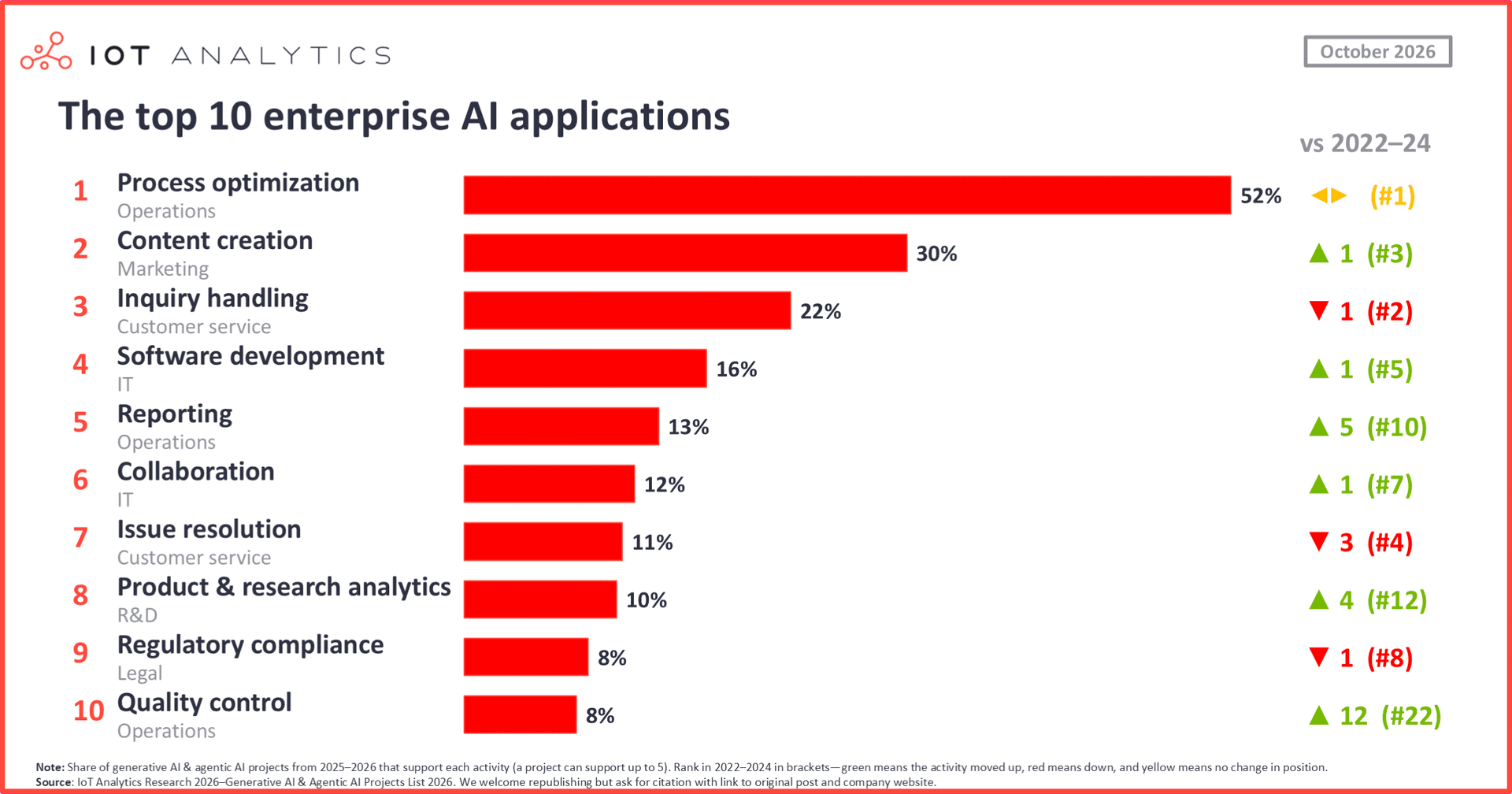
- Operations use cases now sit at the center of enterprise AI adoption. According to IoT Analytics’ Generative AI & Agentic AI Projects List 2026, operational process optimization was the top AI use case in 2025 and Q1 2026, up from 30% in 2022–2024.
- Agentic AI is still early. Single- and multi-agent systems accounted for 13.4% of projects in 2025 and Q1 2026, up from 0.5% in 2022–2024, while non-agentic chatbots and assistants still made up 60.1%.
- Autonomy is rising. The share of projects that execute multi-step tasks autonomously rose from 1.1% in 2025 to 17.8% in Q1 2026, while the share of output-only projects fell from 59.5% to 32.2%.
Why it matters
- Technology vendors. The ranking shows where enterprises deploy AI today, helping vendors focus product development and sales on the most in-demand use cases.
- Enterprise adopters. The 10 examples show how peers in retail, software, and other industries apply AI to specific workflows and what results they report.
In this article
- Where enterprise AI stands in 2026
- The top 10 enterprise AI applications
- 1. Operations: Process optimization (52.2% of projects)
- 2. Marketing: Content creation (30.1% of projects)
- 3. Customer service: Inquiry handling (22.2% of projects)
- 4. IT/technology: Software development (16.5% of projects)
- 5. Operations: Reporting (13.2% of projects)
- 6. IT/technology: Collaboration (11.6% of projects)
- 7. Customer service: Issue resolution (10.8% of projects)
- 8. R&D: Product & research analytics (10.4% of projects)
- 9. Legal/compliance: Regulatory compliance (8.4% of projects)
- 10. Operations: Quality control (7.6% of projects)
- Analyst takeaway
- Frequently asked questions about enterprise AI applications
- Further analysis
- Generative and agentic AI projects by department and activity (Insights+ Exclusive)
- Generative and agentic AI projects by industry and department (Insights+ Exclusive)
- Projects by type of generative and agentic AI (Insights+ Exclusive)
Where enterprise AI stands in 2026
Generative AI is mainstream; agentic AI is not. IoT Analytics latest enterprise AI project list tracks 1,533 generative and agentic AI projects that enterprises announced between Q4 2022 and Q1 2026, up from 530 in the previous edition of this analysis. The projects, listed in our Generative AI & Agentic AI Projects List 2026, show the 2 different AI approaches (GenAI and agentic AI) at very different stages of adoption right now. Below is our general view of where industries stand.
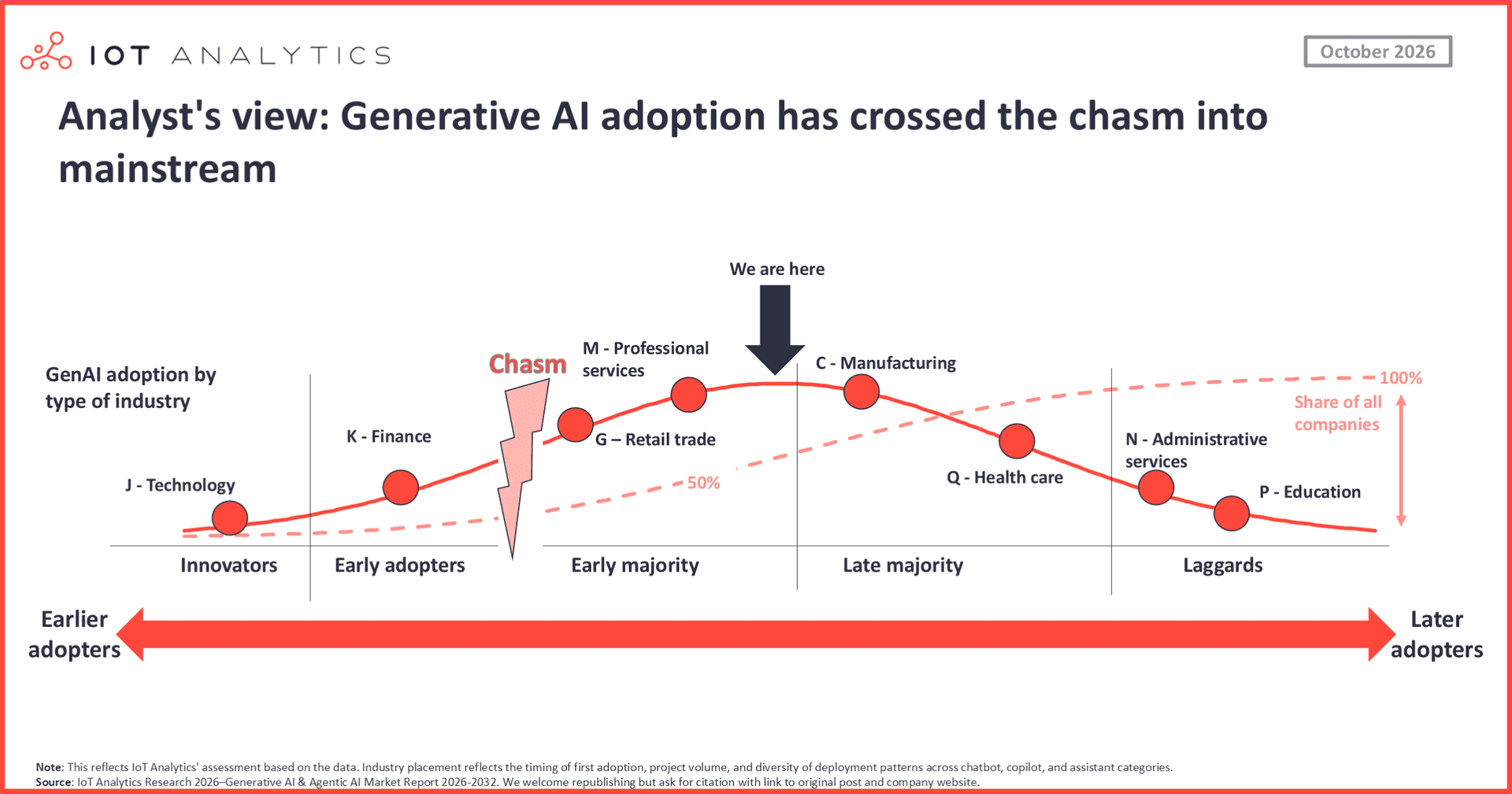
Generative AI has reached the mainstream. Generative AI adoption has crossed the chasm and is now generally entering mainstream adoption with late majority adopters. Technology companies adopted it first, tested what it could do, and built it into their products. Financial services firms followed early to modernize customer service and back-office work. Retail trade and professional services joined as the early majority and now report results across a range of use cases. Manufacturing and health care adopted later, slowed by long manufacturing investment cycles and data security concerns in health care, but activity has increased in recent months. Education and administrative services trail: many have started projects, but few have a clear AI strategy.
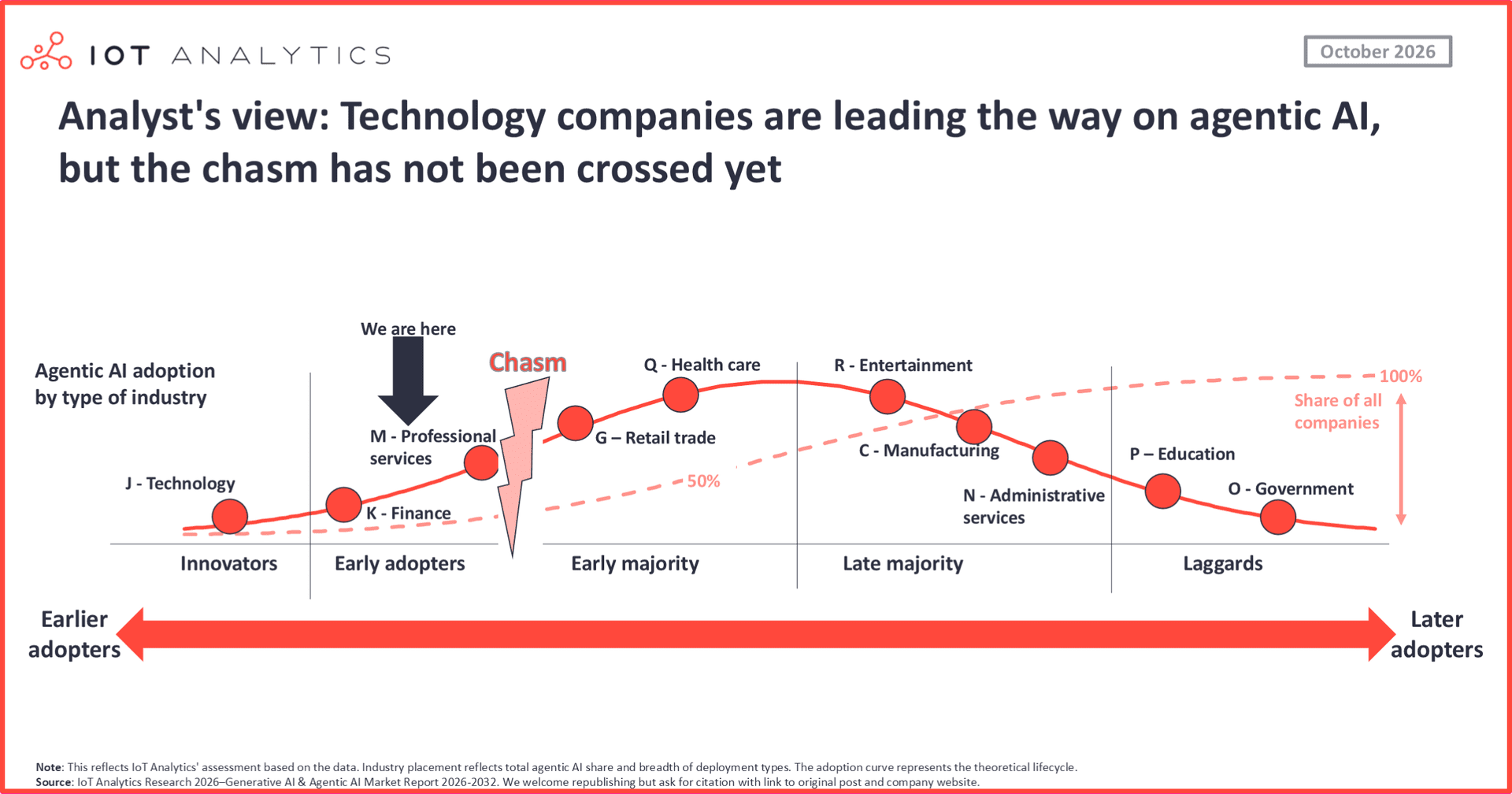
Agentic AI has not yet reached the mainstream. Although technology companies (such as Spotify, Shopify, and Ericsson) lead adoption, they have not yet crossed the chasm in agentic AI adoption. Several finance and professional services firms (such as OffDeal and EY, respectively) have started building complex agentic workflows, but most other industries, including manufacturing, remain at the pilot stage for many agentic AI initiatives. In 2025 and Q1 2026, single-agent systems accounted for 11.3% of projects and multi-agent systems for 2.0%, up from 0.3% each in 2022 to 2024. Non-agentic chatbots and assistants still made up 60.1% of projects, down from 65.0%.
In 2025, 1.1% of projects executed multi-step tasks autonomously within a defined scope. In Q1 2026, that share reached 17.8%, while the share of projects that only generate outputs fell from 59.5% to 32.2%. The 2026 figures are based on 174 projects, so they show the direction of change rather than a stable share.
Below, we share the top 10 business activities the 734 generative and agentic AI projects from 2025 and Q1 2026 support most often.
The top 10 enterprise AI applications
1. Operations: Process optimization (52.2% of projects)
Process optimization jumped to 52.2% of projects in 2025 and Q1 2026, up from 30% in 2022–2024, when it was also ranked 1st.
What it is
Process optimization uses AI to improve the speed, cost, quality, or reliability of a company’s core operational workflows: the activities that produce and deliver its products or services, such as production for a manufacturer, loan and payment processing for a bank, or inventory management and order fulfillment for a retailer. Projects analyze data from these processes, recommend changes to steps or settings, and, in agentic setups, carry out parts of the work themselves. The activity sits in operations, the department that runs these workflows day to day.
Business impact
Process optimization targets the KPIs that determine operating cost, such as cycle time, throughput, manual effort per transaction, error rates, and downtime. AI finds bottlenecks in process data faster than manual review, and agents carry out routine steps without waiting for a person.
Example: NielsenIQ
US-based market research company NielsenIQ (NIQ) automated item coding, turning product packaging images into structured product data, using Microsoft Foundry and Azure OpenAI. Item coding feeds NIQ’s database of 220 million products and used to be manual, at about 4 minutes per item. NIQ’s Capture as a Service now uses a panel of AI “experts” that extract, verify, and structure the data, with NIQ’s data scientists overseeing quality.
In one project, NIQ coded 32,000 products in 10 hours, a task that previously took 300 hours. NIQ reports a 90% cut in item-coding time and expanded the solution to Germany, France, Ireland, and Canada within two months of launch.
“It was a labor-intensive process that required deep market knowledge and meticulous attention to detail. We saw an opportunity to eliminate the manual steps by using language models to automate the entire pipeline.”
Gabriel Harris, Principal Data Scientist, NIQ (source)
2. Marketing: Content creation (30.1% of projects)
Content creation moved up 1 spot, from 27.4% of projects in 2022–2024 to 30.1%.
What it is
Content creation uses AI to produce marketing material such as copy, images, video, and campaign assets. Generative AI drafts the content; in agentic setups, agents also split the work into parallel tasks and assemble the output.
Business impact
Content creation shortens the time from campaign idea to published asset and lowers the cost per asset. Marketing teams can produce more variants for different audiences, channels, and languages without adding staff or agency hours, while brand rules built into the workflow keep messaging consistent.
Example: Kraft Heinz
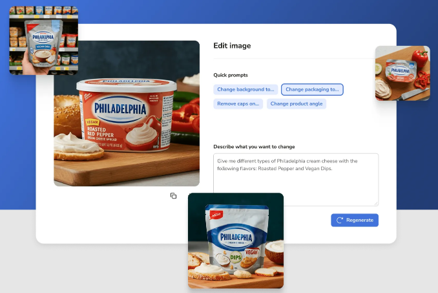
By May 2025, US-based food and beverage corporation Kraft Heinz had built TasteMaker, a generative AI platform for its product development and marketing teams, with Google Cloud and partner Apply Digital. Before TasteMaker, new content passed through separate teams for research, compliance, branding, copy, and production, often with outside vendors, and took about eight weeks to reach market. TasteMaker combines Kraft Heinz’s BigQuery data with Google’s Gemini, Imagen, and Veo models on Vertex AI, and employees use it without writing prompts. Teams use it to develop product concepts and produce images, video, and marketing materials tailored to specific customer preferences. Kraft Heinz reports that product content now reaches market in as little as 8 hours, compared with 8 weeks before.
3. Customer service: Inquiry handling (22.2% of projects)
Inquiry handling dropped 1 spot, falling from 29.9% in 2022–2024 to 22.2% of projects.
What it is
Inquiry handling uses AI to answer customer questions across chat, voice, and email. Assistants and agents resolve routine requests, such as order and status questions, and escalate complex cases to staff. This activity sits within customer service, the department responsible for pre-sale and post-sale support.
Business impact
Inquiry handling moves routine questions away from human staff, lowering cost per contact and shortening first response times. Customers get answers around the clock in their own language, and staff can focus on cases that require judgment.
Example: Carvana
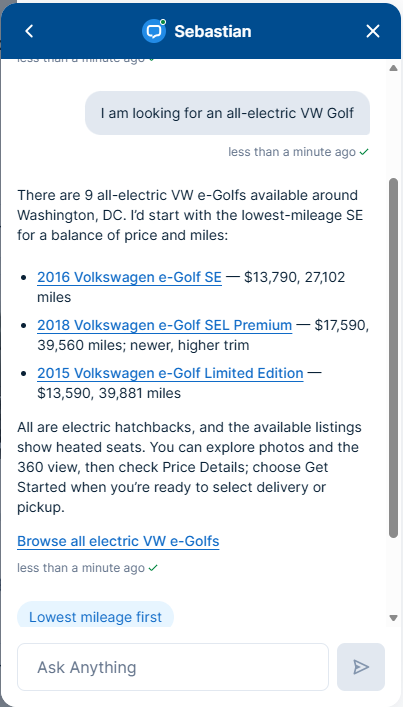
In May 2025, US-based online used car retailer Carvana reported results from 2 AI tools it built with Microsoft for customer support. Sebastian, Carvana’s AI agent, guides customers through each step of buying and selling a car online and handles standard requests, leaving complex cases to Carvana’s customer advocates. CARE (Conversation Analysis Review Engine), a quality review platform built on Azure AI Foundry, transcribes and analyzes the millions of customer conversations Carvana handles each month. CARE gives Carvana visibility into all customer interactions, not just a small sample, and the company uses those insights to improve both Sebastian and its advocate team. Carvana reports that inbound calls per sale have fallen by more than 45% over the past two years.
4. IT/technology: Software development (16.5% of projects)
Software development moved up 1 spot, from 14.3% of 2022–2024 projects to 16.5%.
What it is
Software development uses AI to write, test, review, and merge code. Coding assistants suggest code as developers type, while coding agents pick up tickets, write changes, run tests, and submit the results for review. The activity sits in IT, the department responsible for internal technology delivery, engineering, and infrastructure.
Business impact
Software development shortens development cycles and frees engineers from repetitive work such as boilerplate code, migrations, tests, and code reviews. Teams release faster and spend more of their time on new features. Coding agents now complete entire tasks, shifting the measure of success from developer productivity to completed work.
Example: Delivery Hero
In April 2026, Germany-based food delivery and quick-commerce company Delivery Hero announced Herogen, an agent that picks up Jira tickets, writes code, runs tests, reviews its own work, and submits changes. Herogen runs on Google Cloud using US-based AI research company Anthropic’s Claude models. It reportedly creates and merges more than 100 pull requests per day (about 9% of the company’s total) and has an 85% success rate on assigned tickets. Delivery Hero has since reported more than 170 pull requests per day, over 10% of its total volume.
“As we build the ‘Everyday App’ for our customers, Herogen allows us to deliver much bigger output with the same elite team. It changes how our engineers spend their days, but it does not move them away from their craft. As the tool takes on mundane tasks and repetitive toil, our people regain the time to solve the hardest problems, to build strong systems on a global scale and find new ways to keep us in the lead. As the software engineering profession changes, Herogen enables engineers to have more impact in a shorter time than ever before.”
Benjamin Mann, Chief Technology Officer, Delivery Hero (source)
5. Operations: Reporting (13.2% of projects)
Reporting had the 2nd highest climb, up 5 spots from 7% of 2022–2024 projects to 13.2%.
What it is
Reporting uses AI to compile recurring operational, management, and compliance reports. Projects pull data from production, logistics, and service systems; employees can query KPIs in plain language, flag deviations, and draft summaries for managers. The activity sits in operations, alongside process optimization.
Business impact
Reporting cuts the time between an operational event and the moment a manager sees it in a report. AI pulls data from several systems, drafts summaries, and flags deviations, so teams rely less on analysts and spreadsheets to produce routine reports. Managers can also ask questions in plain language instead of waiting for a custom report.
Example: Copel
Copel, a Brazilian energy company that runs power plants and transmission and distribution lines in the state of Paraná, built an AI agent with Google Cloud to give employees direct access to data in its SAP system. Employees previously pulled reports manually, through robotic process automation tools, and via Excel exports, which took time and often produced inconsistent figures. Copel’s agent runs on Google’s Gemini model and connects to its on-premises SAP system through BigQuery, Dataplex, and Google Cloud Cortex Framework. Employees ask questions in plain language, such as which vendors received the largest payments over the past year or which payments are due tomorrow, and get answers in seconds. Copel reports that the time to answer a data query has fallen from about a day to near real time. Its treasury team uses the agent to resolve accounts payable questions without waiting for reports.
“GenAI in accounts payable has transformed our financial management, bringing agility and rapid resolution of complex issues that previously required a lot of team time. With the possibility of disseminating financial information accurately and instantly, we have gained greater transparency and control over the Accounts Payable process.”
José Lafayette, Head of Treasury, Copel (source)
6. IT/technology: Collaboration (11.6% of projects)
Collaboration rose 1 spot, from 8.6% of 2022–2024 projects to 11.6%.
What it is
Collaboration uses AI to help employees share information and work together. Projects add AI to intranets, document workspaces, and team tools so employees can search company knowledge, summarize threads, and run multi-step tasks across shared content. The activity sits in IT, which owns the internal platforms employees use.
Business impact
Collaboration reduces the time employees spend searching for information, writing summaries, and moving work between teams and tools. AI built into the tools employees already use speeds up everyday tasks and makes company knowledge available to everyone, not only to the people who know where to look.
Example: PepsiCo
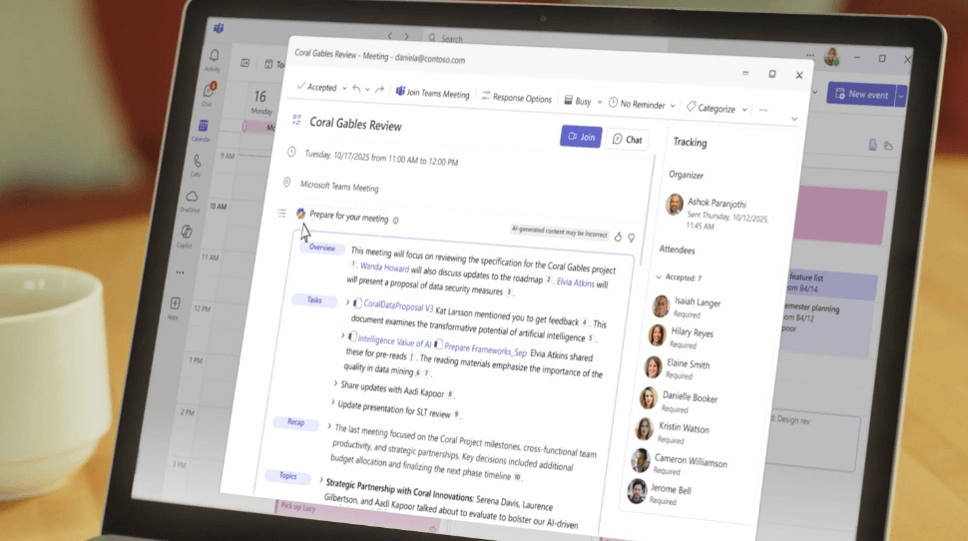
US-based international food and beverage company PepsiCo, with more than 320,000 employees across 200 countries and territories, had employees using a mix of collaboration and productivity tools that slowed cross-team work and limited its ability to use AI. The company standardized collaboration on Microsoft Teams, unifying more than 250,000 employees on one platform and moving 3,300 video conference rooms to Teams Rooms.
PepsiCo then deployed Microsoft 365 Copilot across the Microsoft 365 apps employees already use every day. Copilot draws on each employee’s meetings, emails, files, and chats, and it runs on PepsiCo’s existing Microsoft 365 access controls, so it only reaches information that the employee is already allowed to see. PepsiCo phased the rollout, first moving employees to Teams for calls and chat, and supported it with training and a communication plan backed by senior leadership. Copilot’s daily active use now stands at 90% to 95%, and employees say they go to Copilot first when they need information instead of searching for it.
7. Customer service: Issue resolution (10.8% of projects)
Issue resolution fell 3 places, the largest drop in the top 10, from 23.8% of 2022–2024 projects to 10.8%.
What it is
Issue resolution uses AI to diagnose and fix customer problems after the initial contact. Simple setups are assistants that help support staff and field technicians find the cause and the fix. More advanced setups use several agents that sort incoming requests, find relevant documentation and past cases, propose or apply fixes, and pass unresolved cases to staff. The activity sits in customer service, alongside inquiry handling.
Business impact
Issue resolution improves average resolution time, first-contact resolution, escalation rates, and cost per ticket. AI gathers case context, checks it against documentation and past cases, and proposes or applies the fix, so customers wait less and staff handle fewer repeat contacts.
Example: Hertz
By January 2026, US-based rental car agency Hertz was piloting an AI agent called Manny, built with Microsoft Copilot Studio to help its customer service team resolve roadside assistance requests. When a customer calls with a vehicle problem, representatives ask the agent in plain language and receive vehicle-specific instructions instead of searching manuals and documentation. A platform developer with no prior experience in building agents created the first version. In an early pilot, the agent reportedly cut resolution time by more than 15%.
“We’ve seen what our business users can do with Copilot Studio at the personal and teams level. Now, we’re moving full speed ahead with agents that can be used across the company.”
Zac Cadi, Director, Strategic Technology Initiative, Hertz (source)
8. R&D: Product & research analytics (10.4% of projects)
Product & research analytics climbed 4 spots, from 6.5% of 2022–2024 projects to 10.4%.
What it is
Product and research analytics uses AI to build analytics into a company’s own products or to analyze research data. Projects add AI-generated insights, search, and summaries to products, or analyze consumer, clinical, genomic, or experimental data and summarize findings for product teams, engineers, and scientists. The activity sits in R&D, the department responsible for designing, developing, and improving products or scientific outputs.
Business impact
Product and research analytics shortens the time R&D teams spend finding, combining, and interpreting data before they decide what to build or test. Teams evaluate more options earlier, drop weak concepts sooner, and shorten development timelines.
Example: Estée Lauder Companies
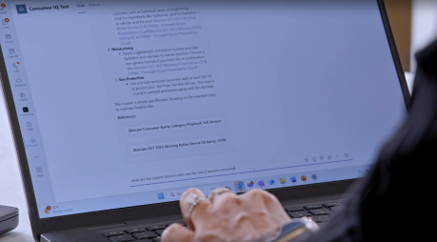
In April 2025, Estée Lauder Companies, a US-based cosmetics company, announced ConsumerIQ, an internal agent built on Microsoft Copilot Studio and Azure OpenAI Service. ConsumerIQ draws on research and document repositories, analyzes consumer, product, and marketing data, and answers product developers’ questions with sourced recommendations. Estée Lauder Companies reports that the time needed to gather data has fallen from weeks to minutes.
9. Legal/compliance: Regulatory compliance (8.4% of projects)
Regulatory compliance dropped one spot but maintained the same share of projects (8.4%) between the compared time frames.
What it is
Regulatory compliance uses AI to check or document compliance with laws and regulations. Projects review documents and evidence against rules and policies, support audits, answer staff questions about requirements, and draft compliance documentation for experts to review. The activity sits in Legal, Risk, and Compliance, the department responsible for legal work, regulatory obligations, and risk management.
Business impact
Regulatory compliance lowers the cost of meeting regulatory obligations and reduces the risk of missed violations. AI continuously screens activity, flags cases for review, and drafts documentation, shortening audit preparation and alert review. It also gives staff consistent answers to compliance questions, with the sources behind each answer.
Example: Dunaway
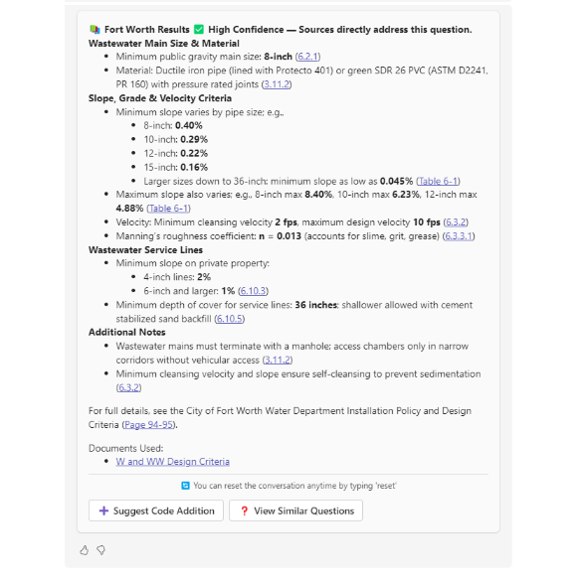
By December 2025, Dunaway, a US-based design, planning, and engineering firm, was using an AI agent built with Microsoft Copilot Studio to help its engineers comply with local building and development codes. Its engineers previously spent more than 10,000 hours a year searching city, county, and state codes across more than 50 Texas cities, often in outdated PDFs and manuals of 500 pages or more. A Power Automate workflow now collects the latest code documents from each city weekly, stores them in SharePoint, and loads them into the agent, keeping each city’s codes separate. Engineers ask questions in plain language and get answers that cite the source page; unclear cases go to subject matter experts. Dunaway reports that manual research time has fallen by 90% and that engineers now run more internal checks before they submit plans.
10. Operations: Quality control (7.6% of projects)
Quality control climbed 12 spots to #10, the biggest jump in the top 10, as its share rose from 3.5% to 7.6%. Quality control also has the highest share of single- and multi-agent projects among the top 10 applications.
What it is
Quality control uses AI to check that products and processes meet specifications. Projects inspect parts and outputs for defects, compare production and test data against requirements, help engineers find the root causes of deviations, and manage non-conformances and corrective actions. The activity sits in operations, alongside process optimization and reporting.
Business impact
Quality control reduces defect rates, scrap, and rework, lowering the cost of poor quality. AI catches deviations earlier in production, before faulty parts or products reach later stages or customers. It also shortens the time it takes to investigate and close non-conformances. It frees quality engineers from manual document and data review so they can focus on fixing defect causes.
Example: Penda Health
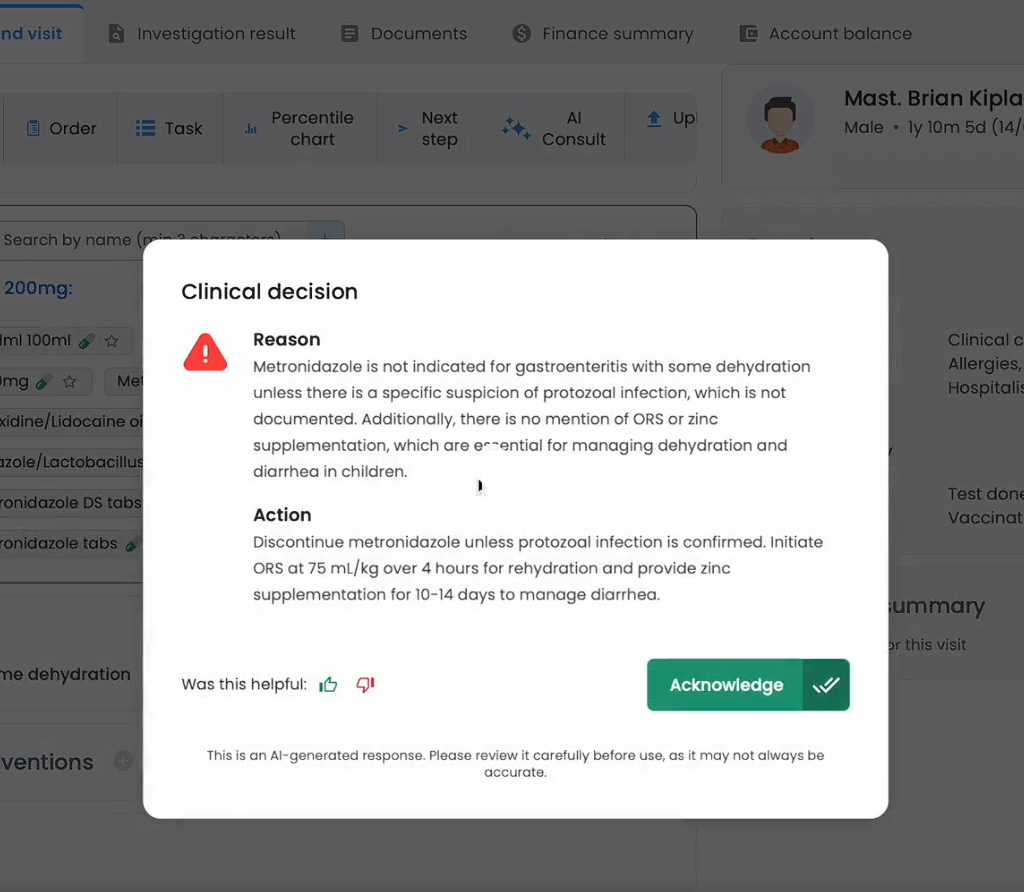
By 2025, Penda Health, a primary care provider that has run clinics in Kenya since 2012, had built AI Consult, a copilot that reviews clinicians’ work during patient visits. AI Consult is built into the electronic health record that Penda’s clinicians use every day and runs in the background during every visit. When a clinician records a diagnosis or treatment plan, the tool checks it against the patient’s data and clinical guidelines and flags possible errors with green, yellow, or red alerts based on the severity of the concern.
Penda tailored the tool to local conditions, including Kenyan disease patterns, local clinical guidelines, and its own clinic procedures. Clinicians keep the final decision, and Penda’s quality leaders recognized the clinicians and clinics that used the tool well. Penda and OpenAI studied 39,849 patient visits across 15 clinics, comparing clinicians who had AI Consult with those who did not. Clinicians using the tool made 16% fewer diagnostic errors and 13% fewer treatment errors.
Analyst takeaway
IoT Analytics analyst Joaquin Fernandez performed most of the analysis for the Generative AI & Agentic AI Market Report 2026-2032 and the associated Generative AI & Agentic AI Projects List 2026, which tracks 1,533 generative and agentic AI projects. Comparing the projects from 2025–2026 with those from 2022–2024, these are his 5 main takeaways:
- Workflows are replacing isolated outputs. In 2025–2026, 53.0% of projects only generated outputs, such as a draft or an answer, down from 66.8% in 2022–2024. Workflow assistance rose from 33.2% to 42.0%, and 5.0% of projects executed multi-step tasks autonomously within a defined scope, a capability none of the 2022–2024 projects had.
- Mainstream use has spread beyond technology and finance. Retail trade and professional services have joined technology and finance as mainstream adopters. Retail trade’s share of projects rose from 3.6% in 2022–2024 to 6.5% in 2025–2026, and professional services’ from 7.9% to 9.3%. For example, Uruguay-based e-commerce and fintech company Mercado Libre reported a 25% increase in click-through rates from its new AI advertising tool.
- Technology retains its lead in AI adoption. Even as other industries add projects, technology companies still account for about half of 2025–2026 projects (49.7%), down from 54.5% in 2022–2024.
- Agentic AI is growing from a low base. Single- and multi-agent systems account for 13.4% of 2025–2026 projects, up from 0.5% in 2022–2024, while non-agentic chatbots and assistants still account for 60.1%. Agentic shares are highest in technology (16.8%), professional services (16.2%), and finance (13.7%), and lowest in manufacturing (4.3%) and education (no agentic projects).
- AI adoption has moved from the back office into core operations. Process optimization, already the top application in 2022–2024, now appears in 52.2% of projects, ahead of content creation (30.1%) and customer inquiry handling (22.2%). By main department, operations (22.8% of projects) has overtaken IT (20.2%), which led in 2022–2024.
Frequently asked questions about enterprise AI applications
Based on 734 generative and agentic AI projects from 2025 and Q1 2026, the top five are process optimization (52.2%), marketing content creation (30.1%), customer inquiry handling (22.2%), software development (16.5%), and operational reporting (13.2%). Collaboration, issue resolution, product and research analytics, regulatory compliance, and quality control make up the rest of the top 10.
Agentic AI is growing but not yet mainstream. Single- and multi-agent systems made up 13.4% of enterprise AI projects in 2025 and Q1 2026, up from 0.5% in 2022–2024. Non-agentic chatbots and assistants still accounted for 60.1%. Technology (16.8%), professional services (16.2%), and finance (13.7%) lead agentic adoption, while manufacturing (4.3%) and education trail.
Technology companies still lead, with about half (49.7%) of 2025–2026 projects. Financial services adopted early, and retail trade and professional services have now joined them as mainstream adopters. Manufacturing and health care adopted later because of long investment cycles and data security concerns. Education and administrative services trail.
Quality control climbed 12 spots to #10 (3.5% to 7.6%), the biggest jump in the top 10. Reporting rose 5 spots (7% to 13.2%), and product and research analytics rose 4 spots (6.5% to 10.4%). Customer issue resolution fell the most, dropping 3 places from 23.8% to 10.8%.
Reported results include:
– Kraft Heinz: Product content now reaches market in 8 hours instead of 8 weeks.
– NielsenIQ: Item-coding time fell by 90%.
– Carvana: Inbound calls per sale fell by more than 45%.
– Penda Health: Clinicians using its AI copilot made 16% fewer diagnostic errors.
– Delivery Hero: Its coding agent merges more than 170 pull requests per day.
Further analysis
Below, in our Insights+ section, we share further insights from our Generative AI & Agentic AI Market Report 2026-2032, including a deeper look at generative and agentic AI projects by department & industry, by industry & activities, and by type of generative and agentic AI.
Access key market data for $99/month per user
The Insights+ Subscription unlocks exclusive facts & figures. You will gain access to:
- Additional analyses derived directly from our reports, databases, and trackers
- An extended version of each research article not available to the public
Full report access not included. For enterprise offerings, please contact sales: sales@iot-analytics.com